FIGI vs CUSIP is a choice between an open, free identifier that names a security at several levels (globally, per country and per exchange) and a licensed number that the US settlement, custody and reporting systems are built on. The question became urgent when nine US agencies proposed FIGI as the common instrument identifier under the Financial Data Transparency Act. Their final rule, effective 1 October 2026, did not adopt it: it established the LEI for legal entities and the CFI code for classification, and no instrument identifier at all. A security master should therefore keep CUSIP, ISIN and FIGI side by side and record which one each report needs. Botminds' Security Master Data Management, which sets up and checks instrument terms from prospectuses for reference data teams, holds all three on every record, each with its source.
The rule text quoted here is the joint final rule as published in the Federal Register on 25 June 2026. Examples of the solution's screens use fictional sample data.
The FDTA joint data standards, proposed in 2024 and final in 2026, standard by standard
Proposed, August 2024: FIGI as the identifier of financial instruments.
Final rule, June 2026: No common instrument identifier. FIGI, CUSIP, ISIN and others left to each agency's own rulemaking.
Proposed, August 2024: ISO 17442, the Legal Entity Identifier (LEI).
Final rule, June 2026: LEI, as proposed.
Proposed, August 2024: ISO 4914 Unique Product Identifier (UPI).
Final rule, June 2026: UPI, as proposed.
Proposed, August 2024: ISO 10962 CFI code for reporting of other financial instruments.
Final rule, June 2026: CFI, but to classify instruments, not to identify them.
Proposed, August 2024: ISO 8601 in its Basic format (YYYYMMDD).
Final rule, June 2026: ISO 8601, without requiring the Basic format.
Proposed, August 2024: Standards to be adopted later in each agency's own rules.
Final rule, June 2026: No reporting changes until each agency acts; agencies may tailor or add standards.
FIGI vs CUSIP: what is the difference?
CUSIP and FIGI both identify a security, but they differ in who controls them, how they are licensed, and how many of them one security has. A CUSIP is assigned through CUSIP Global Services, which the final rule names alongside the American Bankers Association when it records commenters' suggestions for wider access. A US ISIN is built on the CUSIP; the rule describes the ISIN as one "which includes CUSIP numbers". The US agencies' 2024 proposal treated both as proprietary and not openly licensed in the United States, which was its reason for choosing FIGI (the passage is set out in our guide on the FDTA final rule for municipal bonds).
FIGI, the Financial Instrument Global Identifier, is an Object Management Group standard. The proposal described its intellectual property as owned by OMG, "an open-membership standards consortium", and noted that it "has been implemented as a U.S. standard (X9.145)"; a footnote adds that Bloomberg L.P. "continues to function as a registration authority for FIGI issuances" (FDTA final rule, section II.C.2). Its supporters told the agencies that no licence is needed to view, download or use a FIGI.
The structural difference matters more to a security master than the licensing. One security has one CUSIP. It can have several FIGIs: commenters described a share-class FIGI that identifies a security "no matter where it trades", a country composite FIGI, and an exchange-level FIGI. Opponents told the agencies that "although each security has one CUSIP number, it can have multiple FIGIs, which may result in confusion and errors"; supporters replied that the exchange-level and composite FIGIs all roll up to the share class. Both statements are true, and a master that stores a FIGI has to say which level it holds.
The identifiers a security master keeps, who issues them, and where US and EU reporting asks for them
| Identifier | What it identifies | Issued by | Where reporting asks for it |
|---|---|---|---|
| CUSIP | A security; the key in US settlement and reporting | CUSIP Global Services | Form 13F (mandatory under section 13(f)(1)); Form N-PORT "(if any)" |
| ISIN | A security, globally; the US ISIN contains the CUSIP | National numbering agencies | N-PORT as the first "other identifier"; EU reference data (FIRDS) |
| FIGI | A security at share-class, country or exchange level | OMG standard; Bloomberg as registration authority | Form 13F, optional beside the CUSIP since the 2022 amendments |
| LEI | A legal entity: issuer, guarantor, fund, counterparty | Local operating units under GLEIF | N-PORT for issuers "(if any)"; EU reference data for the issuer; FDTA joint standard |
| CFI | A class of instrument, not one security | National numbering agencies | EU reference data; FDTA joint standard for classification |
| FISN | A short name for the instrument | National numbering agencies | EU reference data |
Did the FDTA make FIGI mandatory? No, and here is what the agencies adopted
No. The final joint rule established the LEI for legal entities, the UPI for swaps, the CFI code for classifying other instruments, ISO 8601 for dates and a short list of code sets, and expressly did not establish FIGI or any other common instrument identifier. The rule took effect on 1 October 2026 and, as its own summary says, changes no reporting requirement until each agency acts.
"the Agencies are not establishing FIGI or any other common financial instrument identifier as a joint standard."
FDTA joint data standards, final rule, 91 FR 38246 (2026)
The change on classification is the other one a security master should note. The proposal would have used the CFI code for "reporting of other types of financial instruments"; commenters pointed out that it is a classification system, and that all preferred shares from all issuers share the same letters. The final rule therefore establishes CFI "to classify financial instruments, not to identify them". A CFI code on the record tells a regulator what kind of instrument a holding is; it never tells anyone which one.
The statute still drives a deadline. Each implementing agency must adopt its own data standards by rule, and those standards "must take effect not later than two years after the final joint rule is promulgated" (FDTA final rule, section I.B.2). Our reading puts that at mid-2028 for rules published in June 2026. That is when an SEC or CFTC form could first require a specific instrument identifier under the FDTA, and nothing in the joint rule says which one it would be.
From the statute to an instrument identifier: the FDTA's months so far, and the ones left
- Act signed to proposal20 mo
- Proposal to final rule22 mo
- In force3
- Agency-specific standards must take effect≤ 21 mo
Why did the agencies drop FIGI? The comment record in their own words
The agencies dropped FIGI because the comments split on almost every question, from whether it is truly open to whether any common instrument identifier was needed. The final rule says that "Comments were mixed regarding nearly every aspect of the FIGI proposal" and that, given "the notable divergence in commenters' views", leaving it out gives the agencies "flexibility to consider what further action, if any, to take regarding FIGI".
Four strands of the record matter to a reference data team, because they describe the work a security master would face either way:
- Coverage at issue. Some commenters said FIGIs are thin for some asset classes, loans and municipal bonds among them, and that "there are typically delays in obtaining a FIGI for municipal or newly issued financial instruments". A new issue is exactly where a master has to work fastest.
- Mapping. Supporters pointed to a free mapping service; others said mapping "may be challenging given, for example, the varying levels of FIGI granularity".
- Corporate actions. A FIGI does not change after a corporate action and is never reused. Supporters saw a permanent historical key; opponents said that if ISIN or CUSIP changes and FIGI does not, "there may not always be a one-to-one mapping".
- Cost. Several commenters warned that reporting an identifier "not currently widely used in the financial markets would be highly costly and disruptive", and that CUSIPs would still be needed, so firms would run both.
None of these is a finding by the agencies; the rule records them as commenters' views. Together they describe a security master that holds more than one identifier, maps between them, and keeps the history of each through every corporate action, which is how most masters already work.
Where FIGI already appears in US reporting: Form 13F
FIGI is already an optional field on one SEC form. Since the 2022 amendments to Form 13F, a manager may report a security's share-class FIGI next to its CUSIP. The CUSIP stayed, because the statute requires it: as the SEC's release notes, section 13(f)(1) requires managers to disclose information "including the CUSIP number of each security".
The SEC's reasoning reads like a design note for a security master. It said that "CUSIP numbers and FIGIs are both able to provide the unique identification of a reported security in a manner that is standard across datasets", and that investors who use FIGIs internally could use the reported ones "without having to first convert a security's CUSIP number to a FIGI" (SEC, Form 13F amendments, 87 FR 38943). The level matters here too: the form asks for the share-class FIGI, the one that is the same across exchanges.
Form N-PORT works the other way. It asks for the CUSIP "(if any)" and then "at least one of the following other identifiers": the ISIN, a ticker if there is no ISIN, or another unique identifier whose type is stated (Form N-PORT, Item C.1). A FIGI can fill that last slot, but only after the ISIN and ticker are checked. A master that knows which identifier each form wants, in which order, builds the filing; one that holds a single identifier per bond leaves the gap to a person at quarter-end.
Outside the US: ISIN, CFI and FISN in EU reference data
In the EU the identifier question is settled: the ISIN. Before trading starts in an instrument, a venue or systematic internaliser "shall obtain the ISO 6166 International Securities Identifying Number ('ISIN') code" (Delegated Regulation (EU) 2017/585, Article 3(1)), and ESMA's Q&A says the ISIN, CFI and FISN used for reference data should be those issued by the relevant national numbering agency (ESMA Q&A 1504).
The UK's T+1 planning raised FIGI from another direction. Among the changes the Accelerated Settlement Technical Group suggested to the wider market, it proposed that "a minimum of a FIGI identifier should be made available upon the launch of any debt issue", because "The provision of identifiers on a primary market new issue will remove barriers or delays to trading once first issued" (Technical Group report, February 2025, ENV 04.00). The group presents its environment items as calls to action, not requirements, and the US commenters' view that FIGIs can lag new issues points the other way. For a security master the lesson is the same: whichever identifier arrives first at launch, the record must accept it and fill in the others as they come.
An identifier change is an economic change: it waits for a steward
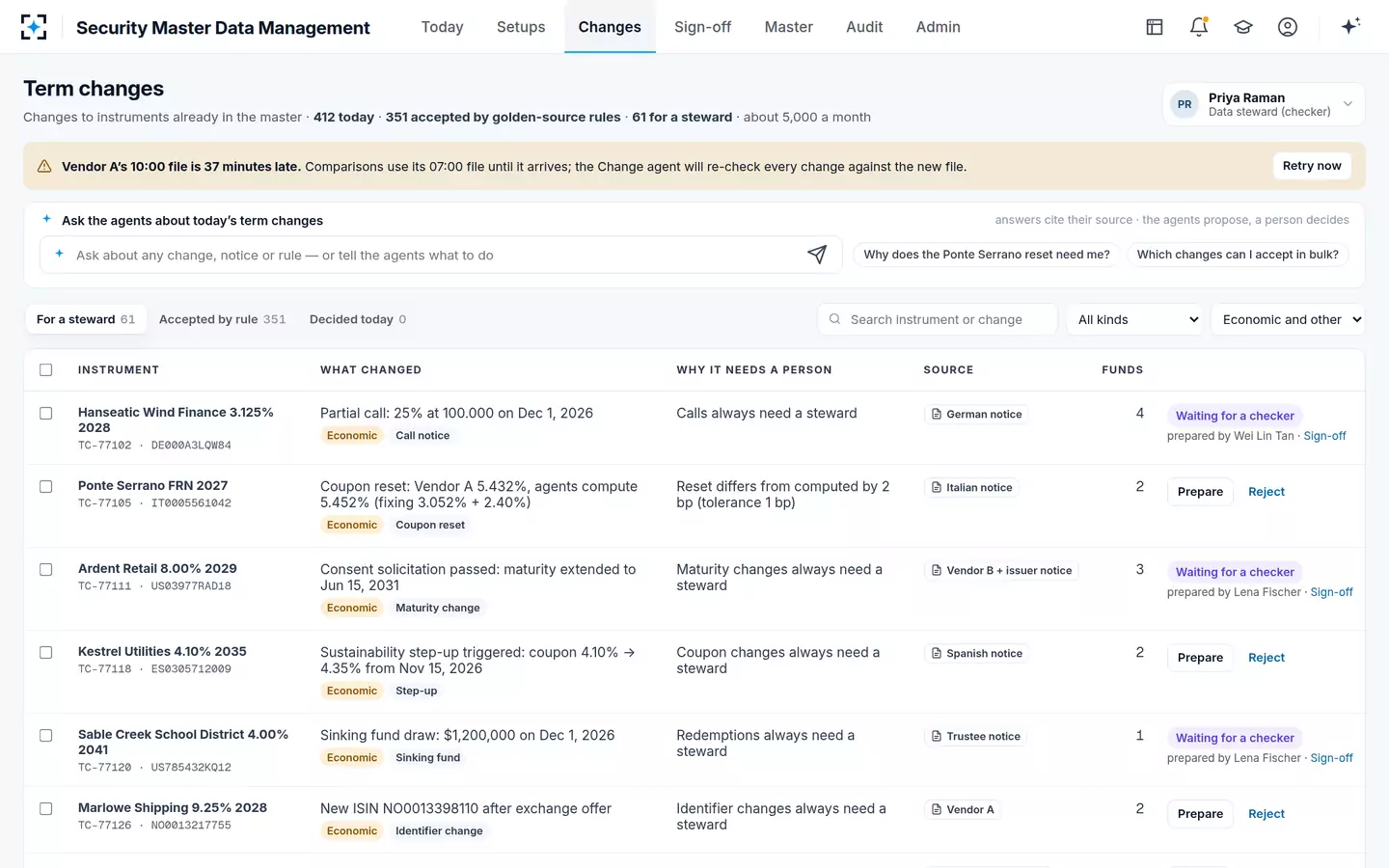
What should a security master store now?
Store every identifier the instrument has, at the level each form needs, with its source and its history, and do not pick a winner the regulators have not picked. The final rule leaves each agency free to choose an identifier later, to tailor the standards, or to adopt ones the joint rule did not establish. Until then, the reporting forms in force are the specification.
Identifier fields for a security master after the FDTA final rule
- CUSIP, where one exists, as the US key
Form 13F requires it by statute and N-PORT asks for it first; commenters told the agencies US clearance and settlement run on CUSIP and ISIN.
- ISIN for every instrument
The EU key, N-PORT's first "other identifier", and for a US security a container of its CUSIP — test that the two agree.
- FIGI, with its level stated
Share-class FIGI for Form 13F; record whether any other FIGI held is country composite or exchange-level.
- Issuer and guarantor LEIs, with registry status
The one joint standard for entities; a lapsed status is information, not a delete.
- CFI and FISN from the numbering agency
To classify, never to match; keep them separate from your own sector and asset-class codes.
- Identifier history through corporate actions
A new ISIN after an exchange offer is a new row in the history, approved by a steward, with the old one kept.
- Which identifier each report uses
Map per form (13F, N-PORT, EU reports) so a filing never depends on one person's memory of the rules.
What to watch next: agency rules, and what a FIGI mapping costs
The next decisions are agency by agency. The final rule says each implementing agency "retains the flexibility to consider whether to utilize these or other financial instrument standards" in its own rulemaking, and can seek public input when it does. For a fund manager that means the SEC's FDTA rules for its own forms; for a manager that trades swaps, the CFTC's.
Two practical preparations hold whichever way those go. First, measure your coverage today: how many instruments in the master carry a FIGI, an ISIN and a CUSIP, and how many carry only one. Second, decide where FIGIs would come from and how often you would refresh them, because a mapping that is correct on the day it is loaded drifts with every exchange offer, merger and new listing. Corporate events that change identifiers follow the corporate actions processing life cycle; the identifier on the record belongs to the master.
How Security Master Data Management holds identifiers today
The solution treats identifiers as economic terms: any change to one goes to a steward, and the old value is kept on the record's history. When a new bond arrives, the Intake agent reads the identifiers from the document and checks the ISIN's check digit before linking it to the setup request, and the nightly quality checks look for duplicates: on the sample morning, one CUSIP sat on two records and was opened for a person to resolve. The agents propose; they do not merge records or delete identifiers on their own.
The morning briefing: one CUSIP found on two records overnight
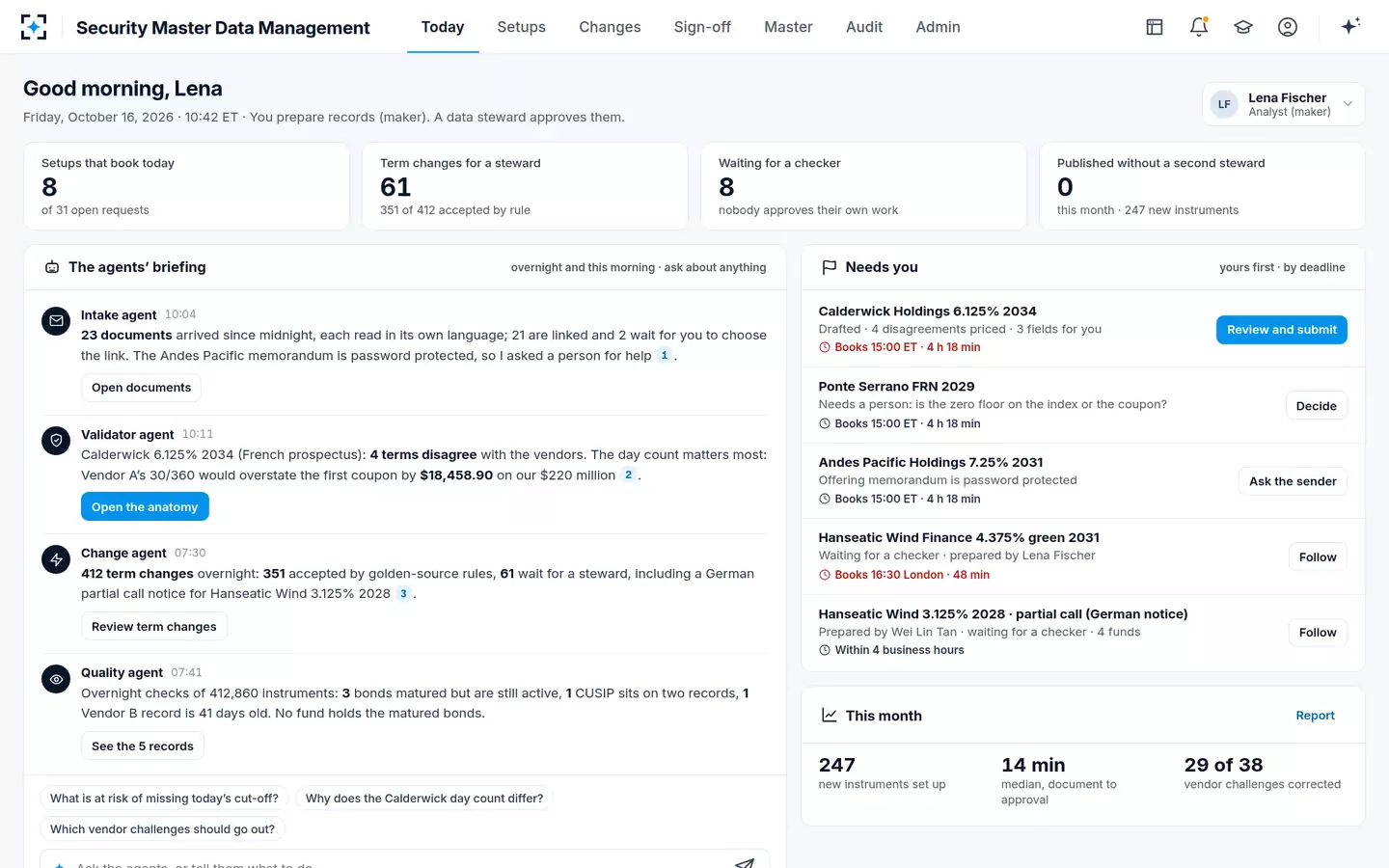
Every identifier on the record carries its source: the page of the offering document, the numbering agency's file or the vendor. That is what lets a firm answer the question the FDTA will eventually ask of it, which identifier it reported and where it came from, without reconstructing it. How the same discipline applies to the entity identifier is in LEI renewal, and the full field map is in the security master in finance. The solution itself is on the Security Master Data Management page.
Questions people ask
Is FIGI free to use?
Its supporters told the agencies that it is: no licence to view, download or use, and an open MIT licence. Other commenters disputed that it is free in practice, saying the freely available reference data is not always enough to identify a security uniquely without a paid service. The agencies took no position when they dropped it from the final rule.
Does the FDTA replace CUSIP numbers?
No. The final joint rule established no common instrument identifier, and Form 13F still requires the CUSIP because the Exchange Act names it. Any change would come in an agency's own rulemaking, with its own public comment.
What is the difference between FIGI and ISIN?
An ISIN is issued by a national numbering agency and identifies a security globally; a US ISIN contains the security's CUSIP. A FIGI is an OMG-standard identifier that comes at share-class, country and exchange level, so one security can have several FIGIs but only one ISIN.
When could the SEC require a FIGI?
Only through its own rulemaking. The FDTA requires each agency's data standards to take effect within two years of the June 2026 joint rule, and the joint rule leaves the choice of instrument identifier to the agencies. Until a rule is proposed and adopted, no SEC form requires one.
What is a CFI code used for after the FDTA rule?
To classify instruments by type, such as a fixed-rate unsecured bond or a preferred share, for aggregation. The final rule is explicit that CFI classifies and does not identify, because many instruments share the same code.