Bond reference data is the set of terms and identifiers that describe a bond: issuer, currency, coupon, day count, payment dates, maturity, calls and puts, minimum denomination, selling restrictions and its ISIN, CUSIP and classifications. For a new issue it has to exist in the security master before the first allocation can book, because the order management system, compliance checks and settlement messages all need it. Under a one-day settlement cycle that means the bond must be set up on the day it is allocated, often from a two-page pricing term sheet before the full prospectus has been read. Botminds' Security Master Data Management treats that setup as a pre-trade control: it ranks each request by its booking cut-off, drafts the record from whatever documents exist, and escalates anything that will miss.
The examples come from the solution on fictional sample data: Quillfield Capital's allocation of $220 million of the Calderwick Holdings 6.125% Senior Notes due 2034 across six funds, booking at 15:00 ET on Friday 16 October 2026. The rules quoted come from the SEC, the European Commission and ESMA, and HM Treasury's T+1 group.
From pricing to the first booking: how a new bond's reference data firms up
Agent
Pricing term sheetCoupon, issue price, size, dates, denominations and identifiers arrive first, often as two pages from the syndicate.
Never: Never the governing terms: the offering document prevails
Agent
Provisional recordFields the term sheet states are drafted and marked by source; everything else waits.
Never: Nothing provisional publishes as final
Agent
Prospectus or final terms readDay count, business days, call schedule, step-ups, selling restrictions; each term cited to its page.
Never: Below the confidence line, a value is only proposed
A person decides
Analyst settles and submitsChecks the proposals and disagreements with vendors, accepts values with reasons.
Never: Cannot approve her own record
A person decides
Second steward approves before the cut-offApproves the record; it publishes and the allocation can book.
Never: Setups at risk are escalated before they miss
What bond reference data must exist before a trade can book?
Enough for each system that touches the first trade to do its job: the order system must recognise the bond and its lot sizes, compliance must test it against every fund's limits, settlement must instruct it, and accounting must accrue it from the settlement date. Each needs a different subset, which is why "set up" is a series of thresholds rather than one.
The bond fields each step of the first trade needs
| Step | Fields it cannot do without | What fails without them |
|---|---|---|
| Booking the allocation | Identifier (ISIN or CUSIP), issuer, currency, minimum denomination and increment, issue price | The order system cannot accept the allocation, or accepts lots that cannot settle |
| Pre-trade compliance | Issuer and guarantor (with LEIs), ranking, country, sector, rating, selling restriction (Reg S, 144A) | Limits aggregate under the wrong issuer; an account buys a bond it may not hold |
| Confirmation, affirmation and settlement | Settlement date, place of settlement, nominal, price, accrued interest from the first accrual date | A confirmation does not match; under T+1 the trade risks failing |
| Accounting and NAV | Coupon, frequency, day count, first coupon date, business-day convention | Daily accruals are wrong from the first day |
| Pricing and risk | Maturity, call schedule and make-whole, puts, step-ups | Yield and duration are computed to the wrong date |
The first row is the one with a clock on it. On the sample day, Quillfield's open order for $220 million was "waiting for the instrument": the allocation could not book until the record published. The last two rows can be wrong for a day without stopping a trade, which is exactly why they are dangerous: a wrong day count does not fail the booking, it misstates every accrual quietly until someone notices.
How long does a new bond setup take, and where do the hours go?
A plain bond with good vendor coverage can be set up in minutes; for a complex one from a foreign-language prospectus, the practitioner accounts the solution was designed from put the work at one to three hours by hand, most of it spent finding terms in the document. No regulator or independent study publishes setup times, so the figures below are from the solution's sample month, where agents drafted each record and people approved it.
Median time from offering document to second-steward approval, by asset class
Private placements take longest for a reason that has nothing to do with speed: no vendor covers them, so every term comes from the note purchase agreement, and there is nothing to compare it with. The sample's rules say so plainly: for private placements the agreement is the only source and "no vendor coverage expected". Municipal bonds come next, where serial maturities and sinking funds multiply the schedule a record has to hold.
Term sheet first, prospectus later: provisional and final terms
A new bond is usually allocated on the strength of its pricing term sheet, while the governing terms sit in a prospectus or offering circular that runs to hundreds of pages. The term sheet gives the coupon, price, size, dates and denominations; the prospectus gives everything else, and where the two differ, the prospectus governs. A security master therefore needs a way to hold a record that is complete enough to book but marked by source, and a rule for what happens when the full document is read.
The sample bond shows why. Its two-page English pricing term sheet arrived with a 412-page French prospectus. Six fields were cited to the term sheet, 131 to the prospectus. On one, the clean-up call threshold, they disagreed: the term sheet said 75%, the prospectus 80%. The agent proposed the prospectus figure with a confidence of 0.71 and left it unticked, so the analyst had to read page 60 herself. A term sheet is a summary; a security master that stops at it inherits every simplification the syndicate made.
For bonds issued under a base prospectus, the final terms complete it for each issue, setting the coupon, dates and other variables that the base document leaves open. The principle is the same: record which document each value came from, and let the governing document win.
What happens when a bond is not set up on trade date?
The trade cannot complete its same-day steps. In the US, Rule 15c6-2 has required since May 2024 that a broker-dealer's agreements or procedures get every trade allocated, confirmed and affirmed on trade date (SEC Rule 15c6-2), and an allocation cannot be sent for a bond the buy side's systems do not recognise. A missed setup becomes a late allocation, then a late affirmation, and in the worst case a failed settlement; what a failed trade costs picks up from there.
In the EU, a Commission regulation adopted in July 2026 sets an evening deadline on the business day of the trade for professional clients to deliver written allocations and confirmations to their investment firm, and under its application article, Article 2, that applies from 7 December 2026 (Delegated Regulation (EU) 2026/1536). EU settlement moves to T+1 on 11 October 2027. A bond allocated at 16:00 that is not in the master by early evening is a breach of a deadline, not a task for tomorrow.
Setups ranked against the cut-off, on one sample day
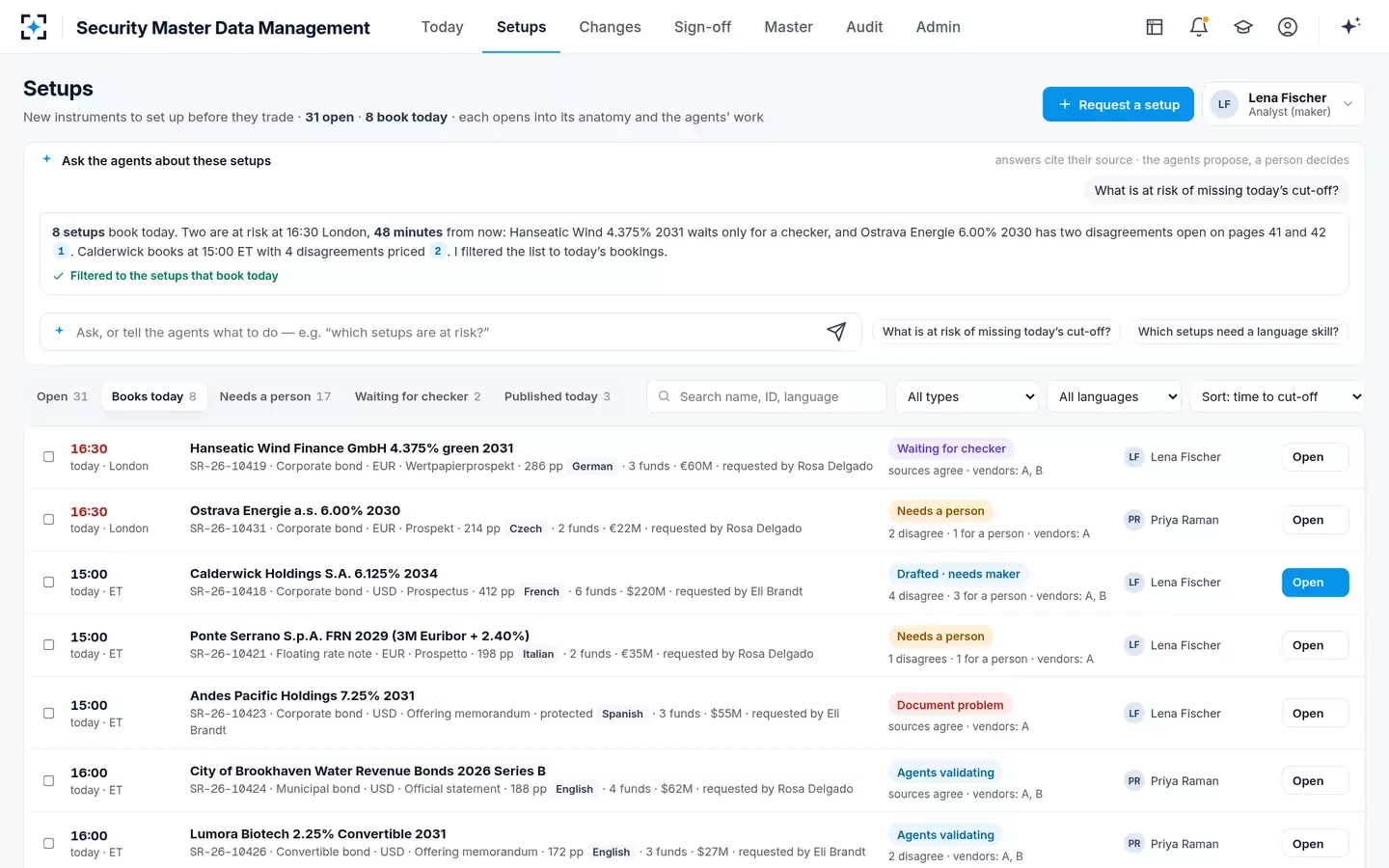
8 of 31
open setup requests had to book the same day
2
were at risk 48 minutes before a 16:30 London cut-off
99.2%
of setups met the cut-off in the month
60min
before a cut-off, a setup at risk is escalated
What do the UK and EU T+1 plans say about reference data?
Both name reference data, in different senses. The UK Technical Group asked all market participants to review and test their reference data functions for T+1 by the end of 2026, one of its "highly recommended" actions, STAT 03 (Technical Group report, February 2025); the full wording and what it means for the team that does the work are in the reference data analyst. The EU regulation asks firms to make professional clients supply the data needed to settle in a standard electronic format and keep it current well ahead of settlement (Delegated Regulation (EU) 2026/1536); what that data is, field by field, is in the standard settlement instructions template.
The EU text is about settlement data: accounts, place of settlement and intermediaries. It does not mention instrument terms. But the logic runs straight back to the security master. Settlement data can only be applied to a trade in an instrument the firm has set up, and an allocation's settlement amount, which the same regulation adds to the allocation, depends on the price, nominal and accrued interest, which depend on the bond's terms. Readiness of instrument data is the step before readiness of settlement data.
Identifiers at launch: why a new issue can trade before its data is complete
A new bond can be allocated before every identifier and classification exists, which is a problem for systems keyed on them. In the EU, a venue must obtain the ISIN before trading begins (RTS 23, Article 3(1)) and must report the instrument's reference data by 21:00 CET the same day for instruments first traded before 18:00 (Article 2). ESMA's answer is that ISINs "have to be allocated in time to be included in the submission of reference data" (ESMA Q&A 1679).
Other identifiers can lag. The UK Technical Group suggested making a FIGI available at the launch of every debt issue so that new issues are not held back from trading, and commenters on the US agencies' 2026 data-standards rule said FIGIs can be slow to appear for new and municipal issues (FDTA final rule; both are discussed in FIGI vs CUSIP). A setup process should therefore accept the identifier that exists, usually the ISIN, and add the others later as changes a steward approves, rather than wait for the full set.
New instrument setups, ranked by booking cut-off, with the agents' answer on what is at risk
Private placements, local-market bonds and documents no vendor has read
The hardest setups are the ones no vendor can help with: private placements documented in a note purchase agreement, local-market bonds documented only in Czech, Norwegian or Japanese, and new issues whose terms the vendors have not yet loaded. For these, the offering document is not the best source but the only one, and the analyst's time goes into reading it.
Two controls matter more for these bonds than for any others. First, every value must point to its page, because no vendor will contradict a mistake and no comparison will catch it. Second, the second steward must be able to read the source in a language she understands, or she is approving on trust. On the sample day, the setup queue held documents in ten languages, and each term carried its original clause with an English translation beside it.
Pre-trade setup checklist for a new bond
- Know the cut-off for every request
Booking time, time zone and the funds buying; rank the queue by it, not by arrival.
- Book on the identifier that exists
Usually the ISIN; add CUSIP and FIGI as they arrive, each as an approved change.
- Mark every field by source
Term sheet, final terms, prospectus or vendor; a provisional value is visibly provisional.
- Read the governing document for the economic terms
Day count, business days, calls, puts, step-ups, minimum denomination and selling restrictions.
- Test the cash flows before approval
Generate the coupons; check the first one against the document's own example where it gives one.
- Run the funds' rules before publishing
Limits, ratings, selling restrictions and lot sizes for every fund in the allocation.
- Escalate early
A setup at risk an hour before its cut-off goes to the head of reference data, with the reason.
How Security Master Data Management sets up a new bond before allocations book
The solution runs the checklist on every request. The Intake agent took the sample bond's French prospectus and English term sheet from the syndicate inbox, checked the ISIN's check digit and linked both to the request. The Setup agent drafted 142 fields within minutes, each cited, and drew the bond's whole life on one timeline. The Validator agent compared 31 economic terms with two vendors and priced the four disagreements on Quillfield's position. Then the Downstream agent showed what the record would touch before anything published.
Before it publishes: the six funds buying, their limits and the one warning
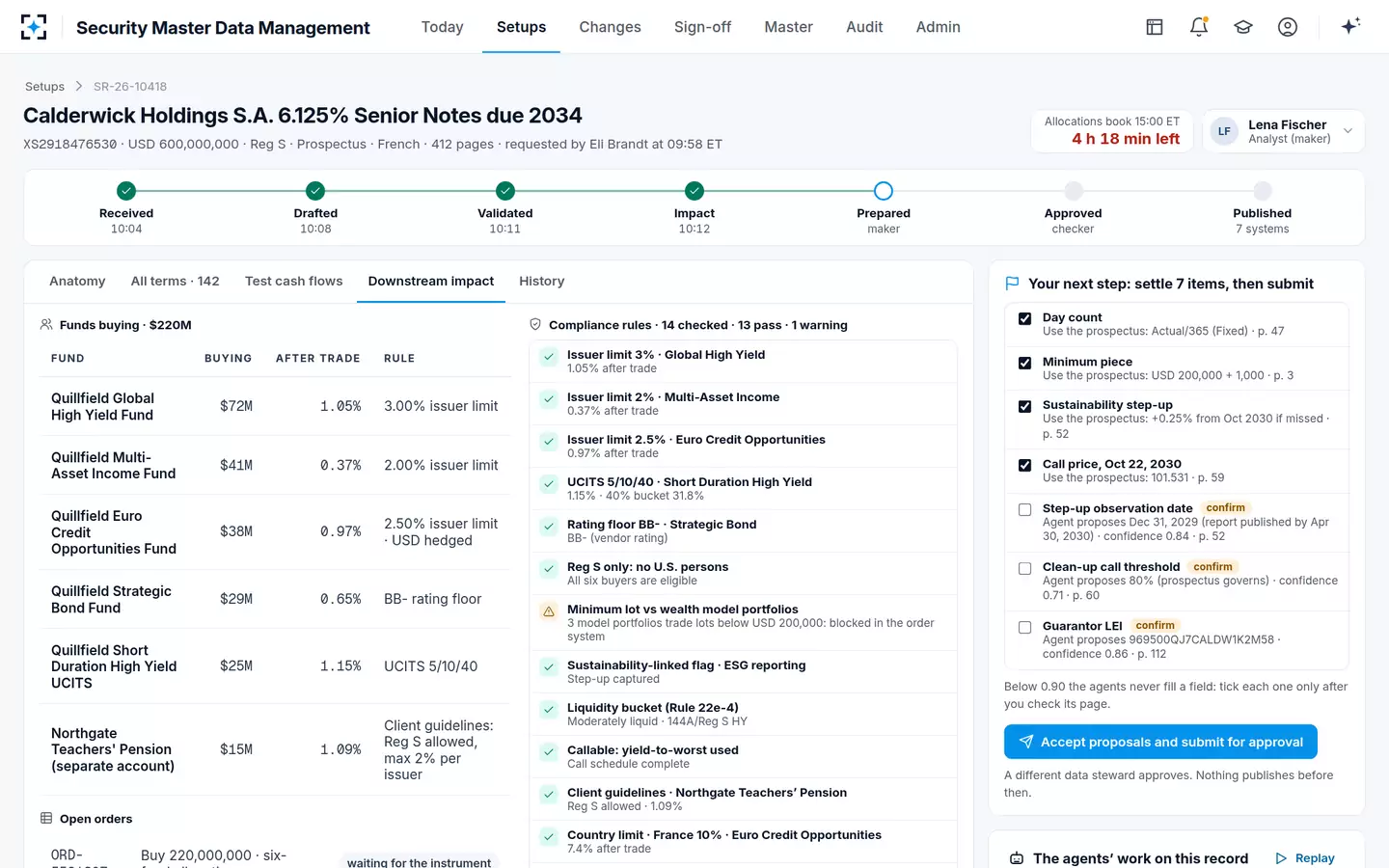
The warning on that screen is the kind a vendor's data would have hidden. One vendor carried a 2,000 minimum piece; the prospectus says USD 200,000 plus multiples of 1,000. With the vendor's value, three model portfolios would have bought lots that could not settle. With the document's, the order system blocks them before the trade. The analyst prepared the record at 11:06, a second steward approved at 11:14, and at 11:15 it published to seven systems, three and three-quarter hours before the cut-off. The solution's design target is that every new instrument is set up before its trade books, including issues no vendor covers yet; how the published values then reach every system is in the golden copy, and the solution is on the Security Master Data Management page.
Questions people ask
What is bond reference data?
The descriptive and contractual data for a bond: identifiers, issuer, currency, coupon, day count, dates, optionality, denominations, ranking and classifications. It is the same for every holder, unlike positions or prices, and it lives in the security master that every downstream system reads.
Can a bond be traded before it is set up in the security master?
The trade can be agreed, but in most firms the allocation cannot be booked, confirmed or tested against compliance rules until the instrument exists in the master. Under a T+1 cycle that leaves the setup a few hours at most.
Should a new bond be set up from the term sheet or the prospectus?
Both, in order. The term sheet lets the bond book quickly; the prospectus or final terms govern and supply the day count, calls, business-day rules and restrictions. Record which document each value came from, and replace term-sheet values when the governing document says something different.
Who supplies bond reference data?
The issuer's offering documents are the primary source; numbering agencies assign ISINs and related codes; data vendors read the documents and publish terms and conditions files; regulators publish limited reference data such as ESMA's FIRDS for EU-traded instruments. A security master combines them under rules for which source wins.
How do you set up bonds no vendor covers?
From the note purchase agreement or local-language offering document alone, with every value cited to its page and a second person approving. In the solution's sample month, private placements took a median of 31 minutes from document to approval, the longest of any asset class, because there was nothing to compare against.