AI for instrument data management works best on the tasks that consume a reference data team's hours but not its judgement: finding terms in a 400-page prospectus, keying 100 to 200 fields, comparing two vendor feeds, generating test cash flows and triaging thousands of routine term changes. Those can move to agents that cite every value to its page. What should not move is the decision that makes a security master trustworthy: which source wins when the document and the vendors disagree, whether a low-confidence value is right, and whether a record is approved. Botminds' Security Master Data Management is built on that split. Seven agents draft, compare, price and check; one data steward prepares each record and a different one approves it, and the agents cannot publish, approve or overwrite a value.
The figures for one bond are the solution running on fictional sample data, an asset manager called Quillfield Capital setting up a new bond from a French prospectus, and our estimate of the same work by hand. The regulatory statements come from the SEC, FINRA, and the Bank of England and FCA.
Where the hours go on one complex bond: by hand the hunt dominates; with agents, the check does
By hand · about 2.5 hours
- Vendor lookups · 16%
- Finding terms · 32%
- Keying · 20%
- Coupon checks · 8%
- Second check · 12%
- Publish, chase · 12%
With agents · about 15 minutes of people's time
- Vendor lookups · 12%
- Finding terms · 16%
- Keying · 12%
- Coupon checks · 8%
- Second check · 40%
- Publish, chase · 12%
Can AI set up securities from prospectuses?
Yes, as a draft that a person checks, provided every value points to the page it came from. Language models can read long offering documents in several languages and pull out the coupon, day count, call schedule and other terms. What makes the result usable in a security master is not the extraction itself but the evidence and the restraint around it: the page and phrase behind each value, a confidence below which the agent proposes rather than fills, and a person who checks before anything publishes.
There is no regulator or independent study that publishes how accurately AI extracts bond terms from prospectuses, so treat any accuracy claim, including ours, as something to test on your own documents. FINRA's oversight report names the risk that matters most here: general-purpose agents may not know enough about a specialised domain to do complex, industry-specific work consistently (FINRA, 2026 Annual Regulatory Oversight Report). A day count convention that is called "Exact/365" in French and Actual/365 (Fixed) in English is exactly that kind of task.
On the sample bond, the Setup agent drafted 142 fields from a 412-page French prospectus and a two-page English term sheet: 131 cited to prospectus pages, 6 to the term sheet and 5 derived. It left three fields for a person, each below its 0.90 confidence line: a step-up observation date, a clean-up call threshold on which the term sheet and prospectus disagreed, and a guarantor's LEI. The analyst could not submit the record until she had opened each page and ticked it.
Which instrument data tasks move to agents, and which stay with stewards?
Tasks that find, copy, compare or compute move to agents; tasks that decide, approve or commit the firm stay with people. The line is not about difficulty: comparing 31 terms across two vendors and pricing each difference on six funds' positions is hard, but it produces information, not a decision. Choosing the document's call price over a vendor's is easy, but it commits every system downstream.
Reference data tasks, one by one: who does each in Security Master Data Management
| Task | Who does it | The limit |
|---|---|---|
| Receive, classify and link offering documents and notices | Intake agent | Quarantines attachments from unknown senders; flags a protected document rather than skipping it |
| Draft every field from the document, cited to page and phrase | Setup agent | Below 0.90 confidence it proposes; it never fills the field |
| Compare each economic term with two vendors and the listing venue | Validator agent | Never overwrites a value |
| Generate test cash flows and price each disagreement on the position | Validator agent | Never resolves a disagreement itself |
| Decide which value wins, with a reason | Analyst (maker) | Cannot approve her own record |
| Approve the record | A different data steward (checker) | The only route to publication |
| Show funds, orders, rules and systems affected; publish | Downstream agent | Publishes only after approval; blocks while a rule breaks |
| Apply routine term changes by rule | Change agent | Economic changes always go to a steward |
| Draft and track vendor challenges | Challenge agent | Sends only after a steward approves; never shares one vendor's data with another |
| Check the whole master nightly | Quality agent | Opens findings for a person; never edits a record |
| Set which source wins, and the thresholds | Head of reference data | Each change needs a second approver |
Reallocating hours does not reallocate accountability. The steward who approved the record is still the one whose name is on the audit trail; the agents' contribution is the evidence she approved it on. That is the difference between an assistant and an autopilot, and it is the difference a buyer should look for.
Reading the document: citations, languages and the confidence line
Three design choices decide whether agent-drafted data can be trusted. First, every value carries its source: the page, the phrase, and for a non-English document the original clause beside the translation. Second, the document is kept unchanged with a hash, so the evidence behind a value cannot drift. Third, there are two thresholds, not one: above the sample firm's 0.95 a field is filled; below 0.90 it is only proposed and a person must confirm it against the page.
The second threshold is the one that matters. A single cut-off forces a choice between filling uncertain values and leaving obvious ones blank. Two give a band where the agent fills but flags, and a floor below which it stops. Both are settings that change only with a second approver, and a change to the agents themselves is tested on the previous month's records before it is approved.
Comparing vendors: an agent that prices disagreements but never resolves them
The comparison is where agents save the most time per bond, because it means checking dozens of terms against two feeds and computing what each difference is worth. On the sample bond the Validator agent compared 31 economic terms: 27 agreed, 4 did not. It priced each on Quillfield's $220 million: $18,459 on the first coupon for a wrong day count, lots that could not settle for a wrong minimum piece, up to $2.2 million of income if a missing step-up were triggered, and $68,200 if the bond were called in 2030 at a rounded price.
Four disagreements, each priced on the firm's position; the agents' work beside them
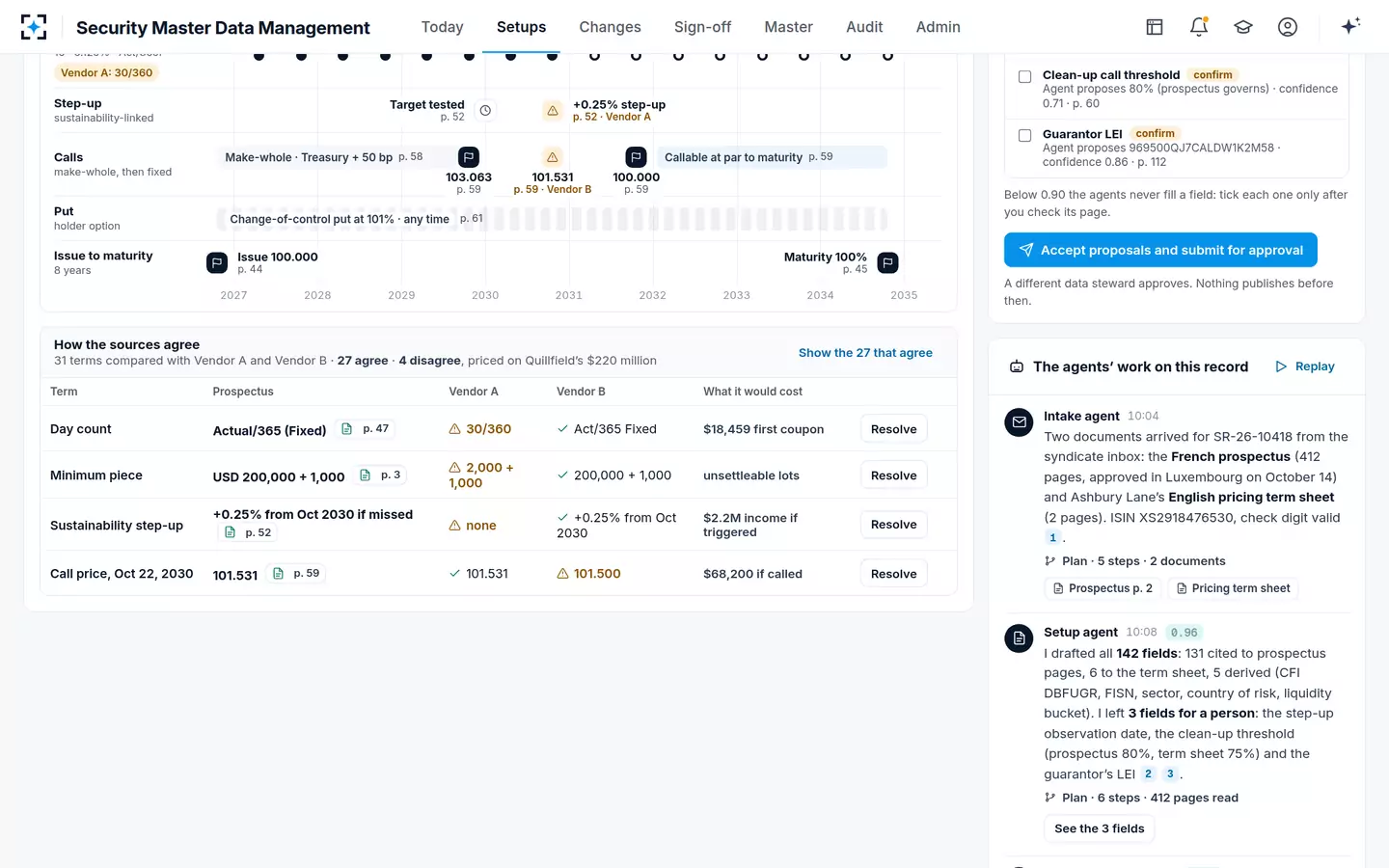
Pricing a disagreement changes how a steward spends her attention. A rounding difference worth $68,200 on one call date and a day count worth thousands on every coupon are not the same kind of problem, and a list that shows only "4 mismatches" hides that. The sample firm's rules escalate any disagreement above $50,000 on its own position to the head of reference data, a threshold that is again a setting.
Term changes at volume: rules for the routine, stewards for the economic
Most of a security master's daily volume is changes to bonds already in it, and that is where rules and agents together remove the most work. On the sample morning 412 changes arrived overnight; 351 were accepted by the firm's golden-source rules and 61 went to a steward. Across the first half of the month, 3,082 changes were processed, 2,611 of them by rule.
Term changes: what the rules accepted, and why each of the rest needs a person
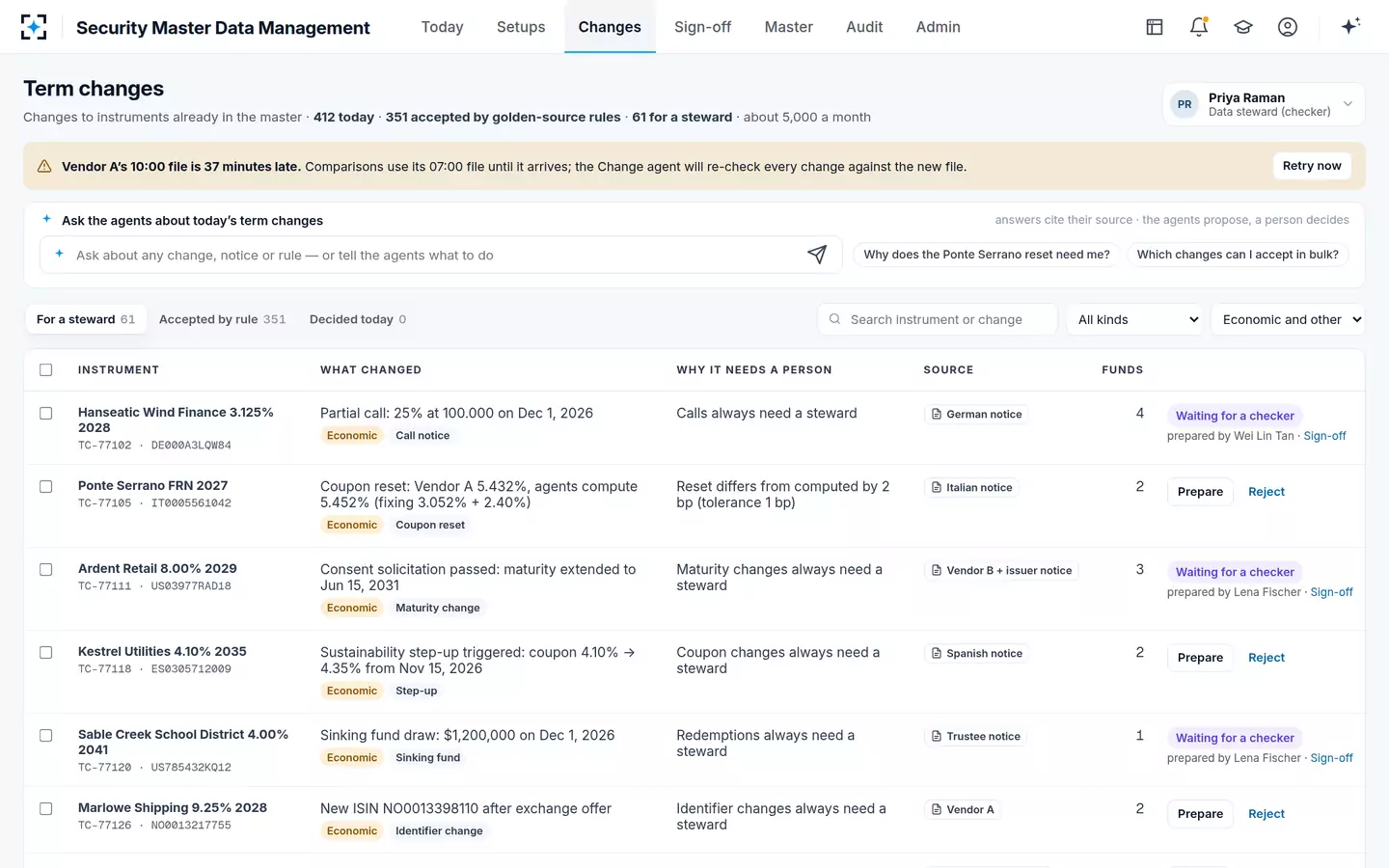
The floating-rate reset is a good example of an agent doing something a feed cannot. The agents computed the coupon from the fixing and the margin, 3.052% plus 2.40%, and found the vendor's figure two basis points away, outside the firm's one-basis-point tolerance. The change went to a steward with the arithmetic attached. Non-economic changes can be accepted in bulk, but never more than 50 at a time and never an economic one. Corporate events such as mergers and exchange offers arrive through the same queue as data; the event processing itself is described in mandatory vs voluntary corporate actions.
What do regulators say about AI agents in operations?
None prohibits them; all expect supervision, records and a person accountable for outcomes. The SEC's Division of Examinations, in its priorities for fiscal year 2027, says it will prioritise examining firms' policies and procedures for monitoring what it calls "super intelligence", including its use in back-office operations (SEC, Examination Priorities, FY2027). Its statement is a staff document, not a rule, and the obligations it examines against are the existing ones, such as keeping required books and records (Rule 204-2).
FINRA's 2026 report lists what firms using AI agents may consider, among them keeping track of what each agent did and decided, and deciding where a person stays in the loop. The Bank of England and FCA's 2024 survey shows how far most firms still are from full autonomy, and where their worries sit.
AI in UK financial services: little autonomy, and worries about data
2%
of AI use cases have fully autonomous decision-making
55%
of use cases have some degree of automated decision-making
4 of 5
top perceived current risks relate to data
118
firms responded to the survey
Read together, these say the same thing a reference data head would: agents can do the work if every action is recorded, if people decide what commits the firm, and if the data the agents produce is checked against its source. A tool that cannot show who approved a value, on what evidence, is a records problem before it is an AI problem.
What to test before you trust it: a buyer's checklist
Test on your own documents, with your own rules, against decisions your team has already made. A vendor demonstration on a clean English term sheet tells you little; last month's new issues, including the awkward ones, tell you a lot.
Seven tests for any AI tool in instrument data management
- Replay last month's new issues
Run the tool on 50 or so recent offering documents and compare every field with what your stewards approved.
- Include your hardest documents
Non-English prospectuses, private placement agreements, scanned pages, password-protected files.
- Open the source of ten random values
Each should take one click to the page and phrase, in the original language.
- Find the confidence floor
Ask what the tool does below it; it should propose, not fill, and the record should not submit until a person confirms.
- Try to make the maker approve
The person who prepared a record should be unable to approve it, and the tool should be unable to publish on its own.
- Change a golden-source rule
It should need a second approver, be versioned, and show its effect on past records before it applies.
- Ask who approved a value, and on what evidence
The answer should come from the audit trail in seconds, with the page attached.
Where agents in instrument data management do not fit
Agents earn their keep where documents are long, languages vary and vendors are slow or wrong. They add less where those conditions do not hold. A firm that trades only large listed equities and government bonds with clean, timely vendor data has little reading to automate. A firm without stewards to approve has nobody to hand the decisions to, and an agent should not take them. And some neighbouring problems are different jobs: challenging a vendor's price rather than its terms belongs to price verification, described in what a price challenge is, and processing elections on voluntary events belongs to corporate actions.
Agents also do not replace a master data platform. The security master still needs a database, versioning, distribution and entitlements for licensed vendor fields. The agents sit in front of it, turning documents and feeds into proposed, evidenced changes that people approve. How that compares with building, buying or outsourcing is set out in reference data management tools.
The analyst's week after the reallocation
The week changes shape. Hours that went to looking up feeds and keying fields go to the cases agents flag and cannot settle: a clause that could apply to the index or the coupon, a password-protected memorandum, a notice in a language nobody on the team reads. The second check, which the Split above shows becoming the largest share of a much smaller total, becomes the core of the job rather than an afterthought.
Seven agents and two people on one new bond
Agent
IntakeReads the French prospectus and English term sheet from the syndicate inbox; checks the ISIN check digit.
Never: Never creates or changes a record
Agent
SetupDrafts 142 fields, each cited; draws the bond's life on one timeline.
Never: Never fills a field below 0.90
Agent
ValidatorCompares 31 terms with two vendors; generates test cash flows; prices 4 disagreements.
Never: Never resolves a disagreement
A person decides
Analyst preparesChecks three proposals on their pages; accepts four document values with a reason.
Never: Cannot approve her own record
A person decides
Steward approvesApproves version 1.0 after checking the source pages.
Never: Approval is the only route to publication
Agent
Downstream and ChallengePublishes to seven systems; sends vendors the pages as evidence once a steward approves.
Never: Never sends or publishes without a person
For the team's head, the measure changes too: not setups per analyst, but setups before the cut-off, publications without a second steward (zero in the sample month), and how often each vendor's data disagrees with the documents. Those are numbers a board's risk committee can read. What the job looks like from the analyst's seat is in the reference data analyst; the solution is on the Security Master Data Management page.
Questions people ask
Can AI replace a security master vendor feed?
Not for everything. Vendors cover millions of instruments and deliver changes continuously; agents reading documents cover the instruments you set up and change, and the ones vendors miss or get wrong. Most firms will keep vendor feeds and use agents to check them against the documents and to cover new issues and private placements.
How accurate is AI at extracting bond terms?
No regulator or independent study publishes a benchmark for this task, so the only reliable figure is one you measure: replay recent offering documents and compare with what your stewards approved. Look at accuracy by field, not overall, because a missed day count matters more than a missed trustee address.
Is it safe to let AI agents change the security master?
Only within limits you can prove. In the solution, agents never publish, approve or overwrite a value; economic changes always go to a steward; non-economic changes accepted by rule are capped at 50 in bulk and recorded on the audit trail.
What does the SEC say about AI in back-office operations?
Its Division of Examinations says, in its fiscal 2027 priorities, that it will prioritise reviewing firms' policies and procedures for monitoring "super intelligence", its own term, including its use in back-office operations. The priorities are a staff statement, not a new rule; existing obligations such as books and records still apply.
How long does it take to go live with agents for reference data?
The work is mostly setting up your sources, field dictionary and golden-source rules, then replaying recent issues to compare with past approvals. The solution's guided setup imports rules from the existing reference data management system and runs the agents on the previous month's 50 new issues before anyone relies on them.