A price challenge is a formal request from a fund, its adviser or its administrator asking a pricing vendor to review a price the fund believes is wrong, sent with the evidence for that belief and the level the fund thinks is right. The vendor either revises the price or confirms it with an explanation, and the fund then decides what to use for the NAV. Under the SEC's Rule 2a-5 a US fund must have a process for initiating price challenges as part of overseeing its pricing services; in Singapore, MAS's 2026 inspections found managers that did not challenge when their own second source disagreed. Challenges are hard because they run on the vendor's clock inside an afternoon that ends at the price lock. Botminds' Independent Price Verification drafts each challenge with its evidence attached, sends it only when the analyst says yes, and tracks the reply against the lock.
The challenges on this page come from Quillfield Capital, a fictional fund complex the solution runs on as a sample, on Wednesday, October 21, 2026.
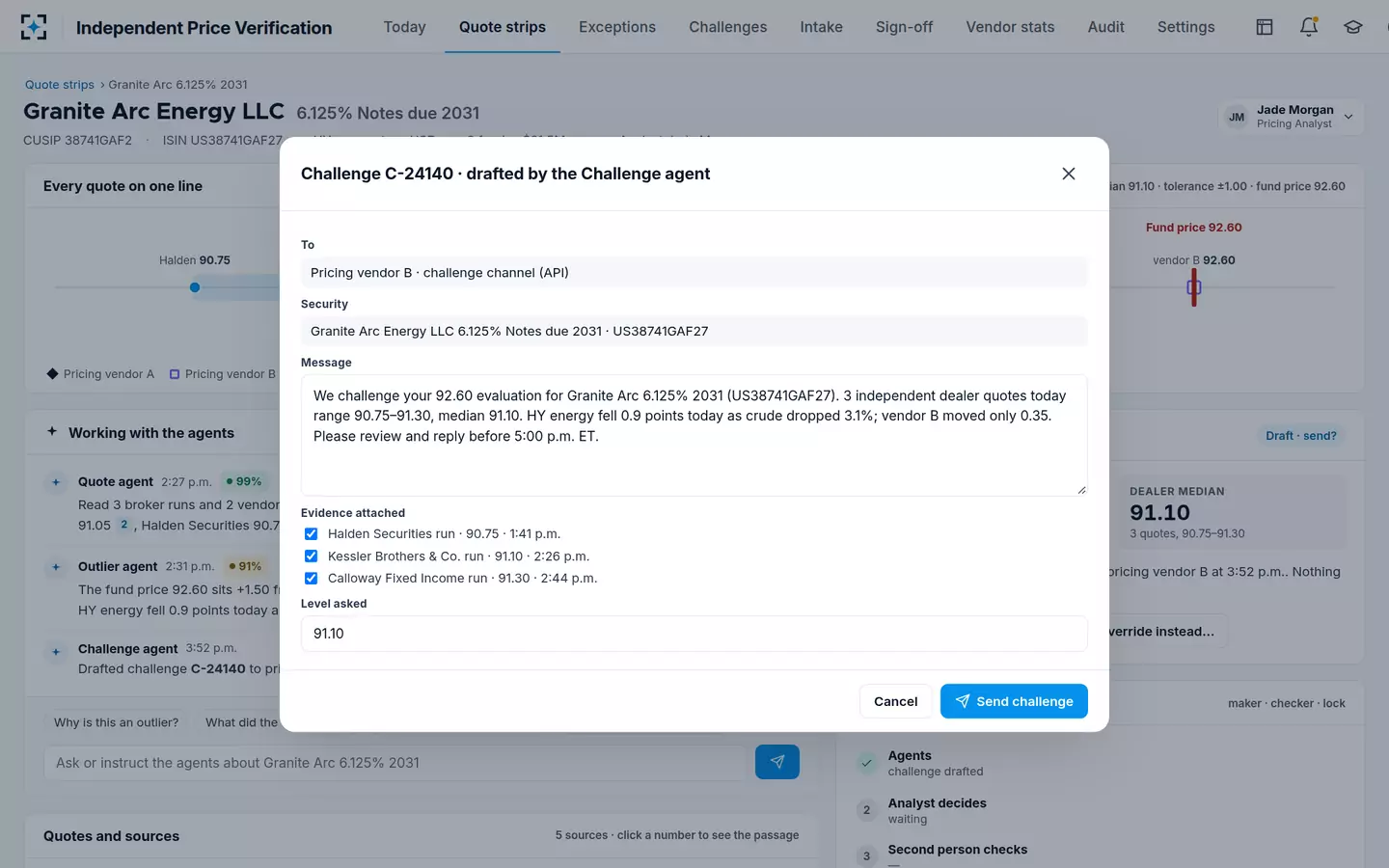
Anatomy of one price challenge: seven fields, each doing a job
To
What it saysPricing vendor B, through its challenge channel
Why it is thereThe vendor that set the price; a challenge sent to the wrong place is a challenge not sent.
Security
What it saysGranite Arc Energy LLC 6.125% Notes due 2031, by ISIN
Why it is thereThe identifier the vendor prices on, so its evaluator finds the bond at once.
The gap
What it saysVendor 92.60 against a dealer median of 91.10: +1.50 points against a 1.00 tolerance
Why it is thereThe size of the disagreement, in the vendor's own units.
Evidence
What it saysThree dealer runs: Halden 90.75 (1:41 p.m.), Kessler 91.10 (2:26 p.m.), Calloway 91.30 (2:44 p.m.)
Why it is thereIndependent, dated, and attached as received, not retyped.
The market context
What it saysHigh-yield energy fell 0.9 points as crude dropped 3.1%; the vendor moved only 0.35
Why it is thereWhy the vendor's model may have lagged, in one sentence.
Level asked
What it says91.10, the dealer median
Why it is thereA number, so the vendor can say yes, no, or something in between.
Reply by
What it says5:00 p.m. Eastern, half an hour before the New York lock
Why it is thereA deadline the vendor can meet and the fund can act on.
What is a price challenge, and who sends one?
A price challenge is the fund's side of a conversation the pricing vendor's model cannot have on its own. Evaluated prices for bonds and loans are model outputs built from trades, quotes and comparable securities, and the vendor sees only the inputs it has. A fund holding the bond may have three dealer runs, a trade report and an issuer announcement the model has not absorbed. The challenge hands that evidence to the vendor's evaluator and asks for a new look.
In practice a challenge is sent by the fund's pricing or valuation team, or by the fund administrator on the manager's behalf, through the vendor's portal, an API or email. When the SEC proposed Rule 2a-5 it described the trigger plainly: "price challenges are typically initiated when pricing information from a pricing service differs materially from the board's or adviser's view of the fair value of an investment" (SEC, 86 FR 748, describing its 2020 proposal). The word that matters is "view": the fund needs a view, built from evidence, before it can challenge anything.
What evidence does a price challenge need?
A price challenge needs evidence the vendor can check and did not already have: dated dealer quotes, reported trades, a second vendor's price, or news about the issuer, with a level asked. No regulator sets a number of quotes. The sample firm's policy challenges when a price sits outside the dealer spread by more than its tolerance "with at least three independent quotes", an internal standard rather than a rule, and it treats a portfolio manager's level as evidence only, never as a quote in the count.
The quality of each quote matters more than the count. A broker run usually says, as the Japanese run on the sample day did, that its levels "are indicative and not a commitment to trade"; a reported trade actually happened, but an old one or a small one says less than its price suggests. The checklist below is the evidence test the sample firm applies before a challenge leaves the building.
What a price challenge should carry before it is sent
- The vendor's price and the gap, in points
The disagreement stated in the vendor's own units and against the fund's tolerance.
- Independent quotes, each with its source and time
Attached as received: the email, the table row, the PDF page. Not retyped.
- Any reported trades, with size and time
A $2.0 million trade at 11:52 a.m. is evidence; an odd-lot print at 9:30 a.m. may not be.
- The market context in one sentence
The sector or curve move that the vendor's price did not follow, or the issuer news it missed.
- A level asked
Usually the dealer median, so the vendor can answer with a number.
- A reply-by time before the lock
Late enough for the vendor to work, early enough for the fund to act.
- Nothing from the portfolio manager as a quote
A portfolio manager's level may be attached as context, never counted as independent evidence.
How do you challenge a pricing vendor? Step by step
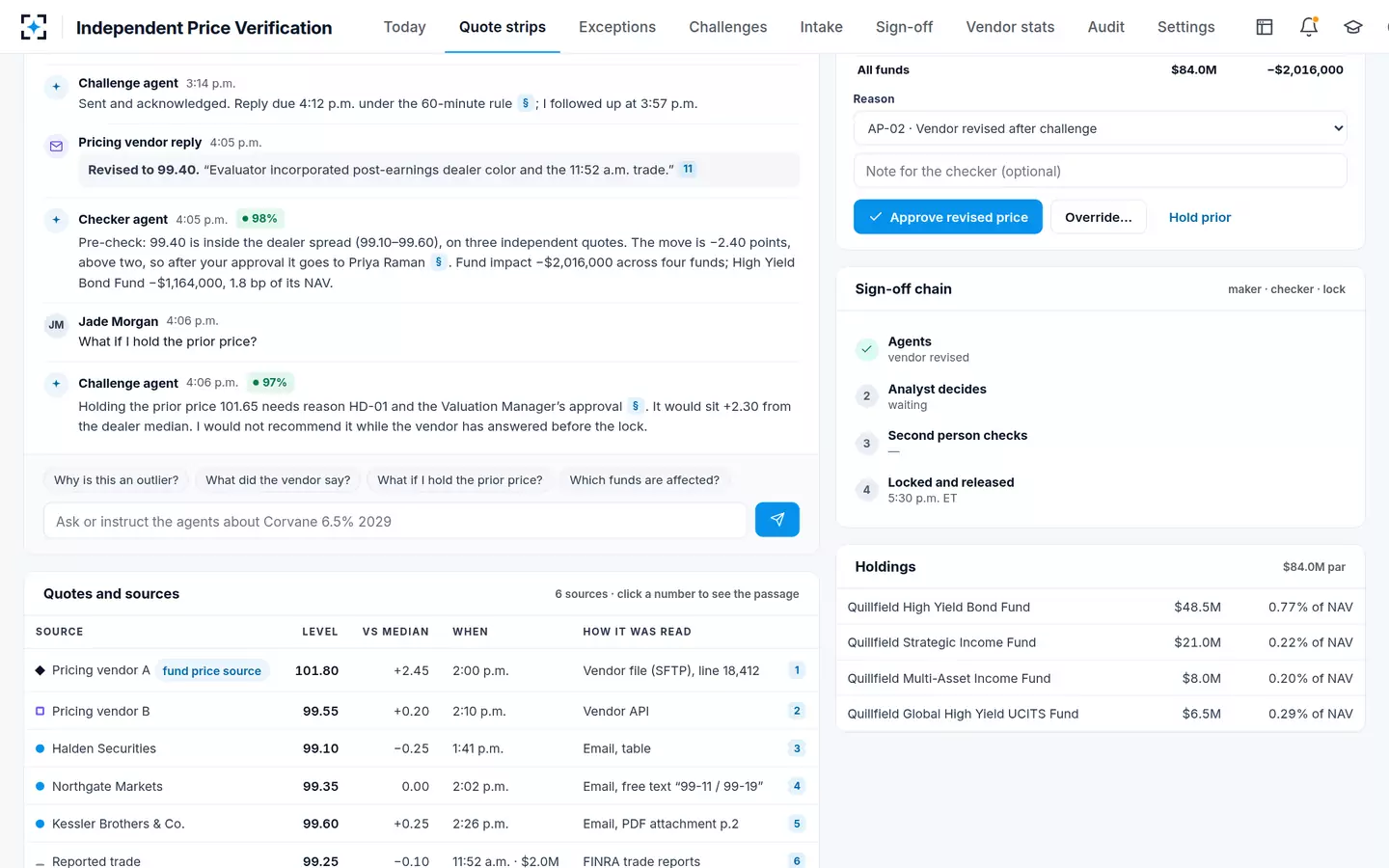
To challenge a pricing vendor, assemble the evidence, state the gap and the level asked, send it through the vendor's challenge channel with a reply-by time, track the reply, and record the outcome with a reason. The sample day's Corvane 6.5% 2029 bond shows the whole sequence. Vendor A priced it at 101.80; three dealers bid 99.10 to 99.60, $2.0 million had traded at 99.25, and the issuer had cut its earnings guidance after the close. High yield as a whole fell only 0.30 that day, so the market did not explain the gap.
One challenge, from the flag to the approved price: 95 minutes
- Flagged, drafted with evidence, sent by the analyst2:31–3:12
- With the vendor; follow-up at 45 minutesto 3:57
- Vendor revises to 99.40; analyst approves at 4:064:06
Two details in that sequence carry the control. The draft waited for a person: the agent assembled three broker runs, the trade and the issuer's release and proposed the dealer median, 99.35, as the level asked, and nothing left until the analyst answered "Send it." And the reply was approved with a reason code and passed to someone else to check. A challenge that ends in a revised price is still a changed price, and gets the same second look as an override.
A challenge drafted in Independent Price Verification, waiting for the analyst's yes
How long do vendors take to respond to a price challenge?
Vendors do not publish their response times, and no regulator collects them, so the only reliable figure is the one a fund measures itself. At the sample firm in September 2026, pricing vendor A's median reply was 47 minutes, pricing vendor B's 63 minutes and the loan pricing vendor's 3 hours 10 minutes, and 48 of 1,184 challenges went past the firm's 60-minute rule. Measured this way, reply time becomes a number the valuation designee can raise at the vendor's service review rather than an impression.
One month of challenges at the sample firm
1,184
challenges sent in September 2026, about 56 a pricing day
58%
revised by the vendor: 682 prices corrected
47 / 63min
median reply, pricing vendor A and vendor B
48
replies past the 60-minute rule, each followed up and escalated
The SEC treats the vendor's side of this as something to assess before relying on a pricing service at all. Among the factors it lists is the pricing service's process for considering price challenges and how it incorporates what it learns from them into its prices. How a fund turns challenge outcomes into a vendor scorecard is covered in the guide to pricing vendors for securities.
Criteria or judgement: where the SEC and MAS part ways
The SEC and MAS disagree on how much of the decision to challenge should be written down in advance. The SEC proposed requiring criteria for when to challenge, and dropped the idea after comments: "Commenters were concerned that this would result in rote or mechanical price challenges that may be unnecessary". The final rule requires a process instead, and the release adds that "Such a process generally should outline the circumstances under which a price challenge should be initiated" (SEC, Good Faith Determinations of Fair Value).
MAS went the other way after its inspections. Among its key takeaways, managers should "establish clear criteria or thresholds for challenging third-party service providers’ valuations", and it criticised a firm whose pricing team was not required to escalate prices that warranted a challenge to an approving authority (MAS, May 2026). The two positions are reconcilable. A threshold that sends a price to a person for a decision, rather than one that fires a challenge automatically, meets MAS's expectation without producing the mechanical challenges the SEC was warned about. That is how the sample firm's policy is built: the tolerance decides what an analyst must look at, and the analyst decides what is challenged.
When should you not challenge a vendor price?
Do not challenge a price the market explains, a price inside the dealer spread, or a price where your evidence is weaker than the vendor's. The SEC's own reason for rejecting fixed criteria was that they "may lead the valuation designee to challenge pricing information that is reasonable given market conditions, solely because such pricing information meets the pre-established criteria". On the sample firm's September figures, 78% of static-tolerance breaches, 11,602 of 14,920, were explained by the market and no challenge was sent.
There is a second reason, and it is about conflicts. The SEC noted that oversight of challenges should mitigate the risk that valuation designees "engage in price challenges that distort determinations of fair value in order to increase their compensation or make their performance appear to be better than it otherwise would". A challenge program that only ever asks vendors to raise prices on long positions is a warning sign, which is why the direction of challenges and overrides is worth measuring, as the guide to pricing exceptions shows with an SEC case.
The challenge that was never sent
The failures in the public cases are mostly challenges that should have been sent and were not. In a settled 2016 order, the SEC found that PIMCO bought small, odd-lot positions of non-agency mortgage bonds for a new ETF at prices well below the vendor's evaluated prices, which were for institutional round lots, and valued them at the vendor's round-lot marks. The administrator's variance notices reached the pricing group, which asked a trader whether to challenge one of them. The answer is quoted in the order.
“[n]o need to challenge” because “the bigger piece of the same cusip is likely to trade at low 80s.”
SEC order, In the Matter of Pacific Investment Management Company LLC, Release IA-4577, December 1, 2016
The order goes on: "Because these repeated variance notices created an administrative burden for the traders, in May 2012 PIMCO’s Pricing Group shut down the automatic challenge process at PIMCO for mortgage securities", so that "there would be no automatic challenge if the trader did not respond to a variance notice". The SEC found the ETF's NAV overstated by up to $0.31 a share; PIMCO agreed, without admitting or denying the findings, to pay a civil penalty of $18,300,000 plus disgorgement and interest. MAS's 2026 paper records a smaller version of the same failure: "although the price from the secondary price source was closer to that of the FMC, it did not issue a price challenge to the fund administrator and merely accepted the fund administrator’s price."
The lesson is about who decides and what the decision leaves behind. In both cases the evidence existed. In PIMCO's case the decision was left with traders whose fund benefited from the higher marks, and the SEC found the pricing policy "failed to provide for sufficient oversight of the traders’ determinations". A process that routes every unexplained gap to an independent analyst, requires a reason for not challenging as much as for challenging, and keeps both is the control that was missing.
What happens after the vendor replies?
After the reply the analyst decides, with a reason, and a second person checks. If the vendor revises, the analyst approves the revised price or overrides it if the revision is still outside the evidence. If the vendor confirms, the analyst weighs the explanation against the evidence: on the sample day vendor A confirmed Calder Bay 9.25% 2032 at 102.40, a $5.0 million trade had printed at 102.10 after a tender offer, and the Checker agent recommended keeping the vendor's price. If no reply arrives by the lock, the price holds its prior-day value with the Valuation Manager's approval and is worked again the next day.
The vendor's revision arrives in Independent Price Verification, and a question before approving
Every outcome is counted. The SEC's adopting release treats a recurring pattern of challenges or overrides that casts doubt on the valuation process as something that may be material, and so may have to reach the board. Counting challenges by vendor, asset class and outcome is the only way to see such a pattern; done in a month-end spreadsheet, it is usually seen late. The full afternoon around a challenge, from vendor file to lock, is in the independent price verification process.
Questions people ask
How many quotes does a price challenge need?
No regulator sets a number. The sample firm's policy asks for at least three independent dealer quotes before challenging, and AIFMD's rules single out prices that rest on a single broker as needing review. One strong piece of evidence, such as a sizeable trade after news, can justify a challenge on its own if the policy allows it.
Is a price challenge the same as a price override?
No. A challenge asks the vendor to change its price and leaves the source independent; an override replaces the vendor's price with the fund's own. Overrides carry more conflict risk, which is why the SEC expects named override authority and a process for reviewing overrides, and the SFC requires a documented reason and a functionally independent review.
Can a fund challenge its fund administrator's price?
Yes, and MAS expects it where the administrator's price is out of line. One of the findings in its May 2026 paper is a manager whose own secondary source was closer to its view but who accepted the administrator's price without a challenge.
What is a price challenge process under Rule 2a-5?
It is the written process the valuation designee establishes for deciding when to challenge a pricing service, who decides, how the challenge is made and how outcomes are tracked. The SEC chose not to require pre-set criteria, but said the process should generally outline the circumstances in which a challenge should be initiated, and it remains subject to board oversight.
Should the board see every price challenge?
Not individually. The SEC removed a proposed requirement to report every price override and allows summaries, but a pattern of challenges or overrides that raises concerns about the valuation process may be a material matter that must be reported to the board within five business days.