A valuation control group is the team that independently verifies the prices used to value positions: in a bank, the traders' marks on the trading book; in an asset manager, the prices from pricing vendors and administrators that go into each fund's NAV. It sits outside the front office, runs the daily price checks, challenges vendors, reviews overrides and reports to a head of valuation and a valuation committee. Its work is invisible on a good day, which is most days, and its independence is what regulators look at when a price turns out to be wrong. Botminds' Independent Price Verification gives the group's pricing analysts agents that read the quotes, explain the moves and draft the challenges, so the people spend their afternoon on decisions and checks rather than retyping.
The people and figures used as examples below come from Quillfield Capital, a fictional fund complex that runs on the solution as a sample, and its five named roles.
Where a pricing analyst's afternoon goes, by hand and with the agents
By hand: about 3.5 hours from the 2:00 p.m. files to the 5:30 p.m. lock
- Reading broker runs and retyping levels · 29%
- Working exceptions the market explains · 29%
- Drafting and chasing challenges · 21%
- Overrides and the second check · 14%
- Gathering evidence · 7%
With the agents: about 50 minutes of the same work
- Reading runs · 12%
- Explained exceptions · 29%
- Challenges · 24%
- Overrides and checks · 29%
- Evidence · 6%
What is a valuation control group?
A valuation control group, or valuation control function, is the team whose job is to make sure the prices a firm reports are supported by evidence independent of the people who set them. The name comes from banking, where valuation control or product control verifies traders' marks under the EU's rule that the check be made by someone who does not benefit from the trading book (Capital Requirements Regulation, Article 105(8); quoted in independent price verification regulations). Asset managers more often call it the pricing team or valuation oversight, and it may sit in operations, fund accounting, risk or a dedicated valuation function.
Whatever its name, the group does the same four things: it runs the daily price checks before the lock, it challenges pricing vendors and the administrator, it reviews overrides made by others, and it reports to the valuation committee and, through the valuation designee or management company, to the board. The work is described step by step in the independent price verification process; this guide is about the seat and the people in it. The analysts who carry the same evidence to the board on the valuation side are described in valuation risk analyst: who waits on whom.
What does a valuation control analyst do all afternoon?
A valuation control analyst spends the hours between the vendor files and the price lock reading evidence, separating market moves from wrong prices, and deciding what to challenge, override or hold. Done by hand, Botminds estimates that more than half of a 3.5-hour afternoon goes on two mechanical tasks: reading broker runs and retyping their levels, and working tolerance exceptions that turn out to be the whole market moving. Challenges take about a fifth; the decisions and second checks that actually need judgement get the least time.
At the sample firm the analyst is Jade Morgan, who covers US high yield, loans and emerging-market corporates in New York. By hand, she reads broker runs by eye and chases vendors by email between the 2 p.m. files and the 5:30 p.m. lock. With the agents she opens each outlier already explained or challenged, every quote on one line, says yes to a drafted challenge or edits it, and decides each price with a reason code. The agents never accept, send or edit on their own, so her decisions are the same in kind; what changes is how many of the afternoon's minutes they get.
Five seats behind one fund's prices, and what each keeps
Today
Reads broker runs by eye, retypes levels and chases vendors by email between the files and the lock.
With agents
Opens each outlier already explained or challenged, says yes to a drafted challenge and decides with a reason code.
Still theirs: Every decision on a price
Today
Checks overrides against a signed printout and rebuilds the evidence behind each one.
With agents
Gets every override and every move above two points with the re-test beside it, and checks the evidence and the reason.
Still theirs: The second check, never on her own work
Today
Wants a clean lock with nothing changing after it, without knowing until late what is still open.
With agents
Sees exactly what blocks the lock, region by region, and releases the prices.
Still theirs: The lock, and no power to change a price
Today
Has challenges counted in spreadsheets at month end for the pricing-service review.
With agents
Signs the monthly pricing-service oversight report drafted from the challenge history, with a citation behind every number.
Still theirs: Policy changes and the signed report
Today
Asks for spreadsheets and emails to test month-end prices and overrides.
With agents
Reads every override, who made it, who checked it and the quote it rests on, read-only.
Still theirs: The audit opinion
Who should the pricing team report to?
The pricing team should report through a line that does not run to portfolio management and is not paid on fund performance: typically operations, risk, finance or a head of valuation reporting to the chief operating or risk officer. MAS's 2026 paper is specific about which functions count as independent: "Functions that are independent from portfolio management include operations, risk management, legal and compliance" (MAS, Valuation Practices for Fund Management Companies). Among the better practices it saw was a valuation committee of senior managers independent of portfolio management "whose remuneration structures were not tied to funds’ performance".
Above the team sits the committee. At the managers MAS inspected, committees with daily-dealing funds met at least monthly, needed a majority of senior members independent of portfolio management to reach a quorum, and drew members with at least five years in the function each represented. Where firms fell short, it was usually at the top: "Some smaller FMCs did not have dedicated committees and appointed senior management member(s) involved in portfolio management function to oversee the valuation of certain assets."
What independence looked like at the managers MAS inspected
Monthly
at least, for valuation committees of daily-dealing funds
5 yrs
minimum experience of committee members in the functions they represented
Majority
of the quorum independent of portfolio management
What independence does a valuation function need?
A valuation function needs independence of three kinds: of reporting line, of sources and of decision. Reporting line means the people who verify prices are not managed or paid by the people whose performance the prices determine. Sources means the evidence comes from somewhere other than the price being tested: MAS faulted a manager that checked its administrator's price against the very source the administrator had used. Decision means nobody upstream can set the price, directly or by pressure. Each regime states the requirement in its own words.
Independence of the valuation function, regime by regime
| Regime | What must be independent | Of whom |
|---|---|---|
| EU banks, CRR Article 105(8) | Verification of market prices and model inputs | Persons or units that benefit from the trading book |
| US funds, Rule 2a-5 | Fair value determinations, by persons whose titles the valuation designee specifies | Portfolio management, which may not determine or substantially influence fair values |
| EU alternative funds, AIFMD Article 19 and Delegated Regulation 231/2013 Article 67(4) | The valuation task, functionally, with safeguards against inappropriate influence | Portfolio management, and anyone who could influence the valuer |
| Singapore, MAS 2026 paper and guidelines | Valuation, by a third party or an in-house function segregated from portfolio management | Portfolio management; committee quorum majority independent |
| Hong Kong, SFC Code 5.3.2 and 5.3.7 | Review of every price override or deviation, and an annual review of the process | Anyone not functionally independent of the decision |
Research on hedge funds adds a twist worth knowing. Studying how funds actually priced their positions, Cassar and Gerakos found that less verifiable pricing sources and more manager discretion were associated with smoother reported returns, and that, after investment style and portfolio characteristics, "pricing controls explain an additional 4.1–8.8 percent" of the variation in their smoothing measures (Review of Financial Studies, 2011). Taking the manager out of setting the NAV did not, on its own, show the same association. What a valuation control group verifies against matters at least as much as where it sits.
Can a portfolio manager supply a price?
A portfolio manager can supply information, such as colour, a quote or a view, but must not set the price. The SEC wrote the line into Rule 2a-5: the valuation designee must reasonably segregate fair value determinations from portfolio management, and the adopting release spells out what that means.
“A portfolio manager determining the fair value of fund investments would not be consistent with the reasonable segregation of functions required by the final rule.”
SEC, Good Faith Determinations of Fair Value, 86 FR 748 (January 6, 2021)
The SEC's case against Visium Asset Management shows how this fails in practice. The firm's compliance manual said the "pricing function will be carried out by the accounting team which is independent of the portfolio managers and trading desk". The settled order found instead that two portfolio managers "played a substantial role in the valuation process", sending month-end prices to the back office and supporting overrides with broker quotes they had arranged themselves, and that the valuation committee "generally did not document any findings concerning the price overrides" (SEC, Release 33-10494, May 8, 2018; settled, findings neither admitted nor denied).
The sample firm's rule is blunt: a portfolio manager's quote is evidence only, recorded with its source, never counted as an independent quote and never used as a price. On the sample day the Larkspur term loan carried the portfolio manager's 98.00 beside a loan vendor's 96.50 and a dealer's 96.25 to 96.75; the 98.00 was on the file and had no effect on the price. The other ways a price goes wrong, and the check for each, are in the guide to pricing exceptions.
The second person on every override
Every override needs a second person who did not make it, because an override replaces an independent source with the firm's own judgement. Hong Kong's code makes it explicit, requiring a documented reason and a review by a functionally independent party, and the SEC's release requires a process for reviewing overrides. In a small team, the second person is usually the Valuation Manager; above a threshold, the Head of Valuation and the committee.
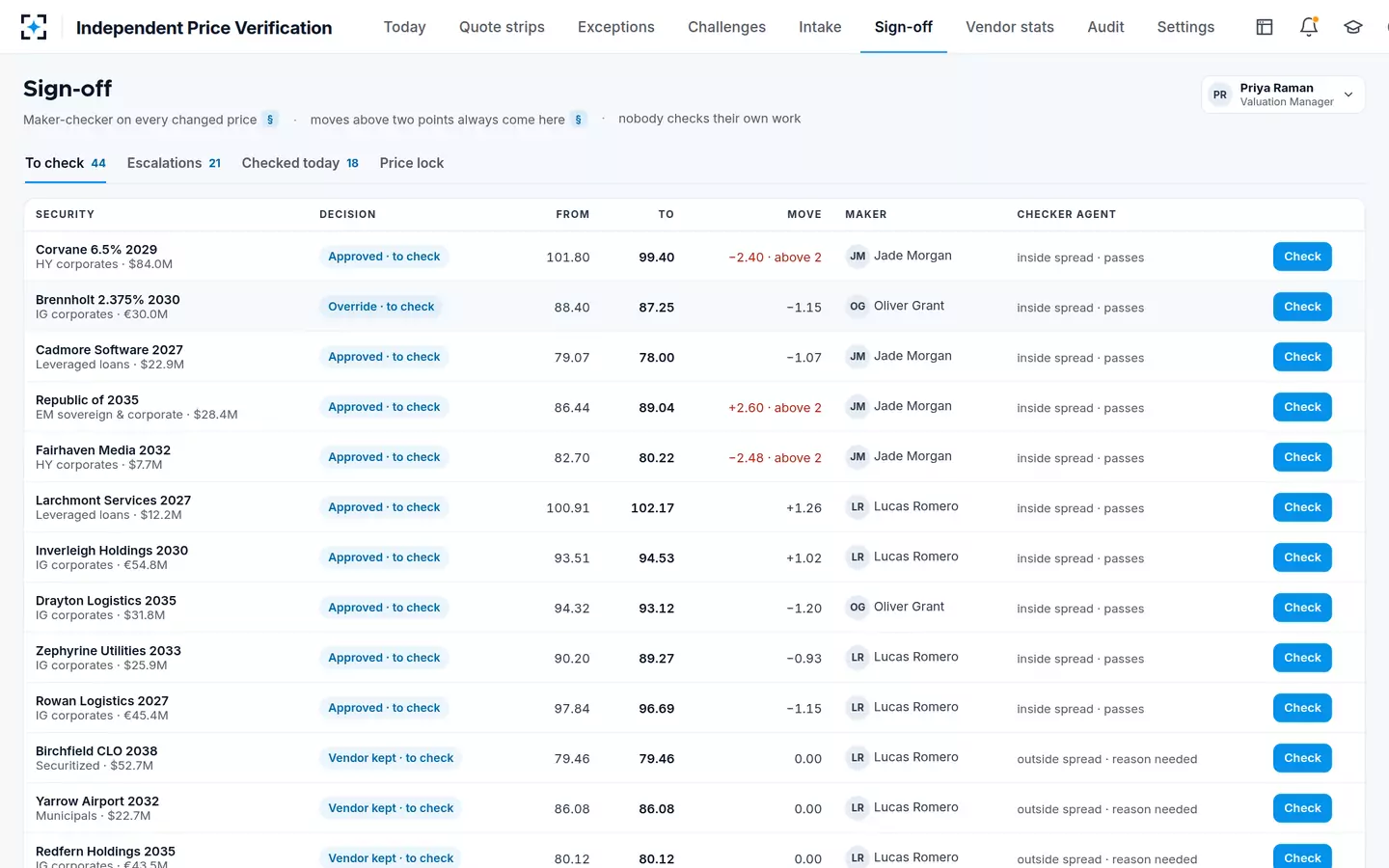
At the sample firm, every override, every move above two points and every kept vendor price outside the dealer spread goes to the Valuation Manager, Priya Raman, and nothing can be checked by the person who made it. The Checker agent re-tests each item against the policy first, but it cannot approve or check: it can only pass an item to a person or return it with a reason. In September, the firm's 214 overrides were each checked by a second person and 11 were returned and decided again. How to measure whether that check catches what it should is the subject of the guide to price validation.
Maker-checker in Independent Price Verification: every changed price waits for someone else
Valuation control jobs: what the work asks, and what it pays
Valuation control jobs ask for market knowledge across asset classes, the judgement to tell a model lag from a market move, and the discipline to document every decision. There is no US government occupation code for pricing or valuation control analysts; the closest the Bureau of Labor Statistics publishes is financial and investment analysts, whose median annual wage "was $102,740 in May 2025", across about 377,200 jobs (BLS, Occupational Outlook Handbook). Treat it as a reference point, not a salary survey for the role.
The skills that make a good analyst are not the ones the manual afternoon uses most. Retyping "99-11 / 99-19" from a broker's email into a spreadsheet uses none of them. Deciding whether a 2.45-point gap on a bond whose issuer cut guidance after the close warrants a challenge, an override or a hold uses all of them. Hiring for the second and spending the day on the first is the quiet cost of the seat, and the reason the mechanical half is the part worth handing to agents.
How the valuation control group shows its work
The group shows its work to three audiences, and each needs a different cut of the same evidence. The valuation committee needs exceptions, overrides and challenges by vendor and asset class each month. The board, under Rule 2a-5, needs the valuation designee's reports, including material matters within five business days. The auditor needs to follow any month-end price back to the quote it rests on and see who decided and who checked.
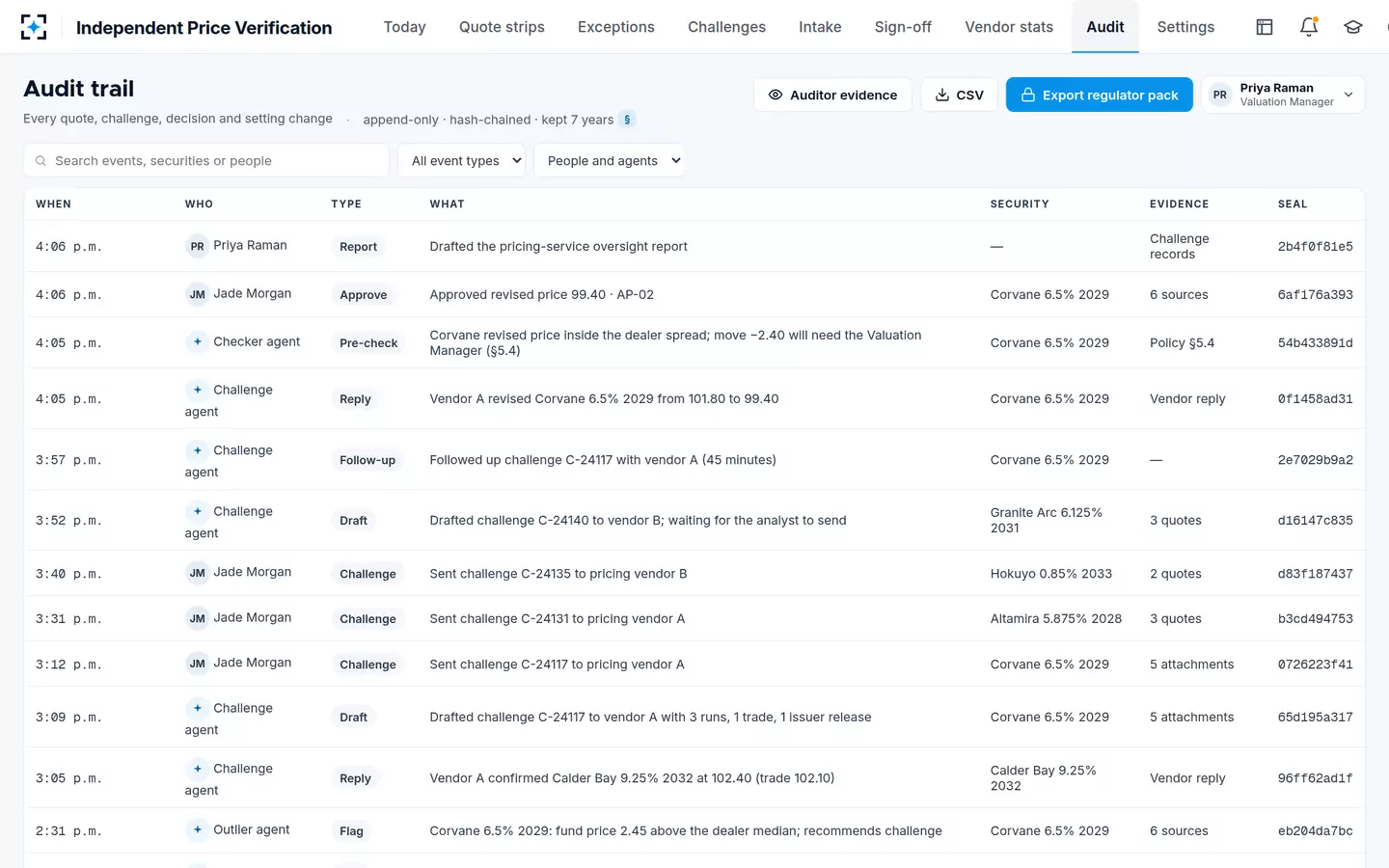
In the solution, all three come from the same trail. Each quote, challenge, decision and setting change is recorded with who, when, the evidence and a seal, kept seven years against the six Rule 31a-4 requires, and an auditor's read-only access replaces the spreadsheet requests. The monthly pricing-service oversight report is drafted from the challenge history and signed by the Head of Valuation.
The audit trail in Independent Price Verification: every quote, challenge, decision and setting
Questions people ask
What is the difference between valuation control and product control?
In banks the terms overlap: product control usually owns daily profit and loss and its explanation, while valuation control owns independent price verification and valuation adjustments; some banks combine them. In asset managers neither term is standard, and the pricing or valuation oversight team does the price verification.
Is valuation control a front-office or middle-office job?
Middle office or control function. The whole point of the role is that it does not report to the front office: EU bank law requires verification independent of those who benefit from the trading book, and fund rules require segregation from portfolio management.
How big is a valuation control team?
No regulator or independent study publishes team sizes for fund pricing teams, and they vary with the number of prices, asset classes and pricing locations. The useful sizing measure is how many prices need a person each day after the market-explained exceptions are removed, multiplied by the time each takes.
Can the fund administrator be the valuation control function?
It can perform the checks, and many managers rely on administrators to value funds independently, but the manager keeps the responsibility. The SFC's code says the manager remains responsible notwithstanding a third party, and MAS expects managers to oversee and periodically verify their service providers' controls.
Who chairs the valuation committee?
Usually a senior person independent of portfolio management, such as the head of valuation, the chief operating officer or the chief risk officer. MAS saw better practice where the whole committee was independent of portfolio management and not paid on fund performance, and at one manager a majority of external members.