Pricing vendors for securities are the third parties that send funds, administrators and banks a daily price for each bond, loan, structured security or derivative they cover, mostly evaluated prices produced by models from trades, dealer quotes and comparable securities. A fund cannot strike a daily NAV on a fixed income book without them, and under the SEC's Rule 2a-5 it cannot simply rely on them either: the valuation designee must approve, monitor and evaluate each pricing service and challenge its prices when they are wrong. The practical answer is to keep the vendors and verify them, every price, every day. Botminds' Independent Price Verification sits beside a firm's existing vendors: it reads their files, tests their prices against dealer quotes and a second vendor, runs the challenges through each vendor's own channel, and counts the outcomes into the monthly scorecard the valuation designee signs.
The vendor figures on this page come from Quillfield Capital, a fictional fund complex that runs on the solution as a sample; its vendors are shown unnamed as pricing vendor A, pricing vendor B and the loan pricing vendor.
From vendor file to vendor scorecard: verification beside the vendors
Agent
Quote agentReceives each vendor file by file transfer or API, checks it arrived on time and complete, and maps every price to the security master. On the sample day vendor B's Asia file came 22 minutes late and was retried.
Never: creates or edits a price
Agent
Outlier agentTests each vendor price against the dealer spread, recent trades and the second vendor, and explains the gaps the market accounts for.
Never: accepts a price
A person decides
Pricing analystDecides which vendor prices to challenge, approve, override or hold, each with a reason code.
Agent
Challenge agentSends the challenge through the vendor's own channel on the analyst's yes, tracks the reply against the policy's 60 minutes and the lock.
Never: sends without the analyst
Agent
Evidence agentCounts every challenge by vendor, asset class, outcome and reply time, and drafts the monthly pricing-service oversight report.
Never: changes a past entry
A person decides
Head of ValuationSigns the report for the valuation designee and takes its findings to each vendor's service review.
What is a pricing vendor?
A pricing vendor, or pricing service, is a firm that regularly provides funds with prices or price estimates for their investments. The SEC describes them as third parties that regularly provide evaluated prices, matrix prices, price opinions or similar estimates, and said in adopting Rule 2a-5 that "the types of entities that would be pricing services under the final rule would include pricing services as defined in the PCAOB standards" (SEC, Good Faith Determinations of Fair Value, 86 FR 748). In practice a fund complex uses several: one or two evaluated-pricing vendors for bonds, a specialist for loans, exchange feeds for listed securities, and dealer quotes as a check on all of them.
What a pricing vendor sells is a method applied at scale. It prices securities that have not traded by inference from those that have, which is what makes its prices useful for a daily NAV and also what makes them fallible. How an evaluated price is built, and why two vendors can be points apart on the same bond, is explained in what is evaluated pricing.
What does Rule 2a-5 require for pricing vendor oversight?
Rule 2a-5 makes overseeing pricing services one of the four duties of fair value determination: the board or valuation designee must oversee pricing service providers, if used, "including establishing the process for approving, monitoring, and evaluating each pricing service provider and initiating price challenges as appropriate" (17 CFR 270.2a-5(a)(4)). Compliance has been required since September 8, 2022. The rule does not prescribe how; the adopting release sets out what the SEC expects the process to consider.
Three parts of that duty are often run as if they were one. Approving is a decision made before a vendor is used, on the factors listed below. Monitoring is the daily and monthly evidence of how its prices behave, which is the verification itself. Evaluating is the periodic judgement, usually annual, of whether to keep using the vendor for each asset class, made from the monitoring evidence. A firm that only does the first has a contract, not oversight.
Six questions before you rely on a pricing service
Before deciding to use a pricing service, the SEC says a board or valuation designee generally should consider six factors, which double as the agenda for any vendor's annual review. The checklist states each in the SEC's terms, with the evidence that answers it.
The SEC's six factors for approving a pricing service, and the evidence for each
- The qualifications, experience and history of the pricing service
Its coverage of your asset classes and its history with them.
- Its methods, inputs and assumptions for each class of holding, and how they change with market conditions
The vendor's methodology papers, read for your asset classes.
- The quality of its prices, and how close to your NAV time it determines them
Your own back-testing against later trades; the file time against your lock.
- Its process for considering price challenges, and how it feeds them back into its prices
Your challenge history: revised rate, reply times, the explanations it gives.
- Its actual and potential conflicts of interest, and how it mitigates them
Including its business relationships with your firm.
- The testing processes it uses
What it tests, how often, and what it does with the results.
The fourth factor is the one most firms cannot evidence without a system. The SEC asks a fund to consider "the pricing service's process for considering price challenges, including how the pricing service incorporates information received from price challenges into its pricing information". That can only be judged from a history of challenges with their outcomes, which is exactly what a verification process produces as a by-product.
How do you oversee a pricing service day to day?
Oversee a pricing service day to day by verifying its prices before every lock, challenging the ones the evidence contradicts, and keeping each challenge, reply and outcome. The checks are the ones in any price validation process: the move against tolerance, the gap to a second vendor and to the dealer spread, stale and single-source prices, and whether each file arrived on time and complete. On the sample day pricing vendor A's New York file carried 12,880 bond prices at 2:00 p.m. and vendor B's 11,980 at 2:10 p.m.; vendor B's Asia file came 22 minutes late and was retried.
The sample day's Corvane bond shows a vendor working well under oversight. Vendor A's model had not absorbed the issuer's earnings guidance cut; the fund challenged at 3:12 p.m. with three dealer runs, a trade and the issuer's release, and at 4:05 p.m. the vendor revised from 101.80 to 99.40, explaining that its evaluator had incorporated the post-earnings dealer colour and the morning's trade. A vendor that answers like that, with evidence, within the hour, is one the fund can rely on; one that does not answer before the lock is one the fund has to plan around. How a challenge is built is in what is a price challenge.
How do you compare two pricing vendors?
Compare two pricing vendors on your own evidence, asset class by asset class: how often each is outside the dealer spread, how often each is revised when challenged, how fast each replies, how close each is to later trades, and whether each delivers on time. A vendor's overall revised rate says little on its own; a vendor that revises everything it is challenged on may be accepting weak evidence, and one that never revises may be ignoring strong evidence. Read the rate beside the explanations.
Comparing vendors also catches inconsistency inside the firm. MAS found a manager whose different administrators priced the same bond differently across its funds although they were meant to use the same pricing hierarchy and sources (MAS, Valuation Practices for Fund Management Companies). A cross-fund, cross-vendor comparison by security identifier, run daily, finds that before an auditor does.
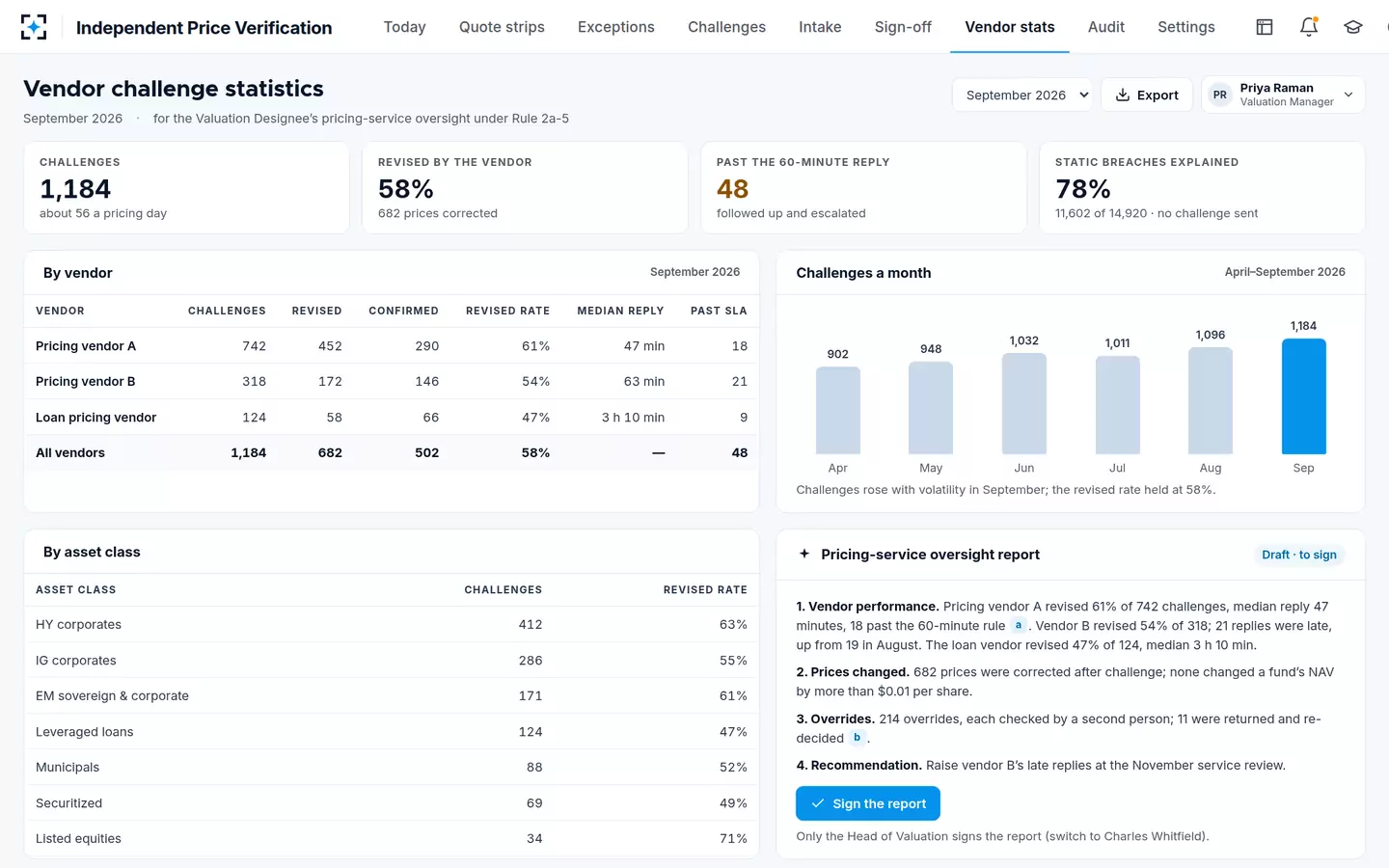
Two vendors, one month: the sample firm's September
61%
of 742 challenges revised by pricing vendor A, median reply 47 minutes
54%
of 318 challenges revised by pricing vendor B, median reply 63 minutes
21
of vendor B's replies past the 60-minute rule, up from 19 in August
3 h 10
median reply from the loan pricing vendor, which revised 47% of 124
What is a pricing vendor scorecard?
A pricing vendor scorecard is a monthly summary of how each vendor's prices behaved under the fund's own verification, by asset class, that the valuation designee uses to monitor and evaluate the vendor. It turns the evidence of the month into a few measures that can be compared over time and raised at the vendor's service review. The table shows the measures the sample firm uses and what each means.
A pricing vendor scorecard: eight measures and what each tells the valuation designee
| Measure | How it is counted | Sample firm, September 2026 | What it tells you |
|---|---|---|---|
| Challenges | Challenges sent to the vendor | Vendor A 742; vendor B 318; loan vendor 124 | How often your evidence disagreed with the vendor |
| Revised rate | Challenges answered with a revised price | 61%; 54%; 47% | How often the vendor accepted the evidence; read with the explanations |
| Median reply time | From challenge sent to reply | 47 min; 63 min; 3 h 10 min | Whether the vendor can be challenged before your lock |
| Late replies | Replies past the policy's 60 minutes | 18; 21; 9 | The service problem to raise at the review |
| Outside the spread | Prices outside the dealer spread at the file | From the daily tests, by asset class | Where the vendor's model lags the market |
| Back-test gap | Vendor price against later trades | Monthly, by asset class | Whether the vendor is biased high or low where it matters |
| File timeliness | Files late or incomplete | Vendor B Asia late on the sample day | Whether the vendor fits your pricing clock |
| Overrides | Vendor prices the fund replaced | 214 across all vendors; each checked by a second person | Where the fund does not use the vendor at all, and why |
When do price challenges become a board matter?
Individual challenges do not go to the board; a pattern can. When the SEC adopted Rule 2a-5 it dropped a proposed requirement to report every price override, but it said that, as an example of a material change in the oversight of pricing services, a recurring pattern of challenges or overrides that raises concerns about the valuation process may be material (SEC, 86 FR 748). Material matters must reach the board within five business days of the valuation designee becoming aware of them.
The SEC also named the conflict that makes vendor oversight necessary even when a vendor is unaffiliated: "pricing services may have conflicts of interest such as maintaining continuing business relationships with the valuation designee". A scorecard is how a designee shows the board that it watches for both: a vendor whose quality is slipping, and a relationship that makes slippage easy to tolerate. Hong Kong's code puts the same expectation on any third party performing valuation services: the manager must select it with due skill, care and diligence, review its activities periodically, and remains responsible (SFC, Fund Manager Code of Conduct, 5.3.4).
Independent Price Verification's vendor statistics and the oversight report, drafted for signature
Keep the vendors: why verification sits beside them, not instead
Verification should sit beside the pricing vendors because it cannot do their job and they cannot do its job. A vendor prices thousands of securities from a market-wide view no single fund has; a fund's verification tests those prices against the dealer quotes, trades and news it sees for its own holdings, at its own pricing time. Replace the vendor and the fund must build a pricing model; drop the verification and the fund is relying on a model it does not test. Neither is what any regulator asks for.
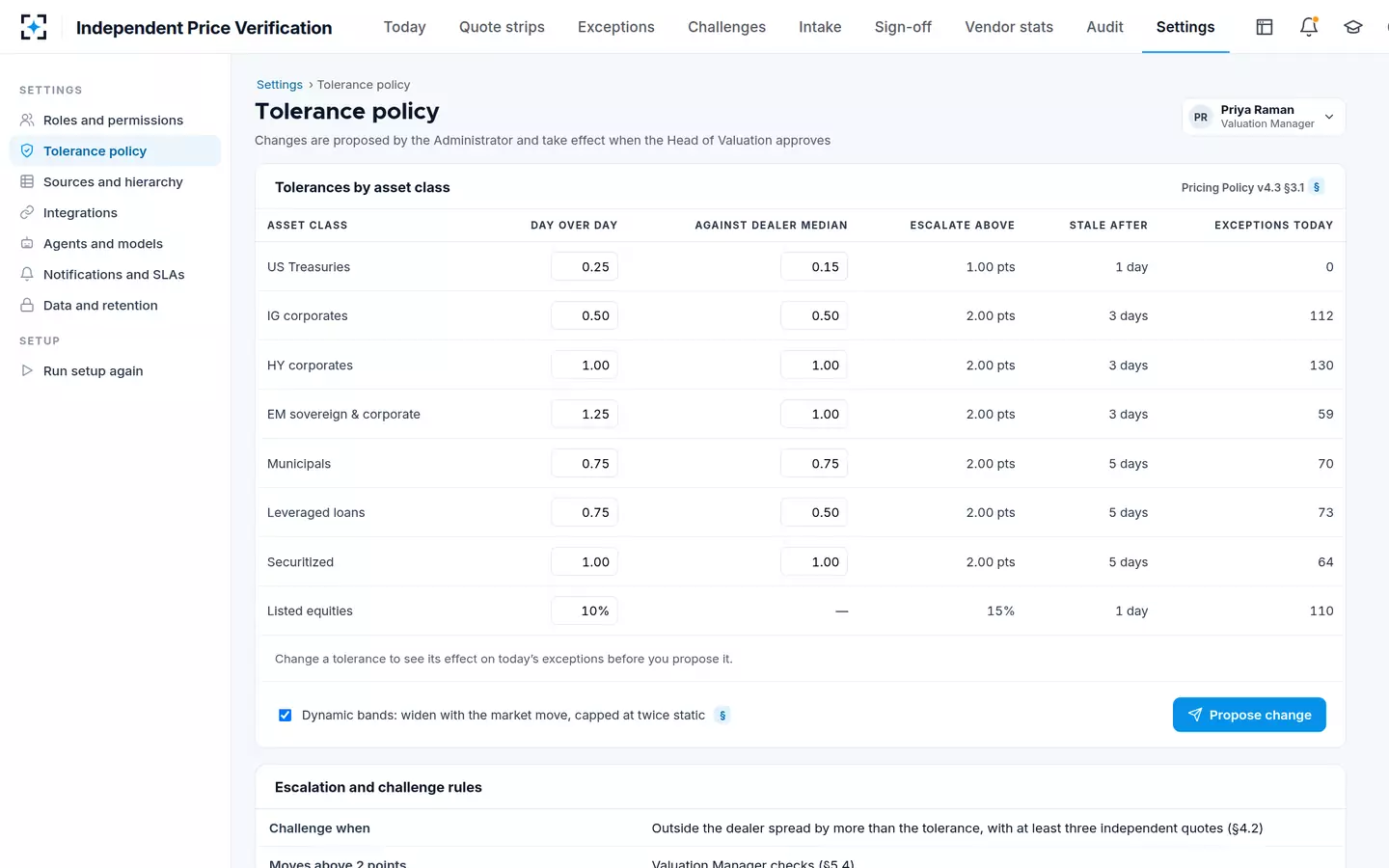
That is also why switching vendors is rarely the first answer to a bad month. The scorecard shows where a vendor is weak, often one asset class, and the source hierarchy can be changed for that class alone: at the sample firm, high-yield corporates run vendor A, then vendor B, then the dealer median from at least three quotes, then the prior day's price held with approval, and each asset class has its own order. Comparing that cost with the alternatives is covered in independent valuation services, in-house team or agents.
Going live beside your pricing vendors: what you bring
Going live beside existing vendors is an integration, not a migration: the vendors, the pricing system, the security master and the administrator stay, and verification connects to them. What a firm brings is its own: the vendor files and challenge channels, the shared pricing mailbox, the pricing policy and source hierarchy, and a past pricing day to test on. The solution's setup ends with that test; on the sample past day the agents raised every price the team had challenged, 49 of 49, and six more for the team to review.
What to have ready before going live beside your vendors
- Each vendor's files and their delivery times
Evaluated prices for bonds and loans, exchange closes, and when each arrives against your lock.
- Each vendor's challenge channel
Portal, API or email, with the contacts and the reply times you expect.
- The shared pricing mailbox
Where dealer runs arrive, in whatever format and language the dealers send.
- Your pricing policy as settings
Tolerances, stale limits and escalation by asset class; challenge rules; reason codes; locks by region.
- Your source hierarchy by asset class
Which vendor first, which second, when the dealer median, when to hold.
- The pricing system, security master and accounting platform
Prices read from one, quotes mapped against another, locked prices released to the third and to the administrator.
- One past pricing day your team remembers
The test: the team's challenges and overrides that day against what the agents raise.
The policy vendors are tested against, as approved settings in Independent Price Verification
Questions people ask
What is a pricing vendor in finance?
A firm that supplies prices or price estimates for securities to funds, banks, insurers and administrators, typically evaluated prices for bonds and loans that do not trade every day. The SEC treats them as pricing services under Rule 2a-5, which the fund must oversee.
Do funds need two pricing vendors?
No rule requires two, but a second independent source is the simplest way to test the first, and MAS's 2026 paper expects independent alternative sources to be used to investigate exceptions. The sample firm uses a second vendor for its corporate bond classes and dealer quotes as a check on every class.
How often should a pricing vendor be evaluated?
Monitored continuously and evaluated periodically, with the monthly scorecard as the evidence; an annual evaluation per asset class is a sensible minimum. Rule 2a-5 does not set a frequency, but the valuation designee must report to the board at least annually on the fair value process and promptly on material matters.
Can a fund use a pricing vendor affiliated with its adviser?
It can, but the conflict needs managing and disclosure. The SEC lists a change to a pricing service affiliated with the valuation designee as an example of a matter that may be material, and expects conflicts of any pricing service to be considered before it is used.
Should we switch pricing vendors after a bad month?
Usually not first. Read the scorecard by asset class: a vendor weak in one class can be moved down the source hierarchy for that class, raised at its service review, and measured again, while it keeps pricing the classes where it performs.