Independent price verification regulations exist under that name only for banks: the EU's Capital Requirements Regulation defines independent price verification and requires it at least monthly, performed by a unit independent of whoever benefits from the trading book, and its results feed the capital deduction for prudent valuation. Funds are held to the same control in other words. UCITS management companies must have OTC derivative values independently assessed; alternative fund managers must review individual values where a price rests on one broker; US funds must oversee their pricing services and run a process for price challenges under Rule 2a-5; and Singapore and Hong Kong now spell out price validation checks and override reviews. Botminds' Independent Price Verification runs the daily verification those rules assume, with every price, challenge and override kept as evidence for whichever of them a firm answers to.
Bank IPV and fund price verification: the same control, two vocabularies
Bank IPV (EU CRR): Independent price verification, defined in Article 4(1)(70)
Fund price verification: Independent assessment of OTC derivatives (UCITS); review of individual values (AIFMD); oversight of pricing services and price challenges (Rule 2a-5); price validation checks (MAS)
Bank IPV (EU CRR): Traders' marks and model inputs on the bank's own book
Fund price verification: Prices from pricing vendors, administrators, counterparties and brokers used for the NAV
Bank IPV (EU CRR): Persons or units that benefit from the trading book
Fund price verification: Portfolio management, and the source whose price is tested
Bank IPV (EU CRR): At least monthly, more often depending on the market
Fund price verification: Set by the fund's dealing frequency: daily for a daily-dealing fund
Bank IPV (EU CRR): Additional valuation adjustments deducted from capital
Fund price verification: A wrong NAV paid out to every investor who deals that day
Bank IPV (EU CRR): The supervisor, through capital and its reporting
Fund price verification: The fund board or management company, the auditor and the regulator on inspection
Is independent price verification a legal requirement?
For an EU bank, yes, by name; for a fund manager, yes in substance, under the fund rules of each jurisdiction. No US rule, UCITS text or Asian code uses the phrase "independent price verification" for funds. Each of them nonetheless requires a fund manager to test the prices it uses against something other than the price's own source, to have people independent of portfolio management do it, and to keep the evidence. The difference is mostly vocabulary, and partly frequency: a bank's minimum is monthly, a daily-dealing fund's is in practice daily.
That difference in vocabulary matters to anyone writing a pricing policy. A policy that says only "we perform IPV" satisfies none of the fund rules; one that says which checks run, against which independent sources, by whom, how exceptions escalate and who may override satisfies all of them. The sections below take each regime in turn, then the question of frequency, then the policy.
Where the term comes from: CRR Article 105
The Capital Requirements Regulation defines independent price verification as "a process by which market prices or marking to model inputs are regularly verified for accuracy and independence" (Article 4(1)(70)) and sets the requirement in Article 105(8). The 2019 amendments rewrote other paragraphs of Article 105, and neither they nor the 2024 package changed the definition or paragraph 8. Paragraph 8 also says what to do when the evidence is thin: "Where independent pricing sources are not available or pricing sources are more subjective, prudent measures such as valuation adjustments may be appropriate."
“Verification of market prices and model inputs shall be performed by a person or unit independent from persons or units that benefit from the trading book, at least monthly, or more frequently depending on the nature of the market or trading activity.”
Regulation (EU) No 575/2013, Article 105(8)
Three words in that sentence carry the design. "Market prices and model inputs": the check covers the inputs to a model, not only quoted prices. "Benefit": independence is defined by incentive, not by org chart. "At least monthly, or more frequently": the floor is monthly, and the market sets how far above the floor a bank must go. A fund manager writing its own policy can borrow all three.
What is prudent valuation, and how does IPV feed it?
Prudent valuation is the bank capital rule that turns pricing uncertainty into a deduction from capital, and IPV is its input. The EU's standard on prudent valuation, Commission Delegated Regulation (EU) 2016/101, requires banks calculating additional valuation adjustments to "consider the same range of market data as the data used in the independent price verification (‘IPV’) process". Where enough data exists, a bank estimates the point "where they are 90 % confident they could exit the valuation exposure at that price or better", and the gap between that point and fair value is deducted from Common Equity Tier 1.
Smaller banks may use a simplified approach: a flat 0.1% of their fair-valued assets and liabilities, if those total less than EUR 15 billion. The contrast with a fund is instructive. A bank can hold capital against the uncertainty in its marks; a fund cannot, because every investor buys and sells at the NAV. A fund's only defence against an uncertain price is to test it before it is used, which is why the fund rules below focus on checks and challenges rather than on adjustments. Bank capital itself is outside this guide's scope.
Prudent valuation in three numbers
90%
confidence that the bank could exit at the prudent value or better
€15bn
fair-valued assets and liabilities below which the simplified approach may be used
0.1%
of those fair-valued positions: the simplified approach's adjustment
Does UCITS require independent valuation of OTC derivatives?
Yes. A UCITS management company must verify that the fund's exposures to OTC derivatives "are assigned fair values that do not rely only on market quotations by the counterparties of the OTC transactions", and must ensure that "the fair value of OTC derivatives is subject to adequate, accurate and independent assessment" (Directive 2010/43/EU, Article 44). The same article requires the arrangements to be documented and appoints the risk management function "with specific duties and responsibilities".
The counterparty clause is the one practitioners underestimate. The bank that sold a fund a swap is usually the easiest source of a daily value for it, and the least independent: it is on the other side of the trade. Article 44 does not ban the counterparty's value; it bans relying only on it. The directive's recitals add that, as good practice, the same arrangements should apply to less liquid or complex securities valued with models.
AIFMD: a review of individual values where the risk is highest
The EU's rules for alternative fund managers are the most explicit about where verification must concentrate. Article 71(2) of Delegated Regulation 231/2013 requires a review process for individual asset values "where a material risk of an inappropriate valuation exists", and lists the cases, starting with valuations "based on prices only available from a single counterparty or broker source" and including valuations influenced by parties related to the manager, by the counterparty that originated the instrument, or by individuals within the manager (Delegated Regulation (EU) No 231/2013).
Article 71(3) then lists the minimum checks, and Article 67 requires, where the manager values the assets itself, safeguards that "include measures to prevent or restrain any person from exercising inappropriate influence over the way in which a person carries out valuation activities". Article 74 sets the frequency for open-ended funds: financial instruments are valued every time the NAV is calculated. Read together, the articles describe an IPV process in all but name, and the single-broker case heads the list of risks.
Is independent price verification required for mutual funds in the US?
No US rule uses the term, but Rule 2a-5 requires the substance. A fund's board, or the adviser it designates, must oversee its pricing service providers, with a process for approving, monitoring and evaluating each of them and for initiating price challenges where appropriate, and must test its fair value methodologies, naming the testing methods and how often, at a minimum, each is used (17 CFR 270.2a-5(a); Rule 2a-5 in plain words). Because the SEC treats a pricing service's evaluated prices as fair values rather than readily available market quotations, that is a daily verification duty for any fund that strikes a daily NAV on them.
The SEC chose not to prescribe how. The final rule requires a process for price challenges "instead of the proposed approach that would have required funds to establish criteria for the circumstances under which price challenges would be initiated" (SEC, 86 FR 748, January 6, 2021). Compliance has been required since September 8, 2022, and the documentation must be kept six years under Rule 31a-4. What the SEC's choice of process over criteria means for an analyst deciding whether to challenge is the subject of what is a price challenge.
Singapore: what MAS expects since May 2026
Singapore's rule is short and its 2026 guidance long. The licensing regulation requires a fund manager to "subject assets under management to independent valuation for the purpose of determining their respective net asset values"; MAS's guidelines allow that to be done by a third party such as a fund administrator, or in house by a function segregated from portfolio management. On May 29, 2026 MAS published its supervisory expectations from thematic inspections, including a full section on ongoing price validation checks (MAS, Valuation Practices for Fund Management Companies).
The paper's key takeaways read like an IPV procedure: adjust tolerances to each asset class, calibrate stale price reports to each fund's dealing frequency, detect the same instrument valued differently across funds, follow up every exception promptly, "use independent alternative price sources to investigate exceptions", set an escalation forum, and keep records of every check and its resolution. No other text cited here is as specific about the daily checks, and the inspection findings behind it are taken up in the guide to price validation.
Hong Kong: the SFC's rule on overrides
For independent price verification in Hong Kong, the reference is the Securities and Futures Commission's Fund Manager Code of Conduct, fifth edition, October 2024, paragraphs 5.3.1 to 5.3.7. A fund manager responsible for valuation must have policies so that "a proper and independent valuation of the fund assets can be performed", must value listed securities from "an automatic price feed or other independent pricing source", and must seek independent confirmation from brokers or market makers for securities that are suspended or not actively traded (SFC, Fund Manager Code of Conduct).
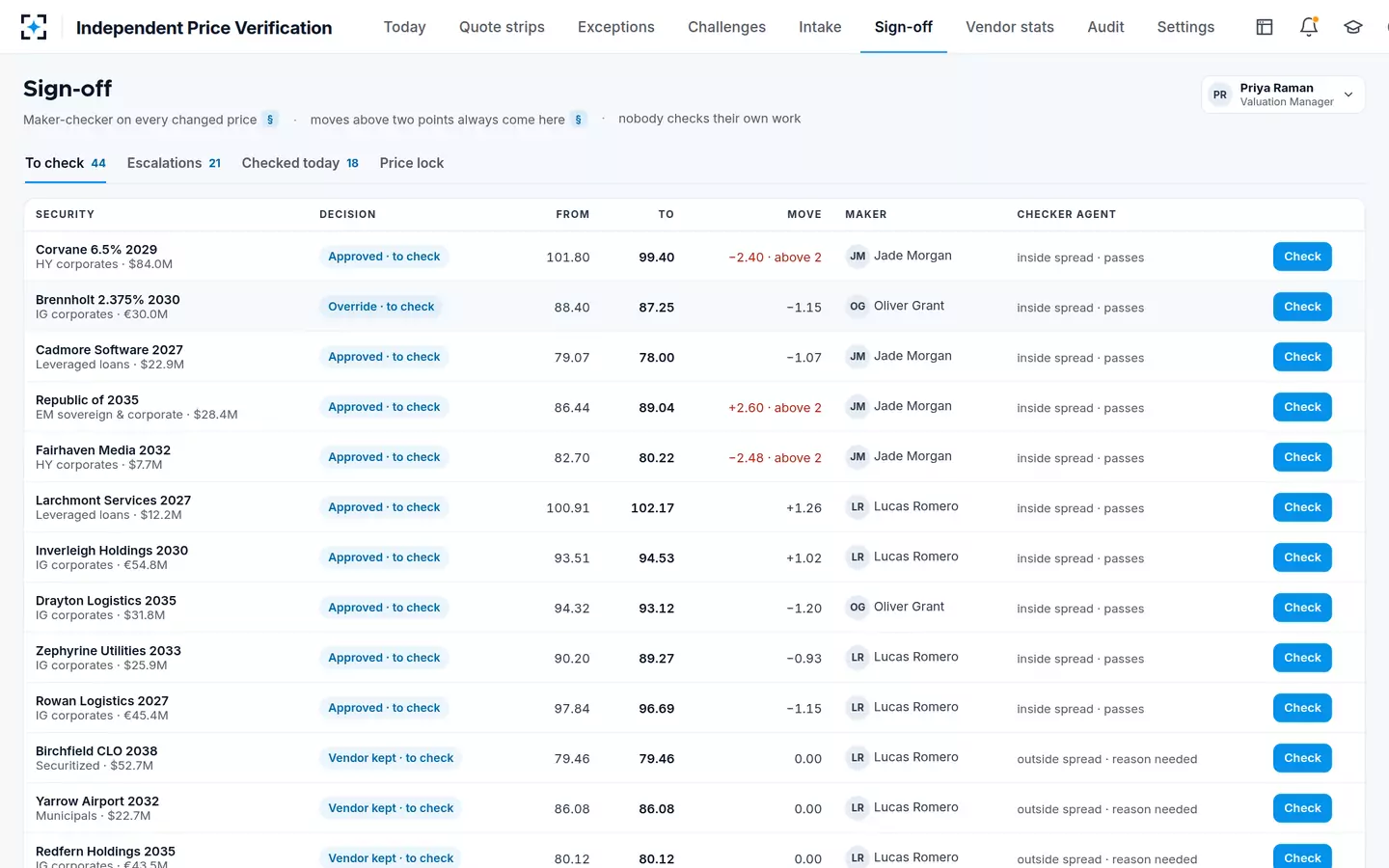
The code is the clearest of all the regimes on overrides. Its note to paragraph 5.3.2 requires the manager to document "the reason for any price override or deviation" and to ensure "an appropriate review of the price override or deviation by a functionally independent party". Paragraph 5.3.7 adds an annual review of the whole valuation process, including testing it, by a competent and functionally independent party.
Independent Price Verification sends every override to someone who did not make it
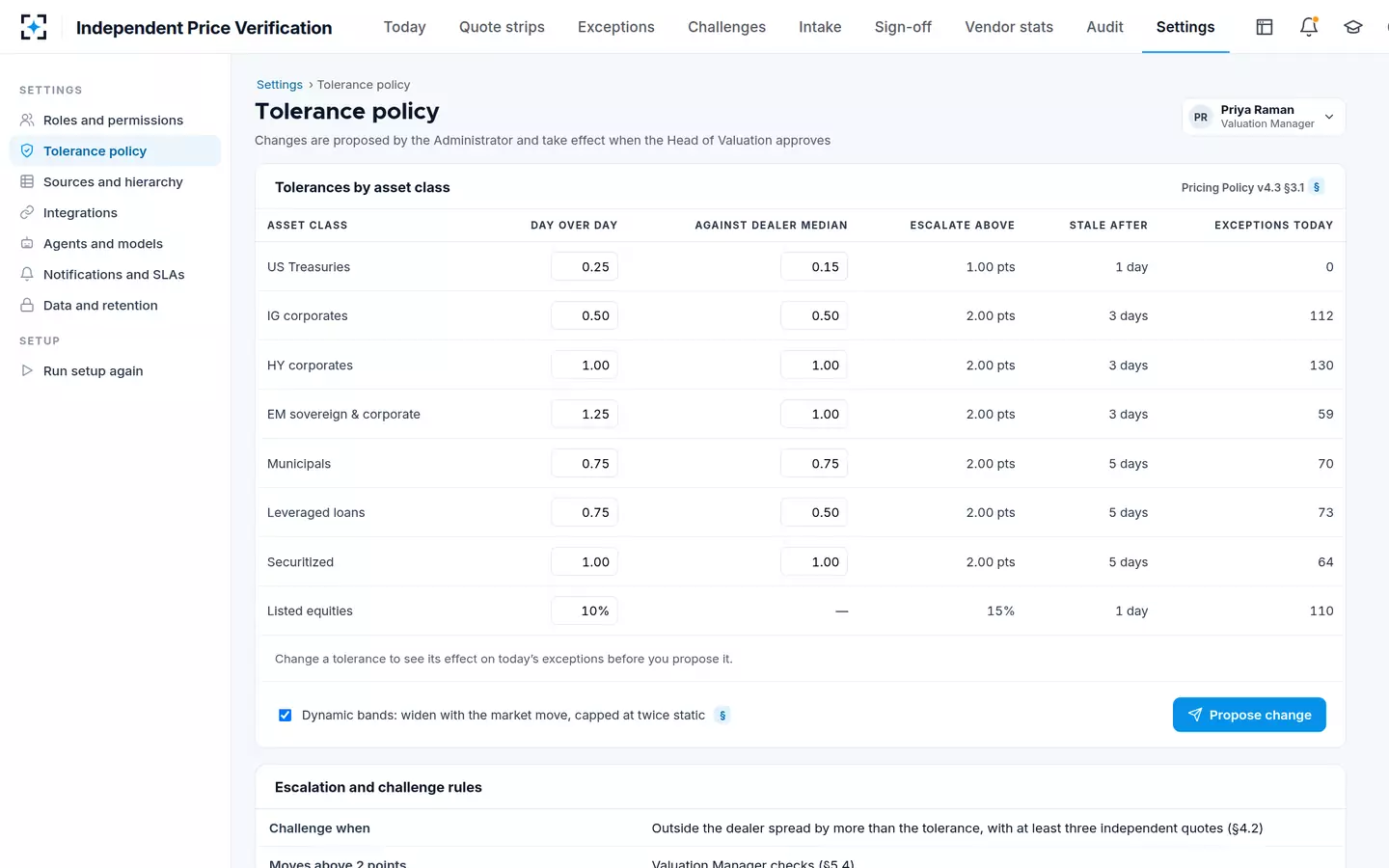
A pricing policy held as settings in Independent Price Verification, by asset class
How often must independent price verification run?
At least as often as the price is used. The only regulation with a numerical floor is the bank rule, at least monthly. Every fund rule ties the frequency to the fund: valuation as often as the NAV is calculated, and checks and reports calibrated to dealing frequency. For a fund that deals daily, that means a daily verification before the lock, plus slower, deeper reviews of hard-to-value positions and of the process itself.
Independent price verification frequency, regime by regime
| Regime | What it says about frequency | In practice for a daily-dealing fund |
|---|---|---|
| EU banks, CRR Article 105(8) | At least monthly, or more often depending on the market or trading activity | Not applicable to funds; the floor a bank cannot go below |
| AIFMD, Delegated Regulation 231/2013 Article 74 | Financial instruments of open-ended funds valued every time the NAV is calculated; other assets at least yearly | Daily verification of every instrument priced that day |
| UCITS, Directive 2010/43 Article 44 | Independent assessment of OTC derivatives; no separate frequency | At each valuation of the derivative, which follows the NAV |
| US, Rule 2a-5 | The designee names its testing methods and their minimum frequency | Daily price tests; periodic calibration and back-testing |
| Singapore, MAS 2026 paper | Stale price reports calibrated to dealing frequency; inspected firms' committees met at least monthly for daily-dealing funds | Daily checks, monthly committee review |
| Hong Kong, SFC Code 5.3.5 and 5.3.7 | Valuation frequency appropriate to the assets and dealing frequency; process review at least annually | Daily valuation, annual independent review |
One policy that satisfies every regime
A firm that answers to more than one of these regimes does not need six procedures. The requirements overlap so much that a single daily process, written down once, meets all of them if it says eight things. The checklist below is that list, with the regime that asks for each point most explicitly.
Eight things a pricing policy must say to satisfy every regime
- Which checks run on every price, and their tolerances by asset class
MAS 2026; AIFMD Article 71(3).
- Which sources count as independent, in what order
UCITS Article 44 (never only the counterparty); SFC 5.3.6.
- When a single-source or broker price goes to a person
AIFMD Article 71(2)(a).
- How a price challenge is decided, sent and tracked
Rule 2a-5(a)(4) and its adopting release.
- Who may override, with what reason, and who reviews it
SFC 5.3.2 note; Rule 2a-5 adopting release.
- How exceptions escalate, and to which forum
MAS 2026; AIFMD Article 71(4).
- Who is independent of portfolio management, and how
CRR Article 105(8) by analogy; AIFMD Article 67(4); MAS guidelines.
- What evidence is kept, and for how long
Rule 31a-4 (six years); MAS 2026 record keeping.
Independent Price Verification holds those eight points as settings rather than prose: tolerances and stale limits by asset class, the source hierarchy, the challenge and escalation rules, the reason codes for overrides and holds, and the retention period. A change is proposed by an administrator and takes effect only when the Head of Valuation approves it, and every version of the policy stays on the audit trail with the prices it governed. How the daily process runs, step by step, is in the independent price verification process.
Questions people ask
What is prudent valuation in the CRR?
Prudent valuation is the CRR's requirement, in Article 105, that banks value fair-valued positions with an appropriate degree of certainty and deduct additional valuation adjustments from capital for the uncertainty. The EU standard, Delegated Regulation 2016/101, sets the method: a value the bank is 90% confident it could exit at or better, using the same market data as its independent price verification.
What is the EBA RTS on prudent valuation?
It is the regulatory technical standard the European Banking Authority drafted under Article 105(14) of the CRR, adopted by the Commission as Delegated Regulation (EU) 2016/101 and published on 28 January 2016. It defines the additional valuation adjustments, the 90% confidence level and a simplified approach of 0.1% of fair-valued positions for banks below EUR 15 billion.
Do fund managers have to calculate prudent valuation adjustments?
No. Prudent valuation is a bank capital rule. A fund prices at fair value and has no capital to absorb uncertainty, which is why fund rules require checks, challenges and override reviews before the price is used instead.
Does Rule 2a-5 require a specific number of dealer quotes?
No. The SEC rejected fixed criteria and required a process for price challenges, leaving thresholds to each fund. MAS takes the opposite line in its 2026 paper and expects clear criteria or thresholds for challenging third-party valuations, so a firm answering to both should write thresholds into a process.
Who must be independent in independent price verification?
In a bank, whoever verifies must be independent of those who benefit from the trading book. In a fund, the valuation function must be segregated from portfolio management: MAS allows a third party or an in-house function, the SFC requires a functionally independent review of overrides, and Rule 2a-5 requires fair value determinations to be segregated from portfolio management.