Rule 2a-5 under the Investment Company Act of 1940 is the SEC rule that defines what it means for a registered fund or business development company to determine fair value “in good faith”: it requires four functions (assess and manage valuation risks, establish and apply fair value methodologies, test them, and oversee pricing services), lets the board hand that work to a “valuation designee”, and fixes how the designee reports back. Its companion, Rule 31a-4, says how long the evidence is kept. The rule is short; the work it describes runs every night across thousands of prices, which is why most of the burden sits in spreadsheets, email and a quarterly report built by hand. Botminds’ Valuation Risk Management exists to keep that work, and its evidence, in one place for the valuation designee.
The examples on this page come from a fictional sample fund complex as it runs through the solution: Quillfield Capital, valuation designee for 90 registered funds, on the night of the October 14, 2026 close.
Rule 2a-5’s four duties, and the evidence each one leaves behind
Clause(a)(1)
DutyAssess and manage valuation risks
What the rule asksPeriodically assess the material risks in fair valuing the fund’s investments, “including material conflicts of interest”, and manage the ones identified. No reassessment frequency is set.
The evidence a designee keepsA register of risks with owners, the triggers that move each one, and the dated reassessments
Clause(a)(2)
DutyEstablish and apply methodologies
What the rule asksSelect and apply methods consistently, with the key inputs and assumptions for each asset class or holding; review them periodically; monitor for events that make fair value necessary.
The evidence a designee keepsMethod descriptions by asset class, change approvals, and the monitoring that caught each fair value event
Clause(a)(3)
DutyTest the methodologies
What the rule asksTest for appropriateness and accuracy, naming the testing methods and “the minimum frequency with which such testing methods are to be used”.
The evidence a designee keepsCalibration and back-test results by method, with every miss explained
Clause(a)(4)
DutyOversee pricing services
What the rule asksIf pricing services are used, a process to approve, monitor and evaluate each one, and a process for challenging their prices when that is appropriate.
The evidence a designee keepsDue diligence on each service, the challenge log, and the annual evaluation
What is Rule 2a-5? Good faith, written down as four functions
Rule 2a-5 is the definition the Investment Company Act never had. Section 2(a)(41) of the Act says a fund values a security at market value when a market quotation is “readily available” and otherwise at fair value determined in good faith by the board. For fifty years the meaning of good faith rested on two accounting releases from 1969 and 1970, ASR 113 and ASR 118, and on decades of staff letters. Rule 2a-5 replaced them with a list: determining fair value in good faith “requires” the four functions in paragraph (a) (17 CFR 270.2a-5).
The list is deliberately functional. It does not say which model to use for a private loan, how often to test, or what tolerance a price check should apply. It says that someone must have looked at where the valuation process can go wrong, chosen methods with named inputs, tested them on a stated schedule, and watched the pricing services the fund depends on. A fund that does all four, and can show it, has determined fair value in good faith in the rule’s sense. A fund with a sound number and no trail of how it was reached has not.
Two details in the first duty are easy to read past. Valuation risk explicitly includes conflicts of interest, so the adviser’s own incentive to mark high is a risk to assess, not an assumption to ignore. And the adopting release counts as valuation risk the chance of getting wrong whether an investment needs a fair value at all (SEC, Good Faith Determinations of Fair Value, 86 FR 748): a fund that never notices a quotation has gone unreliable has a valuation risk problem even if every model it runs is perfect. How to turn those risks into a working register is a guide of its own.
When was Rule 2a-5 adopted, and what did it replace?
The SEC adopted Rule 2a-5 and Rule 31a-4 in December 2020 (Release IC-34128), published them in the Federal Register on January 6, 2021, and made them effective on March 8, 2021, with “an eighteen month transition period beginning from the effective date” (86 FR 748). Funds have had to comply since September 8, 2022. On that date ASR 113 and ASR 118 were rescinded “in their entirety”, along with a list of staff letters and the 2014 money market fund guidance on pricing services, which the release replaced with its own.
The release explains why the SEC acted after half a century: funds now hold instruments that did not exist in 1970, accounting standards had moved on with ASC Topic 820, and fixed income funds, which often need fair value for some or all of their holdings, had grown “from around $800 billion in assets to over $4.5 trillion in just the last 20 years”. The rule applies to registered investment companies and business development companies; unit investment trusts, which have no board, get their own paragraph, which generally puts the duties on the trustee or depositor.
From a 1970 accounting release to a rule with a compliance date
- Proposed, April 2020Apr 2020 proposed
- Adopted, December 2020adopted
- Effective March 8, 202118-month transition
- Compliance September 8, 2022comply
When is a market quotation readily available under Rule 2a-5?
Under paragraph (c), a market quotation is readily available only if it is an unadjusted quoted price, in an active market, for an identical investment the fund can access on the measurement date (what fair value pricing is, with the rule’s wording), and a quotation that is not reliable is not readily available. That is the definition of a Level 1 input under US GAAP, and the release says so: a security has readily available quotations if its value “is determined solely by reference to these level 1 inputs”. Everything else is fair value.
The consequence is larger than it sounds. Evaluated prices from a pricing service are Level 2 inputs, so a corporate bond priced by a vendor is fair valued under the Act even though nobody in the building made a judgement about it that morning. The release lists “indications of interest” and “accommodation quotes” as not readily available too. And a Level 1 price can stop qualifying: a foreign stock’s closing price is unreliable once an event after that market’s close is likely to have changed its value. That is the everyday reason most international equity funds fair value at all, worked through in what fair value pricing is, and the 4 p.m. problem it solves.
One clarification saves arguments with auditors. “Unadjusted” refers to adjustments made by the fund or the valuation designee, not to an exchange’s own closing-price mechanics; the release states that adjustments an exchange makes to set a close do not disqualify the quote.
Who can be the valuation designee, and what must the board still do?
The valuation designee is “the investment adviser, other than a sub-adviser, of a fund”, or, for an internally managed fund, an officer or officers of the fund (paragraph (e)(4)). The board may designate it to perform fair value determinations for some or all investments; the designee then carries out all four functions, and the board oversees it. A sub-adviser can contribute inputs and analysis, but it cannot hold the designation.
Designation comes with two structural conditions in paragraph (b)(2). The designee must specify the titles of the people responsible for fair value and the functions each performs, and must reasonably segregate fair value determinations from portfolio management, so that a portfolio manager does not set a fair value directly or through outsized influence on the people who do. The release is specific about what that means in practice: the people who handle price challenges should be identified, “including those with the authority to override a price”, and the designee must have a process for reviewing overrides. A name and a function for each step is therefore not paperwork for its own sake; it is a condition of the designation.
The board keeps the duty to oversee. It receives the reports described below, can ask for more, and can shorten the deadline for prompt notices. The SEC also allows the reporting to go to a committee of the board made up of a majority of independent directors. How a private credit adviser organises the designee role follows the same rule from a lender’s side.
Valuation Risk Management: the Rule 2a-5 register the designee signs
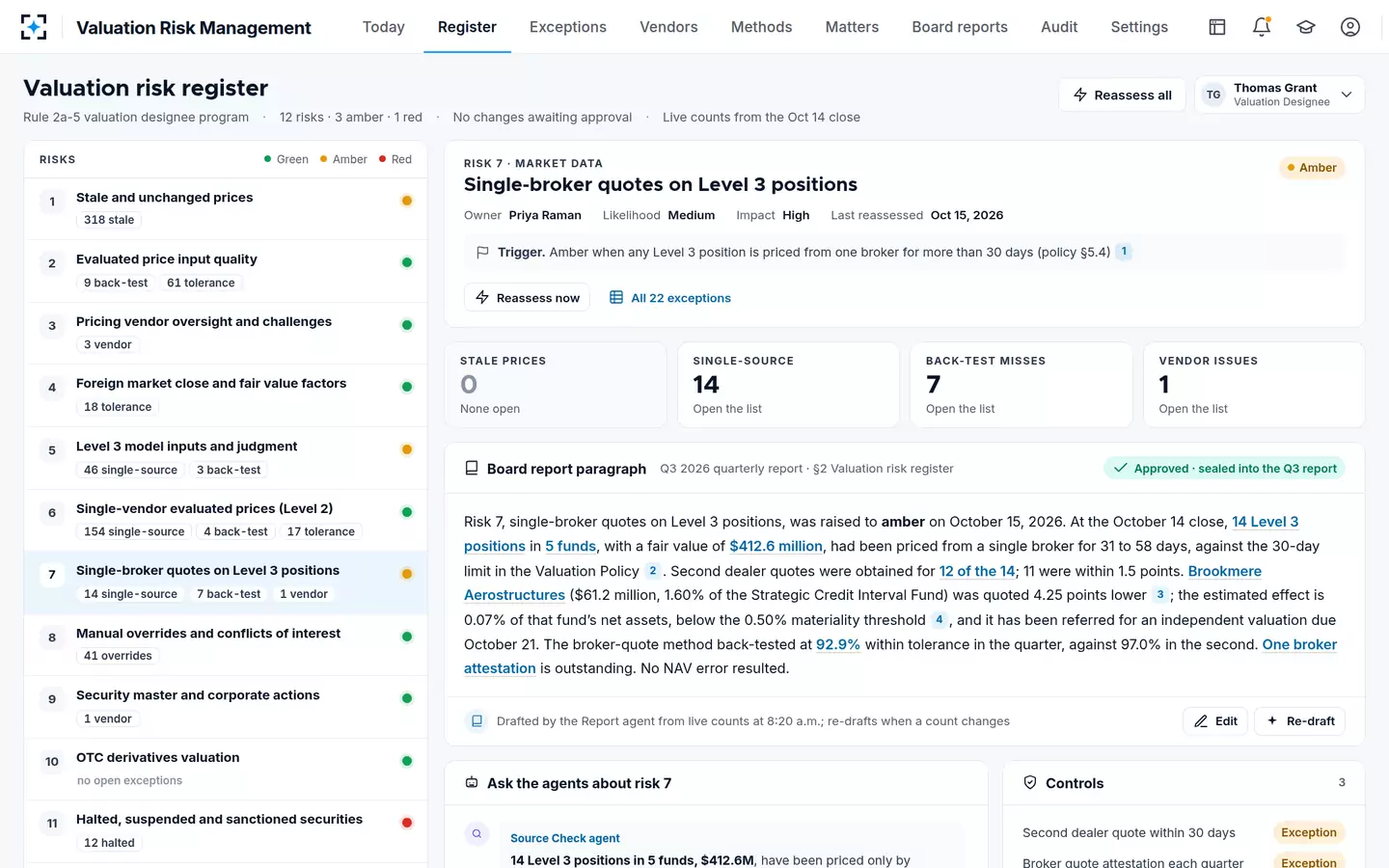
Three reporting clocks: quarterly, annual and five business days
Rule 2a-5 gives the designee three written reporting duties. At least quarterly, it reports any reports or materials the board has asked for and a summary of material fair value matters in the prior quarter: material changes in valuation risks and conflicts, material changes to or deviations from methods, and material changes or events in pricing service oversight. At least annually, it assesses “the adequacy and effectiveness” of its own process, including a summary of the methodology testing results and an assessment of whether enough resources are allocated. And whenever a material matter arises, it notifies the board within a period the board sets.
A material matter includes a significant deficiency or material weakness in how the designee’s process is designed or works, and material errors in calculating net asset value. The board picks the notice period, but it can be no longer than five business days from when the designee becomes aware of the matter. The release adds a second clock that many policies leave out: where the designee cannot yet tell whether a matter is material, it should not wait indefinitely, and after 20 business days of trying it should tell the board the evaluation is still open. The 2a-5 report, section by section shows how each clock turns into a page the board reads.
Three clocks on one designee: prompt, quarterly and annual
- Designee becomes aware (day 0)
- Board-set period, five business days at most≤ 5 business days
- Follow-on reports the board requiresfollow-on
- Designee evaluating20 business days
- Tell the board the evaluation is open≤ 5 more
- Quarterly report on material changeseach quarter
- Annual assessment, testing summary, resourceseach year
What Rule 2a-5 deliberately leaves to the fund
Read alongside the release, the rule is as interesting for what it declines to prescribe. Each of the choices below was asked for by commenters and refused, and each therefore becomes a decision the designee has to make, write down and defend.
Five things the SEC chose not to fix in Rule 2a-5, and who decides instead
| Question | What the SEC decided | So the designee must |
|---|---|---|
| How often to reassess valuation risks | No minimum frequency: different frequencies “may be appropriate for different funds or risks”. | Set a schedule and the events that force an early reassessment. |
| Which testing methods to use | Calibration and back-testing are “particularly useful” but not required; no minimum test frequency. | Name the tests and the minimum frequency for each method, then run them. |
| When to challenge a vendor price | A process for challenges, not pre-set criteria, after commenters warned of “rote or mechanical” challenges. | Describe the circumstances that start a challenge, and keep the log. |
| What a material NAV error is | Declined to set a threshold; relying on the industry’s $0.01 a share or 0.5% of NAV “would not be unreasonable”. | Adopt a written line and apply it consistently. |
| What the board reports must contain beyond the minimum | Dashboards, stale-price reports and trend data are examples, “not mandatory”. | Agree the format and content with the board, and document it. |
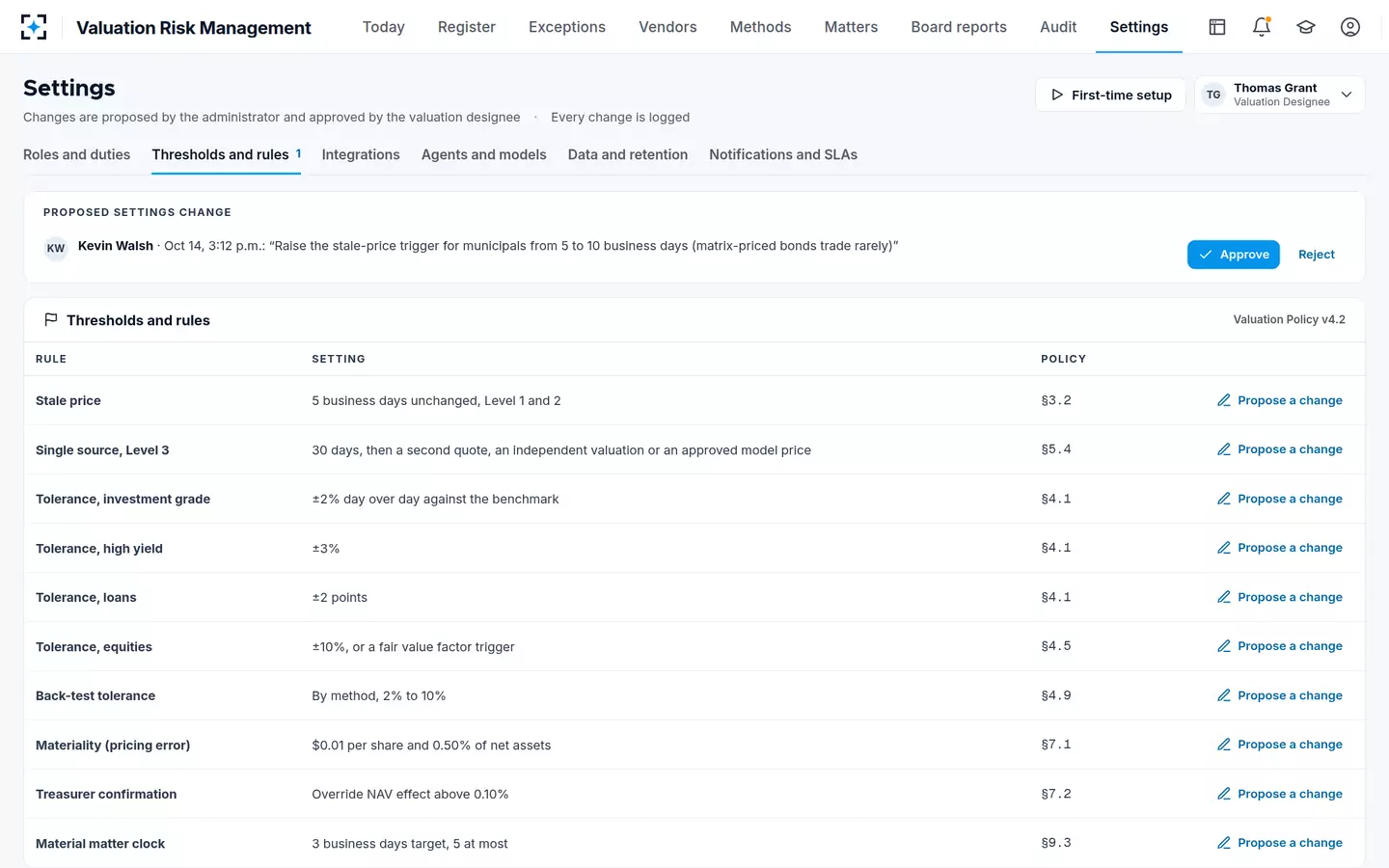
The pattern matters for anyone buying or building tooling. A rule that leaves thresholds, frequencies and formats to the fund cannot be met by software that ships with fixed ones. The settings have to be the fund’s own policy, each traceable to the section that set it, and a change to them has to be approved by the designee and visible to the board as a material change to methods or process.
Valuation Risk Management settings: thresholds from the fund’s own policy
Rule 31a-4: two six-year clocks, and what ‘appropriate documentation’ means
Rule 31a-4 holds the records. Every registered fund keeps appropriate documentation supporting each fair value determination for at least six years from the determination, the first two in an easily accessible place. Where the board has designated a valuation designee, the fund also keeps the reports and other information given to the board for six years after the end of the fiscal year in which they were provided, and the list of investments or investment types designated (17 CFR 270.31a-4). If the adviser is the designee, the adviser keeps them.
The two clocks run from different events, which is why a records schedule that says “six years” in one line is usually wrong for half the material. A determination made on October 14, 2026 is kept until at least October 14, 2032; a quarterly report given to the board in that fund’s fiscal year ending in 2026 is kept until the end of fiscal 2032.
The release also sets the standard. Documentation should be enough for a third party “not involved in the preparation” of the determinations, such as SEC staff, “to verify, but not fully recreate” them. For prices from pricing services, the fund does not have to keep the vendor’s internal inputs; it keeps its own due diligence and ongoing oversight records instead, including its challenge work, stale price analysis and testing. Level 3 positions typically need “different and more extensive documentation” than Level 2. Why the period is six years and not the five originally proposed: the SEC aligned it with Rule 31a-2’s retention of the schedules supporting each NAV computation.
What a valuation program costs, and what examiners ask to see
The SEC’s own paperwork estimates give a floor for the effort. In August 2026 the staff estimated that 10,047 funds each spend 34 hours a year on the paperwork Rule 2a-5 requires, a monetized time cost of $33,422 per fund, plus $3,632 of external cost (91 FR 55658, August 28, 2026); and 36 hours and $15,984 per fund for Rule 31a-4 records (91 FR 54768, August 24, 2026). Those figures cover reporting and recordkeeping only; the nightly checking, testing and vendor oversight are outside them, a gap the economics of Rule 2a-5 oversight works through.
The SEC’s own estimate of the paperwork under Rules 2a-5 and 31a-4
10,047
funds the SEC staff count as subject to the two rules (August 2026)
34hours
a year per fund for Rule 2a-5 reporting, valued at $33,422
36hours
a year per fund for Rule 31a-4 records, valued at $15,984
$3,632
external cost per fund per year under Rule 2a-5
Examiners make the abstract concrete. The Division of Examinations’ November 2024 risk alert lists what it typically requests from funds, including valuation information “detailed by asset class” from pricing services, quotation services and third-party valuation firms, and prices from a pricing service or valuation firm “that were overridden or stale” (SEC risk alert, November 4, 2024). The same alert reports deficiencies on topics including “valuation of portfolio assets”. And the Division’s fiscal 2027 priorities, published October 23, 2026, say it will keep watching funds that hold less liquid or illiquid investments, private credit among them, and how they value them (SEC, Fiscal Year 2027 Examination Priorities).
Can you show each Rule 2a-5 duty on demand? A ten-point self-test
- A dated valuation risk assessment that names conflicts of interest
Paragraph (a)(1) makes conflicts part of valuation risk; an assessment that never mentions the adviser’s incentives is incomplete.
- Methods by asset class with their key inputs and assumptions
The release says naming a model (“discounted cash flow”, “Black-Scholes”) without inputs and sources is not enough.
- A named testing method and minimum frequency for each methodology
Required by (a)(3), even for funds with few fair valued holdings: the SEC refused a de minimis exception.
- Back-test or calibration results, with misses investigated
The release expects the designee to investigate a method that consistently over- or under-values against transactions.
- Due diligence and an annual evaluation for each pricing service
The release lists qualifications, methods and inputs, challenge handling, conflicts and testing as factors to consider.
- A written process for starting price challenges, and the log
A process, not mechanical criteria; the log is the evidence it runs.
- Titles and functions of everyone in the fair value process
Including who may override a price, and how overrides are reviewed.
- Quarterly reports that cover the three required material-change topics
Risks and conflicts, methods, and pricing service oversight.
- An annual assessment with a testing summary and a resources assessment
Both are minimum contents under (b)(1)(i)(B).
- A material-matter log with awareness dates and notice dates
The five-business-day limit is counted from awareness; the log proves it was met.
Valuation Risk Management is built around those ten items: a register tied to live exceptions, methods back-tested every night, vendor reviews drafted from the fund’s own challenge record, a material-matter clock counted in business days and board reports drafted from the counts, with the designee approving every change. The rule remains the designee’s; the solution keeps the evidence. To see it on the sample complex, start at Valuation Risk Management.
Questions people ask
What is SEC Rule 2a-5 in one sentence?
Rule 2a-5 under the Investment Company Act defines determining fair value in good faith as four functions (assessing and managing valuation risks, establishing and applying methods, testing them, and overseeing pricing services), and lets a fund’s board designate the adviser to perform them under board oversight. It took effect on March 8, 2021, with compliance required from September 8, 2022.
Does the board still determine fair values under Rule 2a-5?
It can, for any or all investments, by performing the four functions itself. More often it designates the adviser as valuation designee and oversees it through the quarterly, annual and prompt reports the rule requires, and it can ask for any additional reports it needs.
Does Rule 2a-5 require back-testing?
No particular test is required. The rule requires testing for appropriateness and accuracy and requires the fund to name its testing methods and their minimum frequency; the adopting release calls calibration and back-testing “particularly useful” and expects them to be used “in many circumstances”, while allowing other appropriate methods.
Can a sub-adviser be the valuation designee?
No. The rule defines the valuation designee as the investment adviser “other than a sub-adviser”, or an officer of an internally managed fund. A sub-adviser can still supply inputs and analysis to the designee’s process.
Does Rule 2a-5 apply to private funds?
No. It applies to registered investment companies and business development companies, with a separate paragraph for unit investment trusts. Private fund advisers are not bound by it, though many use its four functions as a benchmark for their own valuation policies.
Are evaluated prices from a pricing service ‘readily available market quotations’?
No. The adopting release states that evaluated prices are not readily available market quotations because they are not unadjusted quoted prices from active markets for identical investments. A security priced from an evaluated price is therefore fair valued under the Act, and the pricing service must be overseen under paragraph (a)(4).