Valuation risk is the risk that the value a fund puts on an investment is wrong, whether because the inputs are poor, the method does not fit, a pricing service or broker cannot be relied on, a market event has made a price unreliable, or someone with an interest in a higher number has influenced it. For registered funds, SEC Rule 2a-5 makes it the first of four duties: periodically assess the material “valuation risks”, “including material conflicts of interest”, and manage them. Most fund complexes hold the result in a register reviewed once a year and never connected to the daily price exceptions that show whether each risk is getting worse. Botminds’ Valuation Risk Management builds the register for the valuation designee from those exceptions, so each risk carries live evidence.
The examples come from a fictional sample complex, Quillfield Capital, valuation designee for 90 funds, as its register stood on the morning of October 15, 2026.
From the SEC’s six sources of valuation risk to a register that counts its own evidence
Source of valuation risk (SEC)The types and characteristics of the investments held
In the SEC’s wordsIncluding size relative to daily trading volume.
Register risks (sample)5 · Level 3 model inputs and judgement; 10 · OTC derivatives valuation
Evidence that moves themPositions by level and asset class; size against volume
Source of valuation risk (SEC)Market or sector shocks, and disruptions to the ability to operate
In the SEC’s wordsIndicators include volatility, liquidity, trading volume and “a sudden increase in trading suspensions”; also “a system failure or cyberattack”.
Register risks (sample)4 · Foreign market close and fair value factors; 11 · Halted, suspended and sanctioned; 12 · Pricing system and data feed outages
Evidence that moves themHalt and suspension counts; late or missing price files
Source of valuation risk (SEC)How far each method relies on unobservable inputs
In the SEC’s words“particularly if such inputs are provided by the valuation designee”.
Register risks (sample)5 · Level 3 model inputs; 7 · Single-broker quotes on Level 3
Evidence that moves themSingle-source days; inputs the adviser supplied
Source of valuation risk (SEC)The share of the fund that is fair valued, and its contribution to returns
In the SEC’s wordsA fund-level measure, not a security-level one.
Register risks (sample)Carried on every risk as fund exposure
Evidence that moves themLevel 3 and fair valued share of net assets, by fund
Source of valuation risk (SEC)Reliance on service providers, and their own providers
In the SEC’s wordsLimited expertise, inputs from third parties and “so-called ‘fourth-party’ risks”.
Register risks (sample)2 · Evaluated price input quality; 3 · Vendor oversight and challenges; 6 · Single-vendor evaluated prices; 9 · Security master and corporate actions
Evidence that moves themChallenge log, vendor issues, back-tests by vendor
Source of valuation risk (SEC)Methods that are inappropriate or wrongly applied
In the SEC’s wordsThe risk that methods are inappropriate “or that such methods are not being applied consistently or correctly”.
Register risks (sample)1 · Stale and unchanged prices; back-test misses feeding 2, 5, 6 and 7
Evidence that moves themStale counts; back-test misses with reasons
Source of valuation risk (SEC)Material conflicts of interest (in the rule text itself)
In the SEC’s wordsRule 2a-5(a)(1) names conflicts as part of valuation risk.
Register risks (sample)8 · Manual overrides and conflicts of interest
Evidence that moves themEvery override, who proposed it, who approved it
What is valuation risk? The SEC’s definition, and the part most teams miss
The SEC never defines valuation risk in one sentence; it defines it by what the designee must do about it. Rule 2a-5(a)(1) requires “periodically assessing any material risks associated with the determination of the fair value of fund investments (‘valuation risks’), including material conflicts of interest, and managing those identified valuation risks” (17 CFR 270.2a-5). A footnote in the adopting release widens it: valuation risk “includes the risks associated with the process of determining whether an investment must be fair valued in the first place” (86 FR 748).
That second sentence is the part most registers miss. Teams list model risk on Level 3 loans, vendor risk and key-person risk, all of which concern how a fair value is computed. Fewer list the risk that a security is still being priced from a quotation that stopped being reliable: a bond whose evaluated price has not moved in three weeks, a foreign share after a large US move, a stock halted at lunchtime. Those are the cases where nobody makes a fair value judgement at all, because nobody noticed one was needed.
For a fund the stakes are concrete. The release opens by noting that improper valuation “can cause investors to pay fees that are too high or to base their investment decisions on inaccurate information”, and every purchase and redemption at a wrong NAV moves value between shareholders. The people exposed to valuation risk are the ones who trade at the NAV, which is why the board, not the adviser, owns the oversight.
What are valuation risks under Rule 2a-5? The SEC’s six sources
The adopting release gives a list, explicitly “non-exhaustive”, of sources and types of valuation risk, broadened from the proposal after comments. It is the best starting point for a register because it is the list an examiner has read. In order: the types of investments held or intended and their characteristics; market or sector shocks and other disruptions that may affect the designee’s or a third party’s ability to operate; the extent to which each method uses unobservable inputs, “particularly if such inputs are provided by the valuation designee”; the proportion of the fund that is fair valued and its contribution to returns; reliance on service providers with more limited expertise, on third-party inputs and on the providers’ own providers; and the risk that methods are inappropriate or not applied consistently or correctly.
The footnotes add the detail that turns the list into measurable indicators. Investment characteristics include “the size of the investment relative to measures of market demand, such as daily trading volume”. Indicators of a shock “could include a significant change in short-term volatility or market liquidity, significant changes in trading volume, or a sudden increase in trading suspensions”. Each of those can be counted from data a fund already has.
The SEC also gave designees room. The rule lets them decide which sources apply to their funds, add others, and weigh some “more heavily than others”. A money market fund and a closed-end private credit fund should not have the same register, and a register copied from a template rather than built from the fund’s holdings is the first thing a reviewer will notice.
Conflicts of interest are valuation risks, starting with the adviser’s own
Rule 2a-5 puts conflicts inside the definition, and the adopting release names several. Portfolio managers are the obvious one: the rule requires the designee to segregate fair value determinations from portfolio management so that a portfolio manager cannot set a fair value directly or by leaning on the people who do. Pricing services are a less obvious one: a commenter argued that a vendor serving many advisers has no reason to favour any of them, and the SEC disagreed. And the adviser itself is paid on assets, so its incentive runs in one direction.
“We believe, however, that the conflict is not necessarily one of responding to pressure from a particular investment adviser, but, rather, a pricing service might generally provide higher or more aggressive valuations to retain business.”
SEC, Good Faith Determinations of Fair Value, 86 FR 748 (January 6, 2021)
Infinity Q is the case that shows why the conflict belongs on the register and not in a policy footnote. The SEC charged the firm’s founder in February 2022 with overvaluing fund assets “by more than $1 billion”, alleging he manipulated the models and inputs of a third-party pricing service the funds relied on (SEC press release 2022-29). In a separate case, the SEC charged the firm’s former chief risk officer, who was also its chief compliance officer and a valuation committee member, with negligently telling investors and representatives of the fund’s board that the pricing service was “independent” when, as alleged, the founder controlled it; he settled and a final judgment followed in April 2024, with a $100,000 civil penalty and a two-year officer-and-director bar (LR-25542; LR-25977). The founder pleaded guilty to securities fraud in November 2022 and was sentenced in April 2023 to 15 years in prison, as the SEC’s later order against the fund’s auditor records (SEC order, In re EisnerAmper LLP, March 6, 2026).
That auditor’s order adds the detail a register owner should read twice. The adviser had represented that the pricing service “modeled and priced the derivatives independently, without any input from Infinity Q”. And in testing values against later sales, the audit team “inappropriately relied” on the founder himself to provide the service’s price at the date of sale. The firm settled without admitting or denying the findings. The lesson for a register is that “reliance on a pricing service” is not one risk but two: whether the service is good, and whether anyone inside the adviser can touch its inputs.
How often should valuation risks be reassessed? On events, not only on a date
Rule 2a-5 sets no frequency. Commenters asked for an annual minimum, and the SEC declined, writing that “different frequencies for the re-assessment of valuation risks may be appropriate for different funds or risks”. What it did say is what a reassessment should respond to: “changes in fund investments, significant changes in a fund’s investment strategy or policies, market events, and other relevant factors”.
An annual review satisfies the letter of a policy that says annual, but it misses the point of the rule. The quarterly report to the board must cover material changes in how valuation risks are assessed and managed (the 2a-5 report, annotated), and a register that only moves once a year cannot report a change in the quarter it happened. A register with written triggers can. In the sample complex, risk 7, single-broker quotes on Level 3 positions, carries the trigger “amber when any Level 3 position is priced from one broker for more than 30 days”, set in section 5.4 of the valuation policy. On October 8 nine positions were over 30 days; by the October 14 close fourteen were, $412.6 million across five funds, and the senior pricing analyst proposed raising the risk to amber.
Eight events that should reopen a valuation risk between scheduled reviews
- A new asset type or strategy in any fund
The SEC expects reassessment to take account of investments the fund “reasonably expects to purchase in the reasonably near term”.
- A written trigger crossed
For example a count of single-source Level 3 positions, or stale prices above a set number.
- A back-test pass rate falling for a method
A method drifting from its later sale prices is the risk “methods are not being applied consistently or correctly” turning real.
- A jump in trading suspensions or halts
One of the SEC’s own indicators of a market or sector shock.
- A pricing service issue
A controls report exception, a model change, late files, or a pattern of successful challenges.
- A change in who supplies unobservable inputs
Inputs that start coming from the adviser rather than an independent source are a conflict as well as a model risk.
- A material matter or NAV error
A matter reported to the board is evidence the register understated a risk.
- A rise in the share of a fund at Level 3
The proportion fair valued is one of the SEC’s six sources.
A valuation risk register that counts its own evidence
A useful register is a short list of risks, each with an owner, a likelihood and impact, a written trigger, and a live count of the exceptions that are evidence of it. The point of the counts is not decoration. When every stale price, tolerance break, single-source position, back-test miss, vendor issue, override and halt is linked to exactly one register risk, the register answers the question the board actually asks, which is what changed and why, and the annual reassessment becomes a review of a year of evidence instead of a meeting about impressions.
Every open exception, linked to one register risk: the sample complex’s 711
Two things stand out in the sample. The biggest count is not the biggest risk: 318 stale prices sit under risk 1 (120 corporate bonds, 88 municipal bonds and 110 foreign equities), and the matrix-priced municipals back-tested at 98.5%, which the draft board report reads as quiet bonds rather than wrong prices. The 22 exceptions under risk 7 are fewer and worse, because they are concentrated, Level 3 and getting older. A register that ranked risks by exception count would point the designee at the wrong one.
Valuation Risk Management: the register with live counts behind each risk
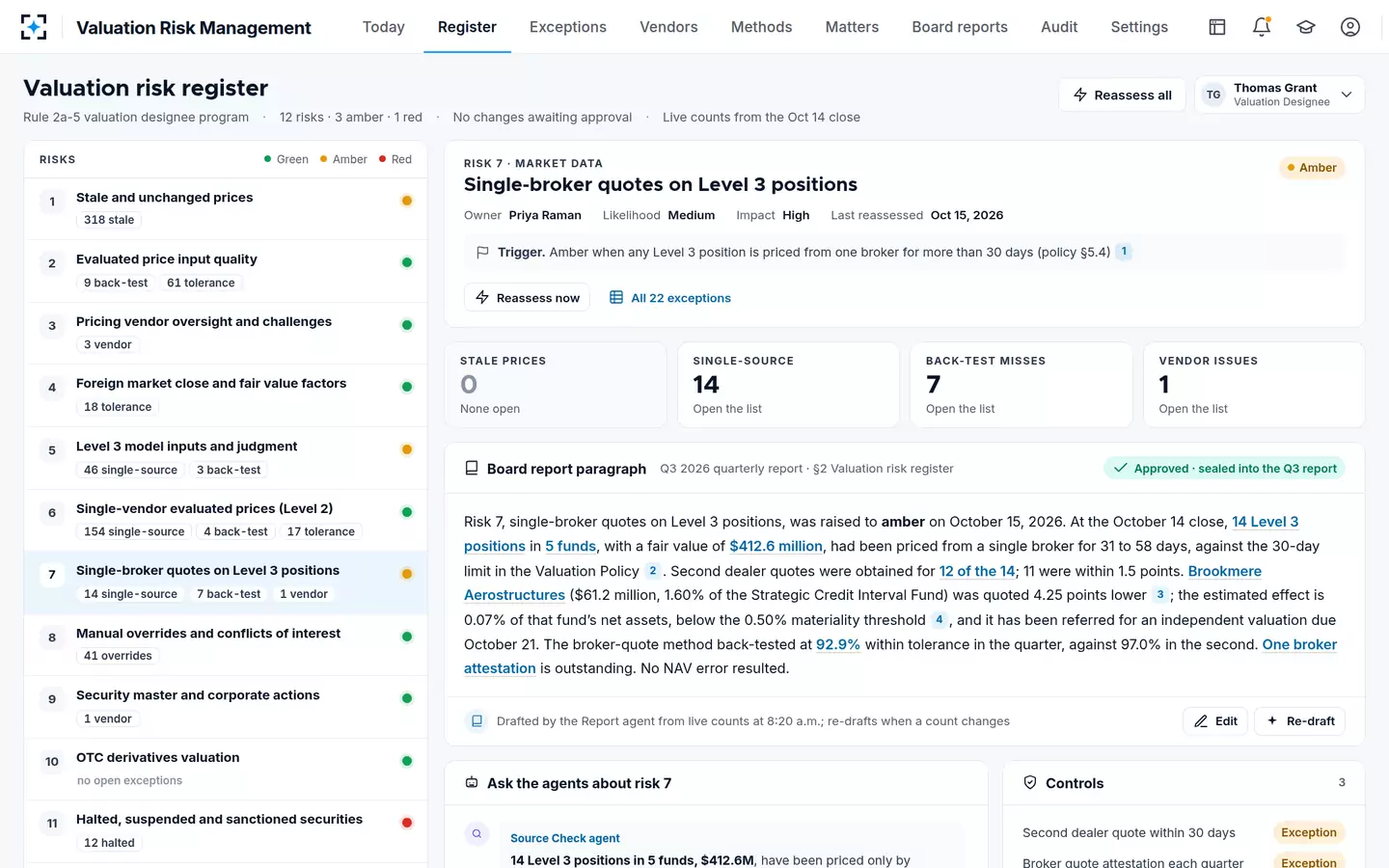
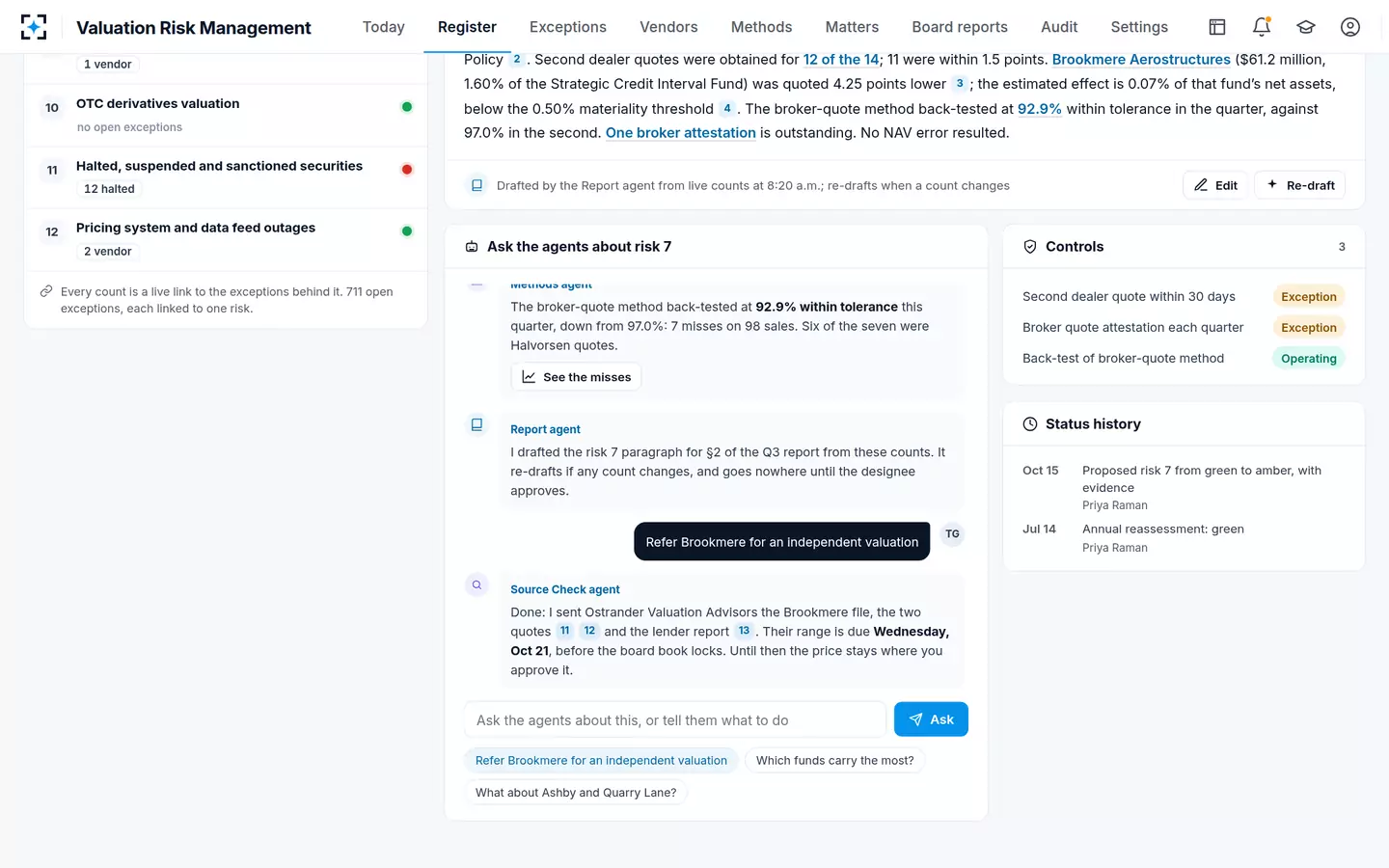
The status change itself follows the rule’s structure. The senior pricing analyst proposed amber at 8:41 a.m. with the evidence: fourteen positions, the dates, the broker, and the method’s back-test falling from 97.0% to 92.9% in the quarter. The valuation designee asked the agents why, referred the largest position for an independent valuation and approved the change with a reason code. The paragraph for the quarterly board report re-drafted itself from the counts and was sealed into the report once approved. Nobody approved their own proposal.
Asking why a valuation risk moved, under the risk itself
How do you measure valuation risk? Five indicators a register should track
Valuation risk is measured through indicators, not a single number. The five below come straight from the SEC’s list and can be computed nightly from the price file, the positions and the fund’s own logs. Each needs a trigger level written in the valuation policy, because the rule leaves the level to the fund.
First, the share of each fund’s net assets at Level 3 and fair valued, the SEC’s “proportion” source. Second, single-source days: how long each position has been priced from one broker or one vendor. Third, back-test pass rates by method, the most direct evidence that a method is or is not working. Fourth, overrides and successful challenges by source, because a pattern of either says something about the source or about the people overriding it. Fifth, stale counts by asset class, because a price that has stopped moving is the commonest sign a quotation is no longer active; what counts as stale, by asset class is a separate guide.
The public data say the first indicator is worth watching across the industry. The SEC staff’s statistics from Form N-PORT show US equity mutual funds’ Level 3 holdings rising from $31 billion in April 2025 to $65 billion by February and March 2026, and taxable bond funds’ from $36 billion to $52 billion (SEC Division of Investment Management, Registered Fund Statistics, period ending March 2026). Net assets of US equity mutual funds with 5% or more of their assets at Level 3 went from $73 billion in April 2025 to $570 billion in February 2026, the latest month the staff published that figure.
More of the fund industry sits at Level 3 than a year earlier
$31B → $65B
Level 3 holdings of US equity mutual funds, April 2025 to March 2026
$36B → $52B
Level 3 holdings of taxable bond mutual funds, same period
$73B → $570B
net assets of US equity mutual funds with 5% or more at Level 3, April 2025 to February 2026
What supervisors found when they looked at valuation risk
Supervisors outside the US have looked at the same risks and found the same weak points. ESMA’s 2023 common supervisory action on asset valuation, run across EU national regulators, found valuation policies that “do not distinguish between normal and stressed market conditions”, cases of “the lack of independence of the valuation function, particularly from the portfolio management”, and smaller managers that “appeared to over-rely on third-party data providers for the pricing of less liquid assets, without performing the appropriate checks, controls and back testing” (ESMA, Final report on the 2022 CSA on valuation, May 2023).
Each finding is a register row with a missing trigger. A policy that does not distinguish stressed markets has no indicator for the SEC’s “shocks or dislocations” source. A valuation function that reports to portfolio management has an unmanaged conflict. Over-reliance on data providers without back-testing is the service-provider source with no evidence feeding it. The fix in each case is the same: name the risk, name the indicator, set the trigger, and link the exceptions. How the register then appears in the quarterly 2a-5 report is covered separately, and the Level 3 hierarchy from a private lender’s side sets out why those positions carry most of the risk.
Where Valuation Risk Management fits, and where the designee still decides
Valuation Risk Management does the counting and the linking. Each night the Price Monitor agent checks every price and links each exception to its register risk; the Source Check agent chases second quotes for single-source positions; the Methods agent back-tests each method; the Vendor Review agent folds the fund’s own challenge record into each vendor’s annual review. When a trigger is met, the risk’s owner sees the evidence and proposes a change.
The register itself stays the designee’s. The agents never change a risk status, a trigger or a method; the analyst proposes, the designee approves with a reason code, and each change is kept on an append-only trail for six years. That is the line Rule 2a-5 draws, and it is the line the solution keeps. To see the register on the sample complex, start at Valuation Risk Management.
Questions people ask
What is valuation risk management?
It is how a fund’s valuation designee identifies, measures and controls the risks that holdings are valued wrongly, and reports them to the board. Under Rule 2a-5 it is the first of four fair value duties, and it explicitly includes material conflicts of interest.
What is a valuation risk register?
It is the designee’s list of material valuation risks, each with an owner, a rating, a trigger and the evidence behind it. Rule 2a-5 does not require a register by name, but the quarterly board report must cover material changes in the assessment and management of valuation risks, which is hard to do without one.
Is valuation risk the same as model risk?
No. Model risk is one part of it, covering methods that use unobservable inputs. Valuation risk also covers vendors, stale and unreliable quotations, market disruptions, the share of a fund that is fair valued and conflicts of interest, all named by the SEC in the Rule 2a-5 adopting release.
Who owns valuation risk in a fund complex?
The board owns oversight, and the valuation designee, usually the adviser, performs the assessment and management under Rule 2a-5. Individual risks normally have named owners in the pricing team, but the designee approves changes and reports material ones to the board each quarter.
Does valuation risk apply to Level 2 prices from a vendor?
Yes. Evaluated prices are fair values under the Act, so reliance on a pricing service is itself a valuation risk; the SEC lists reliance on service providers and the providers’ own providers among its sources. A Level 2 price that has stopped moving can be as risky as a Level 3 model.