A 2a-5 report is the written report a fund’s valuation designee gives the board under SEC Rule 2a-5(b)(1). Quarterly, it must include anything the board has asked for and a summary of material fair value matters in the prior quarter, covering material changes in valuation risks and conflicts, in fair value methods, and in the oversight of pricing services. Annually, it must assess the adequacy and effectiveness of the designee’s whole fair value process, with a summary of methodology testing and an assessment of resources. Material matters cannot wait for either: the board must be told within a period it sets, never more than five business days. The report is hard because its numbers come from every corner of the pricing operation, which is why, assembled by hand, it takes weeks. Botminds’ Valuation Risk Management drafts it from live counts for the treasurer to review and the designee to sign.
The annotated report below is the fictional sample complex Quillfield Capital’s third-quarter 2026 report for its Audit and Valuation Committee meeting on October 29, as drafted in the solution.
The quarterly 2a-5 report, section by section: the rule paragraph each answers, and its evidence
1
Report sectionMaterial fair value matters in the quarter
Rule paragraph it answers(b)(1)(i)(A)(2): summary of material fair value matters in the prior quarter
Evidence behind itThe material-matter log: three matters this year, each with awareness and notice dates
2
Report sectionValuation risk register
Rule paragraph it answers(A)(2)(i): material changes in assessing and managing valuation risks, including conflicts
Evidence behind itStatus changes with reason codes; risk 7 raised to amber on October 15
3
Report sectionPricing services oversight
Rule paragraph it answers(A)(2)(iii): material changes to selecting and overseeing pricing services, and material events
Evidence behind itVendor reviews, controls-report exceptions, the challenge record
4
Report sectionTesting of fair value methods
Rule paragraph it answersRequired annually under (B)(1); quarterly only if the board asks
Evidence behind itBack-test pass rates by method, misses explained
5
Report sectionFair valued securities and overrides
Rule paragraph it answers(A)(2)(ii): material deviations from methods; a pattern of overrides may be material
Evidence behind itOverride log with proposer, approver and reason
6
Report sectionHalted and suspended securities
Rule paragraph it answersBoard-requested material under (A)(1), or a material matter
Evidence behind itEach halted position, its discount and its daily review
7
Report sectionChanges to methods and the valuation policy
Rule paragraph it answers(A)(2)(ii): material changes to methodologies
Evidence behind itApproved method and threshold changes, with the evidence that prompted them
8
Report sectionMaterials the board requested
Rule paragraph it answers(A)(1): any reports or materials the board requested
Evidence behind itWhatever the board asked for at the last meeting, answered
What must the valuation designee report quarterly? Three topics, all about change
The quarterly report has two required parts. The first is “any reports or materials requested by the board related to the fair value of designated investments or the valuation designee’s process for fair valuing fund investments”. The second is a summary or description of “material fair value matters that occurred in the prior quarter”, which must include material changes in the assessment and management of valuation risks, including conflicts of interest of the designee and any other service provider; material changes to, or material deviations from, the fair value methods; and material changes to the process for selecting and overseeing pricing services, together with material events in that oversight (17 CFR 270.2a-5(b)(1)(i)(A)).
Every required item is a change or an event. The SEC chose that deliberately. The proposal would have required a quarterly assessment of the whole process, including testing results and the adequacy of resources; commenters said much of it would not change from quarter to quarter, and the SEC moved those items to the annual report because it agreed that the reporting “could become rote if it does not change” (SEC, 86 FR 748). A quarterly report that repeats last quarter’s policy summary misses the point. One that opens with what moved, why and what the designee did about it is the report the rule describes.
The release also removed two things the proposal would have required every quarter: reporting of each change of service provider, and of individual price overrides. It did not remove them from the designee’s attention: the SEC wrote that “a pattern of price challenges or overrides over time that raise concerns with the overall valuation process may be material”, which is why the sample report keeps a section on overrides and reports their pattern, not each one.
What goes in the annual 2a-5 report? An assessment, not a summary
At least annually the designee must give the board “an assessment of the adequacy and effectiveness of the valuation designee’s process for determining the fair value of the designated portfolio of investments”. At a minimum it includes a summary of the results of methodology testing, and an assessment of whether the resources allocated to fair value are adequate, including material changes to the roles or functions of the people responsible (Rule 2a-5(b)(1)(i)(B)).
The word that matters is assessment. A year’s testing results summarised by method, with each method’s pass rate against its tolerance and the misses explained, is the evidence for the effectiveness half. The resources half is easy to write vaguely and hard to write well: it should say how many people do what, what changed in the year, whether the team kept up with the volume of exceptions and challenges, and whether any function depends on one person. In the release the SEC also suggested the annual review is the place to consider “the adequacy and effectiveness of the pricing services used”.
Quarterly or annual? Where each Rule 2a-5 reporting item belongs
| Item | Quarterly report | Annual report |
|---|---|---|
| Materials the board requested | Required | As requested |
| Material changes in valuation risks and conflicts | Required | Covered by the overall assessment |
| Material changes to or deviations from methods | Required | Covered by the overall assessment |
| Material changes and events in pricing service oversight | Required | Adequacy of pricing services, per the SEC’s guidance |
| Summary of methodology testing results | Only if the board asks | Required |
| Adequacy of resources and changes in roles | Only if the board asks | Required |
| Assessment of adequacy and effectiveness of the process | Not required | Required |
What is a material matter under Rule 2a-5? Three examples from one year
A material matter is anything that materially affects the fair value of the designated investments. The rule names two examples, “a significant deficiency or material weakness in the design or effectiveness” of the designee’s fair value process, and material errors in calculating net asset value. The release adds more: a change to a pricing service affiliated with the designee, and material changes to or deviations from methods, “including changes to critical inputs or assumptions”. The SEC declined to set a NAV error threshold, but said relying on the industry’s line of $0.01 a share or 0.5% of NAV “would not be unreasonable”.
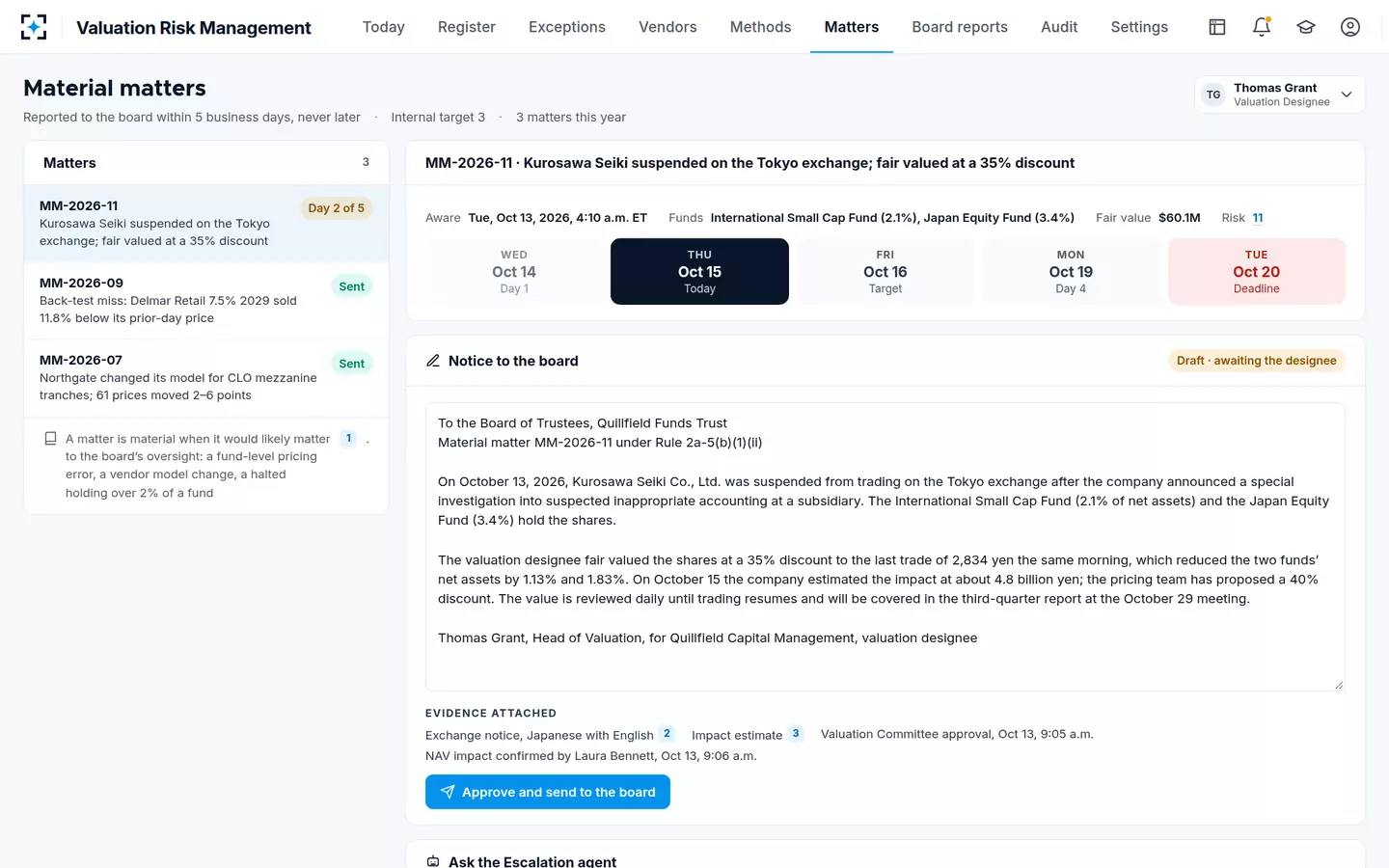
The sample complex reported three material matters in 2026, and they show the range. In MM-2026-07 a pricing vendor changed its model for CLO mezzanine tranches and 61 prices moved by 2 to 6 points. In MM-2026-09 a back-test miss came in large enough to report: a retail bond sold 11.8% below its prior-day price. And MM-2026-11 is the Tokyo suspension of Kurosawa Seiki, fair valued at a 35% discount in two funds where it was 2.1% and 3.4% of net assets. The sample policy defines a material matter as one that would likely matter to the board’s oversight, giving as examples a fund-level pricing error, a vendor model change and a halted holding over 2% of a fund.
How long does the designee have to decide whether a matter is material?
The rule counts five business days from when the designee “becomes aware” of the material matter, inside any shorter period the board sets. The release explains how that interacts with the time it takes to decide materiality. Where materiality is immediately apparent, the notice goes within five business days. Where it is not, the designee should act promptly to decide. The release continues: “If, after 20 business days of becoming aware of the relevant valuation matter, the designee has not been able to determine the matter’s materiality”, the SEC expects it to notify the board that the evaluation is ongoing, within the five-day window that follows. The SEC added that the designee should not “take the 20 business days as a matter of course”.
Two clocks on a material matter: deciding materiality, then telling the board
- Aware (day 0)
- Notify the board≤ 5 business days
- Aware (day 0)
- Evaluate promptly, up to 20 business daysevaluate ≤ 20
- Tell the board the evaluation is open≤ 5
Two practical points follow. The awareness date must be recorded, because it starts the clock and an examiner will ask for it. And a matter can come from outside: the release says the designee must promptly notify the board of material matters it identified itself “or that the valuation designee has been notified of by an independent third party, including the fund’s auditor”. A notice from an auditor about a control weakness starts the same clock as an internal discovery.
Valuation Risk Management: a material matter on day 2 of 5, notice drafted
What format can a 2a-5 board report take? Whatever the board finds useful
The rule fixes the content, not the form. The release is explicit that the specific content of periodic and prompt reports beyond the minimum “is left to the board and valuation designees”, and lists the forms the SEC had in mind.
“These reports can take the form of narrative summaries, graphical representations, statistical analyses, dashboards, or exceptions-based reporting, among other methods.”
SEC, Good Faith Determinations of Fair Value, 86 FR 748 (January 6, 2021)
The proposal had offered a list of data-driven items a board might want, including reports on holdings whose prices moved outside set ranges, “reports regarding stale prices”, and trends in the number of fair valued holdings. Commenters feared boards and advisers would treat the list as mandatory; the SEC kept it as examples and said boards should request the “trend dashboards and other analytical tools” they need. The practical lesson is to agree the format with the board in writing, and to keep it stable enough that quarter-on-quarter changes are visible. Stale price reporting is a good example of a data item many boards choose to see.
Section 2 annotated: one register paragraph and where each number comes from
The register section is where a quarterly report most often turns into narrative. The sample report’s paragraph on risk 7 shows the alternative: every claim is a count with a link. “Risk 7, single-broker quotes on Level 3 positions, was raised to amber on October 15, 2026. At the October 14 close, 14 Level 3 positions in 5 funds, with a fair value of $412.6 million, had been priced from a single broker for 31 to 58 days, against the 30-day limit in the Valuation Policy.” The next sentences give the second quotes obtained (12 of the 14, 11 within 1.5 points), the largest position and its estimated effect on its fund (0.07% of net assets, below the policy’s 0.50% materiality threshold), the independent valuation requested, and the method’s back-test pass rate falling from 97.0% to 92.9%.
The Q3 2a-5 report in Valuation Risk Management, drafted from live counts
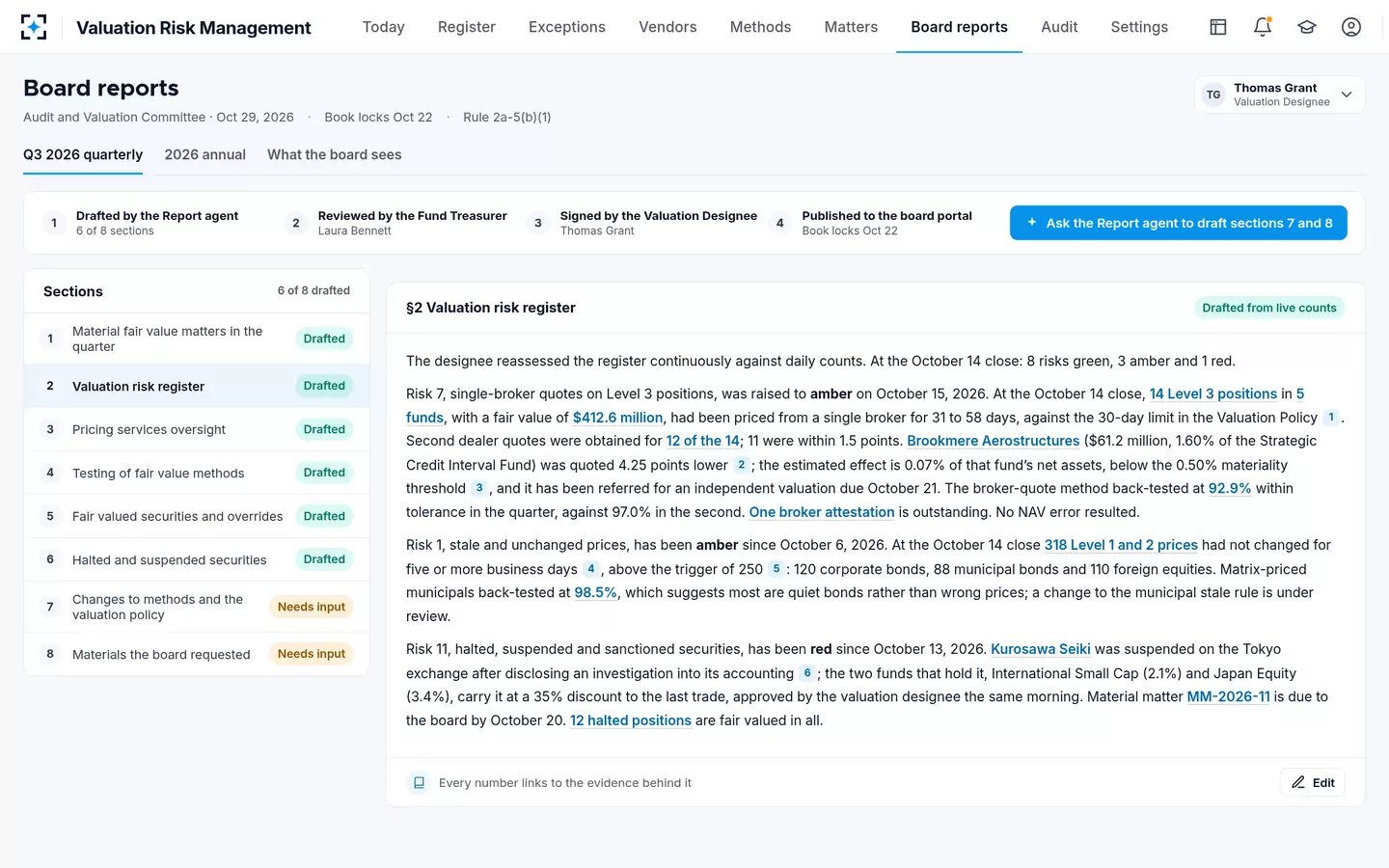
The sign-off order matters as much as the content. The Report agent drafts and re-drafts when counts change; the fund treasurer reviews; the valuation designee signs; only then does the report go to the board portal. That keeps the designee’s name on a document it has read, and keeps the agent out of any communication with the board.
Keeping the reports: six years after the fiscal year, and what examiners ask
Rule 31a-4 requires the fund, or the adviser when it is the designee, to keep copies of the reports and other information given to the board under Rule 2a-5(b)(1) for at least six years after the end of the fiscal year in which the board received them, the first two within easy reach (17 CFR 270.31a-4(b); the full record set an examiner asks for). That clock differs from the one for determinations themselves, which runs six years from each determination.
Examiners ask for the board side too. The SEC’s November 2024 risk alert lists “minutes and materials from meetings of the board, the independent directors/trustees of the board, and board committees” among typical requests to registered funds (SEC risk alert, November 4, 2024). A report whose numbers can be traced to the underlying exceptions and tests is easier to defend than one whose numbers were typed in. The full exam file for valuation is a separate guide, and the committee’s own charter is covered in valuation committee terms of reference.
Before the designee signs: seven checks on a quarterly 2a-5 report
- Every required topic is present, even if the answer is “no material change”
Risks and conflicts, methods, pricing service oversight: (b)(1)(i)(A)(2)(i)–(iii).
- Each material matter of the quarter is listed with awareness and notice dates
The dates prove the five-business-day limit was met.
- Changes are explained, not just listed
The release suggests summarising the market conditions or circumstances that led to a method change.
- New conflicts of interest are flagged with enough detail to evaluate
The release expects the board to seek more information on a new material conflict.
- Patterns in overrides and challenges are shown
A pattern “may be material” even where single overrides are not reported.
- Every figure ties to the underlying evidence
Counts, values and pass rates trace to positions and tests the designee can produce.
- The treasurer has reviewed and the designee signs last
The board receives only signed material.
Drafting the 2a-5 report from evidence, not from memory
The quarterly report takes weeks when it is assembled from exception spreadsheets, challenge logs, back-test workbooks and the register, each in its own place. Valuation Risk Management keeps them in one place for the designee: every exception is linked to a register risk, every test to its method, every challenge to its vendor, every matter to its clock. The Report agent drafts each section from those counts and redrafts when a count changes; the design target is a draft in two days instead of two to three weeks. It never sends anything to the board. To see the sample report, start at Valuation Risk Management.
Questions people ask
What are the Rule 2a-5 board reporting requirements, in short?
The valuation designee reports in writing at least quarterly on board-requested materials and material changes in risks, methods and pricing service oversight; at least annually on the adequacy and effectiveness of its process, with testing results and resources; and promptly on material matters, within a board-set period of no more than five business days.
Can the board shorten the five-business-day notice period?
Yes. The rule says the notice period is determined by the board and cannot exceed five business days, and the adopting release confirms boards may require faster notification. Many policies, like the sample one, also set an internal target shorter than the limit.
Does the quarterly report have to include every price override?
No. The SEC removed the proposed requirement to report price overrides individually. It said, however, that a pattern of price challenges or overrides that raises concerns about the valuation process may be material and should be reported.
Can the 2a-5 report go to a committee instead of the full board?
Yes. Rule 2a-5 defines the board as the full board or a designated committee composed of a majority of directors who are not interested persons of the fund, and the release confirms reports may go to that committee.
Does the annual 2a-5 report replace the compliance officer’s annual report?
No. Rule 38a-1 separately requires the chief compliance officer to report to the board at least annually on the operation of the fund’s policies and procedures, including any material compliance matters. The designee’s Rule 2a-5 annual assessment covers the fair value process; the two can draw on the same evidence but are different reports.
Who writes the 2a-5 report?
The valuation designee is responsible for it, usually through its head of valuation and pricing team, often with the fund treasurer reviewing. The rule does not say who drafts it, but the designee signs and remains accountable for its contents.