Fair value pricing is the valuation of a fund holding at the price it would fetch in an orderly sale at the moment the fund prices its shares, used whenever a reliable market quotation is not available at that moment. For a US mutual fund the moment is usually 4 p.m. Eastern, when it strikes its net asset value; a Japanese share last traded at the Tokyo close about thirteen and a half hours earlier, and a London share about four and a half hours earlier. If markets move in between, yesterday’s closing price is no longer the value, and under SEC Rule 2a-5 the fund must fair value it. The work is hard because it is daily, judgement-laden and easy to leave on autopilot; Botminds’ Valuation Risk Management checks every such price each night and keeps the evidence for the valuation designee.
The worked examples come from a fictional sample fund complex, Quillfield Capital, as it runs through the solution after the October 14, 2026 close. Timings use New York daylight time, which applied on that date.
Fair value pricing exists because markets close at different times
- Tokyo closes, about 2:30 a.m. ETclose
- Hours in which the price cannot move≈ 13½ hours
- London tradingtrading
- London closes, about 11:30 a.m. ET≈ 4½ hours
- New York trading until the NAV is strucktrades to 4 p.m.
What is fair value pricing, and why does a 4 p.m. NAV need it?
A US open-end fund must sell and redeem its shares at the net asset value “next computed” after it receives an order, and must compute that value at least once each business day at a time its board sets (Rule 22c-1). Most boards set the New York close. Everything the fund owns has to be valued as of that minute, and for a growing share of holdings no trade happens in that minute.
The Investment Company Act gives two answers. Where a market quotation is readily available, the fund uses market value; otherwise it uses fair value determined in good faith. Rule 2a-5 makes “readily available” narrow: only “a quoted price (unadjusted) in active markets for identical investments that the fund can access at the measurement date”, and never one that “is not reliable” (17 CFR 270.2a-5(c)). The measurement date for a US fund is 4 p.m. in New York. A Tokyo close is a quoted price, but whether it is still reliable at that hour depends on what happened while Tokyo slept.
The SEC spells out the consequence. In adopting Rule 2a-5 it said funds would, consistent with US GAAP, use previous closing prices for securities that trade principally on a closed foreign market “except when an event has occurred since the time the value was established that is likely to have resulted in a change in such value”, in which case “the quote would be unreliable and the fund would need to fair value the security” (SEC, 86 FR 748, January 6, 2021).
Four questions decide whether a price is a market quotation or a fair value
1Is it a quoted price?
Market quotation if…An exchange trade or official close for this security.
Fair value if…An evaluated price, a matrix price, a broker’s indication or a model output.
2Unadjusted, from an active market?
Market quotation if…Used as printed by the exchange (its own closing mechanics are fine).
Fair value if…Adjusted by the fund or its designee, or from a market that barely trades.
3For the identical investment?
Market quotation if…The same share line or bond.
Fair value if…A proxy: an ADR for the local share, a comparable bond, an index.
4Accessible at the measurement date, and reliable?
Market quotation if…Nothing has happened since the market closed that is likely to have changed the value.
Fair value if…News, a big move in other markets, a halt or a suspension since the close: the quote is unreliable.
Why do international mutual funds use fair value pricing? Stale prices invite arbitrage
International funds fair value because a stale price is not only inaccurate; it can be traded against. If the US market rises sharply after Tokyo closes, Japanese shares are likely to open higher the next morning. A fund that prices them at the Tokyo close strikes a NAV that is predictably too low, and anyone who buys the fund at 3:59 p.m. buys the next day’s gain at today’s price, paid for by the shareholders who were already in.
The SEC named it in 2004, after the market-timing scandals: requiring funds to explain when they fair value, it wrote that fair valuation “can serve to foreclose certain arbitrage opportunities available to market timers”, and it recorded commenters pointing to “foreign stock funds that are subject to time-zone arbitrage” as the case where the issue matters most (SEC, Disclosure Regarding Market Timing, 69 FR 22300, April 23, 2004). The release required every mutual fund other than a money market fund to explain in its prospectus “both the circumstances under which they will use fair value pricing and the effects of using fair value pricing”.
Researchers had measured the problem first. A study of 391 US-based international funds found that “a simple day trading rule” exploiting stale prices “yields large profits”, and proposed correcting NAVs for stale prices instead of policing traders (Goetzmann, Ivković and Rouwenhorst, Journal of Financial and Quantitative Analysis, 2001; abstract quoted from the working-paper version). Another estimated that arbitrageurs in international funds could earn “abnormal returns of 40-70 percent per year at the expense of buy-and-hold shareholders”, with dilution “as high as 2 percent per year” at slow-reacting funds (Zitzewitz, Journal of Law, Economics, and Organization, 2003; quoted from the 2002 working-paper abstract).
What stale prices cost long-term shareholders, as researchers measured it
391
US-based international funds in which a simple day-trading rule on stale prices yielded large profits
40–70%
a year: estimated abnormal returns available to arbitrageurs in international funds
2%
a year: dilution of buy-and-hold shareholders at the slowest funds, at most
A third paper put it most simply: the NAV formula ignored that the underlying securities do not trade at the same moment, and the fix was in the formula: “A modification to the pricing algorithm that corrects for nonsynchronous trading eliminates much of the predictability” (Chalmers, Edelen and Kadlec, The Journal of Finance, 2001). Fair value pricing of foreign equities is that modification, applied with judgement.
How fair value factors work for foreign stocks: a worked example
Most funds that hold foreign equities do not re-value each stock by hand. They adopt a method, written into their valuation policy, that adjusts each foreign close by an amount estimated from what other markets did after it, usually through factors supplied by a pricing service, and a trigger that decides on which days the adjustment applies. The SEC’s 2004 release describes exactly that kind of policy: fair valuing overseas securities “in the event that there is a specific percentage change in the value of one or more domestic securities indices following the close of the overseas markets”.
The arithmetic is simple even if the model behind the factor is not. Take an illustrative Japanese share that closed at ¥2,000. After Tokyo closed, US equities fell 3%. If the method estimates that this stock tends to move 0.6 times the US move on the next Tokyo open, the adjusted price is ¥2,000 × (1 − 0.6 × 3%) = ¥1,964, a 1.8% cut. The fund values the position at ¥1,964 converted at the 4 p.m. exchange rate.
One illustrative fund, two ways of pricing the same evening
| Step | Using the Tokyo close | Using a fair value factor |
|---|---|---|
| Japanese holdings, share of fund | 30% | 30% |
| US market after the Tokyo close | −3% | −3% |
| Price used for the Japanese holdings | Close, unchanged | Close × (1 − 0.6 × 3%) = 1.8% lower |
| Effect on the fund’s NAV | None today; the fall arrives tomorrow | 30% × 1.8% = 0.54% lower today |
| A $10 million redemption at 4 p.m. | Paid about $54,000 more than the holdings are likely worth | Paid at the adjusted value |
| Who bears the difference | The shareholders who stay | Nobody, if the factor is right |
The example also shows where fair value pricing carries its own risk. The factor is a model output, so a price set with it is a Level 2 or Level 3 input, not a quotation, and the method has to be selected, tested and overseen like any other under Rule 2a-5. The usual test is the obvious one: compare each adjusted price with the next morning’s opening price in the home market. A method that keeps over- or under-shooting the open is drifting, and the SEC expects a designee to investigate a methodology that “consistently over-values or under-values” against observed transactions.
What triggers fair value pricing? Five situations a policy should name
A fund fair values whenever its quotation fails one of the four tests above, but policies are more useful when they name the situations in advance. The adopting release says a designee investing in foreign markets “generally should identify and monitor for the kinds of significant events that, if they occurred after the market closes in the relevant jurisdiction but before the fund prices its shares, would materially affect the value of the security”. The SEC’s 2004 guidance gave domestic examples too: an exchange that closes early, or a security halted during the day that did not resume before the NAV calculation.
Five events that should start a fair value review before 4 p.m.
- A large move in other markets after a foreign close
The time-zone case: a policy trigger on a US index move, applied through a factor method, with the trigger level written down.
- A halt or suspension that has not lifted
The last trade is history, not a quotation; the position needs a fair value and a reason for the discount chosen.
- Issuer news after the close
An earnings warning, an accounting investigation, a default or a takeover announced after the home market shut.
- An early close or a market holiday
A foreign holiday can leave a price several days old; the designee decides whether it is still reliable.
- A price that has stopped moving
An unchanged price for days on a security that should trade is a warning that the quotation may not be active; the stale price report exists to catch it.
The last item is where fair value pricing meets the stale price report. A price that has not changed for days is not, by itself, wrong; plenty of municipal bonds and small issues simply do not trade. But it is the commonest symptom of a quotation that is no longer active, and how many unchanged days should count as stale is a policy choice of its own.
Fair value pricing for bonds: most fixed income is fair valued every day
Fair value pricing is not only a foreign equity problem; for bond funds it is the normal case. Most bonds do not trade every day, so funds price them with evaluated prices from pricing services, and the SEC is explicit that evaluated prices “are not readily available market quotations as they are not based upon unadjusted quoted prices from active markets for identical investments” (86 FR 748). A corporate bond priced that way is fair valued under the Act every day, whether or not anyone in the building looked at it.
The SEC staff’s statistics show how much of the market that is. In March 2026, taxable bond mutual funds held $5,378 billion of their $5,688 billion of investments at Level 2 and $52 billion at Level 3, against $256 billion at Level 1 (SEC Division of Investment Management, Registered Fund Statistics, period ending March 2026). For those funds, fair value pricing means overseeing the pricing services, testing their prices against trades, and challenging the ones that look wrong. That daily discipline has a sibling solution of its own, Independent Price Verification, and the independent price verification process follows it from file to lock; the valuation designee’s job is to make sure it runs and to evidence it.
A suspended Tokyo stock: what fair value pricing looks like in the file
Fair value pricing is clearest in a hard case. Take the sample complex’s Kurosawa Seiki, a Tokyo-listed holding suspended on October 13, 2026 after the company disclosed suspected inappropriate accounting at a subsidiary. Two of the complex’s funds hold it: the International Small Cap Fund (2.1% of net assets) and the Japan Equity Fund (3.4%). With no trading, there is no quotation to use, so the position must be fair valued every day until trading resumes.
The valuation designee approved a 35% discount to the last trade of ¥2,834, a fair value of about ¥1,842, the same morning. The discount reduced the two funds’ net assets by 1.13% and 1.83%. Two days later, after the company estimated the impact at about ¥4.8 billion, the pricing team proposed a deeper 40% discount for the designee to approve. Because the sample policy treats a halted holding above 2% of a fund as a material matter, the solution opened a material matter with a five-business-day clock, and drafted the notice to the board with the Japanese exchange notice and an English translation attached.
Valuation Risk Management: a fair valued Tokyo suspension and its board notice
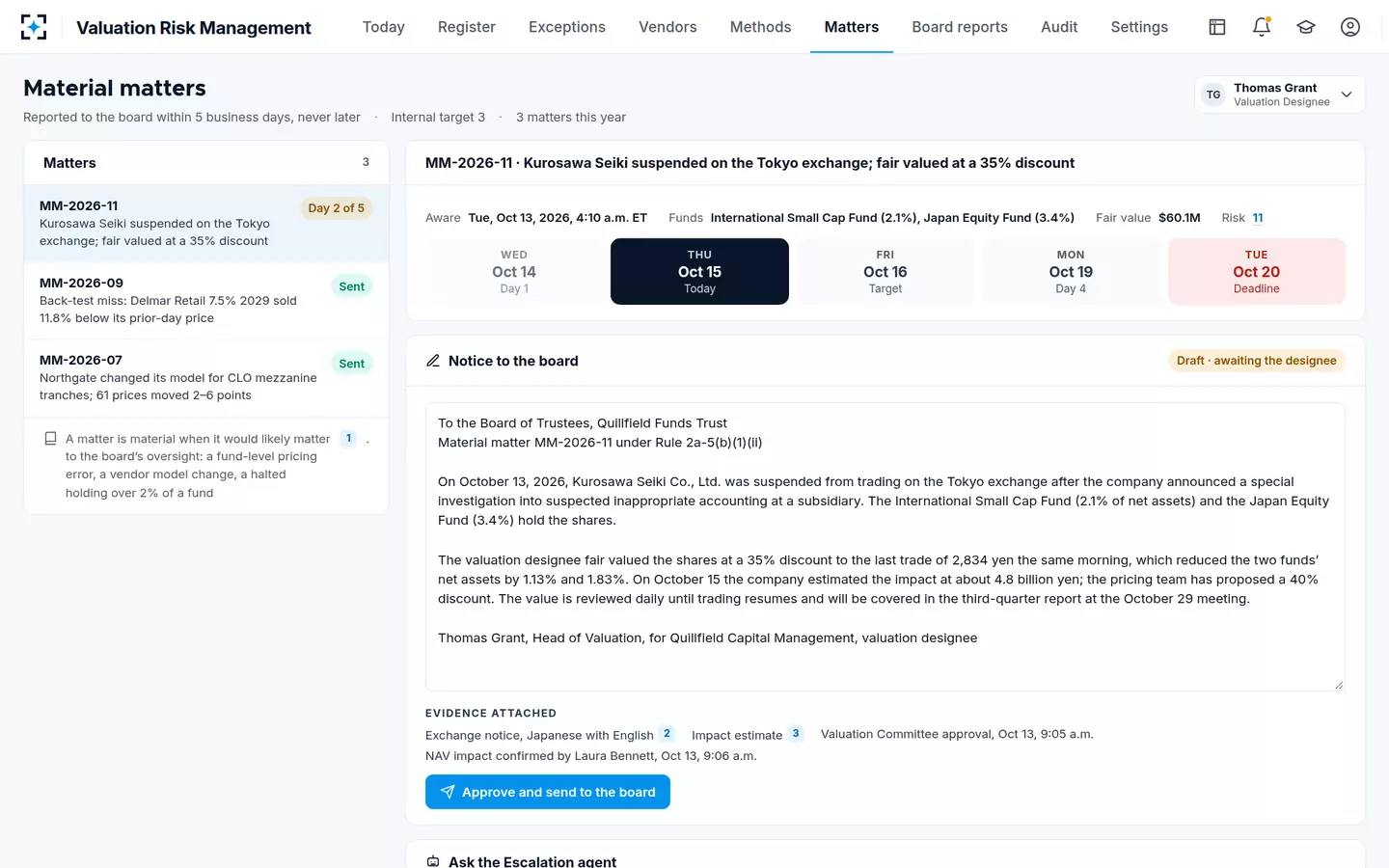
Notice what the file holds and what it does not. It holds the event, the time the designee became aware, the discount, the approval and its time, the treasurer’s confirmation of the NAV effect and the source document in its original language. It does not hold a claim that 35% was the right number; Rule 2a-5 asks for a good-faith process, documented, and the next day’s reassessment is part of that process. How such a matter then appears in the quarterly board report follows the same position forward.
Does fair value pricing change a fund’s NAV? Yes, and the prospectus must say how
Fair value pricing changes the NAV on the days it applies, and that is its purpose. On a day when foreign markets closed before a large US move, a fund that fair values its foreign holdings will report a NAV closer to what those holdings are likely to be worth, and its daily return will differ from the return implied by foreign closing prices. Shareholders see a NAV that already includes the move rather than a NAV that catches up the next day.
Because the effect is visible, the SEC requires it to be explained. Since 2004, every mutual fund other than a money market fund must explain briefly in its prospectus when it will use fair value pricing and its effects; a fund that holds mostly overseas securities is expected to give “a fuller discussion”, such as “specific events occurring after the close of the overseas exchange”. The fund does not have to publish its trigger: the SEC said a fund using an index-move trigger “will not be required to disclose the specific percentage change that would trigger fair valuation”.
Fair value pricing is not market value pricing, and the difference is a duty
A readily available quotation: An unadjusted trade or close in an active market for the identical security.
A fair value: A method: a factor, a model, a matrix, a broker quote, an independent valuation.
A readily available quotation: The market; the fund checks it is still reliable.
A fair value: The board, or the valuation designee it appoints under Rule 2a-5.
A readily available quotation: That nothing after the close made it unreliable.
A fair value: The method, its inputs, its testing, the approval, and the reason for any override.
A readily available quotation: A stale or unreliable price used as if it were live.
A fair value: A method that drifts, an input the adviser controls, a price nobody challenges.
A readily available quotation: The price source and time.
A fair value: Appropriate documentation kept six years under Rule 31a-4.
Fair value pricing in the Valuation Risk Management night run
In Botminds’ Valuation Risk Management, fair value pricing is checked, not performed, by software. The Price Monitor agent loads each night’s prices, including the fair value factors and exchange closes, and flags tolerance breaks; in the sample policy, equities break at ±10% or on a fair value factor trigger. Halted and suspended securities such as Kurosawa Seiki go to a named analyst every day until trading resumes. The Methods agent back-tests each fair value method against later sale prices, or for foreign equities against the next day’s open, and explains every miss.
What the agents never do is set the price. The pricing analyst proposes, the valuation designee approves with a reason code, and the fund treasurer confirms the NAV effect of any override above 0.10% of a fund’s net assets before the strike. That division of labour is the subject of a separate guide on AI in valuation; to see the night run itself, start at Valuation Risk Management.
Questions people ask
What is fair value pricing for mutual funds, in one sentence?
It is the valuation of a holding at what it would likely fetch at the moment the fund strikes its NAV, used when no reliable, unadjusted market quotation exists at that moment. Under SEC Rule 2a-5 it must be determined in good faith by the board or the valuation designee, through a tested method.
Does Rule 2a-5 apply to ETFs?
Yes. Rule 2a-5 defines a fund as a registered investment company or business development company, which includes ETFs, so the holdings behind an ETF’s NAV are valued under it. The price at which the ETF’s own shares trade on an exchange is a separate matter set by the market.
What is stale price arbitrage?
It is buying or selling fund shares at a NAV built from out-of-date prices, to capture the move those prices will make the next day. Researchers estimated abnormal returns of 40 to 70 percent a year in international funds before fair value pricing became common, paid for by long-term shareholders.
Is a pricing service’s evaluated price a market quotation?
No. The SEC states in the Rule 2a-5 adopting release that evaluated prices are not readily available market quotations, because they are not unadjusted quoted prices from active markets for identical investments. A bond priced that way is fair valued, and the pricing service must be overseen.
How is a fair value factor tested?
The common test compares each adjusted foreign price with the security’s next opening price in its home market, method by method and over time. Rule 2a-5 does not require a particular test, but it requires the fund to name its testing methods and their minimum frequency, and the SEC calls back-testing particularly useful.