Investment valuation software is a broad label: it covers models that value a company or a loan, evaluated pricing services that sell prices, fund accounting systems that strike the NAV, and oversight systems that check every price and keep the evidence for the fund’s valuation designee. For a US registered fund the last category is the one Rule 2a-5 makes unavoidable, and its economics are knowable: the SEC estimates what the rule’s reporting and records cost each fund every year, and a fund complex can measure what its own quarterly board report, exception queue and vendor reviews cost in staff days. Software is worth what it removes from those numbers, and the honest test is a short list of programme KPIs measured before and after. Botminds’ Valuation Risk Management is built for that category: seven agents that check, chase and draft, with the pricing analyst, the valuation designee and the treasurer deciding.
The worked examples come from a fictional sample complex, Quillfield Capital, valuation designee for 90 funds with $486.3 billion of net assets. Its report-assembly figures are our estimates of the manual steps, and the solution figures are design targets, labelled as such where they appear.
Where a quarterly Rule 2a-5 report’s business days go, by hand and with the solution
Four kinds of investment valuation software, and the problem each solves
The phrase covers four different products, and most disappointing purchases come from buying one when the problem was another. Valuation models compute a value for something without a market price. Pricing services sell evaluated prices for securities that trade rarely. Fund accounting systems hold the positions and strike the NAV. Oversight systems check all of those outputs against the fund’s policy and keep the designee’s evidence. Rule 2a-5 touches all four, but it places only one of them inside the designee’s own duties without exception: overseeing the others.
Investment valuation software: four categories, four different jobs
| Category | What it produces | Its place under Rule 2a-5 | Who usually runs it |
|---|---|---|---|
| Valuation models | A value for a private company, loan or derivative from inputs and assumptions | A fair value methodology the designee must select, apply and test | Valuation team or an outside valuation firm |
| Pricing services | Evaluated, matrix or model prices for bonds, loans and other rarely traded assets | A pricing service the designee must approve, monitor, evaluate and challenge | A third party, under contract |
| Fund accounting and NAV | Positions, accruals and the daily net asset value | Where approved fair values are applied; material NAV errors are material matters | The fund administrator |
| Valuation oversight | Checked prices, linked exceptions, tested methods, vendor reviews and board reports | Evidence that all four duties were performed, kept under Rule 31a-4 | The valuation designee’s team |
The economics differ by category too. A pricing service is priced per security or per feed and replaces nothing the designee does; it adds a source to oversee. An oversight system is worth what it removes from the designee’s own workload, which is why the rest of this guide prices that workload.
What does Rule 2a-5 cost a fund? The SEC’s own numbers
The SEC publishes two kinds of cost estimate for Rule 2a-5, and a buyer should use both. The first is the one-time cost of complying, estimated when the rule was adopted: “the one-time incremental costs necessary to ensure compliance with these rules range from $100,000 to $600,000 per fund, depending on the current fair value practices of the fund”, across an estimated 9,804 affected funds, for an aggregate of $980.4 million to $5.9 billion (SEC, 86 FR 748, January 6, 2021). The SEC attributed 70% of that to reviewing and updating practices and policies, 15% to recordkeeping and 15% to board reporting.
The second is the recurring paperwork burden, re-estimated every few years for the Office of Management and Budget. In August 2026 the staff estimated 34 hours a year per fund for Rule 2a-5, a monetized time cost of $33,422, plus $3,632 of external cost, across 10,047 funds: $335.8 million of staff time and $36.5 million of external cost a year (SEC notice, 91 FR 55658, August 28, 2026). For Rule 31a-4 records it estimated 36 hours and $15,984 per fund, $160.6 million in all (SEC notice, 91 FR 54768, August 24, 2026).
What the SEC estimates Rule 2a-5 and Rule 31a-4 cost, per fund and in all
$100K–$600K
one-time cost per fund to comply, SEC estimate at adoption (2020)
$33,422
a year per fund: Rule 2a-5 reporting time, 34 hours (2026)
$15,984
a year per fund: Rule 31a-4 records, 36 hours (2026)
$533M
a year across about 10,047 funds: both rules’ time and external costs (2026)
Two things about these figures matter for a business case. They are floors for the activities they cover: the SEC’s burden estimates count reporting and recordkeeping, not the nightly price checks, second quotes, vendor reviews and back-tests that produce what is reported. And they imply rates worth noticing. Dividing the monetized cost by the hours gives about $983 an hour for Rule 2a-5 reporting and about $444 an hour for the records, which says the SEC assumes the reporting is done by senior people. Our arithmetic, not the SEC’s statement.
How long does the quarterly 2a-5 board report take? Weeks, by hand
By hand, assembling a quarterly 2a-5 report at a large complex takes two to three weeks, by our estimate of the manual steps, because its numbers live in different places: stale, tolerance and single-source reports in the accounting platform, broker quotes in email, challenge logs in vendor portals, back-tests in workbooks, and the valuation risk register in a spreadsheet. Each section has to be rebuilt from them and every number checked before the treasurer reviews and the designee signs.
Where twelve business days of report assembly go, by hand
Quarterly 2a-5 report, by hand
- Exception statistics · 16.7%
- Challenge logs · 16.7%
- Back-tests · 20.8%
- Register · 16.7%
- Writing, checking, review and signature · 29.1%
Only the review and signature, one day of the twelve, is judgement the designee must keep; most of the rest is gathering, counting and checking, which is what software can remove if every exception, challenge, test and register change already sits in one place with its evidence. That is the basis of the solution’s design target of a drafted report in two days. Whether it holds for a given complex depends on how many systems feed it, and it should be tested on that complex’s own last quarter before anyone puts it in a budget.
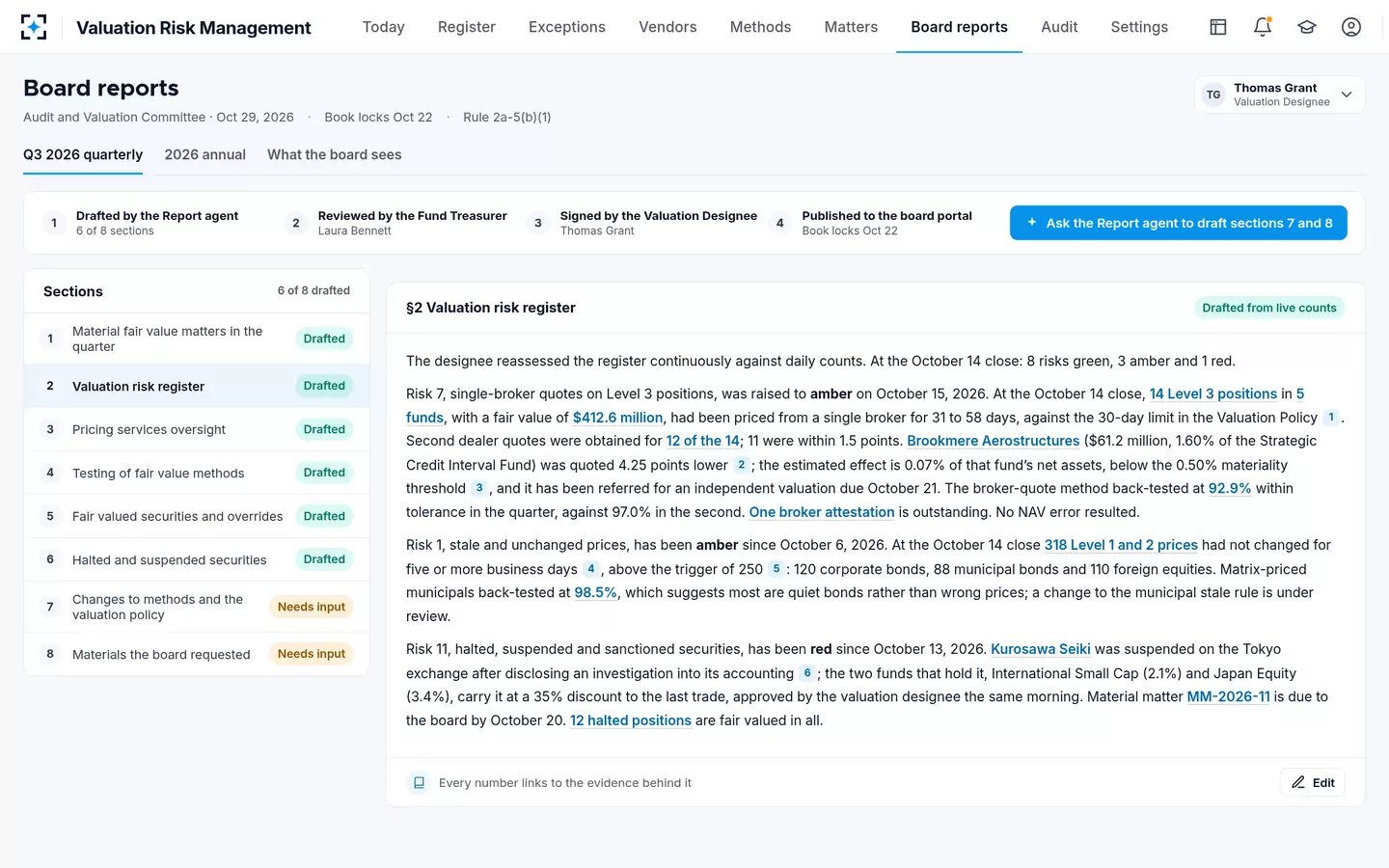
Valuation Risk Management: the Q3 report drafted from live counts
What KPIs should a valuation program report? Eight that show a saving and a control
A valuation program should report KPIs that measure both cost and control, because software that saves time by checking less is not a saving. The eight below can be computed from the records an oversight system keeps, and each can be compared before and after go-live. None has a regulatory benchmark; no regulator or independent study publishes typical values for them, so the baseline is the complex’s own history.
Eight valuation program KPIs, what each proves, and where the number comes from
| KPI | What it proves | Computed from |
|---|---|---|
| Share of prices checked each night | Coverage: every price, not a sample | Price file count against checks run |
| Open exceptions by age band | Exceptions are being decided, not parked | Exception queue with open dates |
| Days single-source, Level 3 | Second sources are found before the policy limit | Single-source start dates per position |
| Back-test pass rate by method | Methods still fit the market | Later sales, or next-day opens for foreign equities |
| Challenge turnaround and change rate by vendor | Vendors respond and challenges matter | Challenge log |
| Overrides by source and approver | No pattern that should go to the board | Override log with reason codes |
| Business days from awareness to board notice | The five-day limit is met with margin | Material-matter log |
| Business days to a signed quarterly report | The cost of reporting is falling | Report drafting and approval dates |
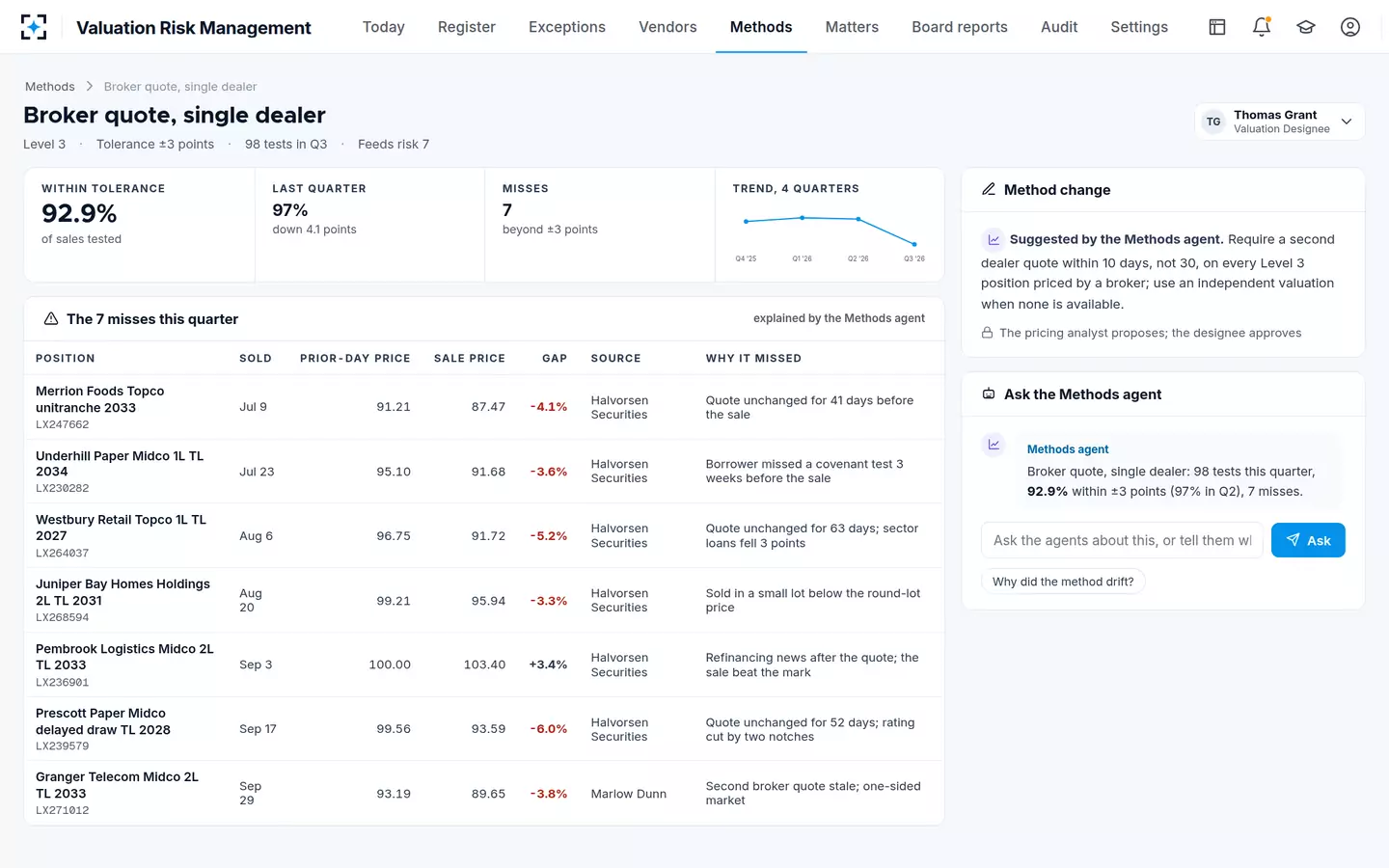
Several of these are things the sample complex’s solution already counts. The broker-quote method’s back-test pass rate fell from 97.0% to 92.9% in the third quarter, the signal that moved a register risk to amber. Its secondary pricing vendor’s challenge record showed 302 challenges in the quarter, 20.2% of them leading to a changed price, with a median turnaround of 2.6 days. The material-matter clock on its Tokyo suspension stood at day 2 of 5 against an internal target of three. Those are the numbers a board and a treasurer can use to judge whether a system pays its way.
A back-test KPI with its evidence: one method drifting, every miss explained
How do you build a business case for valuation software? Four terms, your own numbers
A business case for valuation oversight software has four terms, and each can be priced with numbers the complex already has. Vendors don’t publish prices, and no regulator or independent study publishes what valuation oversight costs a typical complex, so the method below is the honest substitute: measure each term for the last two quarters, then measure again in a pilot on the same quarters.
The business case for valuation oversight software, term by term
Report assembly
Business days per quarterly and annual report × people × loaded daily rate × 5 reports a year
Count the days from the first data pull to the designee’s signature for the last two quarters.
Head of valuation
Exception handling
Exceptions a night × minutes each to gather the evidence × business days
Only the gathering is saved; the decision stays with the analyst.
Pricing analysts
Vendor and method reviews
Annual vendor reviews + quarterly method back-tests × hours to assemble each
Assembly from the challenge log and back-tests, not the judgement.
Valuation designee
Cost of the system
Licence + implementation + internal time to run it
Include the time to keep the policy settings current and to review agent output.
COO or treasurer
Two adjustments keep the case honest. Do not count time saved on judgement: the analyst still proposes and the designee still approves, so the saving is in gathering, matching and drafting. And do not count avoided NAV errors in the base case. They matter, and academic research from before fair value pricing became common measured what stale prices cost long-term shareholders, but no one can show in advance which error a system will catch. What stale prices cost shareholders is covered in the fair value pricing guide.
What a valuation failure costs: the line the SEC’s estimates leave out
The SEC’s burden estimates price compliance, not failure, and a business case that ignores failure understates what oversight is for. MAS’s May 2026 paper lists who pays when valuation goes wrong: investors who subscribe or redeem at the wrong price, performance records that mislead, transfers between funds at the wrong value, and “excessive payment of fees” on an inflated NAV (MAS, Valuation Practices for Fund Management Companies).
Infinity Q shows the scale at the extreme. The SEC alleged that at times during the pandemic the funds’ actual values “were half of what investors were told”, and the mutual fund suspended redemptions in February 2021 under a Commission order (SEC press release 2022-29). The founder was later ordered to pay restitution of approximately $126 million, as recorded in the SEC’s 2026 order against the fund’s auditor (SEC order, March 6, 2026). That was fraud, not a missed stale price, and no software prevents a determined insider alone. But the controls that would have exposed it sooner, independent test inputs, logged model changes and a challenged single source, are the same ones that catch ordinary drift, which is why the base case counts staff days and the failure case is reported beside it.
What should fund valuation software do? Five capabilities to test, and what it should not claim
Valuation oversight software for a registered fund should do five things, each testable in a pilot on the fund’s own files. Check every price every night against the fund’s own policy thresholds. Link each exception to a valuation risk and an owner with a deadline. Back-test every fair value method against later sales and explain each miss. Draft the 2a-5 reports from the counts, with every number traceable. And keep every proposal, approval and source on a record a third party could use to verify a determination, as Rule 31a-4 expects.
It should not claim to replace what it does not do. An oversight system is not an evaluated pricing service, and does not sell prices; it is not a valuation model for private companies; it does not compute the NAV, which stays with the administrator; and it does not replace an independent valuation firm when the designee needs one. A system that claims to do all of these is either several products or none of them well.
Some buyers will need a different category altogether. A private markets manager valuing portfolio companies each quarter needs Private Markets Valuation (private equity valuation software); a private credit lender marking loans needs Private Credit Valuation (private credit valuation software compared). Valuation Risk Management sits above those marks, where the designee oversees them across a registered fund range.
Where Valuation Risk Management fits in the budget, and how to test it first
Valuation Risk Management fits as an oversight layer beside the systems a pricing team already runs. It reads the nightly price file, positions and net assets, trade history for back-testing, vendor files and the broker quote inbox, and writes approved overrides back to the pricing system and signed reports to the board portal. The budget question is therefore not which pricing system to replace but how many staff days of gathering and drafting it removes, measured with the KPIs above.
The safe way to decide is to run it on the complex’s own last quarter: the price files, the valuation policy and the board report the board actually received. If the drafted report and the exception counts match what the team produced, the days saved are measurable; if they do not, the differences are worth knowing either way. An eight-week plan from first files to go-live sets out how. To see the sample complex, start at Valuation Risk Management.
Questions people ask
How much does Rule 2a-5 compliance cost per fund?
At adoption the SEC estimated one-time costs of $100,000 to $600,000 per fund, depending on existing practices. Its August 2026 paperwork estimates add 34 hours and $33,422 a year per fund for Rule 2a-5 reporting, plus $3,632 of external cost, and 36 hours and $15,984 a year for Rule 31a-4 records.
How many hours does valuation oversight take?
The SEC’s 2026 estimates cover only reporting and records: 34 and 36 hours a year per fund. The nightly checks, second quotes, vendor reviews and back-tests come on top, and must be measured locally; in the sample complex the quarterly report alone takes about 12 business days by hand, by our estimate.
Is investment valuation software the same as a pricing service?
No. A pricing service supplies evaluated prices and is itself overseen under Rule 2a-5. Oversight software checks those prices, the other sources and the methods, and keeps the designee’s evidence; it does not sell prices.
How many funds must comply with Rule 2a-5?
The SEC’s August 2026 notice counts 10,047 respondents for Rule 2a-5. Its staff statistics show 8,117 mutual funds and 4,829 ETFs in March 2026, alongside closed-end funds and business development companies, which the rule also covers.
What is a realistic payback period?
No regulator or independent study publishes one. Measure the four terms of the business case on your own last two quarters, run a pilot on the same quarters, and compute payback from the measured difference rather than from a vendor’s claim.