A stale price report lists every holding whose price has not changed for more than a set number of days, so that someone decides, before the next NAV, whether that price still reflects what the holding is worth. No SEC rule sets the number of days. The threshold is a choice in the fund’s valuation policy, it should differ by asset class and dealing frequency, and the evidence that it was applied is one of the work papers the SEC expects a Rule 2a-5 valuation designee to keep. The work is hard because most unchanged prices are harmless and a few are not, and a report that flags hundreds of quiet bonds every morning trains people to stop reading it. Botminds’ Valuation Risk Management runs the stale check every night and links each stale price to the valuation risk it is evidence of.
The worked examples come from a fictional sample complex, Quillfield Capital, valuation designee for 90 funds, at the October 14, 2026 close.
Days unchanged before a price counts as stale, one sample policy
What is a stale price, and what is a stale price report?
A stale price is a price that no longer reflects the current value of the holding, usually because the source has stopped updating it: no trades, no fresh dealer quote, an evaluated price carried forward, a halted share. The working test is an unchanged price over a set number of days. MAS, in its May 2026 information paper on fund valuation, defines the stale price check as one that identifies “securities where the prices no longer reflect their current or true fair value” (MAS, Valuation Practices for Fund Management Companies, 29 May 2026).
The report is the tool that applies the test. It lists every position past its threshold, with the price, the source, the number of days and the fund, and it goes to someone who must decide one of three things for each line: the price is still right, the price needs a fresh source, or the holding needs a fair value. Its value lies in the decisions it forces, not the list; a report nobody acts on is evidence against the fund.
Examiners treat it that way. The SEC Division of Examinations lists, among the documents it typically requests from registered funds, prices from a pricing service or valuation firm “that were overridden or stale (e.g., prices for a given security have not changed over time)” (SEC risk alert, November 4, 2024). In adopting Rule 2a-5, the SEC listed stale price analysis among the work papers that count as appropriate documentation under Rule 31a-4, and gave “reports regarding stale prices” as an example of data a board could request (SEC, 86 FR 748).
How many days before a price is stale? No rule says, so the policy must
No rule sets a stale-price day count, and Rule 2a-5 sets no thresholds of any kind. The number is a policy decision, and the right one depends on how often the asset trades and how often the fund deals. A large-cap share that has not changed for two days is a red flag; a small municipal bond that has not changed for two weeks may simply not have traded.
Five days is the line that appears in MAS’s inspection findings, and five business days is the sample policy’s line for exchange-listed equities and evaluated bonds. The supervisory evidence suggests the bigger risk is not the choice of number but the absence of one. In its 2026 paper MAS described a manager whose own definition of a stale price “did not stipulate the specific number of days a security’s price must remain unchanged before being considered stale”, while its fund administrator used a different definition from the one it reported on. MAS concluded that such “differing definitions and the lack of a clear timeframe could compromise the overall effectiveness” of the manager’s oversight.
A defensible threshold has three parts written down: the number of days, the asset classes it covers, and what happens on the day it is crossed. The sample policy adds a fourth, the trigger for the register: risk 1, stale and unchanged prices, turns amber when more than 250 Level 1 and 2 prices are stale at once. At the October 14 close 318 were.
What MAS found when it inspected stale price controls
The most detailed public account of stale price failures is the Monetary Authority of Singapore’s thematic inspection, published on 29 May 2026 (MAS information paper). The findings concern Singapore fund managers, but every one of them describes a control a US valuation designee runs too.
Six stale price failures MAS found in fund managers’ valuation controls
| What MAS found | What went wrong | The control it implies |
|---|---|---|
| Unchanged versus stale not distinguished | The administrator’s daily report did not separate securities that traded at an unchanged price from those that had not traded and were unchanged for five days; a bond in a daily dealing fund was stale “for a few weeks” unnoticed. | Report the two populations separately. |
| Monthly reports for daily funds | Stale price reports arrived monthly although funds dealt daily and weekly, so stale prices could be used “for up to a month”. | Run the report at least as often as the funds deal. |
| Month-end only to the committee | Only securities stale for more than five days at month-end went to the valuation committee, so others waited more than a month. | Escalate on the day the threshold is crossed, not at month-end. |
| Slow escalation | Some managers took more than a month to escalate stale or suspended securities held by daily dealing funds. | Set a deadline from detection to decision. |
| Delisted security missed | A delisted security was priced at its last exchange trade for a few months. | Feed corporate actions and delistings into the stale check. |
| Mismatched definitions | The administrator treated three days unchanged as stale but reported only those above seven days for daily and weekly funds; the manager’s own policy set no number. | One written definition, shared with every service provider. |
Two of the six are about frequency rather than thresholds, and MAS’s own takeaway says so: managers should “calibrate the frequency of stale price reports according to the dealing frequency of the funds covered by these reports”. A daily dealing fund with a monthly stale report is, in effect, accepting that some subscriptions and redemptions will be struck at prices nobody has looked at.
Should stale price thresholds differ by asset class? Yes, and so should tolerances
Thresholds should differ by asset class because trading frequency does. An exchange-listed equity that stops moving has either been halted or is not being priced; a matrix-priced municipal bond that stops moving may be correctly priced and simply quiet. One threshold for both either floods the report with municipals or misses the equity. MAS made the same point about price tolerance checks, criticising a manager that applied “a uniform 5% threshold for its source-to-source check across all asset types”, and recommending managers “adjust exception tolerance levels according to the characteristics of different asset classes and financial instruments”.
The sample complex shows the trade-off in real numbers. Of its 318 stale prices, 120 were corporate bonds, 88 municipal bonds and 110 foreign equities. The municipals were the noisy group: when the Methods agent back-tested the matrix-priced municipals against the trades that did occur, they passed 98.5% of the time, which suggests quiet bonds rather than wrong prices. That is the evidence behind the pending change to ten business days for municipals. The change was proposed by the systems administrator and waits for the valuation designee to approve or reject it with a reason code, so the threshold moves for a recorded reason rather than because the report was annoying.
One night’s stale price report at the sample complex
318
Level 1 and 2 prices unchanged for five or more business days, against a register trigger of 250
88
of them municipal bonds, beside 120 corporate bonds and 110 foreign equities
98.5%
back-test pass rate of the matrix-priced municipals: quiet, not wrong
58days
the oldest single-broker price on a Level 3 loan, against a 30-day limit
Unchanged is not the same as stale: the distinction regulators asked for
An unchanged price is an observation; a stale price is a judgement. A security can trade every day at the same price, which happens with short-dated paper and pegged instruments, and its unchanged price is current. Another can stop trading altogether and have its last price carried forward by a vendor, and its unchanged price is stale even if it is still correct today. The MAS finding about the bond that went stale for weeks unnoticed came from a report that mixed the two populations.
Unchanged price or stale price: the difference a report has to show
Unchanged, but traded: The market confirmed the same price again.
Unchanged, not traded: Nobody has confirmed the price; it is being carried forward.
Unchanged, but traded: Trades or firm quotes on the days in question.
Unchanged, not traded: No trades, no fresh quotes, or the same broker’s indication repeated.
Unchanged, but traded: Short-dated paper, pegged instruments, a very stable issue.
Unchanged, not traded: Thinly traded bonds, Level 3 loans, delisted or halted shares.
Unchanged, but traded: Nothing beyond normal tolerance checks.
Unchanged, not traded: Seek a second source, back-test the method, or fair value.
Unchanged, but traded: A separate list, if shown at all.
Unchanged, not traded: The stale list, with days since the last real observation.
The distinction matters most for broker-quoted Level 3 positions, where the “price” is one dealer’s indication. A quote repeated for weeks looks like a stable price and is really an unobserved one. In the sample complex, four of the seven back-test misses on the single-dealer broker-quote method this quarter involved stale quotes: three positions whose quote had not changed for 41, 52 and 63 days before the sale, and one whose second broker quote was stale. Each sale came in 3.8% to 6.0% below the prior-day price.
A stale Level 3 quote, followed from the report to a decision
The stale report earns its keep on the positions where staleness hides the most risk. Take the sample complex’s Brookmere Aerostructures first lien term loan, $61.2 million and 1.60% of the Strategic Credit Interval Fund. One broker had quoted it at 96.25 every day since August 17, 58 days against the policy’s 30-day single-source limit. Overnight the Source Check agent asked three other dealers for quotes; one bid 91.50, offered 92.50 and had seen the loan trade at 91.875 on October 8, and the borrower’s second-quarter lender report showed leverage up from 5.9x to 6.8x.
Valuation Risk Management: a 58-day-old broker quote beside a fresh second source
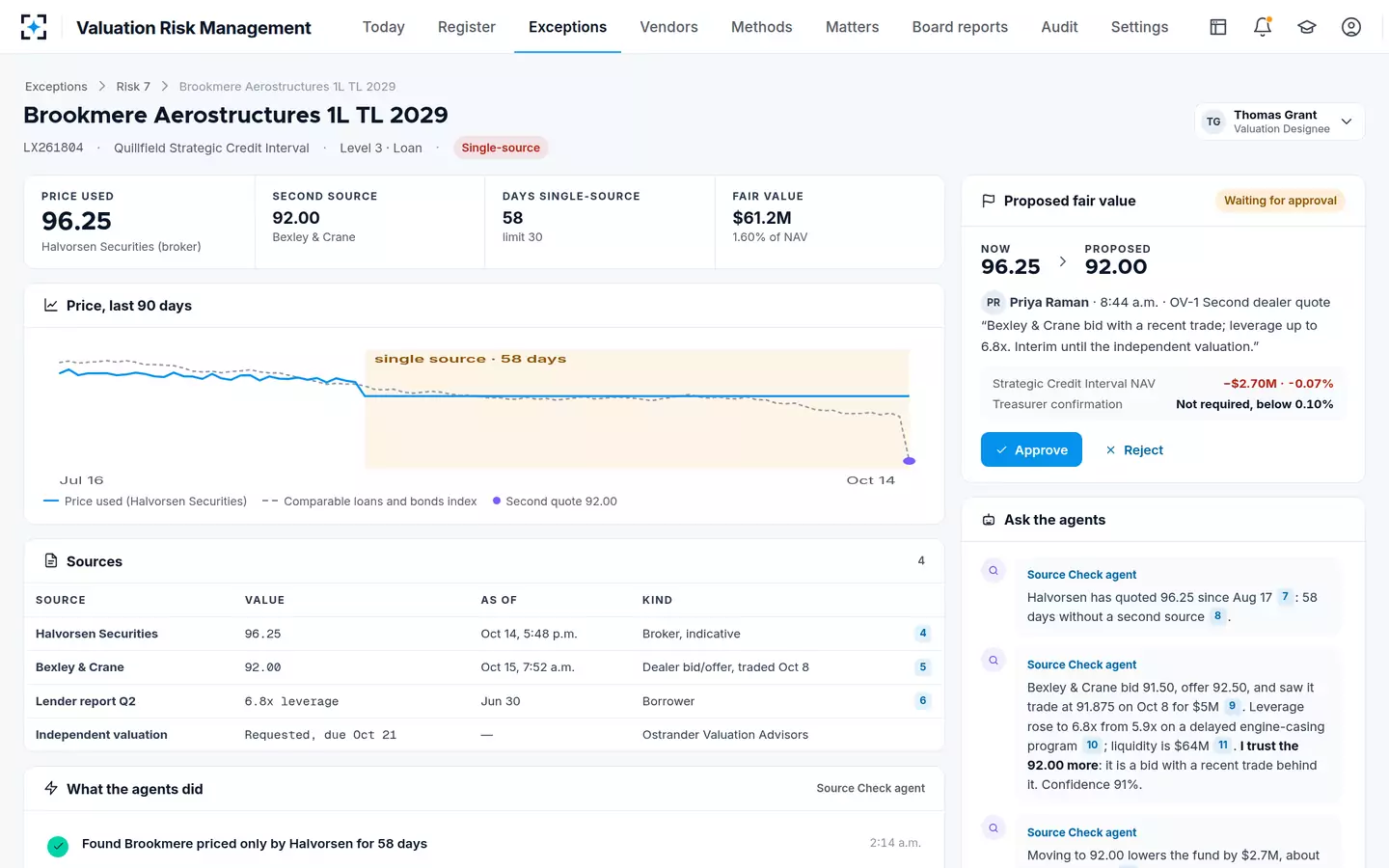
The senior pricing analyst proposed 92.00, a bid with a recent trade behind it. The effect on the interval fund’s NAV was −$2.70 million, −0.07%, below the 0.10% line at which the sample policy requires the treasurer to confirm before the 4 p.m. strike. The designee also referred the loan for an independent valuation due before the board book locked. None of that was decided by the stale report; the report made sure the decision was taken in October instead of discovered in a back-test after the loan was sold. How fourteen such positions moved a register risk to amber follows the same night from the designee’s side.
The reverse case: a fair value that goes stale
A stale price report usually watches market prices that stop moving, but fair values go stale too. A security fair valued after a halt, a default or a missing quote keeps its fair value until someone reassesses it, and that value can sit unchanged while markets move. MAS found a manager that had no process to check whether market prices had become available again for securities it was fair valuing, and as a result “was not aware of available market prices for several bonds, which it had fair valued, for more than a year” (MAS information paper, May 2026).
MAS’s expectation is that assets assigned fair values are monitored with “criteria for triggering a reassessment” clearly set out, such as the emergence of new price sources, deteriorating market conditions, or changes to key inputs. In practice that means the stale price report should include fair valued positions with the date of their last reassessment, and flag any that have not been reassessed within the policy’s period or for which a market price has reappeared. In the sample complex the twelve halted securities, including the suspended Tokyo holding, go to a named analyst every day until trading resumes, so their fair values cannot quietly age.
How often should a stale price report run, and who should see it?
A stale price report should run at least as often as the funds it covers deal, which for a daily dealing mutual fund means every business day before the NAV is struck. It should go first to the pricing analyst who owns the asset class, with a deadline for a decision, and escalate to the valuation designee or committee when the threshold is crossed on a position above a set size or when a decision is overdue. Quarterly, the counts and their resolution belong in the material in front of the board, which is where the SEC put “reports regarding stale prices” in its list of optional board reporting.
A stale price policy that would survive the MAS findings: eight lines
- A number of days, per asset class
Written in the policy, with the reason for each line (trading frequency, back-test results).
- Traded-unchanged and not-traded reported separately
The distinction MAS found missing in one manager’s administrator reports.
- Run at least as often as the funds deal
Daily for daily dealing funds; MAS found monthly reports used for daily funds.
- Escalation on the day of the breach
Not at month-end: a five-day breach on the 3rd should not wait until the 31st.
- A deadline from detection to decision
Keep the price, find a second source, or fair value, each with a reason.
- One definition shared with the administrator and vendors
MAS found a manager and its administrator using different stale price definitions.
- Delistings, halts and corporate actions in the same feed
MAS found a delisted security priced at its last trade for months.
- Thresholds reviewed against back-test evidence
Change a line when the back-tests say it is too tight or too loose, and record who approved it.
The stale list in Valuation Risk Management, beside every other exception type
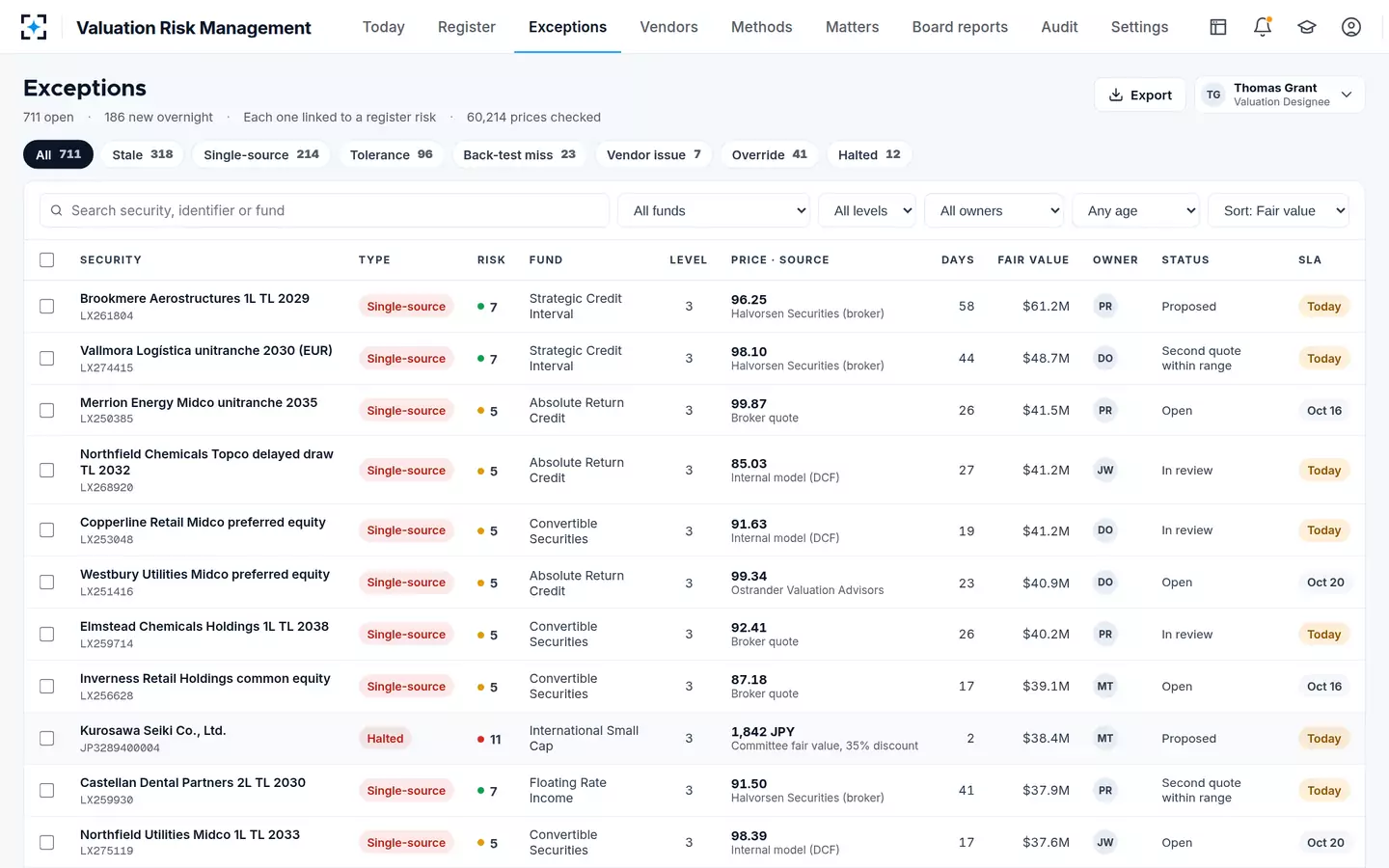
In Valuation Risk Management the Price Monitor agent runs the stale check on every price every night, applies the thresholds from the fund’s own policy, and links each stale price to its register risk; single-source Level 3 positions go to the Source Check agent for second quotes. No agent changes a price or closes an exception. To see the nightly run on the sample complex, start at Valuation Risk Management; how stale price evidence fits the valuation policy file an examiner asks for is covered separately.
Questions people ask
Can a fund keep using a stale price in its NAV?
Only if the valuation designee concludes it still reflects value and records why. Under Rule 2a-5 a quotation that is not reliable is not readily available, so a price the designee cannot rely on must be replaced by a fair value determined under the fund’s methods.
How many days unchanged makes a price stale?
No SEC rule sets a number; the fund’s valuation policy must. Five days is the line used in the examples MAS published in 2026; assets that rarely trade can justify a longer line, provided the policy records why and back-tests support it.
Is an unchanged price always a stale price?
No. A security can trade at the same price repeatedly, in which case the price is current. MAS’s 2026 paper criticised a stale price report that did not separate securities that traded at unchanged prices from those that had not traded and were unchanged for five consecutive days.
What does the SEC ask about stale prices in an exam?
The Division of Examinations’ November 2024 risk alert lists prices from a pricing service or valuation firm “that were overridden or stale” among the documents typically requested from registered funds. The Rule 2a-5 adopting release counts stale price analysis among the work papers that support fair value determinations.
Should a stale broker quote on a Level 3 loan be treated differently?
Yes. A broker’s repeated indication on a Level 3 position is one unobserved input, not a market price, so many policies set a single-source limit, such as 30 days, after which a second quote, an independent valuation or an approved model price is required. In the sample complex, stale broker quotes were behind four of the seven back-test misses on that method in the quarter.