A valuation risk analyst, often titled pricing analyst or senior pricing analyst, works for a fund’s valuation designee: they review the nightly price exceptions, chase second sources for prices that rest on one broker or one vendor, propose fair values and overrides, propose changes to the valuation risk register, and assemble the evidence the designee needs to approve each one and to report to the board under SEC Rule 2a-5. The job is less about valuation models than about hand-offs. The analyst waits on brokers, vendors, borrowers and the fund administrator; the designee, the treasurer and the board wait on the analyst, and most delays sit at hand-offs the rule never names. Botminds’ Valuation Risk Management takes the chasing and the counting off the analyst so the morning starts with the positions that need a judgement.
The examples follow a fictional sample complex, Quillfield Capital, valuation designee for 90 funds, through the morning of Thursday, October 15, 2026, with its senior pricing analyst Priya Raman, its head of valuation and designee Thomas Grant, and its fund treasurer Laura Bennett.
Who waits on whom in a Rule 2a-5 valuation program
Who waitsPricing analyst
On whomBrokers and dealers
For whatA second quote on a single-source Level 3 position
By whenBefore the morning’s proposals
If it is lateThe position is marked from one source another day
Who waitsPricing analyst
On whomPricing vendors
For whatThe evaluated price file, and answers to challenges
By whenBefore the checks run; challenges within the agreed turnaround
If it is lateExceptions cannot be cleared; a challenge ages
Who waitsPricing analyst
On whomBorrowers and agent banks
For whatQuarterly lender reports, in the original language
By whenBefore a Level 3 mark is proposed
If it is lateThe mark rests on last quarter’s financials
Who waitsPricing analyst
On whomPortfolio managers
For whatMarket colour on a position
By whenOptional, logged as information
If it is lateNothing should stall: the PM informs, never prices
Who waitsValuation designee
On whomPricing analyst
For whatA proposal with evidence: a fair value, a register change, a method change
By whenBefore the NAV cut-off, or the board book lock
If it is lateApproval is rushed or the old value stands
Who waitsFund treasurer
On whomValuation designee
For whatApproved overrides large enough to need NAV confirmation
By whenBefore the 4 p.m. strike
If it is lateThe NAV is struck without the confirmation
Who waitsFund administrator
On whomValuation designee
For whatThe approved fair value, communicated correctly
By whenBefore it calculates the NAV
If it is lateThe administrator prices on the old value
Who waitsBoard
On whomValuation designee
For whatSigned quarterly and annual reports; material-matter notices
By whenBook lock; five business days for a material matter
If it is lateA reporting deadline under Rule 2a-5 is missed
What does a valuation risk analyst do in a Rule 2a-5 program?
The analyst performs the functions Rule 2a-5 assigns to the valuation designee, under the designee’s authority. The rule requires the designee to name, by title, the people responsible for fair value determinations and the particular functions each carries out (17 CFR 270.2a-5(b)(2)). In most fund complexes, the analyst’s functions are the day-to-day ones: running and clearing the price checks, investigating exceptions, obtaining second quotes, preparing fair value proposals, logging challenges to pricing services, and feeding the register with evidence.
The SEC was specific about one function. In the adopting release it said the people with duties associated with price challenges should be identified, “including those with the authority to override a price”, along with their roles, and that the designee must have a process for reviewing overrides (SEC, 86 FR 748). An analyst who can change a price and approve the change has no reviewer; the rule’s structure assumes two people.
The analyst also owns much of what the designee later reports. Each quarterly 2a-5 report summarises material changes in valuation risks, methods and pricing service oversight, and each of those starts as an analyst’s proposal with evidence. The quarterly 2a-5 report, annotated follows those proposals into the board book.
The five people in one night’s fair value decisions, before and after
Today
Starts in exception spreadsheets and email, chasing brokers and vendors across 60,000 prices.
With agents
Starts with the fourteen prices that matter, second quotes already in, and proposes for the designee to approve.
Still theirs: Every proposal: fair values, overrides, register and method changes
Today
Signs what goes to the board and asks to see the evidence behind every number in a deck built by hand.
With agents
Approves register changes, overrides and vendor reviews with a reason code, from drafted paragraphs.
Still theirs: Every approval, and the signature on every board report
Today
Owns the NAV and needs to know before 4 p.m. if a price moves it.
With agents
Confirms the NAV effect of every override above the policy line before the strike.
Still theirs: The NAV confirmation, and review of the quarterly report
Today
Wants to be told what changed, why, and what the designee did about it.
With agents
Receives signed reports and material-matter notices with their evidence, within the deadline.
Still theirs: Oversight of the designee
Today
Asks who decided, on what evidence, and samples by hand.
With agents
Filters the trail by person and event type and builds the exam file from it.
Still theirs: The independent check on the whole process
Who waits on whom: the morning of October 15, hour by hour
The sample morning shows where the time goes. The overnight checks finish long before anyone arrives; the waiting starts when a check needs something from outside the building. At 2:14 a.m. the single-source scan found fourteen Level 3 positions priced only by one broker for more than 30 days, $412.6 million across five funds. Dealers do not answer at 2 a.m., so the requests for second quotes went out at 6:30 a.m., and twelve of the fourteen replies were in by 8:05. One vendor’s price file arrived late, at 7:15 a.m., and was handed to the systems administrator.
One morning in a valuation program: most of the elapsed time is waiting on someone
- Checks on 60,214 prices
- Waiting for dealers to openidle until 6:30
- Waiting for second quotesquotes 6:30–8:05
- Back-tests and drafts
- Waiting on dealers for the evidencewaits on dealers
- Reviews the evidence and proposesproposes
- Waits on the designeewaits on approval
- Nothing to approve yetno proposals yet
- Asks why, refers Brookmere, approvesasks, then approves
Then the waits move inside. The analyst proposed raising register risk 7 to amber at 8:41 a.m. and a fair value of 92.00 on the largest position at 8:44, and from that moment the analyst was waiting on the designee. The designee asked the agents why the risk was moving, referred the position for an independent valuation and approved the register change at 10:40. The fair value proposal had its own deadline: before 4 p.m., when the NAV is struck.
The outside waits are mostly fixed: dealers keep their hours and vendors deliver files when they deliver them. The inside waits are the ones a program can shorten, by giving each hand-off a deadline and an owner, and by making sure the person who must approve sees the evidence with the proposal rather than asking for it afterwards.
Valuation Risk Management: the designee’s morning, every waiting item with its deadline
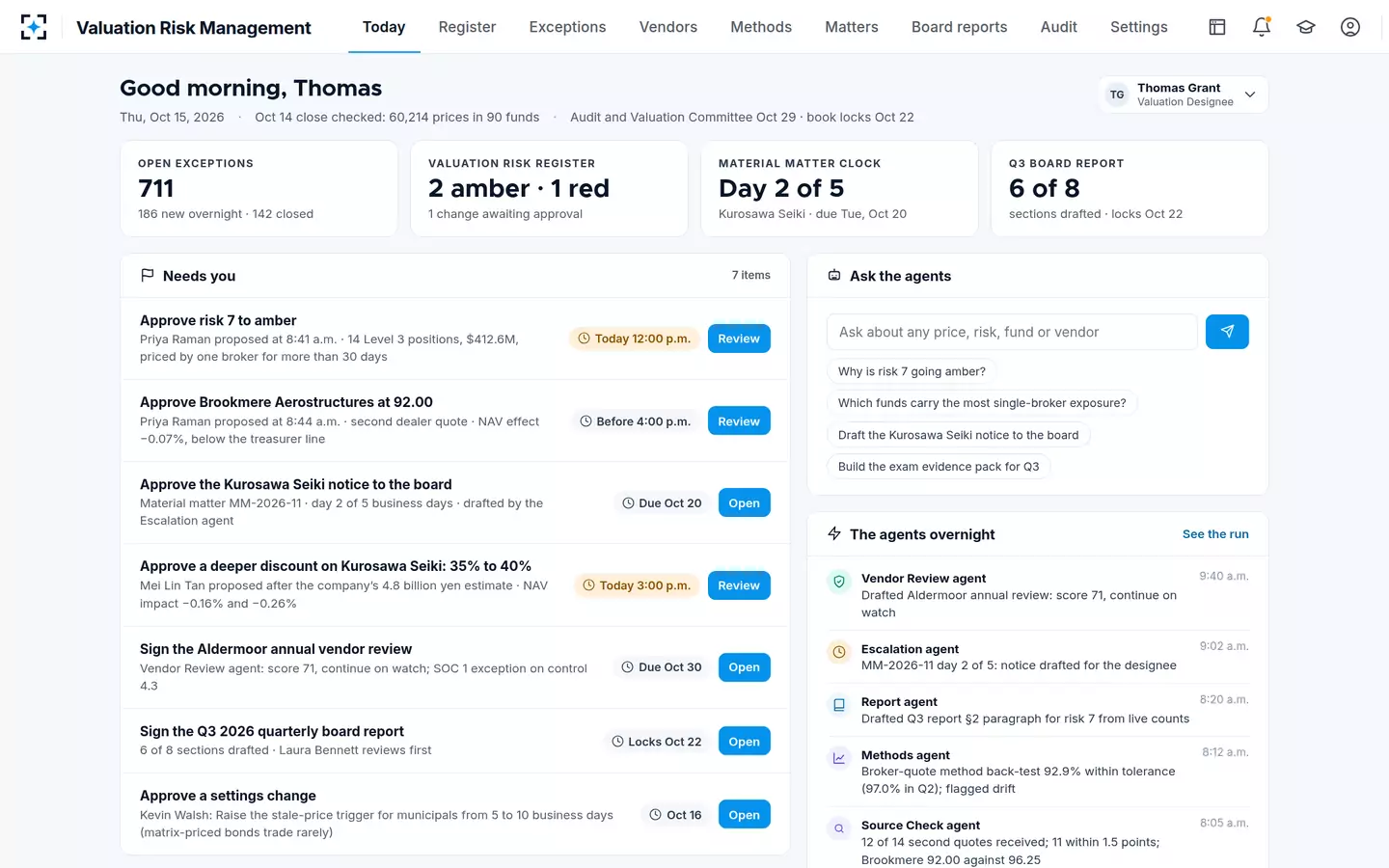
Who signs a fair value override? The analyst proposes, the designee approves
A fair value override is approved by the valuation designee or the people it has named for that function, never by the person who proposed it. Rule 2a-5 does not prescribe the sign-off chain, but it requires the designee to name the people and their functions, and the SEC expects the people with authority to override a price to be identified and a process for reviewing overrides to exist. The sample complex writes it as a maker-checker rule: the analyst proposes, the designee approves with a reason code, nobody approves their own proposal, and the fund treasurer confirms the NAV effect of any override above 0.10% of a fund’s net assets before the strike.
Who may propose, approve, confirm or only inform in one sample program
| Decision | Proposes | Approves | Confirms or informs |
|---|---|---|---|
| Fair value or price override | Pricing analyst | Valuation designee | Treasurer confirms the NAV effect above 0.10%; portfolio manager may add market colour, logged as information |
| Register risk status change | Risk owner (pricing analyst) | Valuation designee | Reported to the board if material |
| Fair value method change | Pricing analyst, from back-test evidence | Valuation designee | Reported to the board as a material change |
| Policy threshold change | Valuation systems administrator | Valuation designee | Logged; material changes reported |
| Pricing vendor annual review | Drafted for the designee | Valuation designee | Summarised in the pricing services section |
| Material-matter notice | Drafted for the designee | Valuation designee sends | Board or its committee receives within five business days |
Can a portfolio manager set a fair value? No, but they can inform it
A portfolio manager may provide input into fair value but may not determine it. Rule 2a-5(b)(2) requires the designee to segregate fair value determinations from portfolio management so that portfolio managers cannot set the values, directly or by exerting substantial influence. The SEC deliberately stopped short of excluding them: the release says the rule does not prohibit portfolio managers from participating “because of the unique insights that portfolio management may have regarding the value of fund holdings”.
The SEC also said what to do when that input is heavy: “If portfolio managers provide a significant amount of input on the fair value of an investment, the segregation process should be appropriately rigorous and robust”, and listed ways to achieve segregation, “such as independent reporting chains, oversight arrangements, or separate monitoring systems and personnel”. For the analyst this is concrete. Market colour from a portfolio manager is evidence to be weighed and logged with its source, not an instruction, and an analyst who reports to the portfolio management desk has a conflict the register should name. How conflicts sit in the valuation risk register is covered separately.
Supervisors elsewhere have found this line blurred. ESMA’s 2023 review of EU fund managers found valuation functions in some cases not independent enough, above all from portfolio management (quoted in the valuation risk register), and recorded four models managers used: a valuation function separate from both portfolio and risk management, one inside risk management, one delegated externally, and combinations (ESMA, CSA on asset valuation, May 2023). MAS found smaller managers that had appointed senior people involved in portfolio management to oversee the valuation of hard-to-value assets.
How do valuation teams work with fund administrators? Two directions, two risks
The administrator usually computes the NAV, so the valuation team depends on it in both directions. The administrator’s price checks and stale reports feed the analyst; the designee’s approved fair values feed the administrator. MAS’s May 2026 inspection of fund managers found failures in both directions (MAS, Valuation Practices for Fund Management Companies).
On the inbound side, MAS found that for one manager there was “no established requirement” for its pricing team to escalate cases where an administrator’s or service provider’s price warranted a challenge to the approving authority, and that managers received stale price reports on schedules that did not match their funds’ dealing frequency. On the outbound side, it found managers that “did not communicate the outcomes of fair value assessments to their fund administrators in a timely manner”, including one whose operations team misinterpreted the valuation committee’s decision and failed to tell the administrator to use an approved evaluated price for a stale security. MAS’s expectation is “a clear and predefined timeline” for communicating fair value decisions to administrators, set with the funds’ dealing frequency in mind.
For the analyst the lesson is that a fair value is not finished when it is approved. It is finished when the administrator has used it in the NAV, and the trail shows both.
When the analyst waits on an outside valuation firm
The longest wait in a valuation program is often for an outside valuation firm, engaged when the designee wants an independent view on a hard position. The engagement is a hand-off like any other and needs the same discipline: what was sent, what was asked, when the answer is due, and what price applies until it arrives. MAS expects the use of external valuers to “be properly documented, including the asset types and circumstances under which they are engaged”, with an assessment of their independence, expertise and qualifications, and expects managers to keep enough resources and expertise in-house to assess the valuer’s conclusions critically and challenge them where needed (MAS, Valuation Practices for Fund Management Companies).
In the sample complex, the designee referred the Brookmere loan to an outside valuation firm at 10:37 a.m. on October 15, and the referral went out two minutes later with the file, the two dealer quotes and the borrower’s lender report. The range was due on Wednesday, October 21, the day before the board book locked, so the answer could reach the quarterly report. Until then, as the agent put it, “the price stays where you approve it”: the outside firm informs the designee’s determination, it does not replace it.
What does a valuation designee do day to day?
Day to day, the designee, usually the head of valuation acting for the adviser, approves or rejects what the analysts propose, decides the cases they escalate, chairs or reports to the valuation committee, signs the board reports and material-matter notices, and owns the valuation policy and its thresholds. MAS observed valuation committees meeting regularly, at least monthly where a manager runs daily-dealing funds and otherwise as needed, with a quorum made up of a majority of senior members independent of portfolio management. The designee is therefore the person most exposed to waiting: every approval is a queue, and the NAV, the book lock and the five-business-day clock set the deadlines for that queue.
Every hand-off on the record: who did what, when, and on what evidence
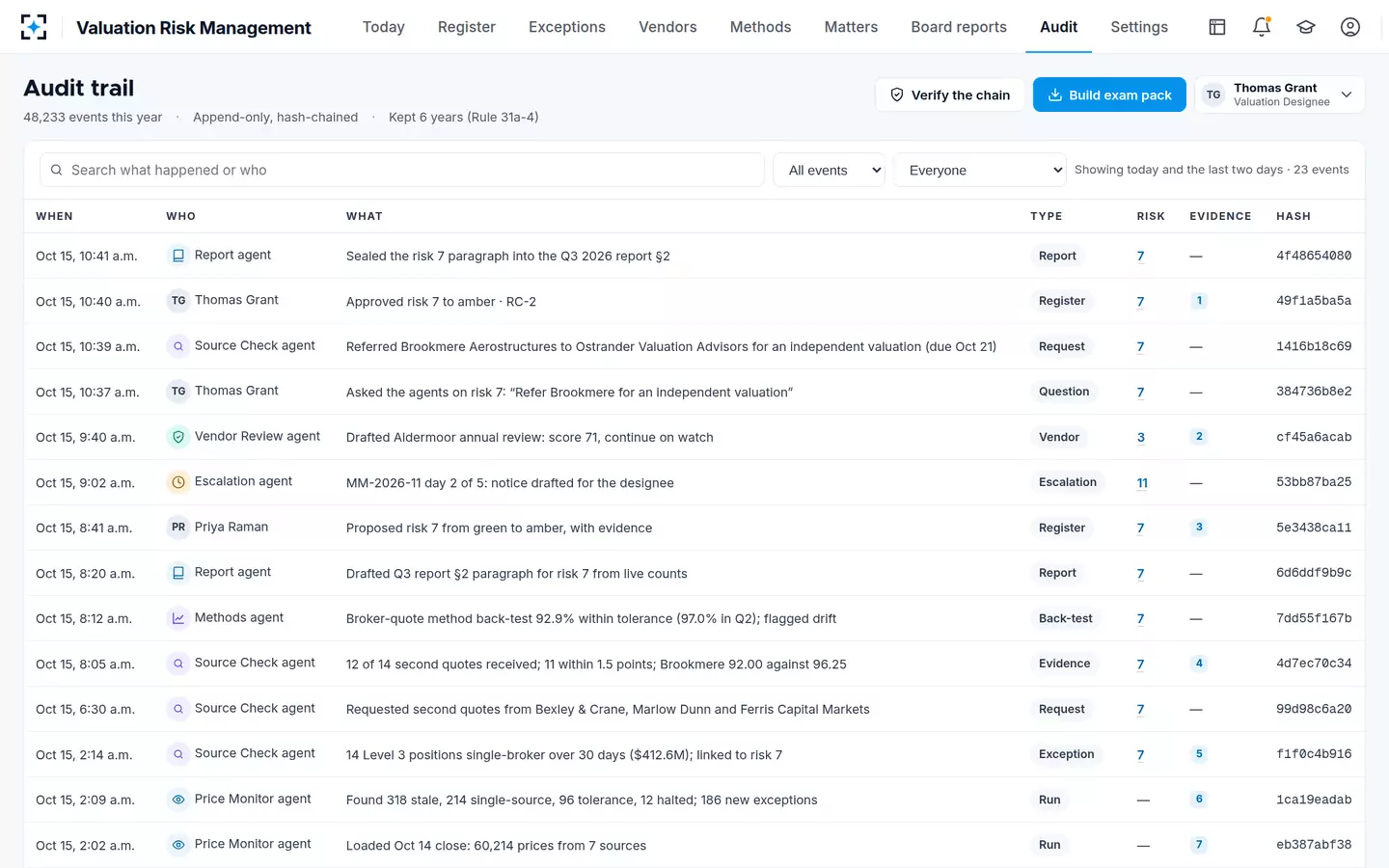
Where Valuation Risk Management shortens the waits, and where it cannot
Valuation Risk Management shortens the waits that are mechanical. The Price Monitor agent runs every check before anyone arrives; the Source Check agent requests second quotes the moment dealers open and reads borrowers’ reports in their original language; the Report agent drafts register and report paragraphs from the counts; the Escalation agent counts the business days on every material matter. Each result is handed to a named person with its deadline, and in the sample night 3 of 711 results fell below the 85% confidence line, below which an item is handed straight to a person.
It cannot shorten the waits that are judgement or that belong to other firms. Dealers still answer when they answer, the designee still has to read the evidence, and the treasurer still confirms the NAV. What changes is that the analyst’s morning starts with the fourteen positions that need a judgement rather than 60,000 prices that need a look. To see the sample morning, start at Valuation Risk Management; what each agent may and may not do is set out in a separate guide.
Questions people ask
What is the difference between a pricing analyst and a valuation analyst?
In fund valuation the titles overlap. A pricing analyst usually clears daily price exceptions and challenges vendors across liquid and evaluated holdings; a valuation analyst usually works on fair values for harder positions, often Level 3. In a Rule 2a-5 program both perform functions the valuation designee must name, and many teams combine them.
Who does a valuation analyst report to?
Normally to the head of valuation or another officer acting for the valuation designee, and not to portfolio management. Rule 2a-5 requires fair value determinations to be reasonably segregated from portfolio management, and the SEC suggests independent reporting chains as one way to do it.
Can a portfolio manager override a fair value?
No. Under Rule 2a-5 a portfolio manager may not determine fair values, directly or by exerting substantial influence on those who do. The SEC allows portfolio managers to provide input, and expects a more rigorous segregation process where that input is significant.
How many people does a valuation team need?
No rule sets a number. Rule 2a-5 requires the designee to assess annually whether the resources allocated to fair value are adequate, including changes in roles, so the honest answer is the number that keeps exceptions, challenges and back-tests current, evidenced in that annual assessment.
Does the analyst talk to the board?
Not usually. The board receives written reports and material-matter notices from the valuation designee. Analysts prepare much of the evidence, but the designee signs and is accountable for what the board receives.