A fund’s valuation policy and procedures are the written rules for how each investment is priced, who checks and approves prices, when fair value is used, how methods are tested and pricing services overseen, and how exceptions and errors are escalated. For a US registered fund they sit under Rule 38a-1, the compliance rule, and they implement the four fair value duties of Rule 2a-5; Rule 31a-4 then requires the documentation that supports each fair value determination to be kept for six years. Writing the policy is the easy half. The hard half is showing, on an examiner’s request, that every price decision followed it. Botminds’ Valuation Risk Management keeps that link for the valuation designee: each threshold cites its policy section, and each exception, decision and report carries its evidence on an audit trail kept six years.
The examples use a fictional sample complex, Quillfield Capital, valuation designee for 90 funds, and its valuation policy, version 4.2. The SEC request list is the one in the Division of Examinations’ November 2024 risk alert.
What examiners ask for on valuation, item by item, and what has to be ready
- Valuation policies and procedures of third-party providers involved in reviewing valuations
Your administrator’s and any outside valuation firm’s procedures, and evidence you reviewed them.
- Information “detailed by asset class” on reports and recommendations from pricing services, quotation services and valuation firms
Sources by asset class, the price hierarchy, and what each service supplied.
- Information on valuation processes
The risk alert’s examples: indicative bids used for fair value, comparisons with prior-day prices and with market indices, use of data or models, and changes in methods.
- Valuation reports and recommendations from third-party valuation firms
Each engagement, its scope and its result, and what the designee decided.
- Communications with auditors, valuation firms and other third parties about valuations
Challenges, queries and answers, dated.
- Prices from a pricing service or valuation firm “that were overridden or stale”
Every override with its reason and approver; every stale price with its resolution.
- Minutes and materials from board and committee meetings
The 2a-5 reports, material-matter notices and the board’s questions.
What should a fund valuation policy include? The four duties, made specific
A fund valuation policy should turn each of Rule 2a-5’s four duties into named methods, thresholds, owners and deadlines. The SEC did not adopt a separate requirement for fair value policies and procedures, because funds already need them under the compliance rule, Rule 38a-1, which requires written policies and procedures reasonably designed to prevent violations of the federal securities laws, approved by the board including a majority of independent directors, and reviewed at least annually for adequacy and effectiveness (17 CFR 270.38a-1; SEC, 86 FR 748).
The adopting release shows how specific the methods section has to be. It is not enough “to simply state that private equity investments are valued using a discounted cash flow model, or that options are valued using a Black-Scholes model”, without the qualitative and quantitative factors to be considered, the sources of inputs and assumptions, and how the calculation is performed. The rule also requires the testing section to name the testing methods and “the minimum frequency with which such testing methods are to be used” (17 CFR 270.2a-5(a)(3)).
Supervisors abroad describe the same content in plainer words. MAS’s May 2026 paper says policies should identify every party in the valuation process and its role, include methodologies and frequency for all relevant asset classes, “clearly outline escalation procedures for exceptions noted”, specify record-keeping, and be subject to regular and ad hoc reviews (MAS, Valuation Practices for Fund Management Companies, May 2026). ESMA’s 2023 review found the gaps that result when they do not, including policies without regular reviews that “clearly allocate operational tasks and responsibilities for asset valuation” and the “lack of a clear definition of the valuation model to be applied” (ESMA, CSA on asset valuation, May 2023).
Each policy line, the evidence the file must hold for it, in one sample policy
| Policy section (sample) | What it sets | Evidence the file holds |
|---|---|---|
| §3.2 Stale price | 5 business days unchanged, Level 1 and 2 | Each night’s stale list; each stale price’s resolution, owner and date |
| §4.1 and §4.5 Tolerances | ±2% investment grade, ±3% high yield, ±2 points loans; ±10% or a factor trigger for equities | Each tolerance break and how it was explained or escalated |
| §4.9 Back-test tolerance | 2% to 10%, by method | Every back-test result by method, every miss with its reason |
| §5.4 Single source, Level 3 | 30 days, then a second quote, an independent valuation or an approved model price | Single-source days per position; second quotes; referrals and results |
| §7.1 Materiality (pricing error) | A written materiality line | Error calculations and the decision on each |
| §7.2 Treasurer confirmation | Override NAV effect above 0.10% | The treasurer’s confirmation, timed before the NAV strike |
| §9.3 Material matter clock | 3 business days target, 5 at most | Awareness date, notice date and the notice for every matter |
| Roles and duties | Titles and functions; who may override; segregation from portfolio management | Who proposed and who approved each decision, with reason codes |
What does the SEC request about valuation in an exam?
The SEC’s Division of Examinations has published what it asks for. Its November 2024 risk alert on registered investment companies lists the documents typically requested, and the valuation items are concrete: “Information detailed by asset class regarding reports and/or recommendations from pricing services, quotation services, third-party valuation firms, and externally acquired portfolio accounting systems used in the valuation process”; information on valuation processes, such as “practices for comparing securities’ prices against prior day’s prices” and “review of securities’ prices against relevant market indices”; communications with auditors and valuation firms; and prices “that were overridden or stale” (SEC risk alert, November 4, 2024).
The same alert describes what examiners found. Deficient practices were observed on topics including “valuation of portfolio assets”, and the common failures were policies “not tailored to the funds’ business model” or “inconsistent with actual practices”. The second phrase is the one a valuation policy most often fails: a policy that says the stale threshold is five days, while the administrator’s report uses seven and the team clears exceptions on instinct, is a policy that does not describe the practice.
The list also shows what examiners do not ask for. They do not ask for a fund’s philosophy of valuation. They ask for records, by asset class, by source and by decision, which is why a policy is only as defensible as the file that shows it was applied.
What documentation does Rule 31a-4 require, and for how long?
Rule 31a-4 requires “appropriate documentation” supporting each fair value determination for at least six years from each determination, the first two in an easily accessible place; where a valuation designee is used, it also requires the board reports and the list of designated investments to be kept, the reports for six years after the end of the fiscal year in which they were given (17 CFR 270.31a-4). The policy itself, adopted under Rule 38a-1, is kept on that rule’s own schedule: the versions in effect at any time in the past five years, in an easily accessible place.
The SEC set the standard for “appropriate”. Documentation should let a third party who took no part in the determinations “verify, but not fully recreate” them. For prices from pricing services, the fund keeps its due diligence before selecting the service and its records of ongoing monitoring, including its challenge work, stale price analysis and testing, rather than the vendor’s internal inputs; and Level 3 positions typically need “different and more extensive documentation” than Level 2. The SEC’s 2026 estimate of the paperwork alone is 36 hours a year for each of about 10,047 funds (SEC notice, 91 FR 54768, August 24, 2026).
Three retention clocks for one valuation program
6years
from each fair value determination: the documentation supporting it (Rule 31a-4(a))
6years
after the fiscal year they were given: the designee’s board reports (Rule 31a-4(b))
5years
the policies and procedures in effect at any time in that period (Rule 38a-1(d))
36hours
a year per fund for Rule 31a-4 records, valued at $15,984 (SEC, August 2026)
What an auditor missed: the Infinity Q valuation file as the SEC described it
The SEC’s March 2026 order against the auditor of the Infinity Q Diversified Alpha Fund is the most detailed public account of a valuation file that could not support its numbers. The firm settled without admitting or denying the findings; the fund’s founder had already pleaded guilty to securities fraud and been sentenced to 15 years in prison (SEC order, In re EisnerAmper LLP, March 6, 2026).
Three findings are directly about the valuation file. The audit team identified the valuation of Level 3 assets as a significant risk and a fraud risk, yet the evidence it cited for effective valuation controls “addressed only the processes for the purchase and sale of investments—not valuation processes”. It “relied solely on inquiry” of the adviser and the administrator to understand how Level 3 assets were valued. And when it compared later sale prices with the pricing service’s values, it “inappropriately relied” on the founder to provide the service’s price at the date of sale. The order quotes the PCAOB standard on what an auditor considers in a fair value process, including “the integrity of change controls and security procedures for valuation models and relevant information systems, including approval processes”.
What the auditor could not find, and what a defensible valuation file holds
The Infinity Q audit, as the SEC found: Evidence covered purchases and sales, not valuation processes.
A defensible file: The valuation controls themselves: thresholds, owners, approvals, each tied to a policy section.
The Infinity Q audit, as the SEC found: Understood by inquiry of the adviser and administrator alone.
A defensible file: Method descriptions with inputs and sources, and the record of each determination.
The Infinity Q audit, as the SEC found: Sale-date prices for the back-test came from the founder.
A defensible file: Test inputs drawn from records the adviser’s investment staff cannot edit.
The Infinity Q audit, as the SEC found: A pricing model whose inputs and model choices the founder manipulated.
A defensible file: Every model and input change logged, with who approved it and when.
The Infinity Q audit, as the SEC found: Representations that the service priced “independently, without any input” from the adviser.
A defensible file: Due diligence on the service and a record of who can touch its inputs.
The lesson for a valuation policy is that a file can be complete and still worthless if the people it is meant to check controlled its inputs. A defensible file records not only what was decided but who could change the data behind the decision. Why that belongs on the valuation risk register as a conflict is covered separately.
How often should a valuation policy be reviewed, and who approves changes?
A valuation policy should be reviewed at least annually, because Rule 38a-1 requires an annual review of the adequacy of the fund’s policies and the effectiveness of their implementation, and on events that make it out of date. MAS found managers whose policies “did not reflect current practices”, managers that failed to review them at least annually, and one that did not state the frequency or triggers for review, so a change in its valuation committee’s composition was not reflected in time. It also found a manager that, contrary to its own policy, failed to obtain its valuation committee’s approval for the fair valuation of a listed security with a stale price, and did not document why.
Between reviews, changes to thresholds and methods should be proposed by one person and approved by another, and material ones reported to the board: Rule 2a-5’s quarterly report must cover material changes to, or deviations from, fair value methods. In the sample complex the systems administrator proposes changes to thresholds, the valuation designee approves or rejects them with a reason code, and every change is logged. On October 14 the administrator proposed raising the stale-price threshold for municipal bonds from five to ten business days because matrix-priced municipals trade rarely; until the designee decides, the five-day line stands.
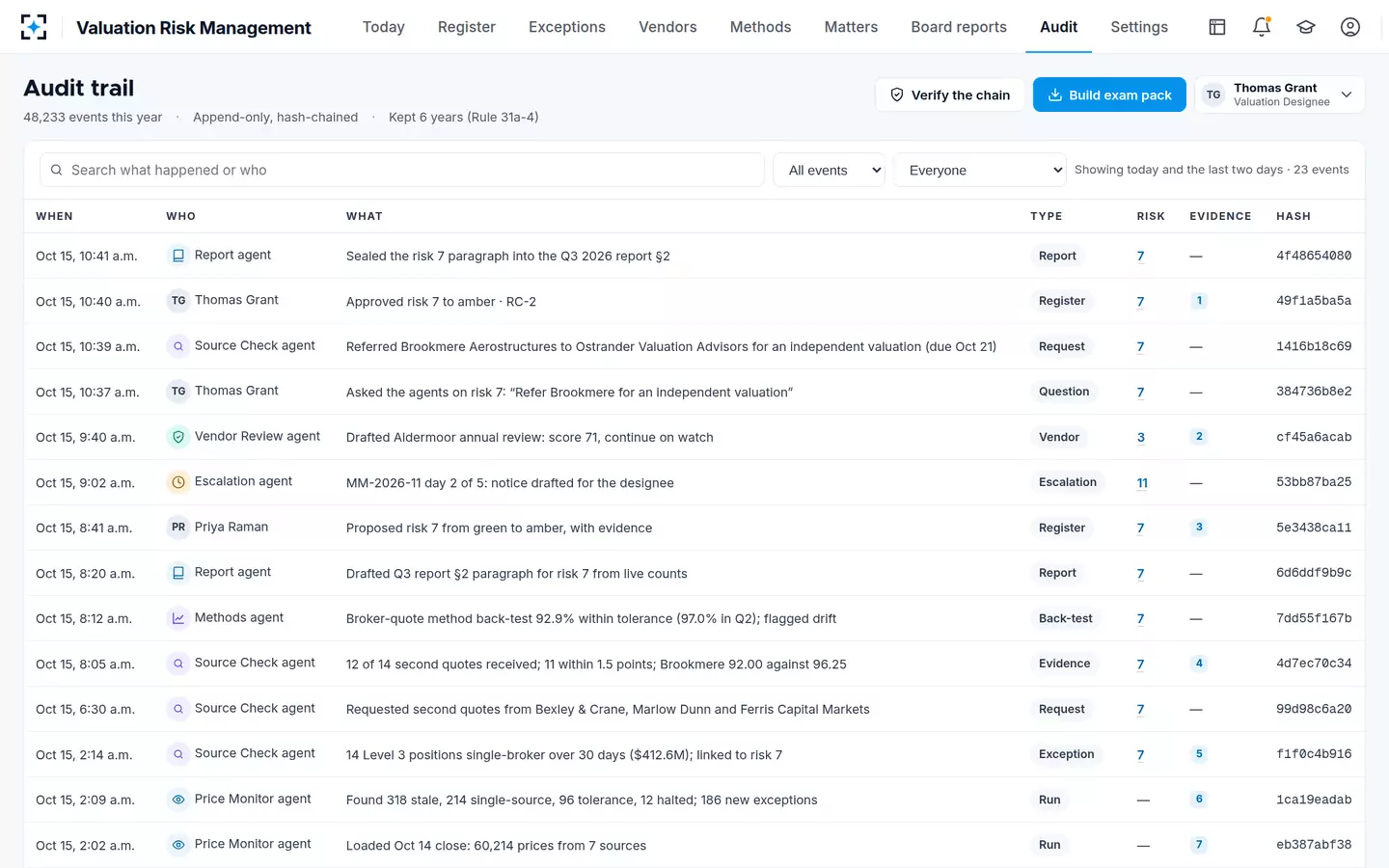
Valuation Risk Management: the audit trail an examiner can filter
How to prove the policy was followed: sample the file like an examiner
The quickest way to know whether a valuation policy is defensible is to test it the way an examiner or internal auditor would: pick decisions at random and try to trace each one back to the rule it applied. A sample of 25 is enough to find structural gaps; take it across asset classes and across the year, and include at least a few overrides, stale price resolutions, single-source Level 3 marks and vendor challenges.
For each decision, ask five questions. Which policy section governed it? What evidence was in front of the person who decided? Who proposed it and who approved it, and were they different people with the authority the policy gives them? Was it decided before the deadline that mattered, such as the NAV strike or the board book lock? And can a third party see all of that without asking anyone, which is the SEC’s “verify, but not fully recreate” standard? Score each decision complete or incomplete on each question. The share complete is a better measure of defensibility than any review of the policy text, and the incomplete ones show exactly which part of the process to fix.
The same test, run on a replayed quarter, is how a fund can evaluate oversight software before buying it. If the sampled decisions trace completely in the system and only partially in the current files, the difference is the case for the system; if they do not trace in the system either, it is not doing the job.
Pricing service oversight: the part of the file that is easiest to leave thin
Pricing service oversight is where valuation files are most often thin, because the prices arrive every night and nothing obliges anyone to look at the vendor until the annual review. The adopting release lists what the designee should consider before using a pricing service, and the list doubles as a file index: the service’s qualifications, experience and history; its methods, inputs and assumptions by class of holding and how they change with market conditions; the quality of its pricing information and how close to the NAV time it is determined; its process for handling price challenges; its actual and potential conflicts; and its own testing.
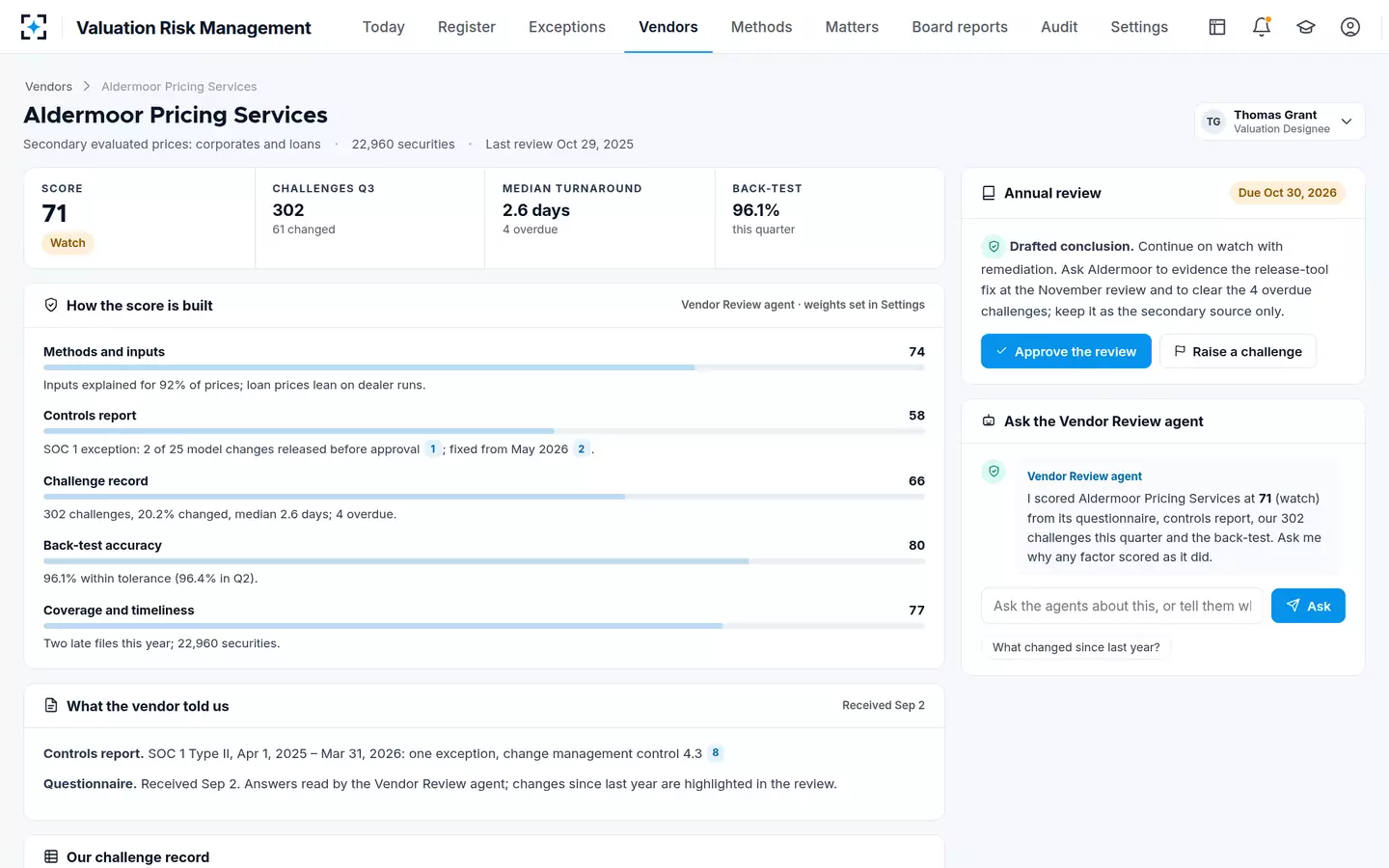
The sample complex’s annual review of a secondary vendor shows the evidence those factors call for. The review scores the vendor on its methods and inputs, its controls report (one exception: two of 25 model changes released before approval), its challenge record (302 challenges in the quarter, 20.2% leading to a change, a median turnaround of 2.6 days, four overdue), its back-test accuracy (96.1%) and its coverage. The draft conclusion, keep on watch as the secondary source, is for the designee to approve. The challenge process itself is the subject of what is a price challenge.
Valuation Risk Management: a vendor’s annual review, built from the fund’s own records
Turning a policy into a file that defends itself
A valuation policy defends itself when the system that applies it reads its thresholds from the policy, records each decision against the section it applied, and keeps the result where an examiner can filter it. Valuation Risk Management works that way: the settings cite policy sections, the Price Monitor agent applies them to every price every night, each exception carries an owner and a deadline, the analyst proposes and the designee approves with a reason code, and the Evidence agent seals the trail and builds the exam file. The policy, and every change to it, remains the designee’s. To see the file on the sample complex, start at Valuation Risk Management; the rule the policy implements is read clause by clause in a separate guide.
Questions people ask
What is a mutual fund valuation policy?
It is the board-approved document that sets how a fund’s holdings are priced each day: price sources and their hierarchy, fair value methods by asset class, tolerances and stale thresholds, how pricing services are overseen and challenged, who may override a price, and how errors and material matters are escalated. For US funds it is adopted under Rule 38a-1 and implements Rule 2a-5.
Does Rule 2a-5 require written fair value policies?
Not as a separate requirement. The SEC dropped the proposed requirement because Rule 38a-1 already requires funds to adopt and implement written policies and procedures, approved by the board and reviewed at least annually, which must cover compliance with Rule 2a-5.
What should a valuation policy say about portfolio managers?
That they may inform but not determine fair values. Rule 2a-5 requires fair value determinations to be reasonably segregated from portfolio management, so a policy should say how portfolio managers’ input is given and logged, who weighs it, and what extra review applies when that input is significant.
Who approves changes to a valuation policy?
The fund board approves the policies under Rule 38a-1, including a majority of independent directors. Within the policy, changes to thresholds and methods are usually proposed by the pricing team and approved by the valuation designee, and material changes to methods are reported to the board in the quarterly 2a-5 report.
What do regulators most often find wrong with valuation policies?
Policies that do not match practice. The SEC’s November 2024 risk alert cites policies “inconsistent with actual practices”; MAS in 2026 found policies that “did not reflect current practices” and a manager that did not follow its own approval rule for a stale price; ESMA in 2023 found policies that did not clearly allocate responsibilities.