The use of AI in fund valuation works best on the parts of the job that are high-volume and checkable: testing every price every night, chasing second quotes, reading borrowers’ and issuers’ reports, back-testing methods and drafting the board reports. It does not belong in the decision itself. Under SEC Rule 2a-5, fair value is determined in good faith by the fund’s board or by a valuation designee that must be the adviser or an officer of the fund, acting through people it names; an agent can propose and explain a price, but a person must approve it and answer for it. Botminds’ Valuation Risk Management is built on that line: seven agents that check, chase and draft, and a pricing analyst, a valuation designee and a fund treasurer who decide.
The examples come from a fictional sample complex, Quillfield Capital, valuation designee for 90 funds, and the night of its October 14, 2026 close.
Seven agents in Valuation Risk Management: what each may do, and what it never does
Price Monitor agent
MayCheck every price every night: stale prices, tolerance breaks by asset class, halted and suspended securities; link each exception to its register risk.
NeverChange a price; close an exception on its own.
Source Check agent
MayAsk other dealers for quotes on single-source positions; read issuers’ and borrowers’ reports in the original language; say which price it trusts and why.
NeverAccept a quote as fair value; below 85% confidence it hands the item to a person.
Methods agent
MayBack-test each fair value method against later sales, or the next day’s open for foreign equities; flag drift and explain every miss.
NeverChange a method; it proposes, for the analyst and then the designee.
Vendor Review agent
MayRead each pricing vendor’s questionnaire and controls report, join them with the fund’s own challenge record and back-tests, draft the annual review.
NeverApprove a review: the valuation designee approves every one.
Report agent
MayDraft the quarterly and annual 2a-5 reports and register paragraphs from live counts; redraft when the evidence changes.
NeverSend anything to the board; only signed reports are published.
Escalation agent
MayOpen a material matter by the board’s definition, count business days, draft the notice, chase the designee.
NeverNotify the board without the designee’s approval.
Evidence agent
MaySeal every exception, decision and report with its source and hash; build the auditor and exam files.
NeverEdit or delete anything: the trail is append-only.
Can AI set a fair value? Not under Rule 2a-5
No. Rule 2a-5 allows a fund’s board to designate a “valuation designee” to perform fair value determinations, and that designee can only be the fund’s adviser (not a sub-adviser) or, for a fund without one, its officers (17 CFR 270.2a-5(e)(4); the rule in plain words). The designee must specify the titles of the persons responsible for fair value and their functions. A model, however good, is not a person with a title; it is an input.
That does not make AI irrelevant to the rule. It places it. An AI system that proposes prices from comparables, reads a borrower’s accounts or estimates a factor adjustment is a methodology, or an input to one, and the rule’s second and third duties apply: the designee must select and apply it with its key inputs and assumptions specified, review it, and test it, naming the tests and their minimum frequency. If the AI comes from a third party and supplies pricing information, it looks a great deal like a pricing service, and the SEC’s oversight factors for pricing services, from their methods and inputs to their conflicts and testing, are the natural checklist (SEC, 86 FR 748).
The SEC also anticipated that testing would change. Calibration and back-testing are named as particularly useful, but the release says “new and different tools for testing may also become more prominent or useful” and that the rule “provides flexibility to allow funds to use new, appropriate testing methods”. An agent that back-tests every method nightly is one of those tools; it is still the designee who decides what a miss means.
What regulators have said about AI in asset management
US regulators have so far applied existing duties rather than writing AI-specific rules for fund valuation. In June 2025 the SEC withdrew its 2023 proposal on conflicts of interest associated with the use of predictive data analytics by broker-dealers and investment advisers, together with other pending proposals, saying it “does not intend to issue final rules” on them (SEC, Withdrawal of Proposed Regulatory Actions, 90 FR 25531, June 17, 2025). In its fiscal 2027 examination priorities, the Division of Examinations uses its own term, “super intelligence (SI)”, for the technology registrants are bringing into their businesses, and says it is stepping up its work to understand how these tools shape outcomes and whether firms still meet their existing obligations (SEC, Fiscal Year 2027 Examination Priorities, October 23, 2026).
ESMA, writing about retail investment services in May 2024, put the accountability point plainly: the management body answers for a firm’s decisions whether people or AI tools take them. It listed over-reliance among the risks, warning that firms and clients could lean on AI for decisions at the expense of human judgment (ESMA public statement, 30 May 2024). The statement concerns MiFID investment services, not fund valuation, but its logic transfers directly to a valuation designee.
The Financial Stability Board’s November 2024 report names the vulnerabilities that matter most for a valuation function: “third-party dependencies and service provider concentration”, “market correlations”, cyber risks, and “model risk, data quality and governance” (FSB, The Financial Stability Implications of Artificial Intelligence, 14 November 2024). Every one of those is already a source of valuation risk in the SEC’s list for Rule 2a-5; AI changes their size, not their kind. How those risks sit in a valuation risk register is covered separately.
How is AI used in fund valuation? Four jobs where it earns its place
AI earns its place in valuation where the job is reading, matching and counting at a scale people cannot do every night. The four that matter most are checking, chasing, reading and drafting.
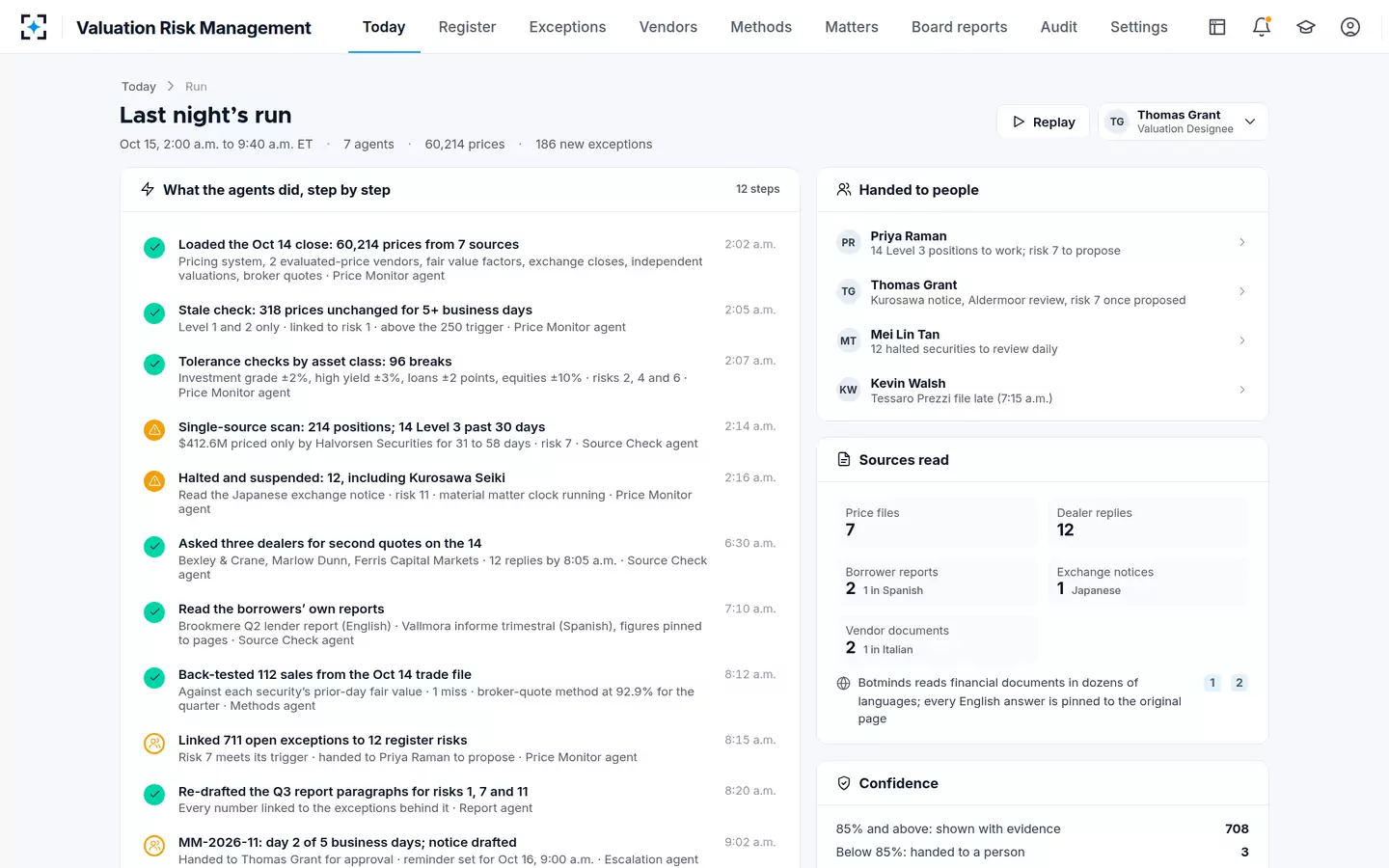
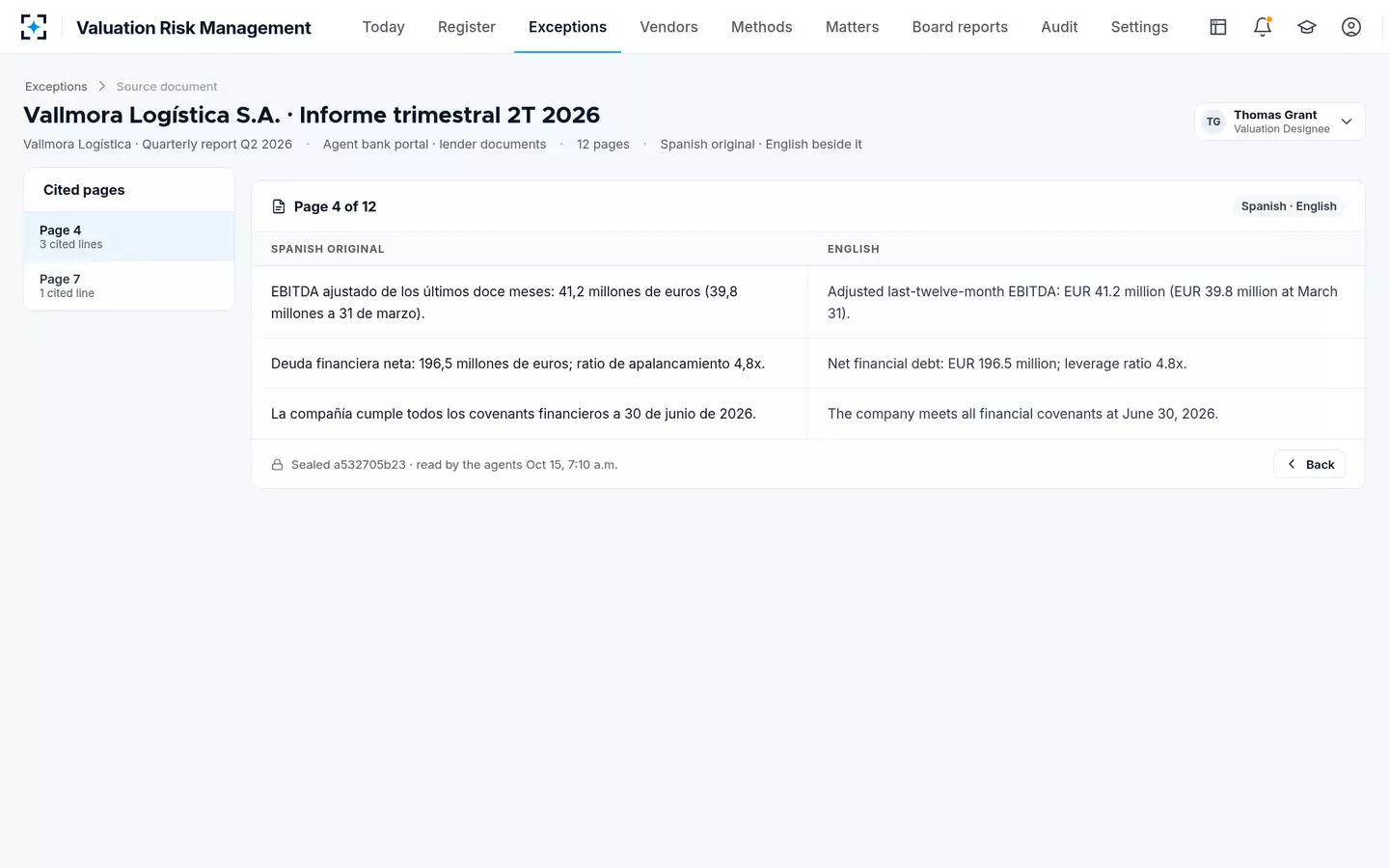
Checking means testing every price, not a sample, against the policy’s thresholds every night: the sample run tested 60,214 prices from seven sources and found 318 stale, 96 tolerance breaks, 214 single-source and 12 halted. Chasing means asking dealers for second quotes the moment they open and matching the replies to positions: requests went out at 6:30 a.m. and twelve of fourteen were in by 8:05. Reading means extracting the figures that move a Level 3 mark from a borrower’s quarterly report or an exchange notice in its original language, with each figure pinned to its page. Drafting means writing the register paragraph or the board report section from the counts, and redrafting it when a count changes.
One night in Valuation Risk Management: agents check and draft, people decide
Agent
Price Monitor agentLoads 60,214 prices; finds stale, tolerance, single-source and halted exceptions; links each to a register risk.
Never: Changes no price
Agent
Source Check agentAsks three dealers for second quotes on 14 single-source Level 3 positions; reads the borrowers’ reports; recommends a price with its reasons.
Never: Accepts no quote as fair value
Agent
Methods agentBack-tests the night’s sales; flags the broker-quote method falling to 92.9% within tolerance.
Never: Changes no method
A person decides
Senior pricing analystProposes a fair value of 92.00 on the largest position and raises the register risk to amber, with the evidence.
A person decides
Valuation designeeAsks why, refers the position for an independent valuation, approves the register change with a reason code.
A person decides
Fund treasurerConfirms the NAV effect of any override above 0.10% of a fund’s net assets before 4 p.m.
Agent
Report agentRedrafts the board report paragraph from the new counts.
Never: Sends nothing to the board
Last night’s run: twelve agent steps, each handed to a named person
Who is accountable for an AI-proposed price? The person who approves it
Accountability sits with the person who approves the price and, above them, with the valuation designee and the board. The agent’s recommendation is evidence in the file, like a broker’s quote or a vendor’s evaluated price, and it is weighed the same way: what is it based on, how independent is it, and how has its source performed when tested. In the sample, the Source Check agent recommended 92.00 for a loan one broker had quoted at 96.25 for 58 days, because a second dealer’s bid had a recent trade behind it. The analyst proposed 92.00 for the designee to approve before the 4 p.m. strike, the designee referred the loan for an independent valuation, and the file shows each step, including the agent’s stated confidence of 91%.
Three design rules keep that accountability real rather than nominal. Nobody approves their own proposal. An agent’s recommendation is never pre-selected as the answer; a person makes the proposal. And every recommendation shows its sources, so a reviewer can disagree with the reasoning and not merely with the number. ESMA’s over-reliance warning is about the failure mode these rules prevent: a person clicking approve on a number they have not examined.
Reading a borrower’s report in Spanish, every figure pinned to its line
Can an agent close a pricing exception? No: closing is a decision
An agent can resolve the evidence on an exception, but closing it is a decision and stays with a person. Closing a stale price exception says the price is still right; closing a tolerance break says the move is explained; closing a single-source exception says the second source is good enough. Each is a judgement about a fund investment’s value, and under the sample policy each is made by the analyst and, where it changes a price, approved by the designee. The Price Monitor agent never closes an exception on its own.
The same applies to anything the board will read. Agents draft the register paragraphs, the material-matter notice and the quarterly report, and the Escalation agent counts the five business days, but the notice goes to the board only when the designee approves it, and the report only after the treasurer has reviewed it and the designee has signed it. The 2a-5 report, annotated follows that sign-off chain.
One night’s numbers, and the one number that should always be zero
60,214
prices checked overnight from the October 14 close, across 90 funds
708
agent results at 85% confidence or higher, each shown with its evidence
3
results below 85%, handed straight to a person
0
prices, methods or register statuses changed by an agent
How do you test AI valuation agents before trusting them? Replay, seed, then watch
Test AI valuation agents the way Rule 2a-5 asks fair value methods to be tested: against outcomes, with named methods and a minimum frequency. Three tests do most of the work, and all three run on a fund’s own files rather than a vendor’s demonstration data.
The first is a replay. Run the agents over a past quarter’s nightly files and compare what they flagged and recommended with what the pricing team actually did and with what the securities later sold for. Every disagreement is either a miss by the agents, a miss by the team, or a policy setting nobody had written down, and each is worth knowing. The second is a seeded test: plant known problems in past files, such as a price held flat for weeks, a vendor price far from a dealer quote, or a halted share priced at its last trade, and count how many the agents catch, by type. The third is ongoing: track how often people overturn the agents’ recommendations above the confidence line, because a confidence threshold that people routinely overrule is set too low.
Changes to the agents need the same discipline as changes to a method. In the sample solution, every change to an agent’s instructions or model is versioned, evaluated on past decisions and approved by the valuation designee before it runs, and a change that alters what reaches the board is the kind of methodology change the quarterly 2a-5 report covers. A tool that cannot show this history for its own updates cannot show an examiner why a recommendation changed between quarters.
What to ask before buying AI for valuation: eight questions
A buyer evaluating AI for fund valuation should ask what the system decides, not only what it can do. The questions below follow the structure of Rule 2a-5 and the SEC’s oversight factors for pricing services, which are a sound template for any third party whose output reaches a fair value.
Eight questions for any AI valuation tool, and the answer to look for
- Can it change a price, a method or a register status without a person?
The answer should be no, enforced in the product, not just in a policy.
- Does every recommendation show its sources?
Dealer quotes, documents and policy sections, each opening to the line it came from.
- What happens below its confidence threshold?
The item should go to a named person with no answer pre-filled.
- Are the thresholds yours?
Stale days, tolerances and materiality lines should come from your valuation policy, each change approved by the designee.
- How is the tool itself tested?
The SEC requires named testing methods and frequencies for methodologies; a model that proposes prices needs the same, run on your own past decisions.
- Who can touch its inputs?
The Infinity Q case turned on a third-party pricing model whose inputs the adviser’s founder could alter; ask who can edit what the model reads.
- Is every step on an append-only record?
Rule 31a-4 asks for documentation a third party could use to verify a determination; a trail of each step, person and source is that documentation.
- Does it work beside your administrator and vendors?
It should read the files you already receive and write approved overrides back, not replace your NAV process.
Where Valuation Risk Management fits, and where it does not
Valuation Risk Management is an oversight system for the valuation designee, not a pricing service. It does not produce evaluated prices for bonds, value private companies from scratch, or replace an independent valuation firm; in the sample, the designee referred a loan to an outside valuation firm, and the agent sent the file and logged the due date. It does not compute the NAV; the fund administrator does, and approved overrides are written back to the pricing system. What it does is make sure every price has been checked, every exception has an owner and a deadline, every method is tested and every decision is recorded, so the designee can show the four Rule 2a-5 duties were performed. For the same discipline in the daily price challenge itself, see what a price challenge is, and the evidence behind one; to see the agents on the sample complex, start at Valuation Risk Management.
Questions people ask
Should the board be told when AI is used in valuation?
If adopting it is a material change to fair value methods or to the oversight of pricing services, Rule 2a-5 requires it in the quarterly report. Otherwise the board can ask for whatever it needs to oversee the designee, and a description of how agents are used and limited is a reasonable thing to provide.
What does the SEC say about super intelligence?
The SEC’s Division of Examinations uses the term in its fiscal 2027 priorities, published October 23, 2026: it says registrants are increasingly incorporating “super intelligence (SI)” into their businesses and that it is working to understand how the technologies influence outcomes and whether firms still comply with existing obligations. It has not adopted a valuation rule specific to it.
Is an AI pricing model a pricing service under Rule 2a-5?
If a third party regularly supplies evaluated prices, matrix prices, price opinions or similar pricing information from it, it fits the SEC’s description of a pricing service and should be overseen like one. A model built in-house is a methodology the designee must select, apply and test.
How do you test AI valuation agents?
Test them the way Rule 2a-5 asks methods to be tested: against outcomes. Replay past nights and compare the agents’ flags and recommendations with what the team decided and with later sale prices, and keep testing after go-live; the sample solution evaluates any instruction or model change on past decisions before the designee approves it.
Does using AI change the Rule 31a-4 records a fund must keep?
The rule is the same: appropriate documentation to support each fair value determination, kept six years. Where an agent’s recommendation is part of the evidence, the recommendation, its sources and the person who acted on it belong in that documentation.