The independent price verification process is the daily check that every price a fund is about to strike its NAV on is supported by evidence from someone other than the person or vendor who produced it. In practice it runs as six steps between the afternoon vendor files and the price lock: map every vendor price and dealer quote to a holding, test each price against its tolerances and second sources, separate the moves the market explains from the prices that are wrong, challenge or override the wrong ones, have a second person check every changed price, and lock. It is hard because the window is a few hours, the evidence arrives as emails and PDFs, and a static tolerance flags hundreds of prices that are fine. Botminds' Independent Price Verification runs the mechanical part of each step with agents and leaves every decision, check and lock to named people.
The worked examples on this page come from Quillfield Capital, a fictional fund complex the solution runs on as a sample: 312 funds, 25,184 prices on a Wednesday in October 2026, and a New York price lock at 5:30 p.m. Eastern.
The sample New York afternoon: files at 2:00 p.m., lock at 5:30 p.m.
- Files in, tested2:00–2:31
- Outliers explained, draftedto 3:12
- Challenges with the vendors3:12–4:05
- Decisions and second checks4:05–5:00
- Escalate, then lock5:00–5:30
- Released for the NAV5:30–6:30
What is independent price verification? A second, independent look at every price
Independent price verification, or IPV, is the control that tests a price against evidence its producer did not supply. The term is defined in EU bank law, as a process that regularly checks market prices and model inputs for accuracy and independence (Capital Requirements Regulation, Article 4(1)(70); the text is quoted in independent price verification regulations). In a bank, it checks the marks traders put on their own book. In a fund complex, the same idea is applied to the prices the fund accountant or administrator is about to use for the NAV, most of which come from pricing vendors rather than traders.
That difference shapes the fund version of the process. EU law lets a bank run its IPV as little as monthly on positions marked by the desk; a fund that deals daily has to verify daily, before the NAV is struck, because a wrong price is paid out to every investor who buys or redeems that day. The independence also lives somewhere else. In a bank it is the separation of the product control function from the trading desk; in a fund it is the separation of the pricing team from portfolio management, and the use of sources other than the vendor whose price is being tested. What counts as "independent" under each regime, and how often each requires the check, is set out in the companion guide to independent price verification regulations.
What are the steps in the independent price verification process?
The IPV process has six steps, and the order matters more than the tools: evidence first, tests second, judgement third, a second person fourth, the lock last. The table gives each step the owner, the output and the deadline it carries at the sample firm. The deadlines are that firm's policy settings, not rules; the owners are the ones any regulator would expect to find, because each hand-off is where independence is either kept or lost.
The independent price verification process: six steps, each with an owner and a deadline
| Step | Who does it | What comes out | Deadline at the sample firm |
|---|---|---|---|
| 1. Map every quote to a holding | Quote agent; the pricing analyst maps what it cannot | Every vendor price and dealer quote tied to a security, with where it came from | Continuously from midnight; vendor files by 2:10 p.m. |
| 2. Test every price | Outlier agent, against the firm's tolerance policy | Exceptions: prices outside tolerance, without a second source, stale, or moved by a corporate action | Within minutes of each file |
| 3. Separate the market from the error | Outlier and Market context agents propose; the analyst accepts | Moves the market explains, each with a reason and sources; the rest marked for a decision | Before the challenge cut-off |
| 4. Challenge, override or hold | Pricing analyst decides; Challenge agent drafts and tracks | Vendor challenges sent with evidence; overrides and holds with a reason code | Vendor reply within 60 minutes; escalation at 5:00 p.m. |
| 5. Second-person check | Valuation Manager; Head of Valuation above five points | Every changed price and every kept price outside the spread checked by someone who did not make it | Before the lock |
| 6. Lock and release | Fund Controller, who cannot change a price | Prices released to the accounting platform and the fund administrator | 5:30 p.m. New York; 4:30 p.m. London; 5:00 p.m. Singapore |
Two things in that table are easy to miss. The agents appear in steps one to four, but never as the owner of a decision: they read, test, explain and draft, and a person accepts, sends, overrides or holds. And step six has an owner who can do nothing except lock and release. Separating the person who locks from the people who decide is what lets the lock mean something.
Step one: every vendor file and broker run, mapped to a holding
The process starts with evidence, and most of the evidence is not in a feed. Vendor files arrive by file transfer and API, but dealer quotes arrive as broker runs in a shared pricing mailbox: tables in the body of an email, free text such as "99-11 / 99-19", PDF attachments and spreadsheets, some in German, Japanese or Portuguese. On the sample day the Quote agent read 1,312 runs from 46 dealers and six vendor files into 16,904 quotes and mapped 16,890 of them to the security master; the other 14 went to an analyst, because the solution hands any quote below 95% parse confidence or 98% mapping confidence to a person rather than guess.
Mapping is a verification step in its own right. A quote mapped to the wrong bond is worse than no quote, because it can make a wrong price look supported. That is why every quote keeps a pointer to where it was read: the vendor file line, the email and the table row, or the page of the PDF. When a challenge or an override relies on a quote later in the afternoon, the second person can open the original in one click.
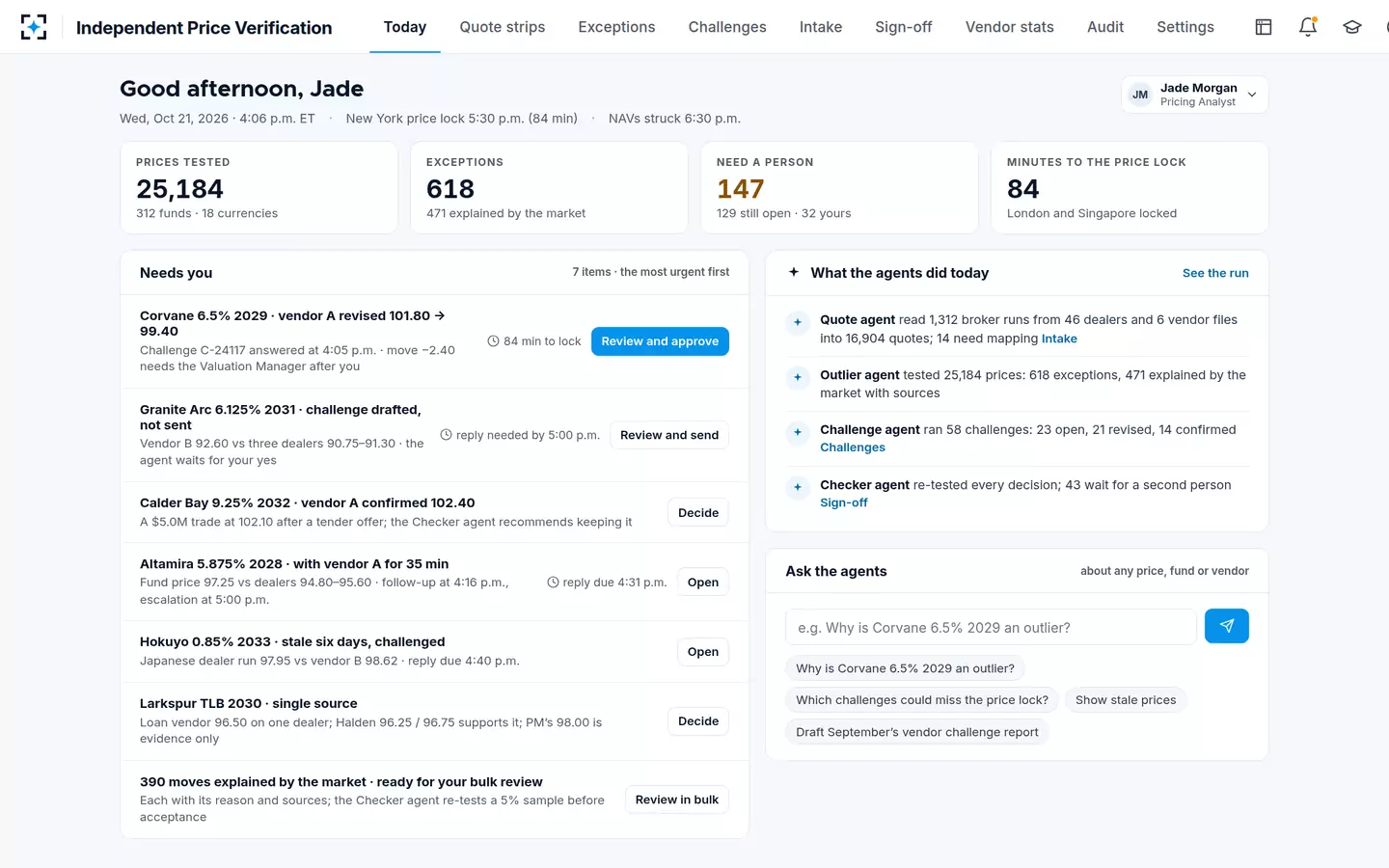
Independent Price Verification at 4:06 p.m.: what still needs a person before the lock
Step two: which checks does every price go through?
Every price should pass several different tests, because each test catches a different kind of error and misses the others. The Monetary Authority of Singapore's May 2026 paper on fund valuation lists the standard set: a price variance check on the day's move, a source-to-source check between two price sources, a missing price check, a stale price check, and two fund-level checks of the NAV against its index and against its previous NAV. MAS expects firms to "implement independent and ongoing price validation checks", and found that "Most FMCs, either on their own and/or through their third-party service providers, implemented at least two types of price validation checks" (MAS, Valuation Practices for Fund Management Companies).
The EU's rules for alternative fund managers go further and list the minimum checks on individual values, which make a good test of any IPV design. They include "verifying values by a comparison amongst counterparty-sourced pricings and over time", comparing realised prices with recent carrying values, comparing with a third party's values, "testing for stale prices and implied parameters", and, for model prices, "a review of the inputs used in model-based pricing, in particular of those to which the model’s price exhibits significant sensitivity" (Delegated Regulation (EU) No 231/2013, Article 71(3)).
“These checks should be supported by well-defined exception tolerance levels, along with clear escalation protocols and approval channels.”
Monetary Authority of Singapore, Valuation Practices for Fund Management Companies, May 2026
The checks a fund price should pass before the lock
- Day-over-day move within tolerance
Set by asset class: at the sample firm 0.25 points for Treasuries, 1.00 for high yield, 10% for listed equities.
- Second source within tolerance of the first
A second vendor, or the dealer median from at least three independent quotes; never the same source twice.
- Inside the dealer spread
The fund price sits between the lowest and highest dealer level; outside it, the gap needs a reason.
- Not stale
Unchanged beyond the asset class limit (one day for Treasuries, three for corporates, five for loans at the sample firm) while the market moved.
- Not single-source
A price that rests on one broker or one counterparty goes to a person, whatever its level.
- Corporate actions reflected
Calls, tenders, defaults and delistings move a price in ways a tolerance does not.
- Recent trades consistent
Reported trades of the same bond, adjusted for size and time, agree with the price.
- Fund-level sense check
The NAV move against its benchmark and its last NAV, which catches what security checks miss.
Step three: the market or the vendor?
Most exceptions are not errors. A static tolerance flags a bond whose price fell a point and a half, and it does not know that the whole high-yield energy sector fell a point that afternoon. On the sample day 618 of 25,184 prices broke a test, and the agents found that 471 of those were moves the market explained, each with its reason and sources: a sector move, a curve shift, a trade, or an issuer's own announcement. The remaining 147 needed a person.
The explanation has to be specific to be useful. "The market moved" is not a reason; "the whole Veloria curve fell 2.6 to 3.0 points after the budget vote failed" is, and so is an energy issuer's material-fact notice, published in Portuguese, that cut its allowed revenue 11% from 2027. The solution proposes explained moves for acceptance, never accepts them itself, and before the analyst accepts the 390 New York moves in one step its Checker agent re-tests a 5% random sample against the quotes. The seven kinds of exception that are genuine errors, and the check that catches each, are the subject of the guide to pricing exceptions.
One sample day: most exceptions are the market, not the vendor
25,184
prices tested across 312 funds and 18 currencies
618
exceptions, 2.5% of the prices tested
471
explained by the market, each with a reason and its sources
147
needed a person: a challenge, an override, a hold or a check
Step four: challenge, override or hold
For each price the market does not explain, the analyst has four choices, and each needs evidence and a reason. Approve the vendor's price, or a revised one; challenge the vendor with the dealer evidence and a level asked; override with a better-supported price; or hold the prior day's price because nothing reliable has arrived. The sample firm's policy gives each choice a reason code, from AP-02 ("vendor revised after challenge") to OV-04 ("corporate action not reflected") and HD-01 for a hold, and requires a reason before any of them is accepted.
The challenge is the step most often done badly, because it is the one that waits on someone else. On the sample day the Corvane 6.5% 2029 bond sat at 101.80 at pricing vendor A while three dealers bid 99.10 to 99.60 and $2.0 million had traded at 99.25. The agent drafted the challenge at 3:09 p.m. with three broker runs, the trade and the issuer's release cutting its earnings guidance attached and the dealer median, 99.35, as the level asked; the analyst sent it at 3:12, and vendor A revised to 99.40 at 4:05 p.m. How a challenge is built and what moves a vendor is covered in what is a price challenge.
An override is the riskier choice, because it replaces an independent source with the firm's own view. The SEC said as much when it adopted Rule 2a-5: alongside naming who may override, "the valuation designee is required to establish a process for the review of price overrides" (SEC, Good Faith Determinations of Fair Value, 86 FR 748). That review is step five.
Step five: a second person, then the lock
Every changed price goes to someone who did not make it. At the sample firm that is the Valuation Manager for any override, any kept vendor price that sits outside the dealer spread, and any move above two points; above five points, or for a Level 3 position, the Head of Valuation and the valuation committee. The checker does not redo the work. The solution's Checker agent re-tests each approval against the pricing policy first, so the person sees whether the evidence is present, whether the new price sits inside the spread and whether the reason fits, and the system will not let anyone check an item they made.
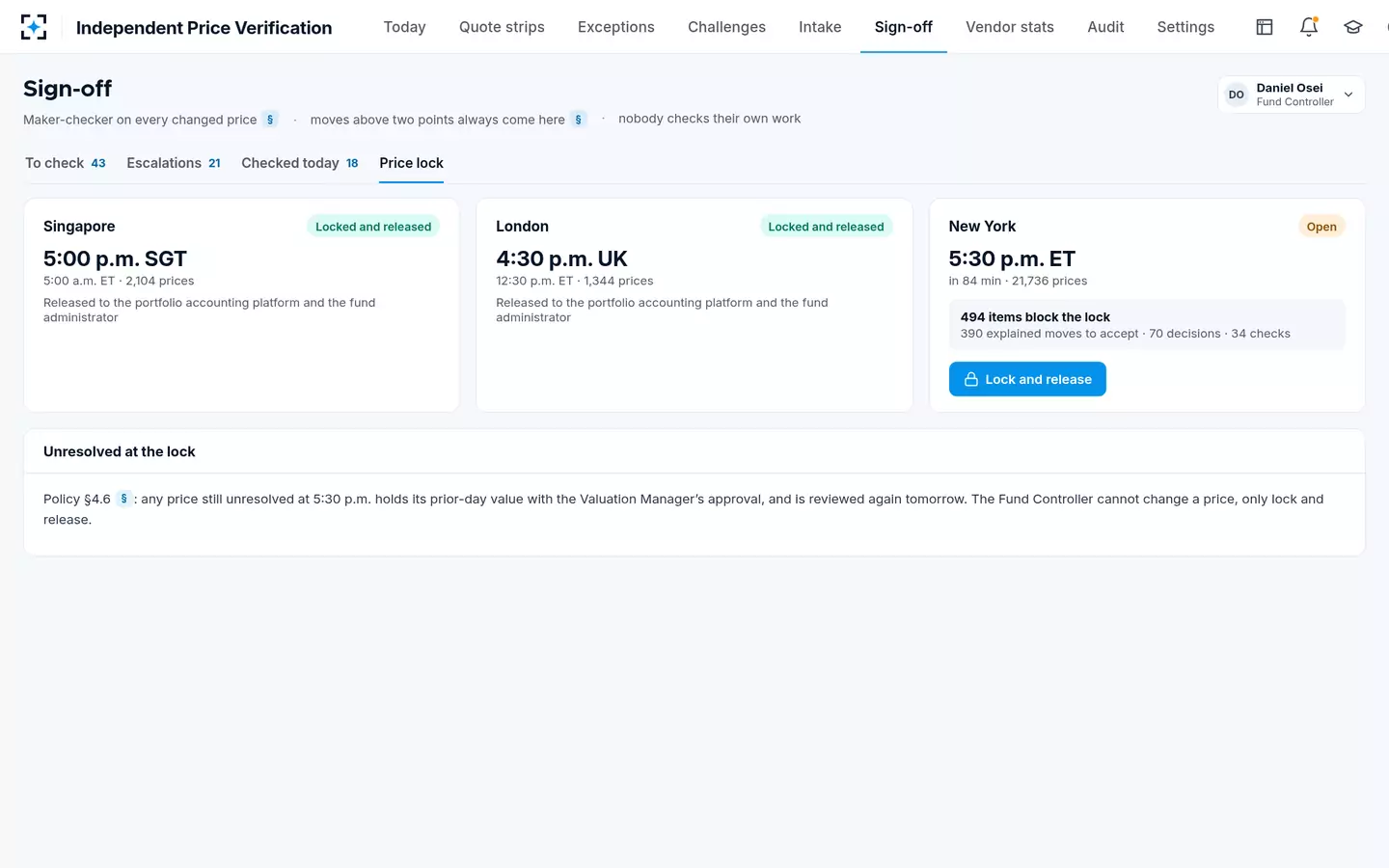
The lock closes the process. At 4:06 p.m. on the sample day 494 items still blocked the New York lock: 390 explained moves to accept, 70 decisions and 34 checks. The Fund Controller locks and releases when they clear, and the policy says what happens to anything still open at 5:30 p.m.: it holds its prior-day value with the Valuation Manager's approval and is reviewed again the next morning. A lock with a written rule for the unresolved is what stops a price changing after the NAV has been struck.
The price lock in Independent Price Verification: three regions, and what still blocks New York
How long does independent price verification take?
A daily-dealing fund's IPV has to fit between the last vendor file and the price lock, and at the sample firm that window is three and a half hours. No regulator or independent study publishes how long the process takes, so the useful measure is your own. At the sample firm the New York files arrive at 2:00 and 2:10 p.m. and the lock is at 5:30 p.m. Botminds estimates that, done by hand, the analyst's afternoon divides into about an hour reading broker runs and retyping levels, an hour working static-tolerance exceptions the market explains, 45 minutes drafting and chasing challenges, half an hour on overrides and the second check, and a quarter of an hour gathering evidence. That leaves no slack for a volatile day.
The clock that matters most is not the analyst's but the vendor's. A challenge sent at 4:45 p.m. will not be answered before a 5:30 p.m. lock, so the process has to surface the outliers early. The sample policy gives vendors 60 minutes to reply, follows up at 45 and escalates anything unanswered to the Valuation Manager 30 minutes before the lock. Measured on the sample firm's September, pricing vendor A's median reply was 47 minutes and vendor B's 63; a firm that does not know its own vendors' reply times cannot set a challenge cut-off.
What evidence does the independent price verification process leave behind?
Every step should leave its evidence, because the process is examined afterwards. US funds must keep the documents that support their Rule 2a-5 fair value determinations for at least six years (17 CFR 270.31a-4), and the Rule 2a-5 adopting release names the working papers it expects, including those on price challenges and stale price analysis. MAS found the opposite in practice: some managers "failed to maintain proper records to evidence the price validation checks performed, the investigations conducted on exceptions identified and how they were resolved".
In the solution the evidence is a by-product of doing the work. Each quote keeps its source; each exception keeps its test, the agent's explanation and its citations; each challenge keeps the message, the attachments, the reply and the times; each decision keeps the reason code, the maker and the checker. The trail is append-only and kept seven years, and an auditor with read-only access can follow any month-end price back to the quote it rests on without asking for a spreadsheet.
Questions people ask
What is IPV in finance?
IPV stands for independent price verification: testing the prices used for a book or a fund against evidence from sources independent of whoever set them. In banks it is defined in the EU Capital Requirements Regulation and checks traders' marks at least monthly; in fund management it is the daily check of vendor and administrator prices before the NAV is struck.
Who performs independent price verification?
A team independent of the people whose prices are tested: product control in a bank, and in a fund complex a pricing or valuation control team that does not report to portfolio management. Many fund managers also rely on the fund administrator's checks; MAS's 2026 paper notes that firms commonly use administrators to value funds independently, but the manager still owns the oversight.
How often should independent price verification run?
As often as the price is used. EU bank law sets a minimum of monthly for trading book positions, more often depending on the market. A daily-dealing fund prices daily, so the verification that matters runs daily before the lock, with month-end reviews for hard-to-value positions on top.
What is the difference between independent price verification and fair value pricing?
Fair value pricing is setting a value when no reliable market quotation exists, using a method; independent price verification is testing whatever price is used, quoted or fair valued, against independent evidence. Under Rule 2a-5 most bond prices from pricing services are fair values, so IPV is largely the testing of fair values every day.
Can the price verification process be automated?
The mechanical steps can: reading quotes, mapping them, running the tests, explaining market moves and drafting challenges. The decisions should not be. In Independent Price Verification the agents never accept a price, send a challenge unseen or edit a price; the analyst decides, a second person checks, and only the Fund Controller locks.