Independent valuation services are third-party firms that value, or give an opinion on the value of, a fund's hard-to-value investments, usually private or illiquid positions, on a monthly or quarterly cycle; they are not usually what checks the thousands of vendor prices a daily-dealing fund uses every afternoon. That daily work is done by the fund administrator's price checks, by the manager's own pricing team, or by that team working with agents, and the choice between them is a choice about coverage and cost. Under every regime the manager keeps the responsibility whichever it chooses. Botminds' Independent Price Verification is the agents option: it does the reading, testing and drafting for the manager's own team, so the team covers every price daily without growing with the number of exceptions.
Independent valuation services, the administrator, an in-house team or a team with agents
| Option | What it usually covers | How often | Who decides the price | How the cost is set |
|---|---|---|---|---|
| Independent valuation firm | Hard-to-value and Level 3 positions: a full valuation, a range or an opinion | Monthly or quarterly, and on events | The manager, using the opinion as evidence | Fees per engagement or per position; not published |
| Fund administrator's price checks | Tolerance, stale and missing-price checks on every price it uses for the NAV | Daily, with the NAV | The administrator flags; the manager decides challenges and overrides | Within or beside the administration fee; not published |
| In-house pricing team | Every price, challenges, overrides, vendor oversight | Daily before the lock, plus month-end reviews | The team, with a second person | Analysts' time plus second-source data |
| In-house team with agents | The same, with reading, testing, explaining and drafting done by agents | Daily before the lock, plus month-end reviews | The team, with a second person; agents never decide | Fewer analyst hours per price, plus the software subscription |
What are independent valuation services?
Independent valuation services are firms outside the manager that provide valuations of specific investments, from a full independent valuation to a review of the manager's own number, typically for assets with no reliable market price. The UK Financial Conduct Authority's 2025 review of private market valuation found that "Most participants engaged a third-party valuation adviser, where a full independent valuation was the most common service type", and put their role simply: "Third-party valuation advisers can provide additional independence and expertise" (FCA, Private market valuation practices).
The same review sets the limit. "The value of their services as an additional control will depend on how firms use and engage with these providers." Under UK rules a full-scope AIFM must appoint an external valuer if it does not perform the valuation itself, and the FCA found that arrangement rare: firms used advisers "while retaining responsibility for valuation". That is the shape of the market in general. An independent valuation service adds evidence and expertise; it does not take the decision, or the responsibility, off the manager.
What do independent valuation firms review?
Independent valuation firms usually review the positions a manager cannot price from the market: private credit and equity, structured and distressed debt, and anything valued by model with unobservable inputs. Their output is a value, a range or an opinion on the manager's value, delivered monthly or quarterly and on events. MAS's 2026 paper describes the same role for Singapore managers: "External valuers may be engaged to provide relevant valuation expertise if this is lacking within the FMCs, the fund administrators or custodian" (MAS, Valuation Practices for Fund Management Companies).
What they do not usually do is the daily verification of thousands of vendor-priced bonds, loans and equities before a NAV is struck. That is a different job on a different clock, and it is where most of a daily-dealing fund's prices sit. The comparison below sets the two side by side.
What an independent valuation firm reviews, and what daily price verification covers
Independent valuation firm: A few dozen to a few hundred hard-to-value positions
Daily price verification: Every price used for the NAV, often tens of thousands
Independent valuation firm: Monthly, quarterly, or on an event
Daily price verification: Every pricing day, before the lock
Independent valuation firm: Models, comparables, the manager's information
Daily price verification: Vendor prices, dealer quotes, trades, issuer news
Independent valuation firm: A value, a range or an opinion
Daily price verification: Exceptions explained, challenged, overridden or held
Independent valuation firm: Fee dependence on the manager
Daily price verification: Pressure at the lock; quotes the portfolio manager supplied
Should we outsource price verification?
Outsource the work you cannot do better yourself, and never the responsibility. For hard-to-value positions, an external valuer brings expertise and a second view the in-house team may not have. For daily verification of market-priced positions, the administrator's checks are a useful first line, but the manager still has to oversee them, challenge them and decide. Hong Kong's code puts it in one sentence: "the Fund Manager remains responsible for the valuation of a fund’s assets notwithstanding the appointment of a third party to perform valuation services" (SFC, Fund Manager Code of Conduct, paragraph 5.3.4).
Two risks come with any outsourced service. The FCA warns that a service provider which depends on a firm's fees may be less independent than it looks. And an outsourced check is only as good as the manager's oversight of it: MAS found managers that accepted their administrator's price although their own second source disagreed, and one whose administrator's stale price reports used a different definition of stale from its own. Whatever is outsourced, the manager needs the people and the evidence to check the checker.
Is daily price verification outsourced?
Often in part, rarely in full. MAS observed that managers "commonly engaged third-party service providers, such as fund administrators to independently value funds’ assets", with the administrator performing the ongoing price validation checks and reporting the outcomes. Larger managers it inspected added their own checks on top, including a shadow NAV run by teams independent of portfolio management.
The split that works in practice is that the administrator runs the checks it needs to strike the NAV, and the manager's pricing team owns the decisions: which prices to challenge with the vendors, which to override, which to hold, and how to evidence each. The manager's team is also the only one that can see across all its funds and administrators at once, which is where MAS found one bond priced differently in different funds. Who sits in that team, and to whom it reports, is the subject of the valuation control group.
How much does independent price verification cost?
No public price list exists: pricing vendors, valuation firms, administrators and software vendors do not publish prices, and no regulator or independent study has measured what daily verification costs a fund. What can be estimated is the largest cost a manager controls, the analyst time, from public wage data and the work itself. The method below uses Botminds' estimate of one analyst's afternoon on a day like the sample firm's and public employer-cost figures.
One analyst seat's afternoons for a year, by hand and with the agents (our estimate)
Read the estimate for what it is. It prices one seat's afternoon; a firm with several pricing locations or asset-class desks multiplies it. It does not include the second-source data, which most firms already buy, or the software. And it does not price the outcome a pricing team exists to prevent, a wrong NAV paid to investors, which is case-specific: in one SEC case the odd-lot marks added up to $0.31 a share to an ETF's NAV, and the settlement included an $18.3 million penalty.
There is also a cost every US fund carries whichever option it chooses: the paperwork of fair value. The SEC's own estimates, in its August 2026 notices extending the rules' information collections, put Rule 2a-5's information collection at "34 hours per response", one response per fund each year, with "a monetized time cost of $33,422 per response" and an external cost of $3,632, and Rule 31a-4's record keeping at about 36 hours and $15,984 per fund a year (SEC notice, 91 FR, August 28, 2026; August 24, 2026). Those figures cover documentation and reporting, not the daily verification itself.
What the SEC estimates fair value paperwork costs a fund each year
34h
a fund a year for Rule 2a-5's information collection
$33,422
monetized staff time per fund, plus $3,632 of external cost
36h
and $15,984 a fund a year to keep Rule 31a-4's fair value documentation
The number that drives the cost: prices that need a person
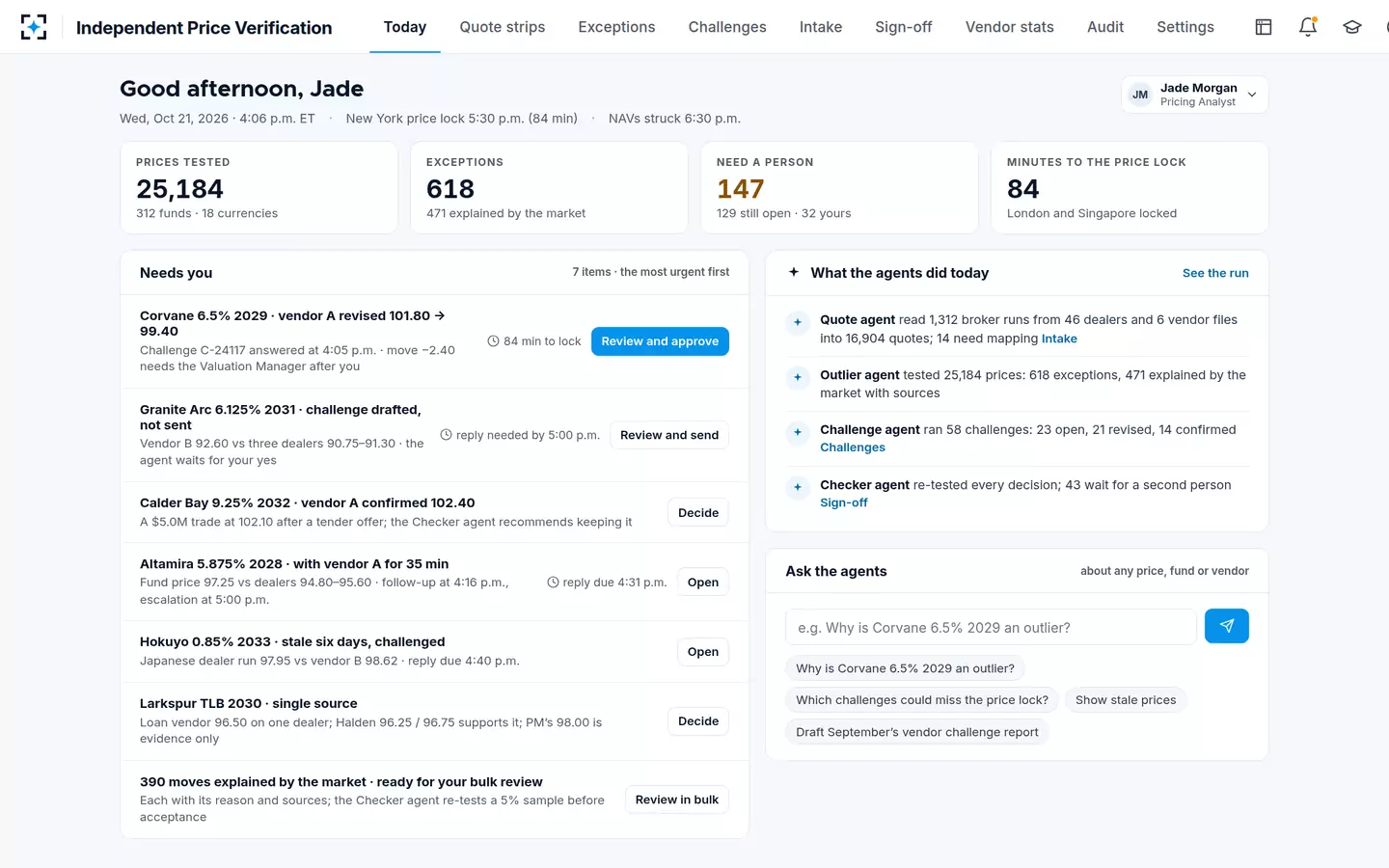
The cost of daily verification is set less by how many prices a firm holds than by how many need a person each day, and how long each takes. On the sample firm's day, 25,184 prices were tested; 618 broke a test; 471 of those were explained by the market with their sources; 147 needed a person. If a team works all 618 by hand, its size follows its tolerances and the day's volatility. If the market-explained exceptions are separated first, it follows the 147, about one price in 170.
That ratio is the one to measure before choosing an option. Take a month of your own exceptions, count how many ended in a challenge, an override or a hold, and time a sample of each. The result tells you how many analyst hours the work really needs, how much of the afternoon is mechanical, and whether the time goes on the prices that matter. How to build that measurement properly, including the direction of overrides, is set out in price validation.
Independent Price Verification on the sample day: 147 prices need a person, out of 25,184
Which option fits which kind of fund complex?
The right mix follows the book, not the size of the firm. Three profiles cover most cases, and each ends with the same rule: the manager decides and keeps the evidence.
Mostly listed equities and government bonds. Prices come from exchanges and active markets, exceptions are few and mostly stale or missing prices, and the administrator's checks with a small in-house review may be enough. The risk to watch is the one MAS found, a check that compares the administrator's price with the same source the administrator used.
Large bond and loan books, daily dealing. Thousands of evaluated prices a day, dealer quotes arriving by email in several languages, and challenges that must be answered before the lock. This is where the in-house team carries the load and where its hours go on reading and on exceptions the market explains; it is the case agents are built for. External valuers come in only for the hard-to-value tail.
Private credit and other Level 3 positions. Few prices, each a model with unobservable inputs, valued monthly or quarterly. Daily price verification has little to test here; the work is the valuation itself, an external opinion where the expertise or the independence is needed, and a committee that can explain each number. The SEC's fiscal 2027 examination priorities single out the valuation of illiquid investments, including private credit, as an area of interest.
Where agents fit, and where you still need a valuer
Agents fit the daily, evidence-heavy, rule-driven work: reading broker runs in any format, mapping quotes, running every check, explaining moves with sources, drafting challenges and tracking replies. That is where the hours go and where a team's size is set. They do not replace the judgement the team keeps, the decision on every price, the second check and the lock, and in Independent Price Verification they are not allowed to: the agents never accept a price, send a challenge unseen or edit a price.
Nor do they replace an independent valuer for positions with no market to verify against. A private credit loan valued quarterly by a discounted cash flow model needs expertise in the borrower and the model, and possibly an outside opinion; testing it against dealer quotes that do not exist is not verification. A sensible budget therefore has three lines: the team, with agents doing the mechanical work, for the daily prices; external valuers for the hard-to-value positions; and the pricing vendors themselves, overseen rather than replaced, as the guide to pricing vendors for securities explains.
Before you sign for any of the four options
- Count the prices that need a person each day
From a month of your own exceptions, not from the exception total.
- Split positions by how they can be verified
Market-priced daily, hard-to-value by model, and those in between.
- Ask each provider what it covers, how often, and with what output
The FCA expects firms to tell investors the service's portfolio coverage and frequency.
- Check independence, including fee dependence
A valuer or administrator that depends on your fees is less independent than it looks.
- Keep the decision and the evidence in house
Every regime leaves the responsibility with the manager.
- Test on a past day before committing
Compare the option's exceptions and challenges with what your team actually decided.
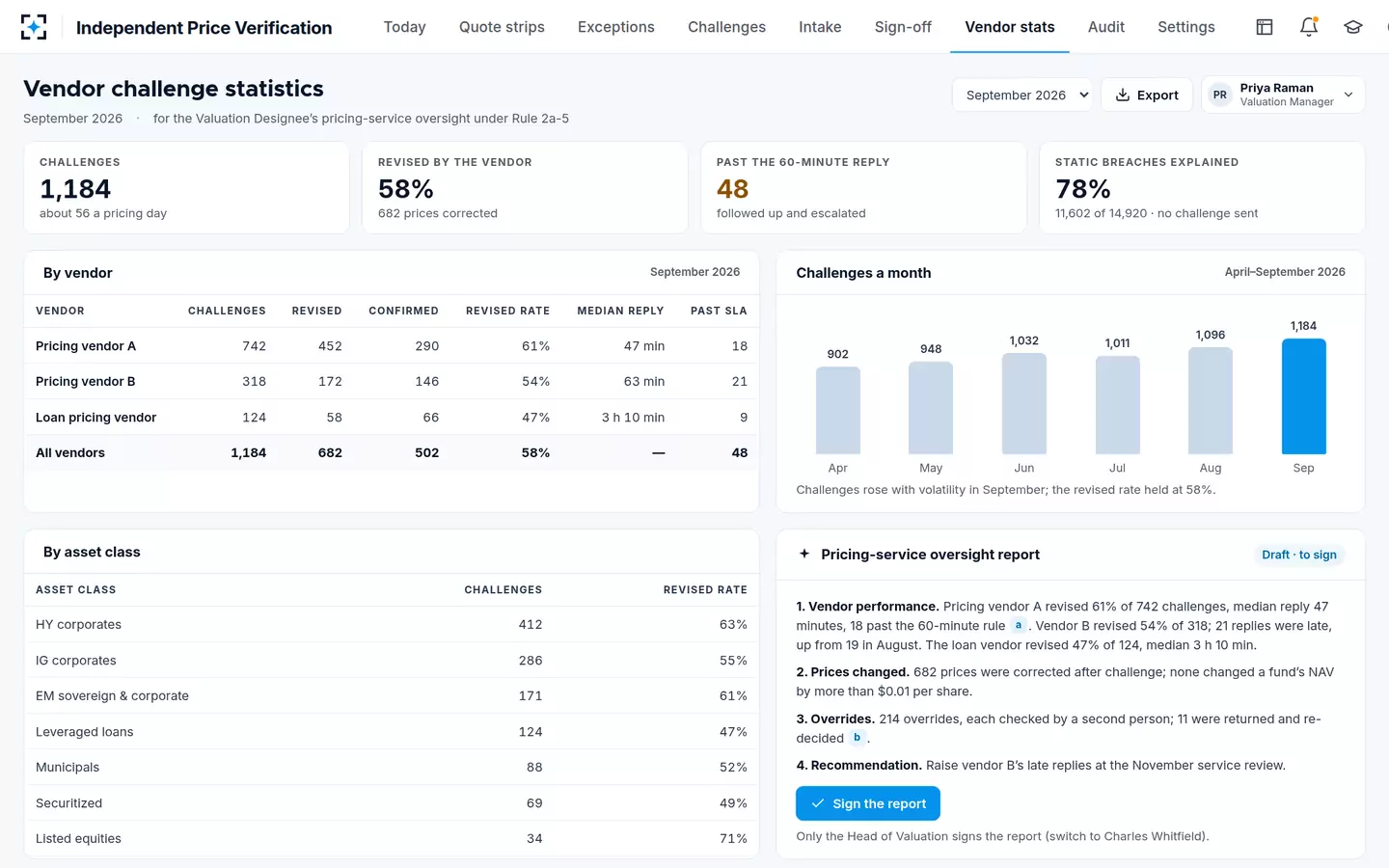
What a month of daily verification in Independent Price Verification gives the valuation designee
Questions people ask
What is an independent valuation review?
It is a review by someone independent of the manager, often an external valuation firm, of the value the manager has put on an investment, or of the valuation process itself. Hong Kong's code requires the process to be reviewed at least annually by a competent, functionally independent party, including testing it.
Does outsourcing valuation move the responsibility?
No. The SFC's code says the manager remains responsible despite appointing a third party, the FCA found firms using valuation advisers while retaining responsibility, and under Rule 2a-5 the board or valuation designee keeps the duty to oversee pricing services.
Is the fund administrator independent enough to verify prices?
It is independent of portfolio management, which is why MAS allows administrators to satisfy the independent valuation requirement. But MAS also found managers that accepted administrators' prices without challenge or did not notice stale prices in administrators' reports, so the manager must oversee and test the administrator's checks.
How many analysts does a pricing team need?
No regulator or independent study publishes a ratio. Estimate it from your own data: the prices that need a person each day after market-explained exceptions are removed, times the time each takes, plus month-end vendor oversight and reviews.
How much do independent valuation firms charge?
They do not publish standard prices; fees depend on the number and complexity of positions, the service level and the frequency. Ask for pricing per position and service level, and weigh it against the FCA's point that a provider dependent on your fees may be less independent.