Evaluated pricing is the price a pricing vendor estimates for a security that has no reliable quoted price of its own, typically a corporate, municipal or securitized bond or a loan, using a model fed by recent trades, dealer quotes, benchmark curves and the prices of comparable securities. It is a model's answer to "what would this trade at now?", delivered daily to funds, administrators and auditors, and for a bond fund it supplies the daily price of every holding that did not trade. That makes it essential and fallible at once: the SEC does not treat an evaluated price as a market quotation, two vendors can price the same bond points apart, and a model lags news it has not been fed. Botminds' Independent Price Verification tests each evaluated price against the dealer quotes and trades a fund already receives, explains the gaps the market accounts for, and drafts a challenge when the vendor's model has missed something.
The bond used as the example on this page comes from Quillfield Capital, a fictional fund complex the solution runs on as a sample.
Evaluated price and trade price: two different kinds of number
Evaluated price: A vendor model's estimate of where the security would trade
Trade price: A price at which a trade actually happened
Evaluated price: Every day, for every security the vendor covers
Trade price: Only when the security trades, which for many bonds is rarely
Evaluated price: Trades, dealer quotes, benchmark curves, comparable securities, vendor assumptions
Trade price: One buyer, one seller, one size, one moment
Evaluated price: A convention, often an institutional round lot
Trade price: The size that traded, which may be small
Evaluated price: Not a readily available market quotation: a fair value input
Trade price: Evidence of fair value, adjusted for size, time and side
Evaluated price: Against quotes, trades and a second vendor, and by its inputs
Trade price: Against other trades and how far it is from the moment of valuation
What is evaluated pricing?
Evaluated pricing is one of several services the SEC groups under "pricing services": third parties that regularly give funds "evaluated prices, matrix prices, price opinions, or similar pricing estimates or information" to help determine fair value (SEC, Good Faith Determinations of Fair Value, 86 FR 748). The vendor publishes a price per security per day, at the sample firm 12,880 bond prices in one vendor's New York file alone, and stands behind its method rather than behind any single number.
Its value is coverage. Most bonds do not trade on a given day, so without evaluated pricing a fund would have no daily price for much of its book. Its weakness follows from the same feature: on the day a bond does not trade, the price is an inference, and the inference is only as current as the inputs the vendor has.
How do pricing vendors price bonds that do not trade?
A pricing vendor prices a bond that has not traded by inference from what has: recent trades in the same bond, trades and quotes in similar bonds from the same issuer or sector, dealer quotes and runs, and a spread over a benchmark curve that it moves with the market. The common technique for less liquid bonds is matrix pricing, which places a bond on a grid of comparable securities by rating, sector, coupon and maturity and reads its price off the grid. For more liquid bonds the vendor leans on trades and quotes in the bond itself, adjusted to the pricing time.
Supervisors describe the same hierarchy. MAS's 2026 paper lists corporate bonds, interest rate swaps and OTC derivatives among Level 2 assets, valued with broker quotes, counterparty valuation statements and valuation models; Level 3 assets, such as private credit, rely on the manager's own estimates (MAS, Valuation Practices for Fund Management Companies). An evaluated price for a bond is usually a Level 2 input: observable data, but not a quoted price for that bond in an active market.
Evaluated price vs trade price: why they differ
An evaluated price and a trade price differ because they answer different questions: the evaluated price estimates a standard trade at the valuation time, while a trade price records one particular trade at one particular size, side and moment. Research on US corporate bonds, comparing reported trades with market-wide average dealer quotes, found that "traded prices may deviate from the expected market valuation of an asset" because of dealers' inventory risk and investors' search costs, and tested how reliable traders' end-of-day marks were (Jankowitsch, Nashikkar and Subrahmanyam, Journal of Banking & Finance, 2011).
“Our evidence suggests that the price deviations from expected market valuations are significantly larger and more volatile than previously assumed.”
Jankowitsch, Nashikkar and Subrahmanyam, Price Dispersion in OTC Markets, Journal of Banking and Finance 35(2), 2011
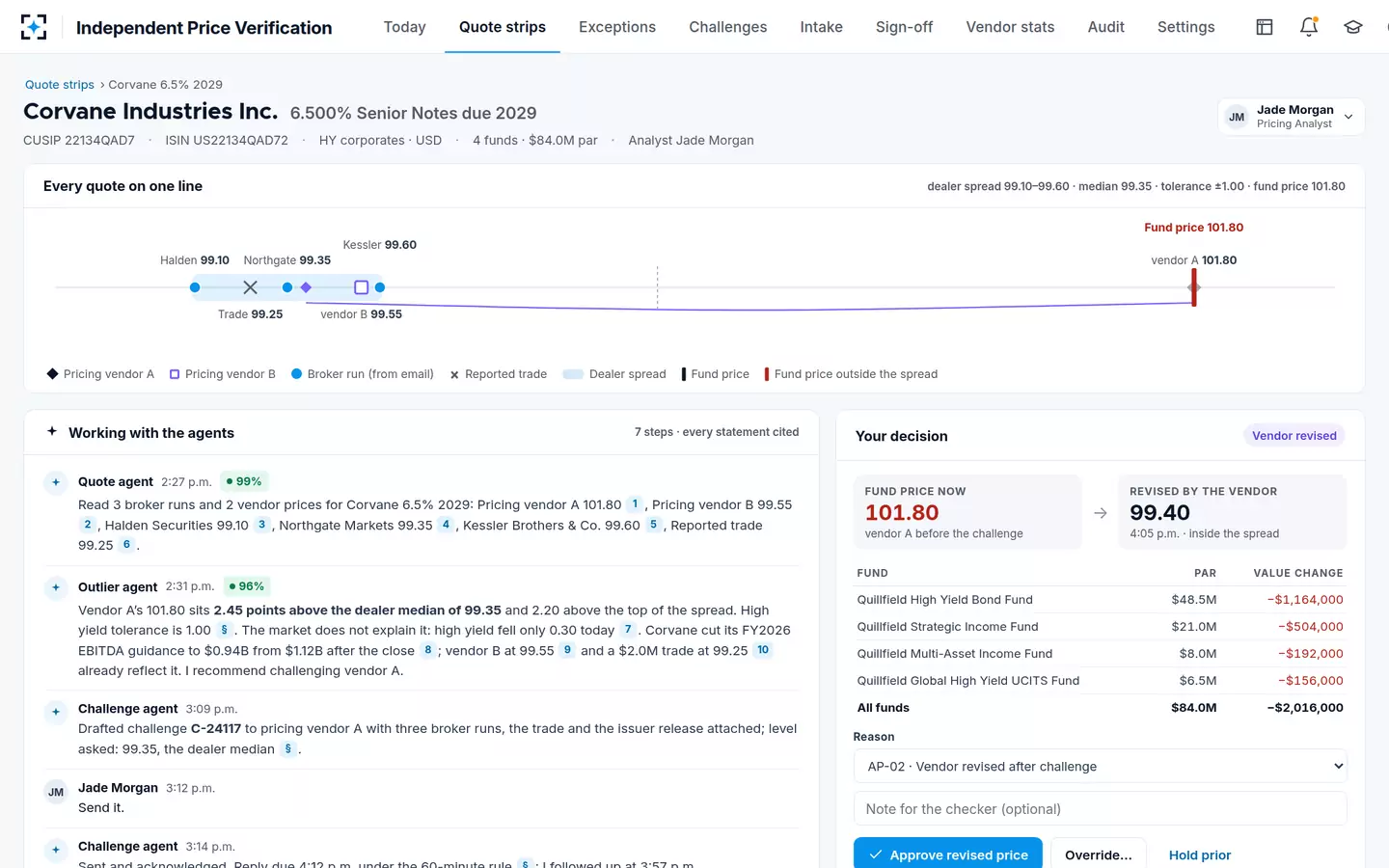
For a verifier, that cuts both ways. A trade is the strongest single piece of evidence against an evaluated price, but a small trade, an old one or one on the wrong side of the market says less than its price suggests. The table shows the four numbers a fund had for one bond on the sample day, and why none of them is "the price" on its own.
One bond, four numbers: Corvane 6.5% 2029 on the sample afternoon
| Source | Level | What it is | What it tells the verifier |
|---|---|---|---|
| Pricing vendor A, 2:00 p.m. file | 101.80 | Evaluated price; the fund's price source | The model had not absorbed the issuer's guidance cut |
| Pricing vendor B, 2:10 p.m. API | 99.55 | A second vendor's evaluated price | An independent model already sat inside the dealer spread |
| Three dealers, 1:41 to 2:26 p.m. | 99.10 / 99.35 / 99.60 | Bids from broker runs: an email table, free text and a PDF | The market's range, median 99.35; indicative, not firm |
| Reported trade, 11:52 a.m. | 99.25 for $2.0 million | A trade of meaningful size, earlier in the day | Hard evidence, a few hours old, consistent with the dealers |
Independent Price Verification puts the evaluated price beside the market's evidence
Is an evaluated price a market quotation?
No. Under the SEC's Rule 2a-5 a market quotation is readily available only when it is an unadjusted quoted price in an active market for the identical investment, and the SEC said in the adopting release that evaluated prices do not meet that test, because they are not built from such prices (SEC, 86 FR 748). Some commenters asked it to treat every Level 2 input, evaluated prices included, as a market quotation; it declined.
The consequence is practical. A bond priced from a vendor's evaluated price is fair valued under the rule, so it falls under the valuation designee's duties: assessing valuation risk, testing the methodology and overseeing the pricing service. The vendor produces the number; the fund remains responsible for it.
Why do two funds mark the same bond differently?
Two funds can mark the same bond differently because they use different vendors, different pricing times, different sources in their hierarchy, or different judgements when sources disagree. A study of month-end marks for identical corporate bonds held by different US mutual funds found that the dispersion "is related to bond-specific characteristics associated with liquidity and market volatility", that "TRACE may have contributed to the general decline in dispersion over our sample period", and that funds with vague marking policies, or holding bonds that are hard to mark, seemed more likely to smooth their reported returns (Cici, Gibson and Merrick, working paper version of the Journal of Financial Economics article, 2011).
Two lessons follow. Public trade reporting narrows the range, so a verifier should always read the reported trades. And a written marking policy is itself a control: return smoothing was associated with ambiguous marking policies. MAS found the inside-the-firm version of the same problem in 2026, a manager that failed to notice one bond priced differently across its own funds by different administrators using the same hierarchy. The daily checks that catch that kind of error are covered in pricing exceptions.
What an evaluated price assumes about the size you hold
An evaluated price assumes a trade size, and a position much smaller than that size may not be worth the evaluated price. The SEC's 2016 order against PIMCO is the textbook case. The vendor's marks were "the evaluated prices that were for institutional round lots", and it treated a round lot as at least $1 million of current face value; PIMCO bought odd lots of non-agency mortgage bonds for a new ETF below that size, at discounts, and valued them at the round-lot marks (SEC, Release IA-4577). PIMCO settled without admitting or denying the findings.
What a round-lot evaluated price did to an odd-lot position
$1M
current face value: the vendor's institutional round lot
27%
one position's rise from purchase at $64.9999 to the round-lot mark of $82.74585
$0.31
per share: the most the odd-lot marks added to the ETF's NAV in the period
The SEC's finding turned on a sentence any verifier can apply: the firm "did not have a reasonable basis to believe that the Pricing Vendor Mark accurately reflected the exit price" the fund would receive. An evaluated price is evidence about a standard trade. Whether it is the fair value of the position the fund actually holds is the fund's question to answer.
How do you test a vendor's evaluated price?
Test an evaluated price three ways: against independent evidence on the day, against what the security later traded at, and against the model's inputs and assumptions. The daily test compares the evaluated price with dealer quotes, reported trades and a second vendor. The retrospective test is back-testing, which the SEC describes as comparing "the fair value ascribed to the fund's investment against observed transactions or other market information, such as quotes from dealers or data from pricing services". The SEC also warns that back-testing "may be less useful for portfolio holdings that trade infrequently", which is exactly where evaluated prices carry most weight.
A second vendor is the cheapest independent test, and the order in which sources are trusted should be written down rather than decided case by case. The sample firm's policy for high-yield corporates reads: pricing vendor A, then pricing vendor B, then the dealer median from at least three quotes, then the prior day's price held with approval. The hierarchy decides which number is the fund's price when sources are available; the tests decide when that number needs a person. A source-to-source gap between two vendors, tracked by asset class over months, also shows which vendor tends to move first when the market turns, which is the vendor worth reading first on a volatile afternoon.
Six tests for a vendor's evaluated price
- Inside the dealer spread on the day
Using independent dealer quotes, never the vendor's own sources passed back.
- Consistent with recent trades, adjusted for size and time
A $2 million trade this morning outweighs a $50,000 print last week.
- Close to a second vendor
Two independent models agreeing is evidence; disagreeing is an exception.
- Moved with its sector and curve
A price that did not follow a market move may be a model that has not updated.
- Right for the position's size
Compare the holding with the vendor's lot convention and the purchase price with the first mark.
- Close to later trades
Back-test month by month: where did the bond trade after the date it was priced?
Why the fund cannot see all of the vendor's inputs, and what to do about it
A fund does not get, and need not keep, the vendor's full model inputs for each price: the SEC's release states that "The fund or adviser will not be required to maintain the internal records of the pricing service or the specific inputs the pricing service used for each piece of pricing information it provides to the fund." What it should understand is the vendor's methods, inputs and assumptions by asset class, and how they change when markets change, which is part of approving and monitoring the vendor in the first place.
The practical bridge is the price challenge. When a fund holds evidence the vendor's model lacks, the challenge puts that evidence into the model, as the sample vendor's reply showed: its evaluator "incorporated post-earnings dealer color and the 11:52 a.m. trade". Over time, the history of what was challenged and how each vendor answered is the best evidence a fund has of how well each vendor's model works, which is how the guide to pricing vendors for securities builds a vendor scorecard.
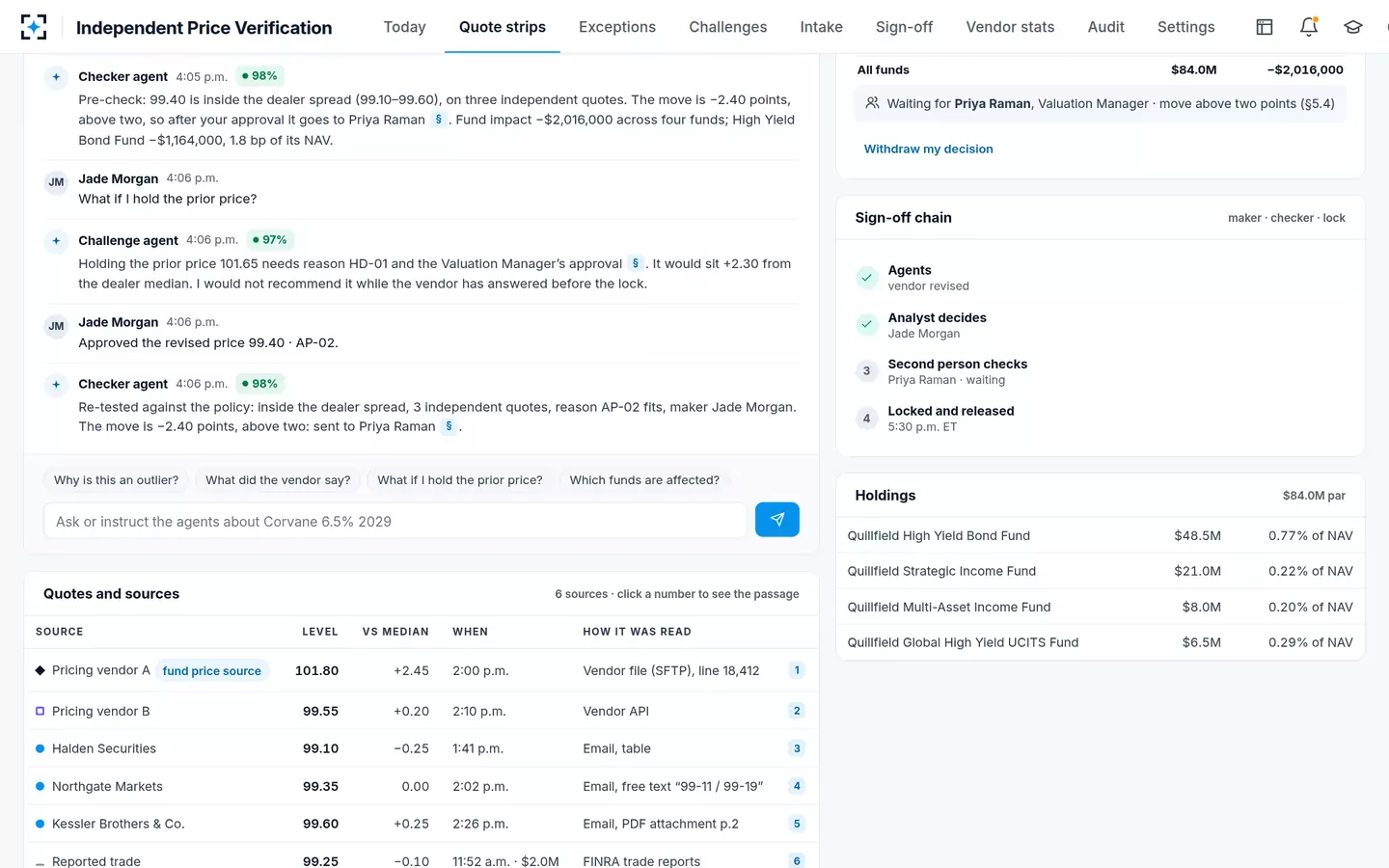
Every source behind a price in Independent Price Verification, with where and how it was read
Questions people ask
What is an evaluated bond price?
It is a pricing vendor's daily estimate of a bond's value, produced by a model from trades, dealer quotes, benchmark curves and comparable bonds rather than read from a trade in that bond. Funds use it for most fixed income holdings because most bonds do not trade every day.
What is matrix pricing?
Matrix pricing values a bond by its position on a grid of comparable securities, typically by issuer type, rating, coupon and maturity, rather than from its own trades. The SEC names matrix prices alongside evaluated prices and price opinions among the information pricing services provide.
Is evaluated pricing Level 2 or Level 3?
Usually Level 2, because the inputs are observable market data such as comparable trades and dealer quotes, even though they are not quoted prices for the identical bond. Where the vendor relies on significant unobservable assumptions, or the fund adjusts the price with its own estimates, the measurement can fall into Level 3.
Can a fund use the vendor's price without checking it?
Not under Rule 2a-5. A vendor's evaluated price is a fair value input, and the valuation designee must oversee the pricing service, test the methodology and have a process for price challenges. The SEC also says a fund should reconsider using a vendor whose methods it has no good-faith basis to believe produce prices that reflect fair value.
Why did the vendor's price not change when the bond's issuer had news?
Because a model updates on the inputs it receives, and news that arrives after the close, or that dealers have not yet priced, may not reach it in time. That is the most common reason a fund challenges an evaluated price with dealer quotes and the issuer's announcement attached.