A price verification system is the software a fund's pricing team uses to test every security price against independent evidence before the NAV is struck: it reads vendor files and dealer quotes, runs the tolerance and source checks, separates market moves from wrong prices, manages challenges to the pricing vendors, records each decision and its second check, and holds the price lock. It does not produce prices, which is the vendors' job, or strike the NAV, which is the accounting platform's. The hard part is not the checks but the afternoon: hundreds of exceptions, quotes buried in emails, and vendors who answer on their own clock. Botminds' Independent Price Verification is such a system built on six agents, and this guide follows it through 84 minutes of one sample afternoon to show what the agents do, what the people do, and what neither may do.
The afternoon is Wednesday, October 21, 2026, at Quillfield Capital, a fictional fund complex that runs on the solution as a sample: 25,184 prices in 312 funds, with the New York price lock at 5:30 p.m. Eastern.
Five threads of one afternoon, from the 2:00 p.m. files to the 5:30 p.m. lock
- In the file2:00
- Drafted, then sent2:31–3:12
- With vendor A3:12–4:05
- Approved; checked; locked4:06–5:30
- Before the challengeto 3:31
- With vendor A, reply due 4:313:31–4:31
- Escalation4:31–5:00
- Manager decides5:00–5:30
- Japanese run read at 3:02 a.m.to 3:40
- With vendor B3:40–4:40
- Decision and check4:40–5:30
- Before the draftto 3:52
- Draft3:52
- Reply asked by 5:00, then decision4:06–5:30
- Opento 4:06
- 390 explained moves, 70 decisions, 34 checks to clear4:06–5:30
What does a price verification system do?
A price verification system does six things a pricing team otherwise does by hand: it reads every price and quote into one place, tests each price, explains the moves the market accounts for, drafts and tracks vendor challenges, routes every decision to a second person, and controls the lock. The order matters. Reading has to finish before testing means anything; explanation has to come before challenges, or the vendors are challenged on moves the whole market made; and nothing should reach the lock without a decision and a check.
Just as important is what it does not do. It does not price securities; the pricing vendors do. It does not decide a price; the analyst does. It does not strike the NAV; the accounting platform and the fund administrator do. A system that blurs those lines saves time and loses the control, because the point of independent price verification is that the person verifying is not the person, or the model, that produced the number.
Six agents and three people: who does what, and what each may never do
Agent
Quote agentReads vendor files and every broker run in the pricing mailbox, in any format and language, and maps each quote to the security master.
Never: creates a price; maps a quote below 98% confidence without a person
Agent
Outlier agent and Market context agentTest each price against its dealer spread and the policy's tolerances, and explain moves by sector, curve, trades and issuer news, citing each source in its own language.
Never: accepts a price; infers a price from news alone
Agent
Challenge agentDrafts the vendor challenge with the evidence and a level asked, sends it on the analyst's yes, tracks the reply against the lock, follows up and escalates.
Never: sends without the analyst; edits a price
A person decides
Pricing analystDecides every price the market does not explain: approve, challenge, override or hold, each with a reason code.
Agent
Checker agentRe-tests every decision against the pricing policy and routes moves above two points to the Valuation Manager.
Never: approves or checks anything
A person decides
Valuation ManagerChecks every changed price and every kept vendor price outside the spread; never her own work.
A person decides
Fund ControllerLocks and releases each region's prices to the accounting platform and the fund administrator.
Agent
Evidence agentKeeps every quote, decision and setting change on an append-only trail and drafts the monthly vendor report for the Head of Valuation to sign.
Never: changes a past entry
2:00 p.m.: what does a broker run look like, and why is reading it half the job?
A broker run is a dealer's list of indicative bid and offer levels for the bonds it makes markets in, sent to clients by email, often several times a day: as a table in the email body, as free text such as "99-11 / 99-19", as a PDF or as a spreadsheet, and in the dealer's own language. Until they are read and mapped, the quotes in them are not evidence for anything. On the sample day the Quote agent had been reading the shared pricing mailbox continuously since midnight: 1,312 runs from 46 dealers, 16,904 quotes, 16,890 of them mapped to the security master.
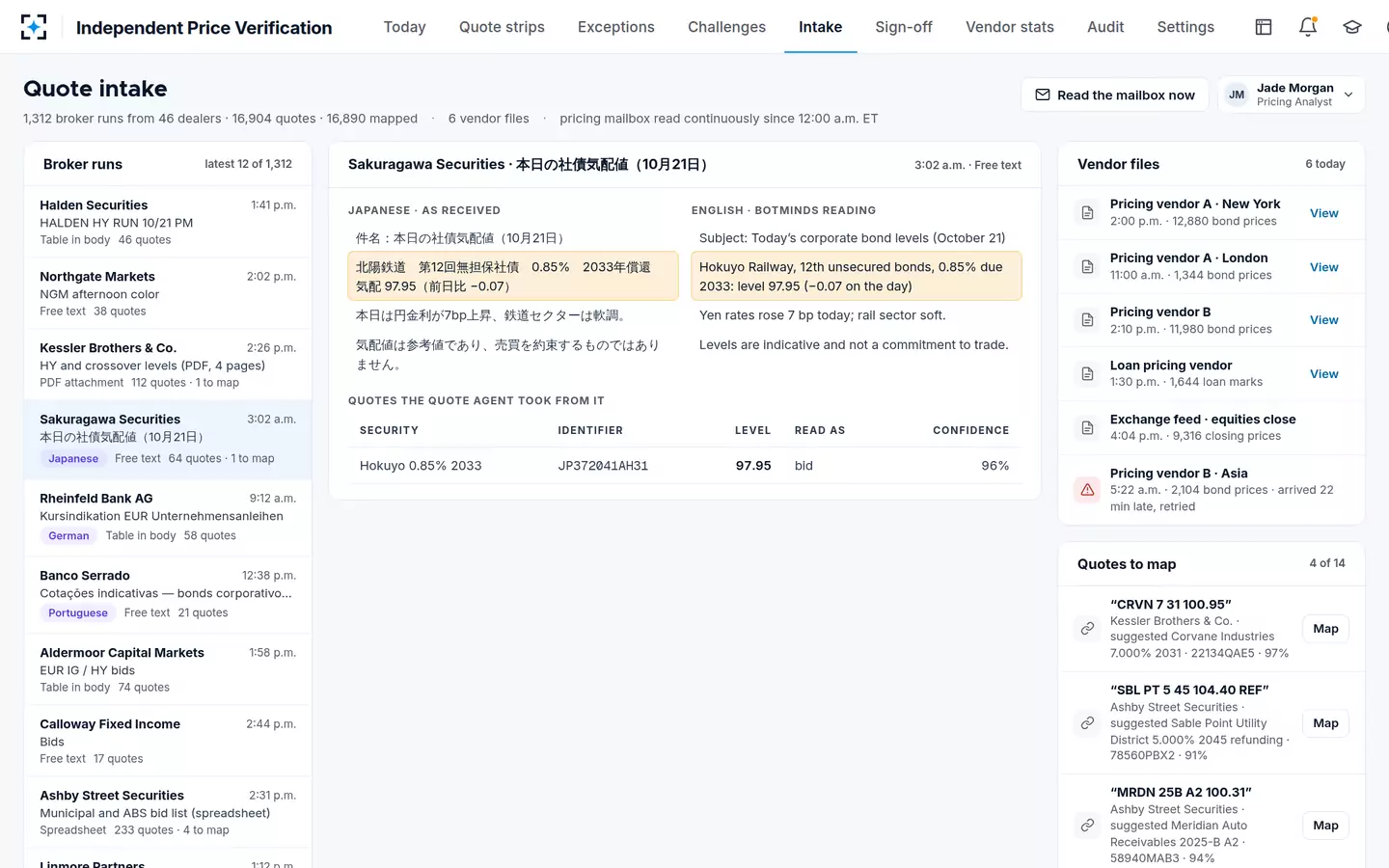
Reading is where a system first shows whether it can be trusted. A run from Sakuragawa Securities arrived at 3:02 a.m. as free text in Japanese; the screen shows it beside its English reading and the one quote taken from it, Hokuyo 0.85% 2033 at 97.95 bid, with a confidence of 96%. Abbreviated lines such as "CRVN 7 31 100.95" are matched to the right bond or held for an analyst: below 95% parse or 98% mapping confidence the quote goes to a person, and the agent never creates a price from a quote it is unsure of. Vendor files are watched too: pricing vendor B's Asia file arrived 22 minutes late that morning and was retried.
Independent Price Verification reads a Japanese broker run, beside its English reading
2:31 p.m.: one bond the market does not explain
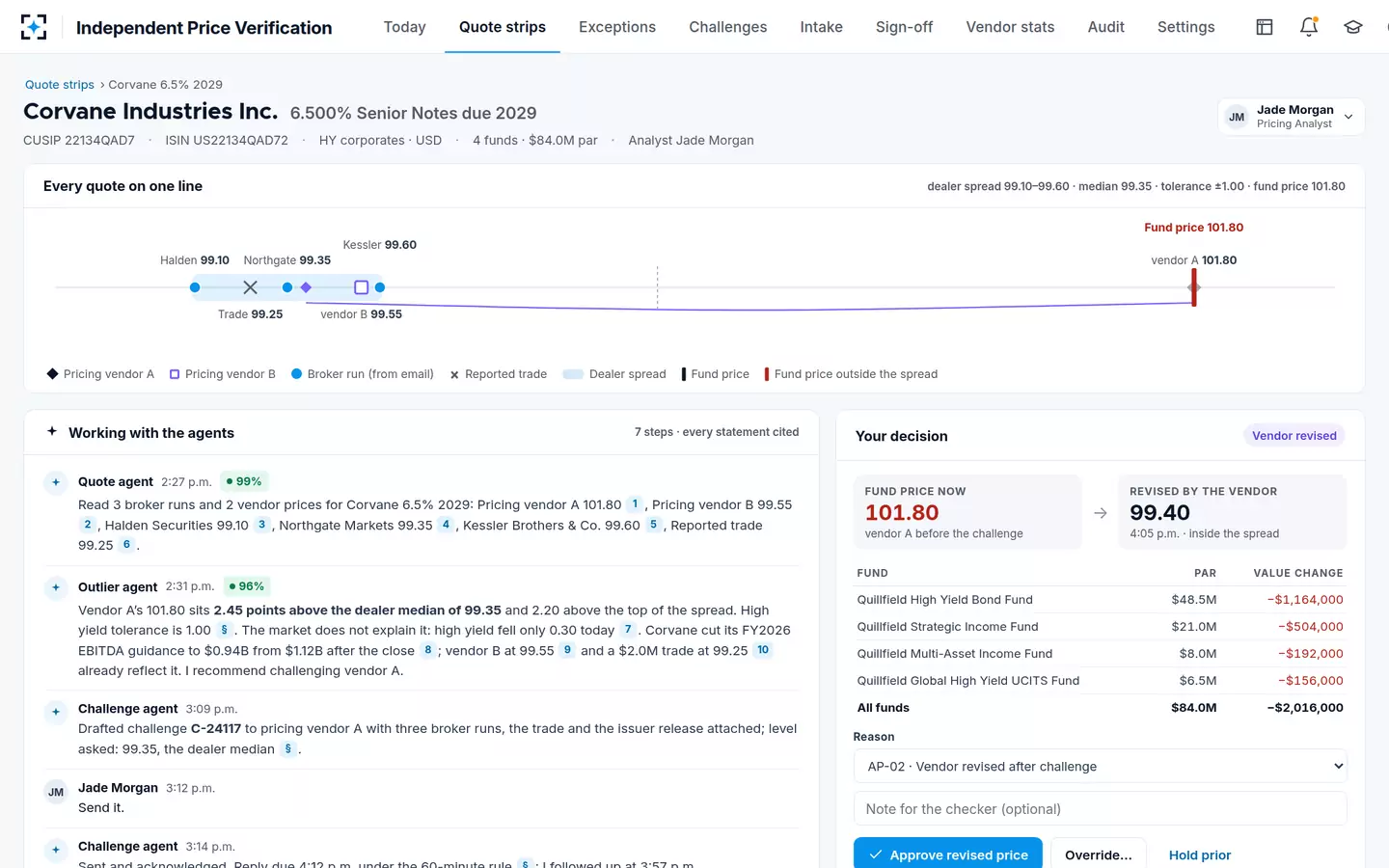
Once every price is tested, the system's job is to say which exceptions the market explains and which it does not, with evidence a person can check in seconds. At 2:31 p.m. the Outlier agent found pricing vendor A's 101.80 on Corvane 6.5% 2029 sitting 2.45 points above the dealer median of 99.35, against a 1.00-point tolerance for high-yield corporates. It then did the part a tolerance cannot: high yield had fallen only 0.30 that day, so the sector did not explain it; vendor B was at 99.55 and $2.0 million had traded at 99.25; and the issuer had cut its full-year earnings guidance after the close. Every number carried a citation that opens its source.
Meanwhile the same agents were closing the opposite case at scale. Of the day's 618 exceptions, 471 were moves the market explained, each with its reason and sources. The 390 of them in New York sat in a queue for the analyst's bulk review, and before she accepted them the Checker agent re-tested a 5% random sample against the quotes. That is the arithmetic that frees the afternoon: the analyst's attention goes to the 147 exceptions that needed a person, not the 618 the tolerances raised.
Can an agent send a vendor challenge?
In Independent Price Verification, no: the Challenge agent drafts the challenge and sends it only when the analyst says yes, and it can never change a price. At 3:09 p.m. it drafted challenge C-24117 to vendor A with three broker runs, the trade and the issuer's release attached, and the dealer median, 99.35, as the level asked. The analyst, Jade Morgan, read it and answered "Send it." at 3:12 p.m. The send is a separate entry on the audit trail from the draft, with her name on it.
The reason is not caution for its own sake. A challenge is a statement to a third party that the fund believes a price is wrong, and the SEC's Rule 2a-5 expects the people with duties for price challenges to be identified. A system that lets software send them on its own has moved that duty somewhere no one can name. The analyst can edit the message, untick a piece of evidence or change the level asked before sending; what a good challenge contains is in what is a price challenge.
How do you track vendor challenge replies?
Track each challenge against two clocks, the vendor's reply time and the price lock, and escalate before the second runs out. The sample policy gives vendors 60 minutes, follows up at 45 and escalates anything unanswered to the Valuation Manager 30 minutes before the lock. On the sample day the Challenge agent followed up C-24117 at 3:57 p.m., and at 4:05 p.m. read vendor A's reply, "Evaluator incorporated post-earnings dealer color and the 11:52 a.m. trade", and its revised price of 99.40 into the case.
The trace shows why the clock matters. Altamira 5.875% 2028 had been with vendor A since 3:31 p.m., reply due 4:31; Hokuyo, challenged with vendor B at 3:40 p.m., was due at 4:40; and the Granite Arc challenge, drafted at 3:52 p.m., asked for a reply by 5:00. A challenge drafted at 4:50 p.m. would be useless, so the system's real contribution is surfacing outliers early enough for the vendors to answer. Counted over a month, the same replies become the vendor's service history: at the sample firm in September, vendor A's median reply was 47 minutes and vendor B's 63.
One outlier worked with the agents in Independent Price Verification, every statement cited
4:06 p.m.: what needs a person
At 4:06 p.m., 84 minutes before the lock, the analyst's home showed four numbers and seven items. Prices tested: 25,184. Exceptions: 618, of which 471 explained by the market. Needing a person: 147, with 129 still open and 32 of them hers. At the top of her list, the Corvane revision waited for approval; then the drafted Granite Arc challenge, a vendor confirmation on Calder Bay 9.25% 2032 to decide, the Altamira and Hokuyo replies, a single-source loan and the 390 explained moves.
She approved Corvane at 99.40 with reason AP-02, "vendor revised after challenge". The Checker agent re-tested the decision against the policy: inside the dealer spread, three independent quotes, the reason fits, maker Jade Morgan. Because the move was −2.40 points, above two, it went to the Valuation Manager, Priya Raman, for the second check; across four funds the market value fell $2,016,000, and the High Yield Bond Fund's share was 1.8 basis points of its NAV.
What is a price lock?
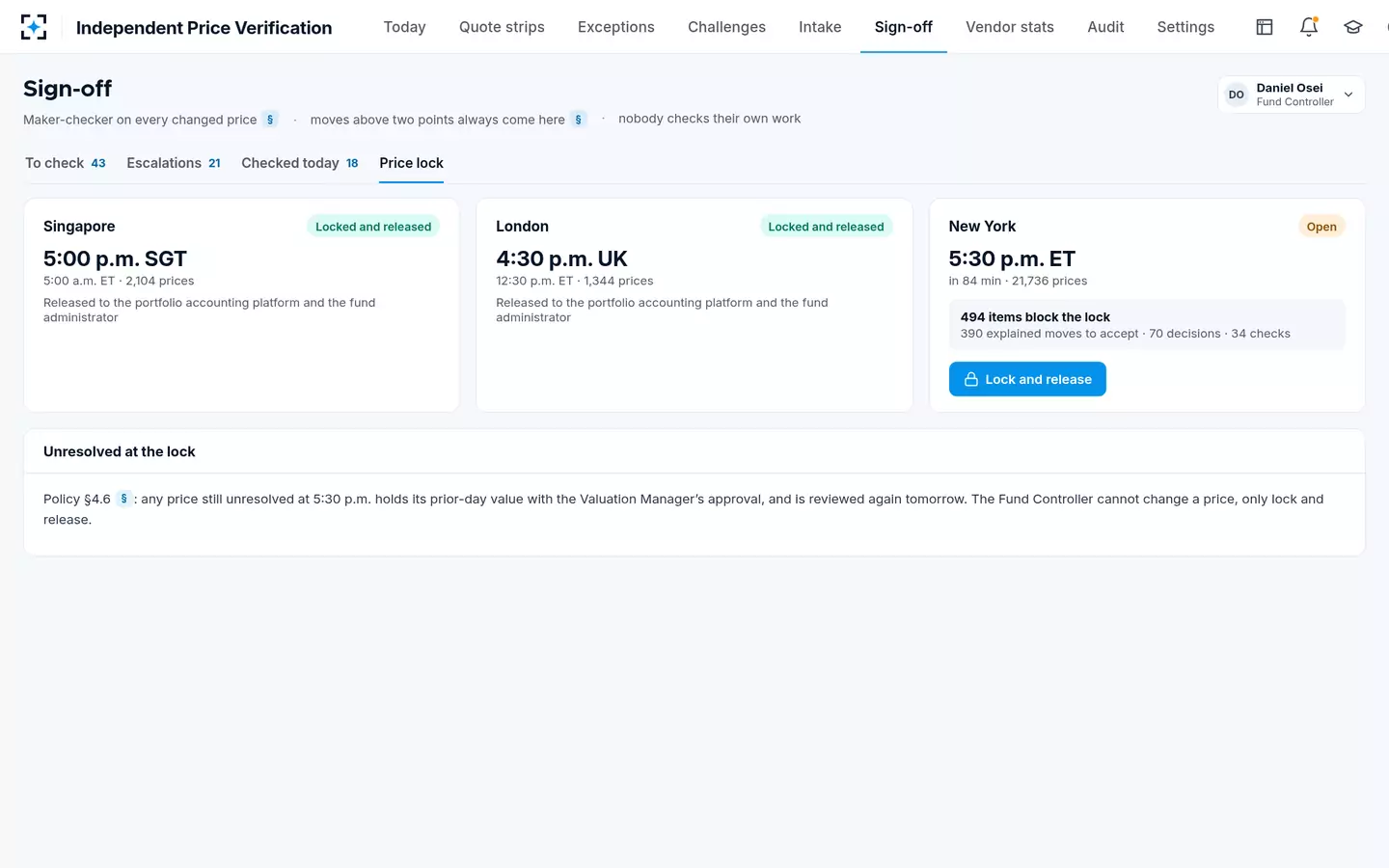
A price lock is the point after which a pricing region's prices are final for the day and released for the NAV; nothing changes after it without a correction process. In the solution only the Fund Controller locks and releases, and the Fund Controller cannot change a price. Singapore locked at 5:00 a.m. Eastern with 2,104 prices and London at 12:30 p.m. Eastern with 1,344; at 4:06 p.m. New York's 21,736 prices were blocked by 494 items, 390 explained moves to accept, 70 decisions and 34 checks.
A lock needs a rule for what is still open when the clock runs out, or someone will make one up at 5:29 p.m. The sample policy's rule is that any price unresolved at 5:30 p.m. holds its prior-day value with the Valuation Manager's approval and is reviewed again the next day. How the lock fits the whole process is set out in the independent price verification process.
What to look for when you evaluate a price verification system
Evaluate a price verification system on what it reads, what it explains, what it refuses to do, and what it leaves behind, and test it on one of your own past pricing days before you believe any of it. A demonstration on clean vendor files proves little; your broker runs, your tolerance policy and a day you remember are the test.
A pricing afternoon by spreadsheet and email, and with a price verification system
Spreadsheet and email: Read by eye from the mailbox and retyped
Price verification system: Read and mapped as they arrive, low-confidence quotes held for a person
Spreadsheet and email: Every tolerance breach worked one by one
Price verification system: Market-explained moves proposed with sources; the rest ranked
Spreadsheet and email: Typed into portals, chased by email
Price verification system: Drafted with evidence attached, sent on a yes, tracked against the lock
Spreadsheet and email: A comment and a signature on a printout
Price verification system: System-enforced maker-checker with the re-test beside each item
Spreadsheet and email: Known to be clean only at the end
Price verification system: What blocks it visible region by region all afternoon
Spreadsheet and email: Challenges counted in a spreadsheet
Price verification system: Vendor statistics and the oversight report drafted from the month's challenges
Ten questions to ask of any price verification system
- Does it read our broker runs as they arrive, in every format and language?
And does it hand back the quotes it is unsure of, with a stated confidence threshold?
- Are tolerances, stale limits and escalation set by asset class, as settings?
MAS faulted a uniform threshold across asset types in 2026.
- Does every explanation cite its sources, openable in one click?
An explanation without evidence is an opinion.
- Can anything accept, send or change a price without a named person?
The answer should be no, for every agent and every automation.
- Does it track each challenge against the vendor's reply time and the lock?
With follow-up and escalation set in the policy.
- Is maker-checker enforced by the system, not by habit?
Nobody should be able to check their own item.
- Is the lock a separate role that cannot change prices?
And is there a written rule for what is unresolved at the lock?
- Is the trail append-only and exportable for the auditor and the regulator?
Rule 31a-4 asks for six years of fair value documentation.
- Does it work beside our vendors, pricing system and administrator?
Replacing them is a different project with different risks.
- Will it run on one of our past days before we commit?
And can we compare its exceptions and challenges with what our team actually did?
Where a price verification system does not fit
A price verification system is the wrong tool where there is nothing independent to verify against. For private credit, private equity and other Level 3 positions valued quarterly by model, the work is building and reviewing a valuation, not testing a daily price against quotes; that belongs to a valuation process with its own committee and, sometimes, an external valuer. It is also not a substitute for a pricing vendor: it tests evaluated prices, it does not produce them. And it cannot make a weak pricing policy strong. If tolerances, source hierarchy and override authority are not written down, the system will surface that gap on the first day rather than fill it.
Supervisors are watching how firms use these tools without changing what firms are responsible for. The SEC's fiscal 2027 examination priorities, published October 23, 2026, note registrants using "super intelligence (SI)" tools across research, compliance monitoring and portfolio management, and say the Division is working harder to understand how these technologies affect outcomes (SEC Division of Examinations), while firms' existing obligations stay technology-neutral. A system in which agents propose and named people decide, with both written down, is one an examiner can follow. How the solution sits beside existing vendors rather than replacing them is covered in pricing vendors for securities.
The price lock, three regions, and the rule for what is unresolved
Questions people ask
What should a price verification system never do?
It should never accept a price, send a challenge or change a price without a named person, and it should never let the person who made a decision check it. In Independent Price Verification the Checker agent cannot approve or check anything; it can only pass an item to a person or return it with a reason.
Does a price verification system replace the pricing vendor?
No. Pricing vendors produce evaluated prices; a verification system tests them against dealer quotes, trades and a second vendor and manages challenges to them. Rule 2a-5 requires a fund to oversee its pricing services, and verification is how that oversight is done day to day.
How long does it take to set up a price verification system?
No regulator or independent study publishes implementation times, so ask for a test on one of your own past days before committing. On the solution's sample past-day test, the agents raised every price the team had challenged, 49 of 49, and six more for the team to review.
Can it read quotes in Japanese, German or Portuguese?
Yes. The Quote agent reads runs in the dealer's language and shows the original beside the English reading; on the sample day it read Japanese, German and Portuguese runs. Quotes below its confidence thresholds go to an analyst to map.
What does the SEC say about firms using super intelligence?
The SEC's fiscal 2027 examination priorities say more and more registrants use what the SEC calls "super intelligence (SI)", and that examiners will look at how the technologies influence outcomes and whether firms keep meeting existing, technology-neutral obligations. Nothing in Rule 2a-5 changes because the checks are run by agents.