Pricing exceptions, in fund valuation, are the prices that fail one of the daily price validation checks before a fund's NAV is struck: a move larger than the tolerance, two sources that disagree, a price that has not changed for days, a missing price, or one that rests on a single broker. (In lending, the same words mean approved deviations from a loan or deposit rate sheet; that is a different subject.) Most fund pricing exceptions are the market moving and need only a reason. The ones that matter are real errors, and they come in seven kinds, each needing its own check. Botminds' Independent Price Verification tests every price, explains the moves the market accounts for with their sources, and sends the rest to an analyst sorted by kind, so the afternoon is spent on the errors.
The figures for the sample day on this page come from Quillfield Capital, a fictional fund complex that runs on the solution as a sample: 25,184 prices on Wednesday, October 21, 2026.
618 pricing exceptions on one sample day, and what they turned out to be
What are pricing exceptions in fund pricing?
A pricing exception is a price that a validation check has flagged for a person to look at; it is a question, not yet an error. The Monetary Authority of Singapore's May 2026 paper lists the checks that raise them: securities whose daily price change exceeds a tolerance, securities where two distinct price sources differ by more than a tolerance on the same day, securities without a price, and stale securities whose prices have stopped reflecting fair value, plus two checks at fund level (MAS, Valuation Practices for Fund Management Companies). An exception becomes an error only when the investigation shows the price is wrong.
The distinction matters because the two are handled differently. An exception the market explains is closed with a reason and its evidence. An error is challenged with the vendor, overridden with a better-supported price, or held at the prior price, and in every case a second person checks it. A team that treats every exception as a potential error spends its afternoon proving that the market moved.
What causes a pricing exception? Mostly the market
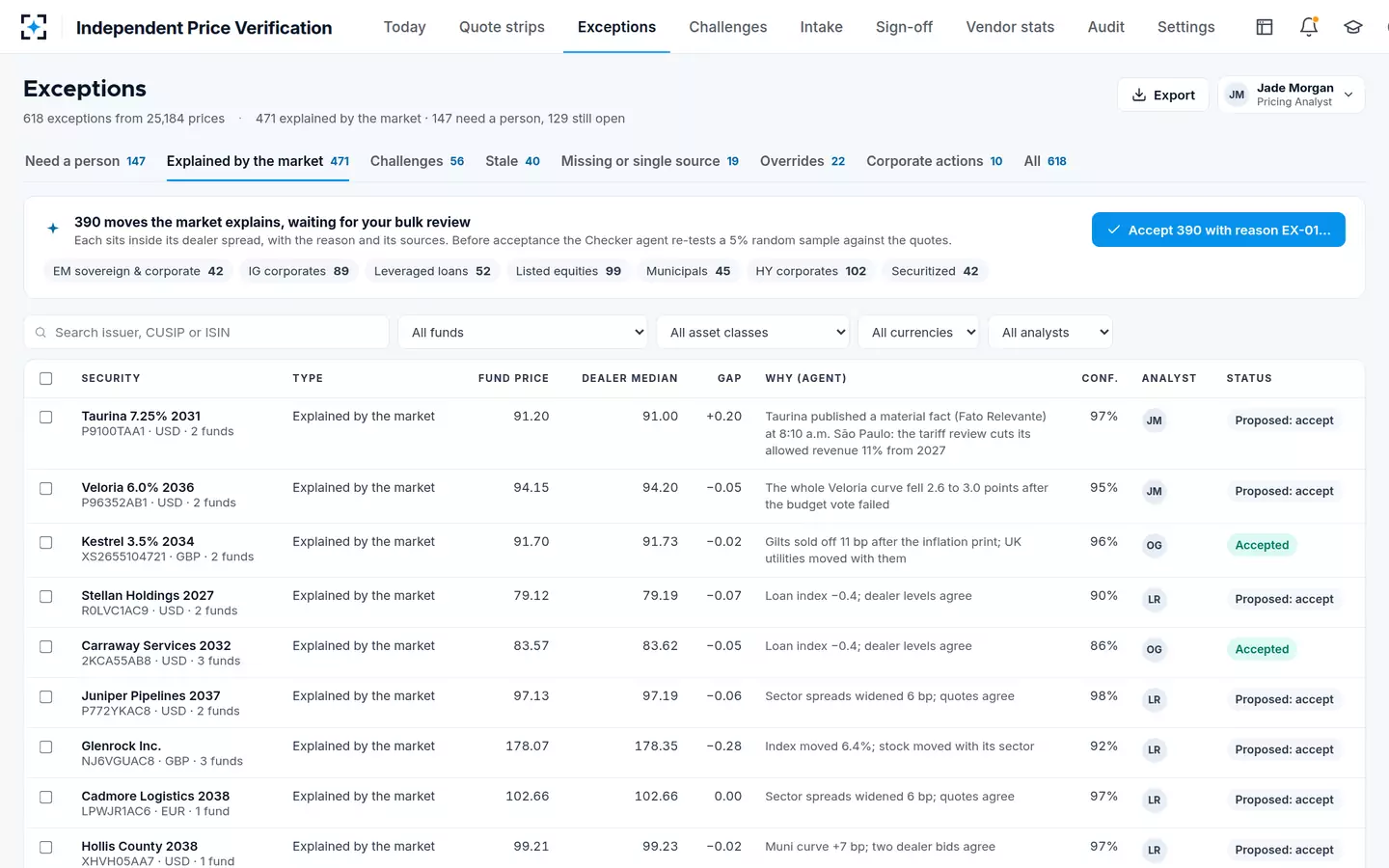
Most pricing exceptions are caused by real market moves that a static tolerance cannot tell from errors. On the sample day 471 of 618 exceptions, three in four, were moves the agents could explain with evidence: the whole Veloria curve falling 2.6 to 3.0 points after a failed budget vote, UK utilities moving with gilts after an inflation print, a loan index down 0.4 points with dealer levels agreeing, an energy issuer's material-fact notice, in Portuguese, cutting its allowed revenue. Each flagged because it moved more than a point; none was wrong.
The useful response is to separate them early, with the reason written down, so that the analyst's time goes to the remainder. The solution proposes explained moves for bulk acceptance and never accepts them itself, and before an analyst accepts a set its Checker agent re-tests a random 5% sample against the quotes. What remains is a short list of prices that may be wrong, and almost all of them belong to one of seven kinds.
Independent Price Verification's exceptions screen: market moves, each with its reason and sources
How many pricing exceptions are normal for a fund?
No regulator or independent study publishes a normal exception rate for fund pricing, and the number depends almost entirely on how tolerances are set and how volatile the day is. The sample firm's 618 exceptions on 25,184 prices is 2.5%; the same book on a quiet day flags fewer, and on a day when a whole sector reprices, many more. The rate that tells you something is not the exception rate but what the exceptions turn out to be: how many the market explains, how many become challenges, how many challenges the vendor accepts.
Measure those over a month and the tolerances can be tuned. At the sample firm in September, 78% of static-tolerance breaches, 11,602 of 14,920, were explained by the market and closed without a challenge. A tolerance that flags four or five prices for every one the market cannot explain is doing its job on a volatile day and wasting an analyst on a quiet one, which is why the firm uses dynamic bands that widen with the market, capped at twice the static level.
What is a pricing tolerance check, and why is one tolerance not enough?
A pricing tolerance check flags a price whose move, or whose gap to a second source, exceeds a set limit; the limit has to differ by asset class, because a normal move in a high-yield bond is an alarming one in a Treasury. MAS found a manager using one 5% source-to-source threshold for every asset type, and pointed out that 5% is far too wide for listed equities, whose sources rarely differ. The sample firm's policy sets the day-over-day tolerance at 0.25 points for Treasuries, 0.50 for investment grade, 1.00 for high yield, 1.25 for emerging markets and 10% for listed equities.
Even a well-calibrated tolerance catches only errors that are large and recent. A stale price passes a day-over-day check because it has not moved, which is why a stale price report counts days unchanged instead. A single-source price passes a source-to-source check if the second source is the same broker. A price inflated by a portfolio manager's friendly broker passes both. That is the case for designing checks by kind of error.
Seven kinds of pricing error, and the check that catches each
| Error | What it looks like | The check that catches it | Where the rules name it |
|---|---|---|---|
| 1. Stale price | Unchanged for days while the market moved | Days unchanged by asset class, against the sector or curve move | MAS 2026; AIFMD Art. 71(3)(g) |
| 2. Single-source price | One broker, or one counterparty, behind the price | Count of independent sources; one-quote prices to a person | AIFMD Art. 71(2)(a); MAS 2026 |
| 3. Model lag | A vendor's evaluated price that has not absorbed news or a sector move | Gap to the dealer median and recent trades, with the day's market move | Rule 2a-5 adopting release (pricing service oversight) |
| 4. Wrong lot size | A round-lot evaluated price applied to a small position | Position size against the vendor's lot convention; purchase price against mark | SEC order, PIMCO, 2016 |
| 5. Wrong bond, or one bond priced twice | A quote mapped to a similar issue; the same bond at two prices across funds | Identifier mapping with confidence; cross-fund consistency | MAS 2026 |
| 6. The portfolio manager's hand | Overrides supported by quotes the portfolio manager arranged | Source independence; direction of overrides over time | AIFMD Art. 71(2)(f); SEC order, Visium, 2018 |
| 7. The event the price missed | A call, tender, default or delisting not in the price | Corporate action feed against holdings, before the lock | MAS 2026 (a delisted security) |
Error 1: the stale price
A stale price is one that has stopped moving while the market has not. It passes the most common check, the day-over-day move, precisely because it does not move. Research on US bond funds found "widespread stale pricing in bond mutual funds and the resulting risks of dilution and fragility", and estimated that buy-and-hold investors bear annual dilution of about $1.2 billion as a result (Choi, Kronlund and Oh, Journal of Financial Economics, 2022). MAS's inspections found stale prices sitting for weeks because reports went monthly to a committee, or because the administrator and the manager defined "stale" differently.
The check is days unchanged, set by asset class, read against what the market did. The sample firm flags a Treasury or a listed equity unchanged for one day, corporates for three, and loans and municipals for five; on the sample day the Hokuyo 0.85% 2033 bond had been unchanged for six days while the yen curve moved 7 basis points, and a Japanese dealer's run showed 97.95 against the vendor's 98.62, so it was challenged.
Error 2: the single-source price
A single-source price is one supported by only one broker or one counterparty, which makes it impossible to tell a market level from that source's view. The EU's rules for alternative fund managers put it first among the cases needing review: a value that rests on prices from one counterparty or one broker alone (Delegated Regulation 231/2013, Article 71(2)(a)). MAS listed, as a better practice at larger managers, "Identifying securities with only one broker quote for further review".
The check counts independent sources and routes any one-source price to a person whatever its level. On the sample day the Larkspur term loan 2030 was priced by the loan vendor at 96.50 on a single dealer; a second dealer's 96.25 to 96.75 supported it, and the portfolio manager's 98.00 was recorded as evidence only. Nineteen exceptions that day were missing or single-source.
Error 3: the model that lags the news
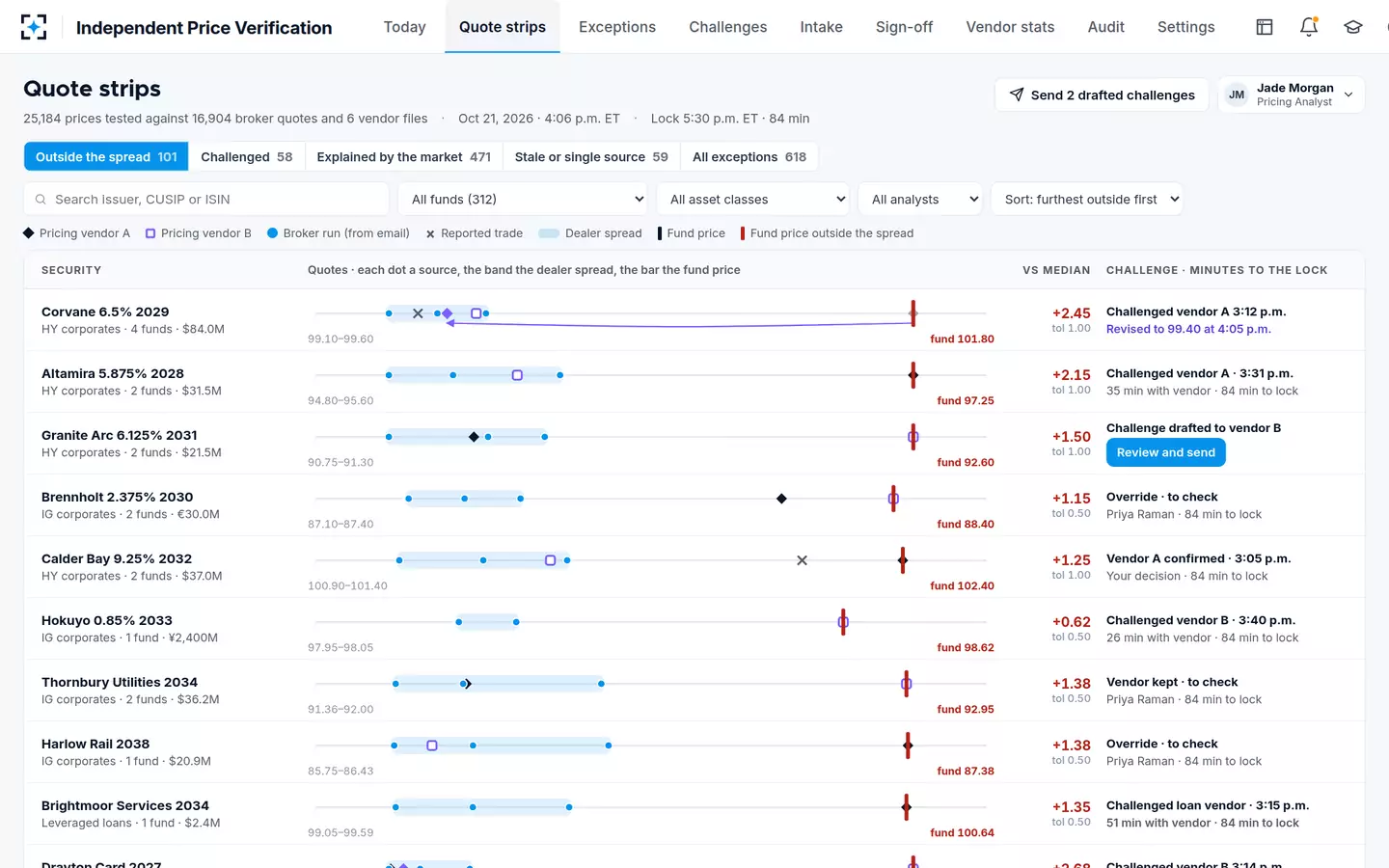
An evaluated price is a model's output, and a model updates on the inputs it receives. When news breaks after the close, or a sector moves faster than the vendor's comparables, the evaluated price can sit far from where dealers bid. On the sample day the Corvane 6.5% 2029 bond stood at 101.80 at vendor A while three dealers bid 99.10 to 99.60, after the issuer cut its earnings guidance; Granite Arc 6.125% 2031 stood at 92.60 at vendor B after high-yield energy fell 0.9 points, a move the vendor had followed by only 0.35.
The check is the gap to the dealer median and recent trades, read with the day's market move: when the sector moved and the price did not, or the issuer had news and the price did not change, the model has probably lagged. That is the classic case for a price challenge, and both bonds were challenged.
Error 4: the price built for a different lot
A pricing vendor's evaluated price assumes a trade size, usually an institutional round lot, and small positions can trade well below it. In its 2016 order against PIMCO, the SEC found that "The Pricing Vendor considered an institutional round lot size for bonds as having at least $1 million current face value", that the firm bought odd lots below that size at discounts and marked them at the round-lot price, and that this inflated a new ETF's NAV (SEC, Release IA-4577). The firm settled without admitting or denying the findings.
No tolerance catches this, because the vendor's price is internally consistent; the error is in applying it to a position it was not built for. The check compares the position's size with the vendor's lot convention and the purchase price with the first mark. Why an evaluated price carries assumptions like this is explained in what is evaluated pricing.
Error 5: the wrong bond, or one bond priced twice
A quote mapped to the wrong security can make a wrong price look supported. Broker runs abbreviate: on the sample day a dealer's line "CRVN 7 31 100.95" had to be matched to Corvane Industries' 7.000% notes due 2031, not the 6.5% 2029 bond in the same name, and the solution held it for an analyst at 97% confidence rather than map it alone. Any quote below 95% parse or 98% mapping confidence goes to a person.
The mirror image is one bond priced two ways. MAS found a manager that used different administrators for different funds and "failed to detect that the same bond was priced differently across different funds by different third-party service providers although they were all required to apply the same pricing hierarchy and use the same price sources". The check is a cross-fund comparison by identifier, run every day, not at audit.
Error 6: the portfolio manager's hand
The most dangerous exception is the one that does not appear, because the person who wants the price higher has supplied the evidence for it. In a 2018 settled order, the SEC found that two portfolio managers at Visium Asset Management obtained "sham broker quotes" from friendly brokers, sending them the prices they wanted and asking them to send the prices back as their own, to "U-turn" the quotes, and used them to override the administrator's prices (SEC, Release 33-10494). The firm settled without admitting or denying the findings.
What the SEC counted in one mismarking case
308
price overrides supported by quotes the portfolio managers arranged, July 2011 to December 2012
91.56%
of those overrides moved the price in the fund's favour: up for longs, down for shorts
2.4–7.2%
by which the fund's month-end NAV was routinely overstated
The order also shows how thin the evidence was. Visium's own policy said it was "preferential to get at least three dealer marks"; of the 308 overrides, the SEC found 216 supported by one broker quote, 91 by two and one by three. Two checks would have caught it: a source-independence test that does not count a quote the portfolio manager obtained, and a running count of the direction of overrides. The sample firm records a portfolio manager's level as evidence only, and how to measure one-sided overrides is set out in the guide to price validation.
How the 308 sham-quote overrides were supported
Error 7: the event the price missed
A corporate action changes what a security is worth in a way no tolerance anticipates: a tender offer, a call, a default, a delisting, a conversion. MAS found a manager that "failed to promptly identify a delisted security for fair value assessment due to staff oversight" and went on pricing it at its last exchange price for a few months. On the sample day ten exceptions were corporate actions not yet reflected, and the Calder Bay 9.25% 2032 bond traded $5.0 million at 102.10 after a tender offer, against the vendor's confirmed 102.40.
The check joins the corporate action feed to the holdings before the lock and flags every affected position, whatever its price did. The sample firm's override reason OV-04, "corporate action not reflected", exists for exactly this case.
The pricing exception process: from flag to closed
A pricing exception process should close every exception with a decision, a reason and its evidence before the lock, and leave a trail a second person and an auditor can follow. MAS's key takeaways ask firms to "ensure timely review and follow-up on all pricing exceptions noted" and to keep records of every check, investigation and resolution, and the SEC's Rule 2a-5 release expects the work papers on price challenges to be kept (SEC, 86 FR 748). The checklist is the closing test the sample firm applies.
A pricing exception is closed only when
- Its kind is named
Market move, or one of the seven errors; the kind decides the check and the evidence.
- The evidence is attached as received
Quotes, trades and notices with their source and time, not retyped.
- A decision is recorded with a reason code
Accept, challenge, approve a revision, override, keep or hold, each with its code.
- A second person has checked any changed price
And any kept vendor price outside the dealer spread; never the person who made it.
- Anything unresolved at the lock is held, not guessed
Prior-day price with the Valuation Manager's approval, reviewed again the next day.
- It is counted
By kind, vendor and outcome, so patterns show up in the month, not at audit.
Quote strips in Independent Price Verification: every source on one line, outliers first
Questions people ask
What is a single-source price?
A single-source price is one supported by only one broker quote or one counterparty, so there is nothing independent to test it against. The EU's AIFMD rules list it first among valuations needing review, and a sound policy sends every single-source price to a person regardless of its level.
What is a source-to-source check?
A source-to-source check compares the prices two distinct sources give the same security on the same day and flags differences above a tolerance. It only works if the second source is genuinely independent: MAS found a manager that checked its administrator's price against the same source the administrator had used.
Who should resolve pricing exceptions?
A pricing or valuation analyst independent of portfolio management decides, and a second person checks any changed price. Portfolio managers can supply colour and quotes as evidence, but the SEC's Rule 2a-5 requires fair value determinations to be segregated from portfolio management.
Should every pricing exception be challenged with the vendor?
No. Most are explained by the market and closed with a reason; the SEC rejected fixed challenge criteria partly because they would trigger challenges of prices that are reasonable given market conditions. Challenge where the evidence shows the vendor's price is wrong and the gap matters.
What are pricing exceptions in banking?
In bank lending, a pricing exception usually means a loan or deposit priced off the bank's rate sheet with approval, a fair-lending and profitability topic. In fund valuation it means a security price that failed a validation check before the NAV, which is the subject of this guide.