A security master database costs what its people, data and errors cost, divided by the work it does: the instruments it sets up and the term changes it processes each month. The software is usually the smallest line. The large ones are analyst and steward hours, licences for two or more vendors' terms and conditions data, and the downstream cost of fields that turn out to be wrong. No regulator or independent study publishes a benchmark for these, and data vendors do not publish their prices, so this guide gives a method instead: a unit-cost calculation you can fill in with your own numbers, using the SEC's own assumptions for hourly rates where you have none. Botminds' Security Master Data Management, which sets up and checks instrument terms from prospectuses for reference data teams, changes the hours per instrument and the error rate; it does not change your licence bill or remove the need for stewards.
The calculation below uses illustrative inputs for a mid-sized manager, labelled as such; the error examples come from the solution running on fictional sample data. Replace every input with your own before drawing a conclusion.
A security master unit-cost calculation, with illustrative inputs
| Line | Illustrative input | Hours a month | Cost a month |
|---|---|---|---|
| Complex new instruments (foreign-language or vendor-poor) | 120 setups × 2.5 hours | 300 | $47,700 |
| Simple new instruments (good vendor coverage) | 280 setups × 0.5 hours | 140 | $22,260 |
| Term changes needing a person | 750 of 5,000 changes × 0.25 hours | 187.5 | $29,813 |
| Exceptions traced back to master data | 60 breaks × 2 hours | 120 | $19,080 |
| Oversight by a senior manager | 40 hours | 40 | $17,040 |
| Vendor terms and conditions licences | Your invoices ÷ 12 | — | Your figure |
| Total before licences | 400 setups and 5,000 changes | 787.5 | $135,893 |
What does a security master database cost to run?
For the illustrative manager above, about $136,000 a month in people's time before any data licences, or about $1.6 million a year. The figure is only as good as its inputs, and the inputs vary more between firms than any average could capture: a manager that buys mostly liquid US corporate bonds with full vendor coverage has few complex setups; one that buys private placements, emerging-market local bonds and European new issues documented in four languages has many.
The useful outputs are not the total but the units. On these inputs a complex setup costs about $400 in staff time (2.5 hours at $159), a simple one about $80, and a term change a person handles about $40. Those numbers let a head of reference data compare approaches, price a new mandate that brings a new asset class, or answer a COO who asks why the team needs another analyst.
The unit that matters: cost per instrument set up, and per term change
Two units cover most of a security master's work. Cost per setup measures the front door: what it takes to get a new instrument from offering document to approved record. Cost per handled change measures the maintenance: what it takes to apply a call, a reset, a step-up or an identifier change that the rules could not accept on their own. A third, cost per exception, measures what leaks: the breaks, rejected reports and compliance failures that trace back to the master.
Separating them matters because they respond to different levers. Setup cost falls when finding and keying terms gets faster. Change cost falls when more changes can be accepted safely by rule. Exception cost falls when fewer wrong values get in, which is an accuracy lever rather than a speed one, and usually the most valuable of the three.
What hourly rate should the calculation use? The SEC's own assumption
Use your own loaded cost if you have it. If not, the SEC's economic analyses publish rates that include salary, bonus, benefits and overhead. In the release adopting T+1 settlement, the SEC costed institutional investors' work to "configure systems and update reference data" at an initial $4.29 million per firm, built from operations specialists, programmers and a senior operations manager at stated hourly rates (SEC, 88 FR 13872, economic analysis).
The SEC's hourly rates for operations work, and what it assumed T+1 cost
$159
an hour, operations specialist
$316
an hour, programmer
$426
an hour, senior operations manager
$4.29M
initial cost per institutional investor to configure systems and update reference data for T+1
A cross-check on salaries alone comes from the Bureau of Labor Statistics, which does not track reference data analysts by name; the nearest occupation, financial and investment analysts, had a median annual wage of $102,740 in May 2025 (BLS OEWS, 13-2051). Salary is not loaded cost, which is why the SEC's rates are higher than an hourly salary.
What does a wrong field cost downstream?
Usually far more than the hours it would have taken to get it right, and in ways that land in other teams' budgets. The four disagreements on the solution's sample bond show the range: one priced in dollars per coupon, one in a lot that cannot settle, one in income that could be missed for years, and one in a single call date.
What the sample bond's disagreements would have cost on one $220 million position
Most of those amounts are misstatements, not losses: a coupon booked wrongly is eventually corrected when the payment arrives. The cost a firm actually bears is the correction: tracing the break, fixing the record, re-running accruals in every fund that held the bond, explaining it to the custodian and the administrator, and, where a published net asset value was wrong, applying the fund's error policy. The missing step-up is different. If nobody records it, nobody claims the higher coupon when the issuer misses its target, and the income may simply never arrive.
The expected cost of errors: frequency times consequence
Expected error cost is the number of wrong values that get through each month, times what each one costs to find and fix, plus any compensation. A worked illustration: if 1% of 400 monthly setups carried one wrong economic term, that is four errors a month. If each took 12 hours to trace and correct across six funds, at $159 an hour, the people cost alone is $7,632 a month, before any fund compensation or the reputational cost of a late fix.
The inputs to that sum are knowable. Frequency can be measured from your own breaks log: how many breaks in the last quarter traced back to master data, and in which fields. Correction effort can be measured from the same log. Compensation follows the fund's own error policy. What cannot be read from any public source is a typical error rate, and anyone who quotes one without a source should be asked where it came from.
Vendor licences: the line nobody publishes
Terms and conditions data from vendors is usually the largest external cost, and its price is negotiated, not published. The calculation therefore leaves it as your own figure. Two things are worth knowing when you put it in.
First, two vendors are often bought for the same fields so that each can check the other. That is a reasonable control, but its value depends on what happens when they disagree. If a person settles every disagreement against the offering document, the second vendor is buying evidence; if the firm averages them or takes the first to arrive, it is buying noise. Second, a vendor scorecard built from page-backed disagreements turns the renewal into a negotiation about quality, not just price. In the solution's sample month one vendor disagreed with the documents on 1.5% of compared terms and corrected 19 of 26 challenges in a median 3.2 days; the other disagreed on 0.9% and corrected 10 of 12 in 1.8 days.
A vendor scorecard built from page-backed disagreements
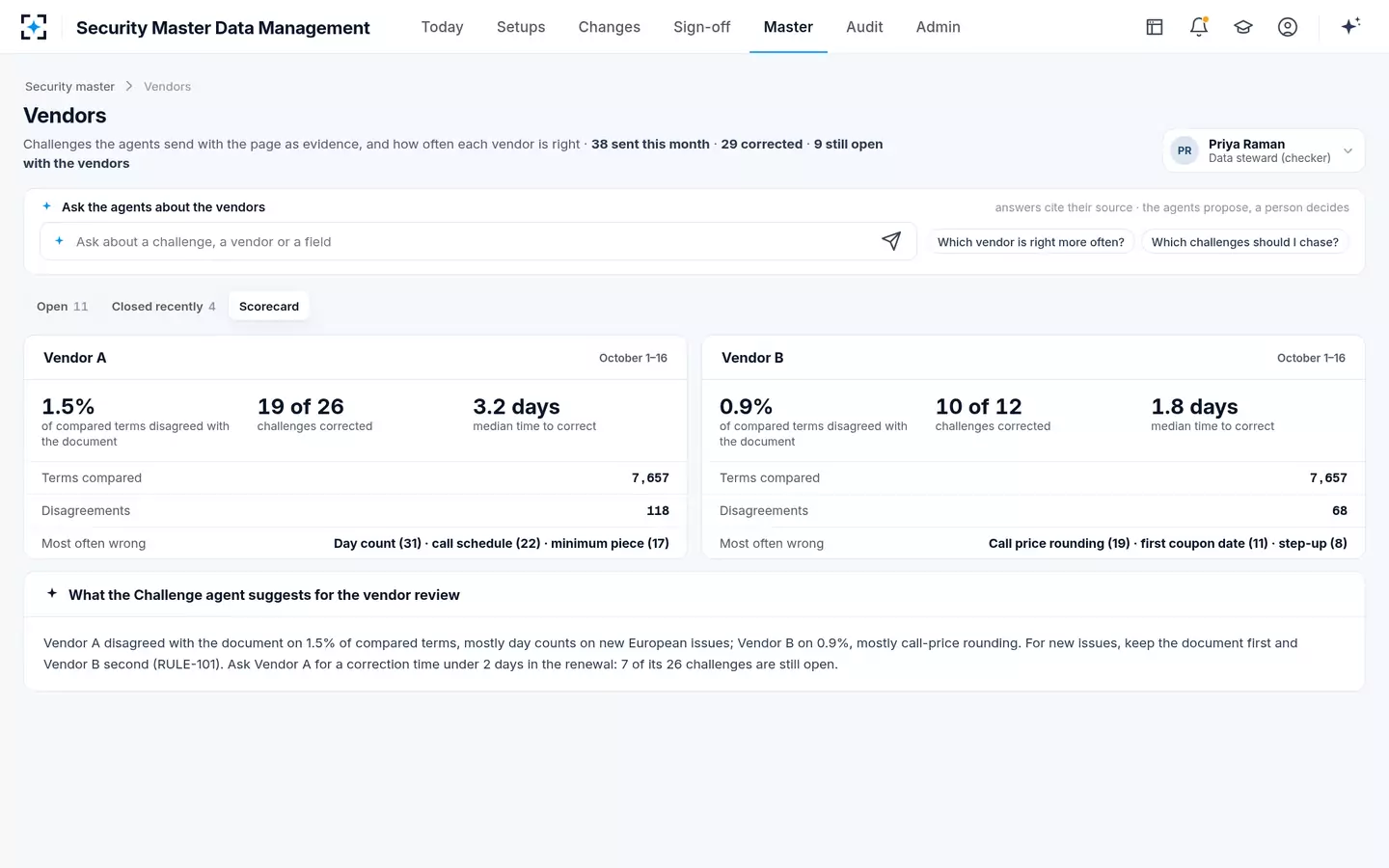
How to measure your security master's unit cost in one month
Four weeks of counting is enough for a first estimate. None of it needs new software; most of it needs someone to log what already happens.
A one-month worksheet for the security master's unit cost
| Measure | Where to get it | How to use it |
|---|---|---|
| New instruments set up, by complexity | Setup requests and the master's creation log | Split into complex and simple by your own test, such as vendor coverage on the day of setup |
| Hours per setup | A time log kept by analysts for four weeks | Median by complexity class; note the slowest ten and why |
| Term changes, and the share needing a person | Vendor delta files and notices; the change log | The share accepted by rule is the first lever on cost |
| Exceptions traced to master data | The breaks log of reconciliation, compliance and reporting | Count by field; this is your error frequency |
| Hours to correct each exception | The same log, with time recorded | Your error consequence, before compensation |
| Vendor disagreement rate, by field | Comparisons settled against the document | Evidence for licence renewals and for which source wins |
| Loaded hourly cost | Finance, or the SEC's published assumptions | Apply consistently to every line |
How automation changes the unit cost, and what it does not
Automation lowers the hours per setup most where documents are long and vendor data is thin, and it lowers exception cost if it catches wrong values before they publish. It does not lower licence costs, and it does not remove the need for a person to approve. The comparison below applies the solution's own design estimate for complex bonds only; simple setups and the exception line are left unchanged, which understates any benefit.
The same month, by hand and with Security Master Data Management's agents
By hand (illustrative): 120 × 2.5 hours = 300 hours.
With the agents (illustrative): 120 × about 0.25 hours of people's time = 30 hours, on the solution's design estimate.
By hand (illustrative): 280 × 0.5 hours = 140 hours.
With the agents (illustrative): Left at 140 hours in this comparison.
By hand (illustrative): 750 handled by a person.
With the agents (illustrative): Unchanged here; in the sample, rules accepted 2,611 of 3,082 changes, and economic ones still go to a steward.
By hand (illustrative): About $135,900.
With the agents (illustrative): About $93,000, plus the solution's own licence, which you would add.
By hand (illustrative): Vendor licences; the need for a second person on every record.
With the agents (illustrative): The same: stewards still approve, and vendors are still bought, now with a scorecard.
The bigger lever is often the last line of the calculator, exceptions, because a wrong value caught before publication costs minutes and one caught at month-end costs a day across several teams. That is why the solution prices each disagreement on the firm's own positions before anything publishes, and why its design target is that every new instrument is set up before its trade books. A month of the solution's own reporting shows the measures a COO would track.
A month of security master work, reported for the COO
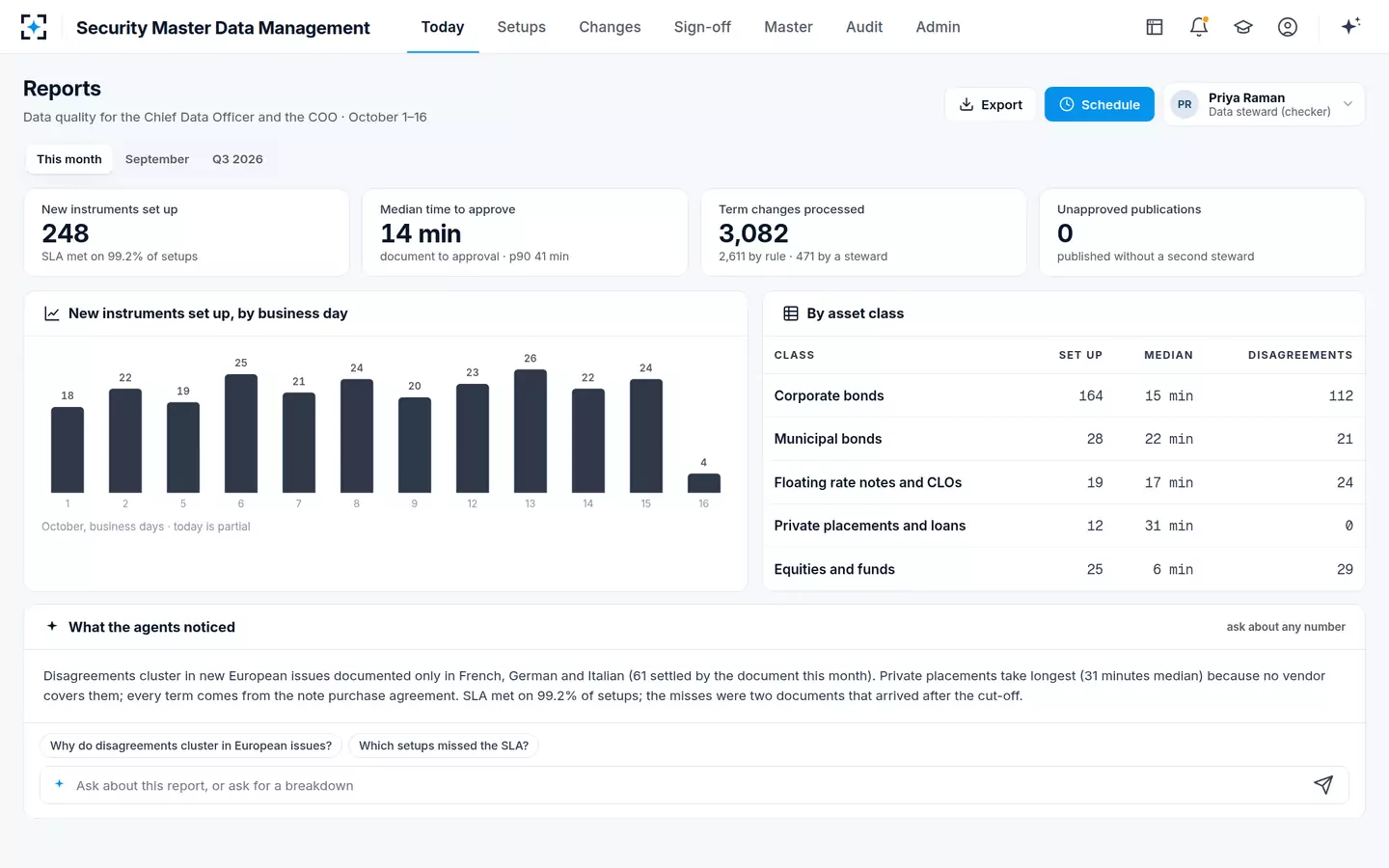
The by-asset-class view is where the calculation becomes a budget. In the sample, private placements took the longest per setup and showed no vendor disagreements, because no vendor covers them; corporate bonds generated most of the disagreements. A firm adding a private credit mandate should cost it at the slow end. Where the agents fit task by task is in AI for instrument data management, and the choice between building, buying or outsourcing the platform is in reference data management tools. The solution is on the Security Master Data Management page.
Questions people ask
What is a security master database?
The database that holds a firm's instrument reference data, identifiers, terms, schedules and classifications, and distributes it to trading, accounting, compliance, pricing and risk systems. It may be built in-house, licensed as a platform, or run by an administrator, but its cost is dominated by the people and data that keep it right.
How much does security master software cost?
Platform vendors and data vendors do not publish prices, and no independent survey of them is public. Treat the software as one line in a unit-cost calculation alongside staff hours, data licences and error correction; for most firms it is not the largest.
How many people does a security master team need?
Divide your monthly hours by productive hours per person. On the illustrative inputs here, about 790 hours a month, roughly five full-time analysts at 160 productive hours each, plus a steward who never approves her own work. Automation reduces the hours; the second person on every record remains.
Does the FDTA add to security master costs?
Not yet. The US agencies' joint data-standards rule took effect on 1 October 2026 without changing any reporting requirement; costs would come with each agency's own rulemaking. The agencies estimate an LEI at roughly $50 to $100 a year in the United States (FDTA final rule).
Is it cheaper to outsource the security master?
Sometimes for setup labour, rarely for accountability. An administrator can run the setups, but the fund's obligations and its board's oversight stay with the manager, and someone in-house still has to decide disagreements and check the administrator's work. Price the oversight hours into any outsourcing comparison.