Treasury management in commercial banking is the set of services a bank provides to business clients to move, collect, track and protect their money: ACH and wire payments, check issuance and positive pay, lockbox and remote deposit capture, balance reporting, sweeps and earnings credits, and the user controls that sit around all of them. Banks usually price these services through account analysis, a monthly statement that offsets fees with an earnings credit on the client's balances. The Federal Reserve describes cash management services as "the payment and collection services that are provided to customers to speed collection of receivables, control payments and efficiently manage deposit balances". Selling them means reading how a business pays and collects today and proposing something better, which is the work Botminds' Treasury Management Proposals does for a bank's treasury officers: its agents read a prospect's statements, recommend the services that answer what they find and price them at the bank's list.
The rest of this page is a plain map for a new relationship manager or a business owner: what the services are, how they are paid for, who in the bank handles them, which rules apply and what is changing in 2025 to 2027.
The rails underneath treasury management, by the numbers
35.2B
ACH payments in 2025, worth $93 trillion
8.1B
business-to-business ACH payments in 2025, up almost 10%
217M
Fedwire Funds transfers in 2025, averaging $5.28 million each
9.2B
check payments in 2024, still falling
What is treasury management in commercial banking?
It is the business banking that happens after the account is open: the services that let a company pay suppliers and staff, collect from customers, see its balances every morning, keep idle cash working and stop fraudulent payments. A commercial loan funds a business; treasury management runs its money every day, which is why banks prize it. A company that runs payroll, payables and collections through a bank is unlikely to move them lightly.
The Federal Reserve's 2003 proposed interpretation of the anti-tying law gives the closest thing to an official definition, in a footnote: cash management services "may include one or more of the traditional bank products listed separately above, such as deposit, payment and lockbox services" (Federal Reserve, proposed interpretation of section 106). The same document lists cash management among the "traditional bank products", which matters for how banks may price relationships, as below.
What is the difference between cash management and treasury management?
In a bank, very little: "cash management" is the older name and "treasury management" the newer one for the same family of services, and many banks use both. The newer name reflects a wider offer, with information reporting, liquidity tools, fraud controls and digital entitlements alongside the payment and collection services the older name described.
The terms do diverge outside banks. A company's treasury department manages funding, investments, risk and cash; the Bureau of Labor Statistics describes cash managers as people who "monitor and control the flow of money into and out of an organization" (BLS). When a bank says treasury management, it means the services it sells to that department, not the department's own job.
Treasury management products and services, mapped
Most banks group treasury services into five families. The table maps each to what it does for the client and the rule or rulebook that governs it, which is also what a treasury officer has to get right before the service goes live.
Treasury management services list, by what each does and the rule behind it
| Family | Typical services | What it does for the business | Rules and rulebooks |
|---|---|---|---|
| Payables | ACH credits, wires, check issuance, controlled disbursement | Pays suppliers and staff; controls when cash leaves | Nacha Operating Rules; UCC Article 4A for wires; UCC Articles 3 and 4 for checks |
| Receivables | Lockbox, remote deposit capture, ACH debits, card acceptance | Collects from customers and gets funds available sooner | Regulation CC availability; FFIEC remote deposit guidance; Nacha for ACH debits |
| Information | Previous-day and intraday reporting, account analysis statement | Shows balances and activity; shows what each service costs | The bank’s agreement and fee schedule |
| Liquidity | Zero balance accounts, sweeps, earnings credit or interest | Concentrates cash and keeps idle balances working | Deposit agreement; interest on business demand deposits allowed since 2011 |
| Controls | Positive pay, ACH debit blocks, dual control, administrator entitlements | Stops unauthorized checks, debits and payments | FFIEC authentication guidance (2021); UCC 4A security procedures |
Two services in the receivables row show how plainly the regulators describe them. The FFIEC's examination glossary defines a lockbox as a "Deposit mechanism used by commercial firms and businesses to facilitate their deposit transaction volume", in which customers send payments directly to an address the bank controls (FFIEC IT Handbook, glossary). Remote deposit capture lets the business scan checks at its own premises instead; because the capture happens outside the bank, the FFIEC's guidance expects a suitability review before the bank offers it.
How the money moves: the payment mix behind every proposal
ACH carries most of the value businesses and consumers move outside wires, and checks still carry more than cards. The Federal Reserve's 2025 payments study found that "In 2024, ACH's share of noncash payments by value reached almost three quarters for the first time", while checks continued to decline by number and value (Federal Reserve, July 1, 2026).
By value, ACH dominates noncash payments; checks still outweigh cards
Two things in those numbers shape treasury proposals. Checks have fallen from 42.6 billion in 2000 to 9.2 billion in 2024, yet the value they carry fell much less, so the checks that remain are larger and more often business payments; that is where positive pay and check-to-ACH conversion earn their place, as ACH payment vs check explains. And instant payments are growing from a small base: the FedNow Service settled 8,413,402 payments worth about $853 billion in 2025, and 6,376,467 in the third quarter of 2026 alone (Federal Reserve Financial Services).
How banks price treasury management: account analysis and earnings credits
Most banks price treasury services per item and per month, list them on a monthly account analysis statement, and let the client pay with an earnings credit on its balances, with any shortfall charged as a fee. A business with large balances may pay little or nothing in cash; one with heavy activity and low balances pays the difference. The credit's arithmetic, line by line, is in the earnings credit rate calculator.
The consumer disclosure rules do not govern any of this. Regulation DD covers only deposit accounts held by or offered to consumers (12 CFR 1030.2; account analysis in banking quotes the definition), so a business account's pricing, earnings credit rate and settlement terms are set by contract and by the bank's fee schedule. That puts the burden of clarity on the bank's own documents, which is why a good proposal shows the price list version and the earnings credit arithmetic. How an earnings credit compares with interest is set out in ECR vs interest-bearing account.
Who sells and runs treasury management at a bank
Treasury management is sold by treasury officers, priced by a product manager's list and an authority matrix, and run by implementation and client-service teams once the client signs. The commercial relationship manager usually owns the overall relationship and brings the treasury officer in.
The people behind a bank's treasury management services, and what Treasury Management Proposals changes for each
Today
Reads the prospect’s statements, recommends and prices services, writes the proposal.
With agents
With agents reading, spends the time on which services to put in and what to say about the price.
Still theirs: The recommendation and the price within authority
Today
Approves discounts beyond an officer’s authority, often by email.
With agents
Approves each price and each proposal with a reason, never one he drafted.
Still theirs: The exception decision
Today
Owns the service catalogue, list prices, tiers and earnings credit rates.
With agents
Sees every price given below the line, and why.
Still theirs: The price list and its versions
Today
Set up limits, entitlements, files and agreements after the sale.
With agents
Receive a readiness list with the rule behind each step.
Still theirs: Go-live and every change after it
The volume is easy to underestimate. The fictional sample bank, a community bank, writes about 260 treasury proposals a year and had 34 open at once, each waiting on something different: statements from the prospect, the agents' reading, a price, an approval or the prospect's answer. A bank that sells treasury management well is one that knows, every morning, which of those is waiting on whom.
A treasury sales pipeline in Treasury Management Proposals: who is waiting on whom
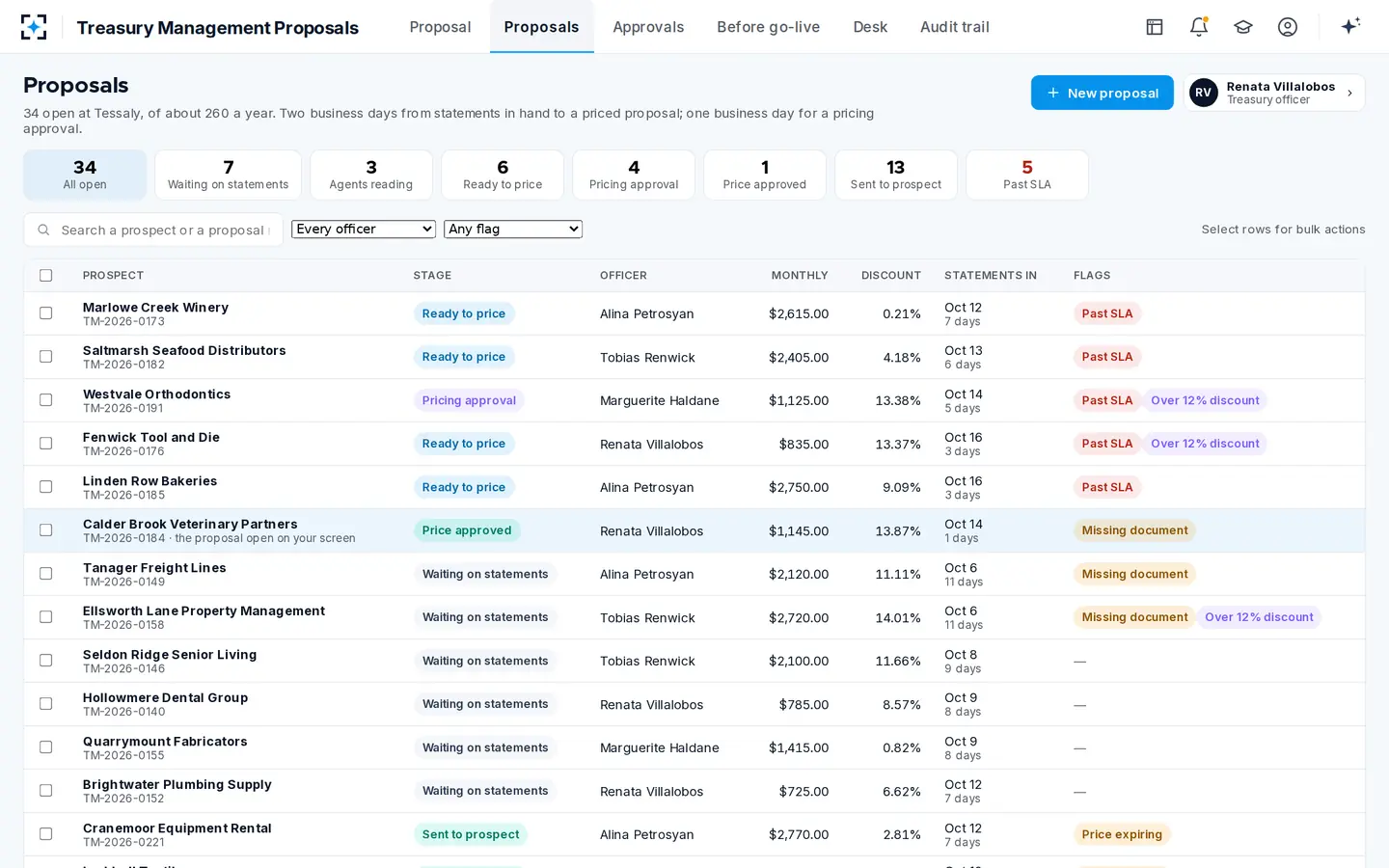
The officer's job, the seat at the front of this chain, is described in the treasury management officer job description.
The controls inside every treasury service
Every treasury service carries controls the business has to choose and the bank has to offer, and the FFIEC's 2021 authentication guidance lists the main ones for business customers. It names positive pay and debit blocks as ways for a business to watch and control its own accounts, extra controls for a business's system administrators, and approval by a second employee before certain transactions go (FFIEC, Authentication and Access, 2021). How positive pay works covers the first, and a corporate account takeover policy the last.
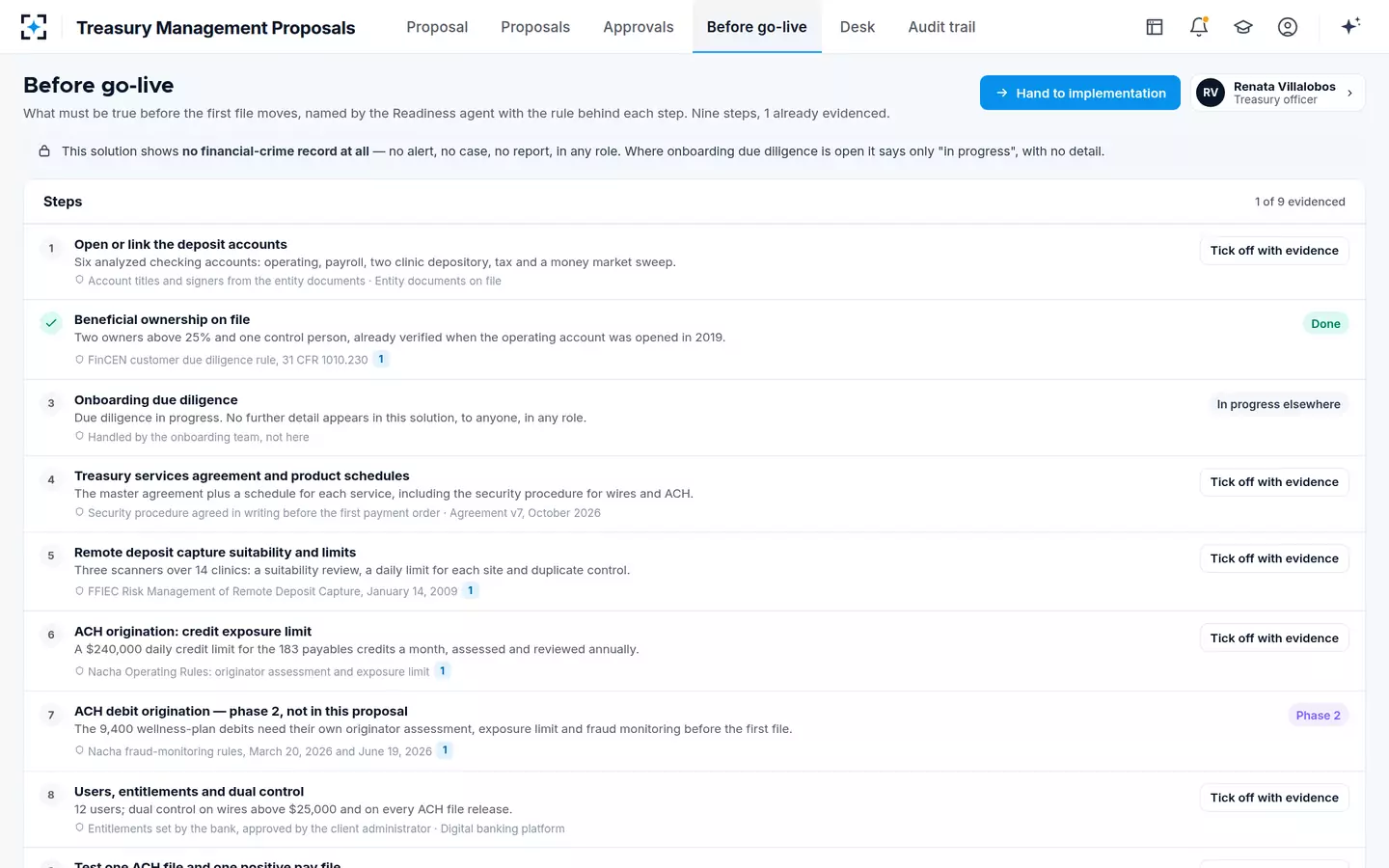
For wires the law adds a sharper edge. Under UCC Article 4A a payment order verified under an agreed, commercially reasonable security procedure binds the business even if it was not authorized, which is why the security procedure, and any control the client declines, belongs in writing. For ACH origination the bank also carries credit exposure for its client's files and sets an exposure limit before the first one moves. A treasury proposal that recommends services without naming these controls has described half the product.
What a treasury service needs before the first file moves, as Treasury Management Proposals lists it
What is changing in treasury management, 2025 to 2027
Several rules and rails that treasury services depend on changed in 2025 and 2026 or have dates set ahead. Each one changes something a treasury officer says to a client.
Changes a treasury management client will hear about, 2025 to 2027
| When | What changed | Source |
|---|---|---|
| November 2025 | FedNow transaction limit raised from $1 million to $10 million | Federal Reserve Financial Services, September 9, 2025 |
| December 9, 2025 | Federal Reserve asks for comment on the future of the Reserve Banks’ check services; no decision yet | Federal Register notice |
| March 20, 2026 | Nacha fraud monitoring phase 1: all ODFIs and the largest non-consumer originators, TPSPs and TPSs | Nacha rule page |
| June 19, 2026 (in practice June 22) | Nacha fraud monitoring phase 2: all remaining non-consumer originators, TPSPs and TPSs | Nacha Operations Bulletin #1-2024 |
| September 17, 2027 | Same Day ACH limit rises from $1 million to $10 million a payment | Nacha rule page |
| No earlier than 2028 | Fedwire Funds Service to operate on Sundays and weekday holidays | Federal Reserve Board, October 9, 2025 |
The Nacha fraud-monitoring rules reach treasury clients directly: a business that originates ACH entries now needs risk-based processes to identify payments initiated by fraud, and a proposal for ACH origination should say so. The limit increases do the opposite job, opening faster rails to larger payments that used to need a wire.
Why banks pair treasury management with lending
Because the law allows it and the economics reward it. The anti-tying statute generally bars a bank from conditioning credit on the purchase of other products, but it exempts traditional bank products, and the Federal Reserve's 2003 proposed interpretation listed cash management services among them. A bank may therefore price or condition a loan on the client also keeping its operating accounts and treasury services there.
The economics follow from what the services touch. Operating balances fund the bank, fees add revenue that does not depend on rates, and daily payments give the bank a view of the client's business that a loan file never shows. How banks turn that into a price, and what to write down when they discount, is the subject of relationship pricing in banking.
Questions people ask
What are treasury management services in banking?
The payment, collection, information, liquidity and fraud-control services a bank sells to businesses: ACH and wires, check issuance and positive pay, lockbox and remote deposit capture, balance reporting, sweeps and earnings credits, and user controls such as dual control. They are usually billed through a monthly account analysis statement.
What is cash management in commercial banking?
The same family of services under its older name. The Federal Reserve's 2003 proposed interpretation of the anti-tying law described cash management services as payment and collection services that speed collection of receivables, control payments and manage deposit balances.
What are examples of cash management products in banks?
ACH origination, wire transfer, positive pay, controlled disbursement, zero balance accounts, lockbox, remote deposit capture, sweeps and previous-day reporting are the common ones. A sample proposal for a 14-clinic veterinary practice priced nineteen such services at $1,145.00 a month.
Who uses treasury management services?
Businesses, public bodies and non-profits with enough payments, collections or balances to need more than a business checking account. In 2025, businesses alone sent close to 8.1 billion business-to-business ACH payments, according to Nacha.
Is treasury management the same as corporate treasury?
No. Corporate treasury is a company's own function, managing funding, investments, risk and cash. Bank treasury management is the set of services a bank sells to that function.
How do banks charge for treasury management?
Per item and per month, on an account analysis statement, with an earnings credit on balances offsetting the fees. Because the consumer rules in Regulation DD cover only consumer accounts, the terms for business accounts are set by the bank's agreement and fee schedule.