Relationship pricing in banking means setting the price of one product, a treasury package, a loan or a deposit rate, by reference to the value of the client's whole relationship with the bank rather than to that product alone. A treasury officer who prices cash management services below list because the client also has a large loan request and keeps substantial balances is relationship pricing. The practice is lawful for traditional bank products, and the Federal Reserve has said the exception exists to let banks negotiate fees "on the basis of the customer's entire banking relationship". What makes it defensible is what was written down at the time: who had the authority to give the discount, what the relationship was worth, why the discount was given and when it ends. Botminds' Treasury Management Proposals captures those four on every treasury proposal, testing each price against the drafter's authority and routing anything beyond it to a named approver with a reason code.
The problem it addresses is ordinary. A discount agreed in an email thread cannot be defended a year later: nobody can say what the officer's authority was, what the relationship justified, or whether the loan that justified it ever closed. The examples here come from a fictional sample bank's pipeline as it runs through the solution.
What is relationship pricing in banking?
Relationship pricing is pricing a product on the whole relationship's value: balances, fees, loans and the services the client uses or is about to use. Banks apply it in three common ways: as a discount on one product because the client holds others, as a combined-balance threshold that unlocks better pricing, and as an exception to the list approved case by case.
In treasury management it usually takes the third form. The officer builds a pro forma at list, finds that winning the business needs a lower price, and asks for an exception because of something the relationship carries. In the sample, the relationship manager had a $6.4 million credit request in process with the same prospect, and the prospect's balances would earn an allowance that more than covered the package. Both are legitimate reasons. Neither is worth anything later unless it was written down when the price was approved.
Is relationship pricing legal? The anti-tying rule and its exceptions
Yes, for traditional bank products. The anti-tying statute says a bank "shall not in any manner extend credit, lease or sell property of any kind, or furnish any service, or fix or vary the consideration for any of the foregoing, on the condition or requirement" that the customer obtain some additional product, but it carves out "a loan, discount, deposit, or trust service" (12 U.S.C. § 1972). A bank may therefore vary a price on the condition that the client also keeps deposits or borrows, and the Federal Reserve's 2003 proposed interpretation listed cash management services among the traditional bank products the exception covers.
The Board also explained why the exception exists: "One of the purposes of this exception was to allow banks and their customers to continue to negotiate their fee arrangements on the basis of the customer's entire banking relationship with the bank" (Federal Reserve, 2003 proposed interpretation). The same document works through a bank that will renew a credit facility only if the client's whole relationship meets a profitability hurdle, and concludes the arrangement is permissible "if, for example, Company could reasonably obtain sufficient cash management services from Bank to permit Company to meet the hurdle rate."
Regulation Y adds a safe harbor for package pricing. A bank may "Vary the consideration for any product or package of products based on a customer's maintaining a combined minimum balance in certain products specified by the bank", provided the bank offers deposits, all its deposits count, and "Balances in deposits count at least as much as nondeposit products toward the minimum balance" (12 CFR 225.7(b)(2)). The line a bank must not cross is conditioning a price on a non-traditional product, such as an affiliate's securities underwriting, without giving the client a meaningful way to qualify through traditional products alone.
Who approves a treasury discount? An authority matrix that names the people
A named person at a defined level, according to a matrix the bank owns. The matrix should say how far below list each role may price on its own authority, who approves beyond it, and what happens when the approver drafted the proposal.
A treasury pricing authority matrix, as the sample bank sets it in Treasury Management Proposals
| Role | Prices on own authority | Above that | Never |
|---|---|---|---|
| Treasury management officer | Up to 10% below list (settable at 5%, 10% or 15%) | Treasury sales manager approves, with a reason code | Approves a proposal they drafted |
| Treasury sales manager | Up to 25% below list | The level above, under the same matrix | Approves a proposal they drafted; it routes one level up |
| Head of treasury management | The matrix’s top band | As the bank’s pricing policy sets | Approves their own draft |
| Commercial relationship manager | Never prices | Adds the relationship context the approver reads | Sets or approves a treasury price |
| Treasury product manager | Owns the list, tiers and matrix, with versions | Changes them with a reason on the record | Approves individual exceptions |
The last two rows matter as much as the first three. A relationship manager who can set a treasury price will price to protect the loan; a product manager who approves exceptions has no independent view of the list. Keeping each role on its own side of the line is what makes the exceptions informative.
How much discount can a treasury officer give? The arithmetic on one price
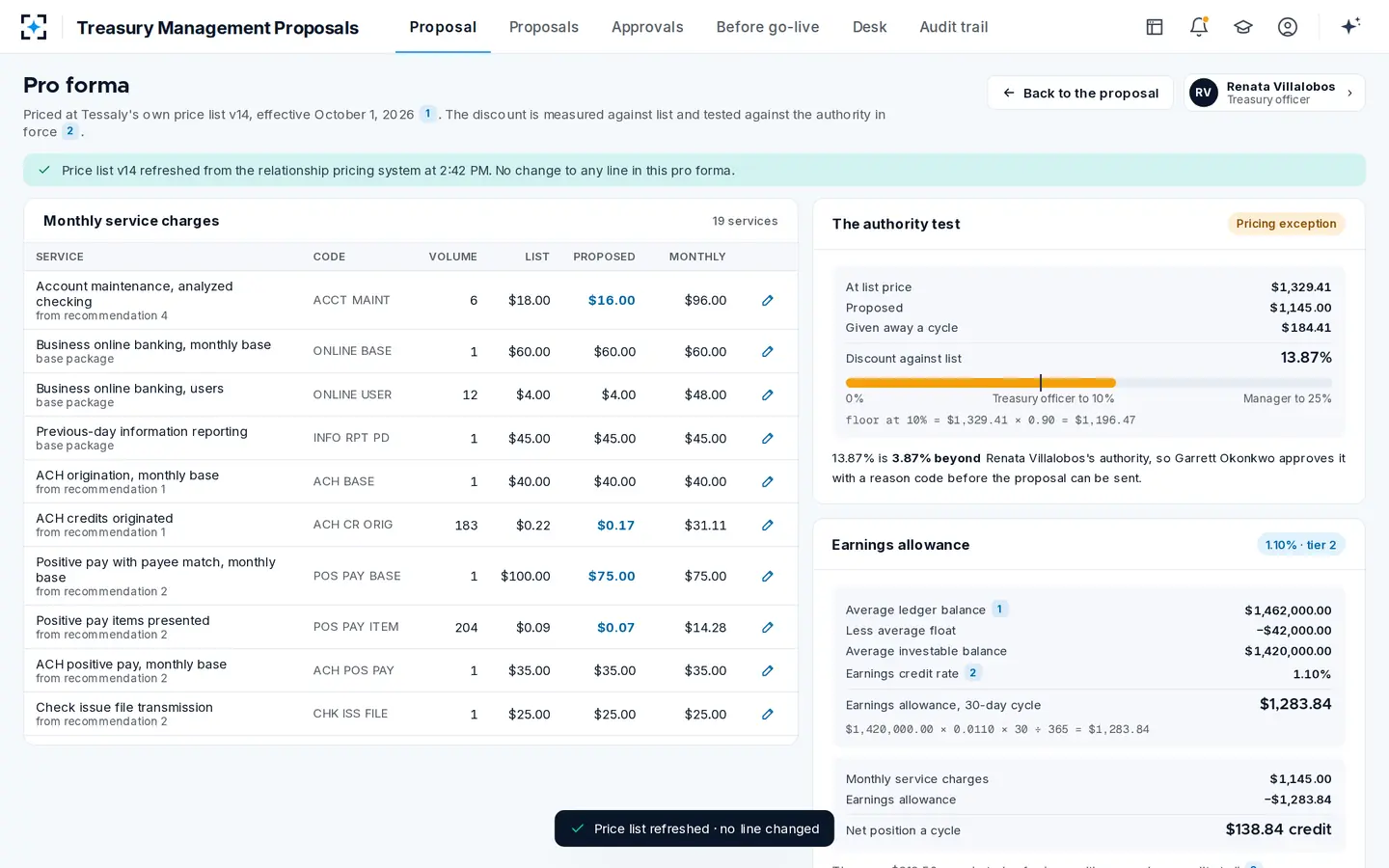
As much as the bank's matrix allows, measured against list and tested before the proposal can be sent. At the sample bank the answer is 10% of list. The arithmetic below shows how one proposal crossed that line and what the approver saw.
One treasury discount, measured against list and tested against authority
At list
$1,329.41 a month
Nineteen services at price list v14, with the prospect’s volumes.
The product manager’s list
Proposed
− $184.41 a cycle
$1,145.00 a month: a discount of 13.87% against list.
The officer’s draft
Authority floor
$1,329.41 × 0.90 = $1,196.47
The lowest price the officer may send on her own 10% authority.
The bank’s matrix
Beyond authority
3.87 points over
A pricing exception: the sales manager approves it with a reason before anything is sent.
A named approver
The pro forma shows where the discount sits, line by line. In the sample, ACH credits are priced at $0.17 against a $0.22 list, positive pay's monthly base at $75.00 against $100.00, positive pay items at $0.07 against $0.09 and account maintenance at $16.00 against $18.00; together those four lines give away $50.23 a month of the $184.41, and the rest sits on lines further down the pro forma. That breakdown matters to the approver. A discount concentrated on the services the bank wants the client to adopt is a different decision from one spread across everything, and the approver should be able to see which it is.
What the OCC says a fee decision should weigh
For national banks, the OCC's rule on non-interest charges and fees describes the decision process it expects. A bank sets fees in accordance with safe and sound banking principles if it weighs, among other factors, what the service costs it to provide, the deterrence of misuse, its competitive position under its business plan and marketing strategy, the use of third parties and the maintenance of safety and soundness (12 CFR 7.4002(c)(2); the factors are quoted in treasury management fees). The rule also says fee decisions should be made "on a competitive basis and not on the basis of any agreement, arrangement, undertaking, understanding, or discussion with other banks or their officers".
The section was revised by an interim final rule published on April 29, 2026 and effective June 30, 2026, which clarified what charging a fee includes and that fees may be set in consultation with third parties (OCC interim final rule). For a treasury discount the factors translate directly into what an approved exception should carry: what the services cost the bank, how the discount serves the bank's plan for the segment, and why it is safe.
How to document pricing exceptions so they survive the next review
Record five things with every exception: the authority that applied, the value of the relationship, the reason code, the approver and the expiry. Everything else, including the email thread, is supporting colour.
An exception approved by email, and an exception on the record
Approved in an email thread: Not stated; the officer’s limit is assumed
Approved on the record: The drafter’s authority and floor, computed: 10%, $1,196.47
Approved in an email thread: “Big relationship, worth it”
Approved on the record: Credit request in process, earnings allowance $1,283.84 a cycle against $1,145.00 of charges
Approved in an email thread: Whatever the email says
Approved on the record: A reason code from the bank’s list, here PX-2, relationship value with credit in process
Approved in an email thread: Whoever replied
Approved on the record: A named approver other than the drafter, with an approval code and a note
Approved in an email thread: None; the price persists until someone notices
Approved on the record: Valid 60 days; revisit at the first repricing after go-live
Approved in an email thread: A search through mailboxes
Approved on the record: An evidence pack: price list version, authority test, reason, approver, expiry
The discount, measured against list and tested against the drafter's authority
Relationship pricing models: five reasons a discount can carry
A relationship pricing model is, in practice, a short list of reasons a discount is allowed, each with its own evidence and expiry. The sample bank uses five, and each implies a different follow-up.
Five reasons for a treasury price exception, and what each one obliges
| Reason code | When it fits | Evidence to record | What to check later |
|---|---|---|---|
| PX-1 Competitive displacement | The prospect has a lower price elsewhere | What the prospect pays today, from its statements | Whether the business moved |
| PX-2 Relationship value | A loan, deposits or other services make the whole worth more | The credit request, balances and their earnings allowance | Whether the credit closed and the balances arrived |
| PX-3 Volume tier | Activity will reach a higher tier soon | Volumes by cycle and the tier thresholds | Whether volumes reached the tier |
| PX-4 Strategic segment | The bank is building a segment on purpose | The plan the discount serves | The segment’s results at the next review |
| PX-5 First-year ramp | A lower price while the client converts | The ramp schedule and its end date | That the price stepped up on time |
The last column is the point of a model. A reason that is never checked turns every exception into a permanent price. PX-2 in particular should be revisited: a discount justified by a loan in process is a different decision once the loan closes, and a different one again if it does not.
What the product manager learns from the exceptions
Exceptions recorded with reasons tell the product manager where the list is wrong. If many proposals in a segment need the same discount for the same reason, the list or the tier is out of line with the market; if one officer's exceptions cluster, the conversation is with the officer.
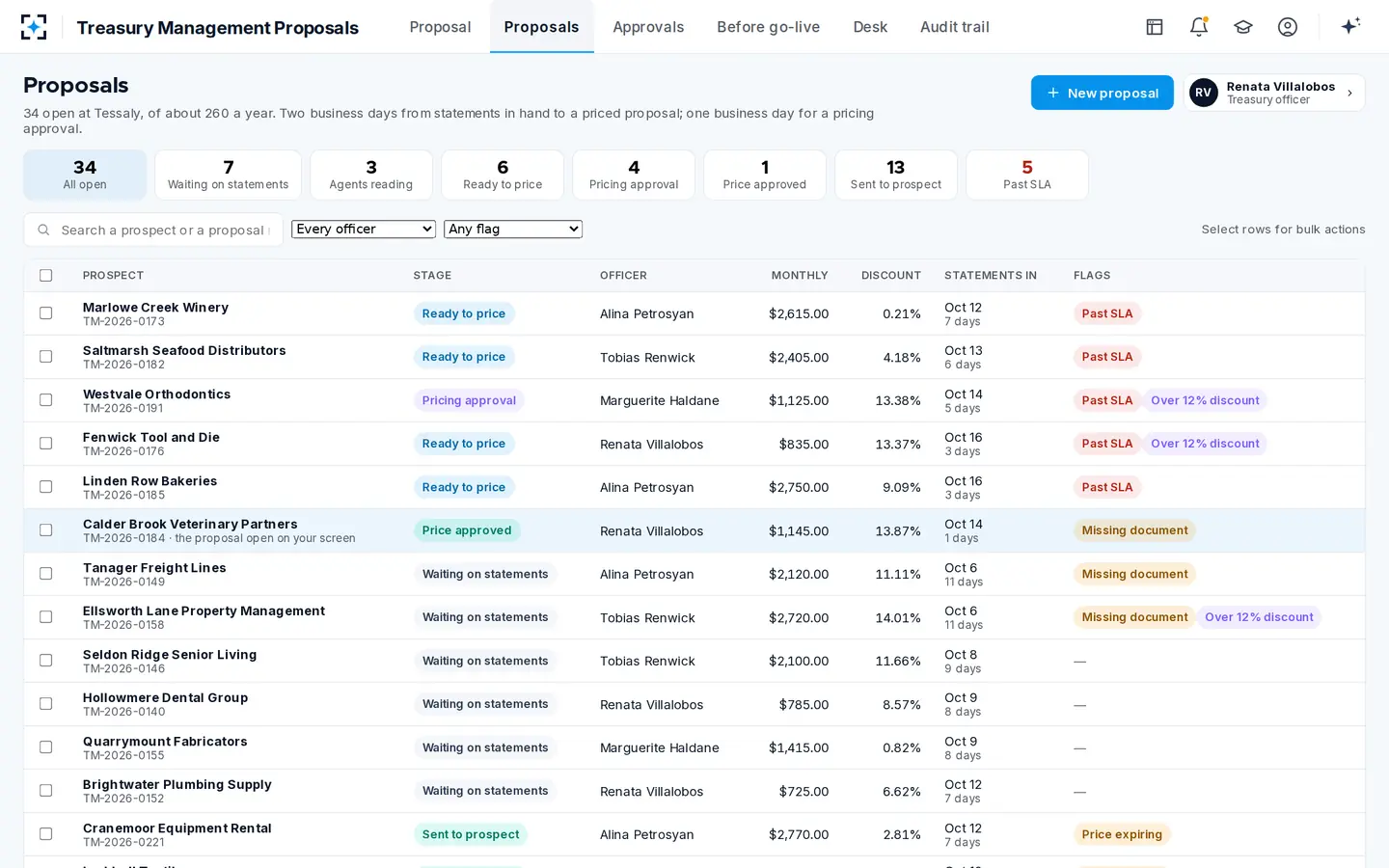
Five proposals waiting on a price: four beyond the drafter's authority
The Harrowgate line shows the maker-checker rule doing its job: the sales manager drafted that proposal himself, so it routes one level up rather than to his own approval queue. Only Greystone Ridge, at 3.82%, sits inside authority and can be approved without an exception. The officers' side of this, how a desk comes to rely on drafted prices, is covered in the treasury management sales analyst, and the authority line in the officer's own job in the treasury management officer job description.
The pipeline, with discounts above 12% flagged for the price review
Relationship pricing with Treasury Management Proposals
The solution does not decide what a relationship is worth; people do. What it does is make the decision visible and durable. Its Pricing agent builds the pro forma at the bank's list and tiers, computes the earnings allowance from the prospect's own balances, measures the discount and tests it against the drafter's authority. It never goes below list without a reason code, never approves its own exception and never prices on a stale list without saying how old it is.
What every treasury price exception should carry, in any system
- The list and its version
So the discount is measured against the price in force that day.
- The drafter’s authority and floor
Computed, not assumed.
- The relationship value
The facts that justify it: a credit request, balances and their allowance, volumes.
- A reason code and a note
From a short list the product manager owns.
- A named approver who did not draft it
With an approval code and a reason of their own.
- An expiry and a review point
The proposal validity, and when the price will be revisited.
That trail then serves three readers: the sales manager deciding today, the product manager reviewing the list next month, and internal audit or an examiner asking a year later why a client pays what it pays. Where the earnings allowance carries the case, ECR vs interest-bearing account shows how to state it without overstating it.
Questions people ask
What is an example of relationship pricing?
A bank prices a business's treasury package 13.87% below list because the business has a $6.4 million credit request in process and keeps balances whose earnings credit covers the package. The exception is approved by a manager with a reason code and expires after 60 days, as in the fictional sample on this page.
What is relationship-based pricing for loans?
The same idea applied to a loan: a lower rate or fee because the borrower also keeps deposits or treasury services with the bank. The anti-tying statute permits conditioning a loan's price on traditional bank products such as deposits, and the Federal Reserve's 2003 proposed interpretation counted cash management services among them.
Can a bank require a business to move its deposits to get a loan?
Conditioning credit on deposits falls within the statute's exception for traditional bank products. What a bank may not do is condition credit on a non-traditional product, such as an affiliate's securities services, without a meaningful option to qualify through traditional products alone.
Do consumer relationship pricing rules apply to business accounts?
No. Regulation DD's account disclosure rules cover consumer accounts, so a business's treasury pricing and its exceptions are governed by the bank's agreement, fee schedule and pricing policy. National banks' fee decisions also fall under the OCC's rule at 12 CFR 7.4002.
How often should relationship pricing be reviewed?
At least whenever the reason expires: when a promised credit closes or fails, when volumes should have reached a tier, or when a first-year ramp ends. A price validity period, 60 days in the sample, and a review at the first repricing after go-live keep exceptions from becoming permanent.