The difference between an earnings credit rate (ECR) and an interest-bearing account is what the balance pays for. An ECR turns a business's collected balance into a credit that offsets its bank's service charges and, in most arrangements, nothing beyond them; an interest-bearing account pays cash on the balance whether the business has fees to cover or not. Which is worth more depends on the prospect's own balances, its fees and the two rates on offer, so the honest way to compare them is on its statements. Botminds' Treasury Management Proposals does that arithmetic in every treasury proposal: it reads the prospect's balances and float, applies the bank's earnings credit tiers, and shows the allowance against the monthly charges with the formula on the screen.
The choice exists because of a 2011 change in law, and it matters more when rates are high, as they are again in 2026. The worked example on this page uses fictional sample data: a 14-clinic veterinary practice with $1,420,000 of collected balances that, at its current bank, earned no credit at all.
Three dates behind every earnings credit conversation
2011
July 21: banks may pay interest on business demand deposits for the first time since 1933
0%
reserve requirement on all deposits since March 26, 2020
3.90%
interest the Federal Reserve pays on reserve balances, effective September 17, 2026
ECR vs interest-bearing account: the short answer
An earnings credit is worth up to the fees it offsets; interest is worth the full amount paid. If a business's earnings allowance is smaller than its monthly service charges, the two are worth the same at the same rate, because every dollar of credit is used. Once the allowance exceeds the charges, the excess is usually forfeited or carried for a limited time, and interest at a lower rate can be worth more.
So the comparison turns on three numbers for the prospect: its investable balance, its monthly service charges, and the gap between the ECR and the interest rate the bank would pay. A treasury officer who shows those three on the prospect's own statements has answered the question. One who quotes a rate without them has left the prospect to do the arithmetic, and it usually does it with the bank that showed its work.
What is an earnings credit rate, and how is the allowance calculated?
The earnings credit rate is the rate a bank applies to a business's investable balance to produce an earnings allowance, a credit against service charges for the cycle. The calculation has four terms, and the formula below is the one Treasury Management Proposals puts on the screen.
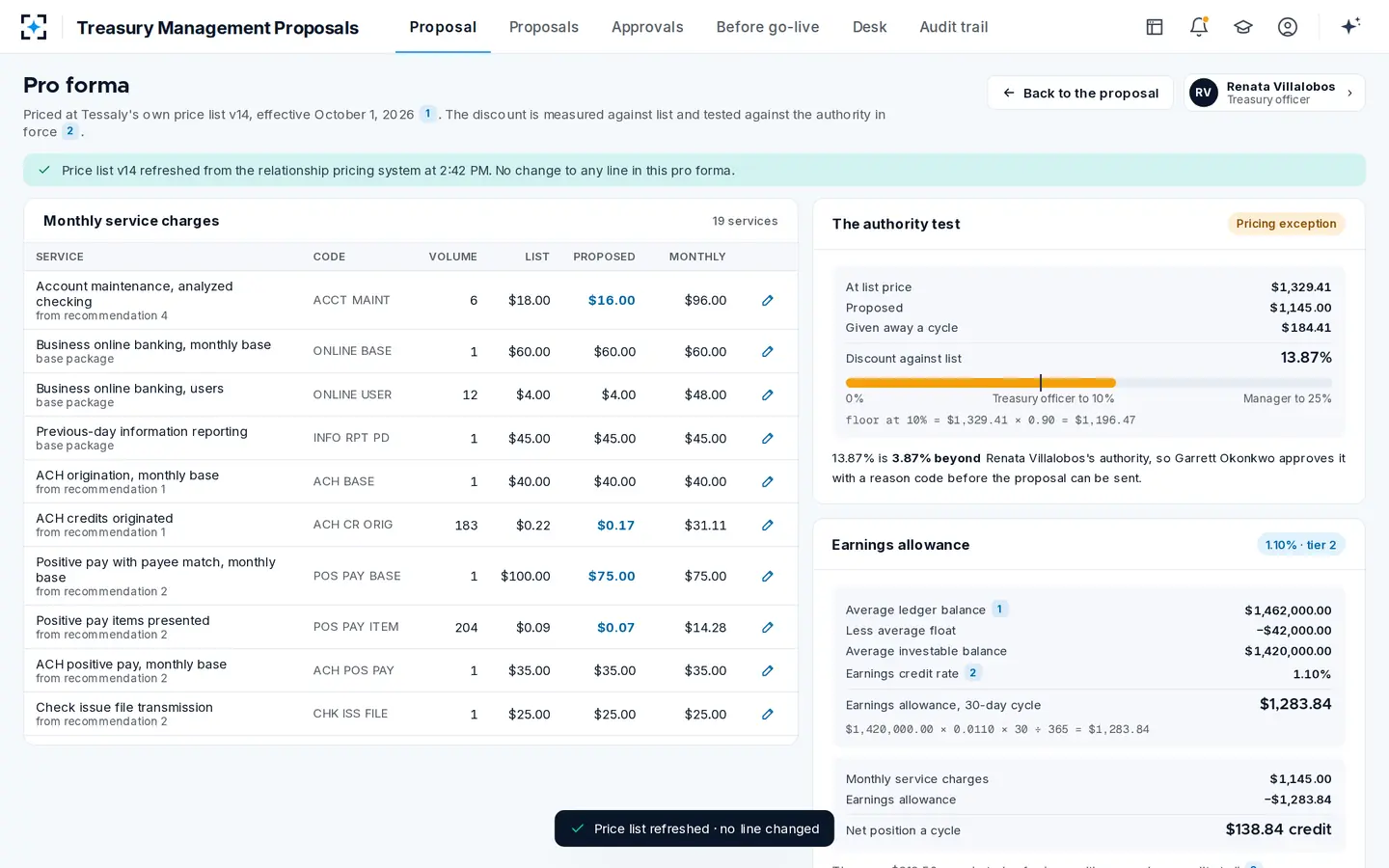
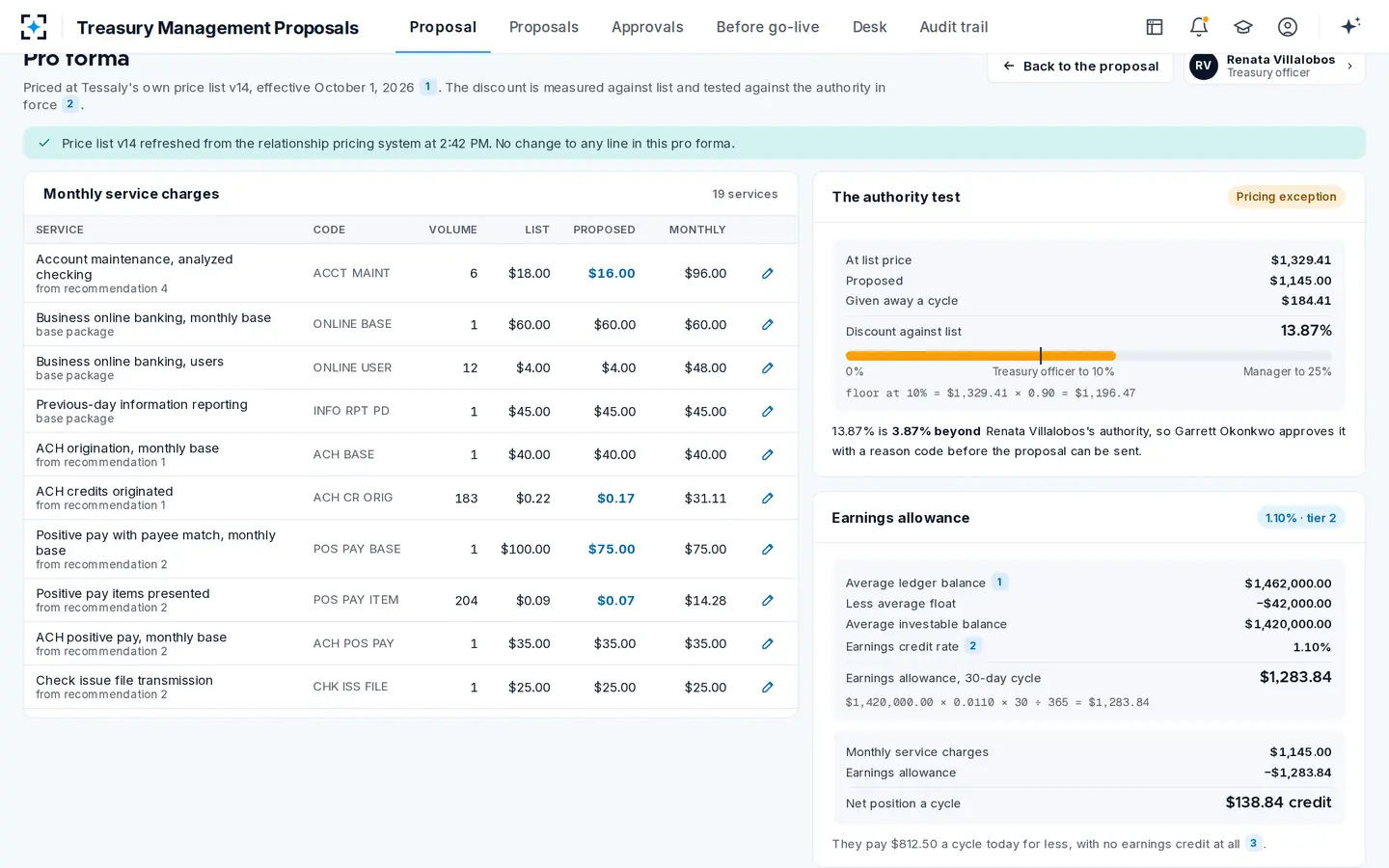
The earnings allowance in Treasury Management Proposals, on one sample prospect's own balances
Average ledger balance
$1,462,000
The cycle’s average of daily ledger balances, from the prospect’s statement.
Read from the statement
Less average float
− $42,000
Deposited items not yet collected. Ledger balance less float is the collected balance.
Read from the statement
Investable balance × ECR
$1,420,000 × 1.10%
Rate from the bank’s tier for this balance; the reserve deduction is now 0%.
The bank’s earnings credit tiers
Days in cycle ÷ 365
× 30 ÷ 365 = $1,283.84
Against $1,145.00 of monthly service charges, a net position of $138.84.
Our arithmetic, shown
Two terms that older formulas carry have changed. Banks used to reduce the investable balance by the reserve requirement, because reserves earned nothing; the Federal Reserve's 1992 senior financial officer survey describes banks paying "the earnings credit rate on the nonreservable portion of the demand deposit" (Federal Reserve, March 1992 SFOS). Since the Board cut reserve requirements to zero on March 26, 2020, that deduction is zero (Federal Reserve; worked through in the earnings credit rate calculator), so a formula still deducting a 10% reserve understates the allowance by a tenth. The other is the day basis: a 360-day basis gives a larger allowance than 365 at the same rate, so the statement should say which applies.
Can a business checking account earn interest? Since July 21, 2011, yes
Yes. For almost eight decades it could not: the Banking Act of 1933 barred member banks from paying interest on demand deposits, and earnings credits grew up as the way around it. Section 627 of the Dodd-Frank Act repealed the prohibition, and the Federal Reserve's final rule repealing Regulation Q took effect on July 21, 2011 (Federal Register, July 18, 2011).
The rulemaking record shows the industry expected exactly the choice this page is about. One commenter told the Board that "customers would be able to choose between receiving earnings credits and direct payments of interest", and the FDIC's parallel rule noted so-called hybrid products that "pay interest and offer earnings credits." (FDIC final rule, July 14, 2011). These were commenters' views summarised in the preambles, not findings by the agencies, but they describe the market that followed: analyzed accounts with an ECR, interest-bearing business checking, and hybrids that do both.
Nor do the consumer disclosure rules fix the terms. Truth in Savings (Regulation DD) applies to consumer accounts, so a business account's rate, tiers and settlement period are whatever the deposit agreement says, which is why the ECR, the tier table and the settlement period should be written into the treasury services agreement and repeated in the proposal.
What are earnings credits worth? Only the fees they offset
An earnings credit is a discount on fees, so its value stops where the fees stop. The same 2011 record put it bluntly: a commenter argued that smaller banks struggled to compete for large balances partly because "earnings credits are not valuable beyond what can be used to pay for fees" (Federal Reserve, Regulation Q repeal). A business with large balances and few services can earn an allowance it cannot spend.
That has a practical consequence for a proposal. Quoting a full year of earnings allowance as ‘value’ overstates it whenever the allowance exceeds the charges. In the sample, the allowance is $1,283.84 a cycle against $1,145.00 of charges, so the credit covers the whole package and $138.84 a cycle is surplus. Whether that surplus is worth anything depends on the bank's carryover rules, which is why the proposal should show the net position rather than add the allowance to the savings.
The charges the allowance has to cover: nineteen services at the bank's list
Earnings credit rate vs interest rate on one prospect's balance
Put the two side by side at the same rate and the pattern is clear: below the point where the allowance equals the fees, they are worth the same; above it, interest pulls ahead because none of it is forfeited. The bars show one cycle's value to a prospect with $1,145.00 of monthly charges at three balance levels.
At the same 1.10% rate, earnings credits stop paying once the fees are covered
Rates are rarely equal, so the useful number is the break-even interest rate: the rate at which interest on the balance equals the fees the earnings credit would have covered. For the sample prospect it is $1,145.00 × 365 ÷ ($1,420,000 × 30), or about 0.98%. An interest-bearing alternative paying less than that on this balance is worth less than the 1.10% ECR; one paying more is worth more, before tax and before any balance-based charges the account carries.
The break-even also shows which prospects to offer what. A business with modest balances and heavy activity uses every dollar of credit, and an ECR is the natural fit. A business with large balances and light activity forfeits much of its allowance, and an interest-bearing or hybrid account, or a sweep, serves it better. A proposal that recommends the same account to both is not reading the statements.
Hybrid accounts, carryover and annual settlement
A hybrid account applies the earnings credit to fees first and pays interest on what is left, and carryover rules decide what happens to a surplus in an analyzed account. Both reduce the forfeiture problem; both need to be written down.
Carryover is older than the 2011 change. In 1992 about nine banks in ten let at least some customers carry a surplus or deficiency into the next period, while over 85 percent capped those carryovers and two-thirds did not let surpluses roll into the next calendar year (Federal Reserve, 1992 SFOS). The survey is old and describes history, not today's market, but the mechanics are the same.
Public-sector buyers make the preference explicit. A Texas city's 2023 depository request for proposals said it "prefers an annual earnings credit settlement where excess earnings credits may be carried forward from month-to-month up until the annual settlement" (City of Bellaire, RFP 23-007). An annual settlement lets a high-balance month pay for a high-activity month, which can be worth more to a seasonal business than a slightly higher rate.
Where rates sit in late 2026, and why ECRs move slowly
Earnings credit rates follow market rates with a lag and only part of the way. On September 17, 2026 the Federal Reserve raised the rate it pays on reserve balances to 3.90%, following the FOMC's decision of September 16 to raise the federal funds target range (Regulation D final rule, September 30, 2026). Banks set business deposit rates well below that, and how far they pass changes through differs by deposit type.
Banks pass only part of a rate rise to business deposits, and less to operational balances
| Deposit type | Cumulative beta, March 2022 to March 2024 | What it means for a treasury proposal |
|---|---|---|
| Retail deposits | 40% | Consumer rates moved least |
| Wholesale operational deposits | 58% | Balances held to run payments: the analyzed accounts a treasury proposal prices |
| Wholesale non-operational deposits | 77% | Balances a treasurer could move; priced closest to market |
The 58% beta on operational deposits is the number to keep in mind when a prospect asks why its ECR lags the Treasury bill rate. Historically ECRs were tied to Treasury bills; the 1992 survey found most banks still set them from the three-month bill rate (the earnings credit rate calculator traces the index). The same survey found that a few banks already used a managed rate set by a bank committee; where tiers are managed rather than indexed, the tier table, its owner and its version belong on the pro forma. In the sample the tiers are 0.85%, 1.10% and 1.25% by balance, owned and versioned by the treasury product manager with the price list.
The lines older formulas deduct: reserves and deposit insurance charges
Two charges can stand between a rate and an allowance. The reserve deduction is now zero, as above. The second is a charge for deposit insurance: the 1992 survey recorded that "Costs associated with reserve requirements and deposit insurance premiums generally are passed on to business customers", either by reducing the rate or by adding a service charge.
Some banks still pass on that cost as a balance-based fee on the account analysis statement, and buyers ask about it. The same Texas request's pricing form has a line for the "FDIC Insurance Assessment", priced as a percentage of average balance. A proposal that quotes an ECR without saying whether such a charge applies has quoted a gross rate, and a prospect comparing banks will net it off for you, probably against your proposal.
Deposit insurance no longer tilts the choice
From the end of 2010 to the end of 2012, noninterest-bearing transaction accounts had unlimited FDIC coverage under section 343 of the Dodd-Frank Act, which gave an analyzed account with an ECR an advantage over interest-bearing alternatives for large balances. The FDIC's notice of expiration said that "beginning January 1, 2013, the FDIC no longer will provide separate, unlimited deposit insurance coverage" for those accounts (FDIC FIL-45-2012).
Since then both kinds of account are insured under the same ownership rules and limit. The choice between an ECR and interest is an economic one, made on the prospect's balances and fees, and a proposal should not suggest otherwise.
How a treasury proposal should show the choice
A proposal should show the earnings allowance on the prospect's own balances, the charges it offsets and the net position, and say what happens to a surplus. Where an interest-bearing or hybrid alternative exists, it should show the break-even rate. Treasury Management Proposals prints the formula with the figures rather than behind them, as the screen below shows.
Treasury Management Proposals works the allowance on the prospect's own balances
What each option should state in a proposal, line by line
Analyzed account with an earnings credit: ECR and the tier it comes from, with the tier table’s version
Interest-bearing or hybrid account: Interest rate, fixed or managed, and how it is reset
Analyzed account with an earnings credit: Investable: ledger balance less float, with any deduction named
Interest-bearing or hybrid account: Collected or ledger balance, as the agreement defines it
Analyzed account with an earnings credit: An allowance against service charges for the cycle
Interest-bearing or hybrid account: Cash interest; hybrids apply credit to fees first
Analyzed account with an earnings credit: Forfeited, carried for a period, or settled annually
Interest-bearing or hybrid account: Paid regardless of fees
Analyzed account with an earnings credit: Any balance-based fee shown separately
Interest-bearing or hybrid account: Service charges paid in cash, plus any balance-based fee
Analyzed account with an earnings credit: Net position a cycle on the prospect’s own balances
Interest-bearing or hybrid account: Break-even rate against the ECR on the same balances
The balance line is often the strongest in a proposal, as it was in the sample: the prospect's current bank paid no credit on $1,420,000, and the proposed package was covered by balances it already kept. Where it goes in the document is shown in the cash management proposal template, and how buyers ask about it in a formal request in the cash management RFP template.
Questions people ask
Is an account with an earnings credit FDIC insured?
Yes, under the same ownership rules and limit as an interest-bearing account. The separate unlimited coverage for noninterest-bearing transaction accounts ended on December 31, 2012, so insurance no longer favours one over the other.
What is a good earnings credit rate?
One that, applied to the prospect's investable balance, covers the fees it will actually incur, with the tier and the settlement terms written down. A higher rate the business cannot use is worth less than an interest-bearing alternative; the break-even rate shows where the line is.
What is the earnings credit allowance?
The dollar credit for a cycle: investable balance times the earnings credit rate times the days in the cycle, divided by 365 or 360. In the sample, $1,420,000 at 1.10% for 30 days is $1,283.84 against $1,145.00 of charges.
Why is my ECR lower than the Treasury bill rate?
Because banks pass only part of market rate changes to business deposits; the Federal Reserve's March 2024 survey found an average cumulative beta of 58% for wholesale operational deposits. Many banks also set the ECR as a managed rate rather than an index.
Do banks still deduct a reserve requirement from the earnings credit?
They should not: reserve requirement ratios have been zero since March 26, 2020. A formula that still deducts a 10% reserve understates the allowance by a tenth, and buyers' requests for proposals now ask banks to state whether they impose one.
Can a business get both interest and an earnings credit?
Yes, through a hybrid account that applies the credit to fees first and pays interest on the remainder; the FDIC's 2011 rulemaking noted such products. The proposal should show the order of application and what happens to any surplus.