A good cash management proposal template has seven sections: what the bank read, what it found and recommends, what the package costs at the bank's list, what the prospect's balances earn against it, what was left out and why, what must be in place before the first payment file, and how long the price holds and who approved it. Each section should tie back to the prospect's own statements, so the chief financial officer reading it can check any figure against its own records. That is the standard a treasury management proposal is held to, and it is the shape Botminds' Treasury Management Proposals writes in: its agents read the prospect's statements, cite every value to a line, price at the bank's list, and draft the proposal only from the services the officer accepted and the price a manager approved.
Many proposal templates in circulation are a cover letter and a fee schedule. They describe the bank rather than the prospect, and nothing in them can be argued with, which is why prospects file them. The annotated example on this page comes from the solution's fictional sample: Tessaly Community Bank's proposal to Calder Brook Veterinary Partners, a 14-clinic practice with $47.2 million of revenue.
One sample proposal in Treasury Management Proposals, from statements to a sent document
18pages
of the prospect’s statements read over three cycles
19services
priced at the bank’s list v14, $1,145.00 a month against $1,329.41 at list
9steps
named before go-live, each with the rule behind it
What goes in a treasury management proposal
A treasury management proposal should carry the prospect's own figures, the bank's priced recommendation and the conditions for going live, in that order. The template below lists the seven sections with what each must contain and the evidence a reviewer would ask for.
Cash management proposal template: seven sections and what each must carry
| Section | What it says | What must stand behind it |
|---|---|---|
| 1. What we read | The statements received, cycles covered, pages that could not be read | A page list with reading confidence |
| 2. What we found and recommend | Each finding tied to a statement line, the service that answers it, and its value | A citation for every figure; the arithmetic shown |
| 3. What it costs | Every service at list with code, volume and proposed price; the monthly total | The price list version and its effective date |
| 4. What your balances earn | Earnings allowance on the prospect’s own balances against the charges; the net position | The formula, the tier and the settlement terms |
| 5. What we left out | Values not counted, and the document each needs | The reason and the request already sent |
| 6. What happens next | The controls and agreements needed before each service goes live | The rule behind each step |
| 7. Validity and approval | How long the price holds and who approved it | A named approver other than the drafter |
The order matters. A proposal that opens with the bank's capabilities asks the prospect to take the bank's word for what it needs. One that opens with the prospect's own statements has earned the next page before the prospect turns to it.
Section 1, what we read: the inventory a prospect can check
The first section says which statements the bank received, which cycles they cover and whether any page could not be read. It is short, and it does two jobs: it shows the prospect what its figures rest on, and it flags any gap before the prospect finds it.
In the sample the section reads, in substance: the prospect sent three cycles, June, July and August 2026; the bank read all eighteen pages; one page, July page 4, arrived as a photograph that could not be read, so nothing in the proposal comes from it and a clean copy has been requested. A proposal that admits a gap on page one is easier to believe on page three. How the reading decides that a page cannot be used is a question of its confidence threshold, set by the bank.
Section 2, what we found and recommend: one finding, one line, one service
Each recommendation should start from a line on the prospect's statement, name the service that answers it and say what it is worth, with the arithmetic. The sample proposal makes four recommendations from five findings, and two of them show the discipline the section needs.
Incoming wires: the statements show 38 incoming wires in the quarter at $15.00 each, which annualizes to 152 a year. At the bank's $12.00 the same wires cost $456 less a year, and the bank's base package adds wire detail to previous-day reporting, which the prospect does not have today. Every input in that sentence is a line on the statement or a price on the list.
Positive pay: the statements show $1,142,380 of checks paid in the quarter, $4,569,520 a year, with no check issue file and no payee verification. The proposal recommends positive pay with payee match and ACH positive pay, and states the exposure covered. It claims no dollar saving, because a fraud control prevents a loss that may or may not have happened, and a figure for it would be invented.
The same recommendation, written as a list and written to be checked
A typical proposal line: Competitive wire pricing
A line the prospect can check: 38 incoming wires last quarter at $15.00; at $12.00, $456 a year less, with wire detail in previous-day reporting
A typical proposal line: Positive pay to reduce fraud losses
A line the prospect can check: $4,569,520 of checks a year issued with no payee verification; positive pay with payee match covers that exposure
A typical proposal line: Attractive earnings credit rate
A line the prospect can check: $1,420,000 collected balance earning no credit today; at 1.10%, $1,283.84 a cycle against $1,145.00 of charges
A typical proposal line: Merchant services review available
A line the prospect can check: Settlements arrive net of processor fees, so the rate cannot be read; we need one month of the processor statement
Section 3, the treasury management pro forma: priced against the list
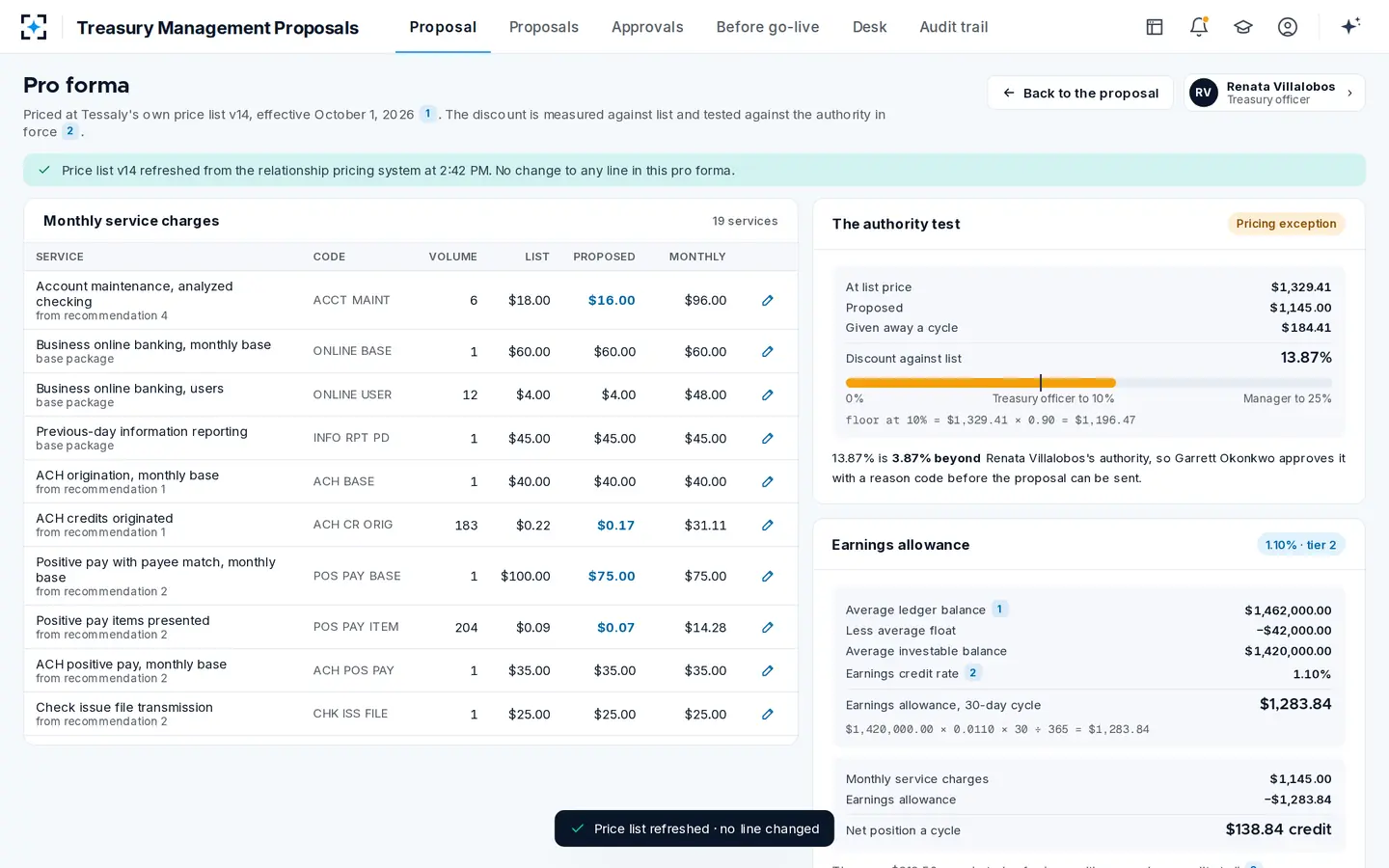
The pro forma lists every service at the bank's list price, with its service code, the volume from the prospect's statements, and the proposed price where it differs. It should name the price list version, because a pro forma priced on an old list is a promise the bank may not keep.
A treasury management pro forma, ten of the sample proposal's nineteen lines
| Service | Code | Volume | List | Proposed | Monthly |
|---|---|---|---|---|---|
| Account maintenance, analyzed checking | ACCT MAINT | 6 | $18.00 | $16.00 | $96.00 |
| Business online banking, monthly base | ONLINE BASE | 1 | $60.00 | $60.00 | $60.00 |
| Business online banking, users | ONLINE USER | 12 | $4.00 | $4.00 | $48.00 |
| Previous-day information reporting | INFO RPT PD | 1 | $45.00 | $45.00 | $45.00 |
| ACH origination, monthly base | ACH BASE | 1 | $40.00 | $40.00 | $40.00 |
| ACH credits originated | ACH CR ORIG | 183 | $0.22 | $0.17 | $31.11 |
| Positive pay with payee match, monthly base | POS PAY BASE | 1 | $100.00 | $75.00 | $75.00 |
| Positive pay items presented | POS PAY ITEM | 204 | $0.09 | $0.07 | $14.28 |
| ACH positive pay, monthly base | ACH POS PAY | 1 | $35.00 | $35.00 | $35.00 |
| Check issue file transmission | CHK ISS FILE | 1 | $25.00 | $25.00 | $25.00 |
Three details make a pro forma credible. The volumes come from the statements, not from a guess about what the prospect might use: 204 positive pay items is the number of checks the prospect paid in August. The codes are the bank's own, so the pro forma matches the account analysis statement the client will receive. And the discount is visible line by line, so the sales manager approving the price can see where it was given.
The pro forma, with the price list version and the authority test above the lines
Section 4, what your balances earn: the earnings allowance
The balance section shows the earnings allowance on the prospect's own balances against the package's charges, and the net position. In the sample it is the strongest line in the document: $1,420,000 of collected balance at 1.10% for a 30-day cycle is $1,283.84, against $1,145.00 of monthly charges, a net credit of $138.84. The prospect pays $812.50 a cycle today for less, with no earnings credit at all.
Two cautions belong in the section. An earnings credit offsets fees and, in most arrangements, nothing more, so a full year of allowance is not a saving to add to the others. And the proposal should say what happens to a surplus. The comparison with an interest-bearing account is worked through in ECR vs interest-bearing account.
Section 5, what we left out: the values not counted
A proposal should list what the bank did not count and why. It is the section most proposals omit, and it is the one that tells a careful buyer the rest is real.
The sample proposal leaves out the card side. The prospect's card settlements arrive net of processor fees, so the effective rate cannot be read from its bank statement; rather than estimate it, the proposal keeps about $14,350 a year out of the figures and asks for one month of the processor statement. It also defers, rather than recommends, ACH debit collection for 9,400 wellness-plan members, for a reason that belongs in the next section.
Section 6, what happens next: readiness before the first file
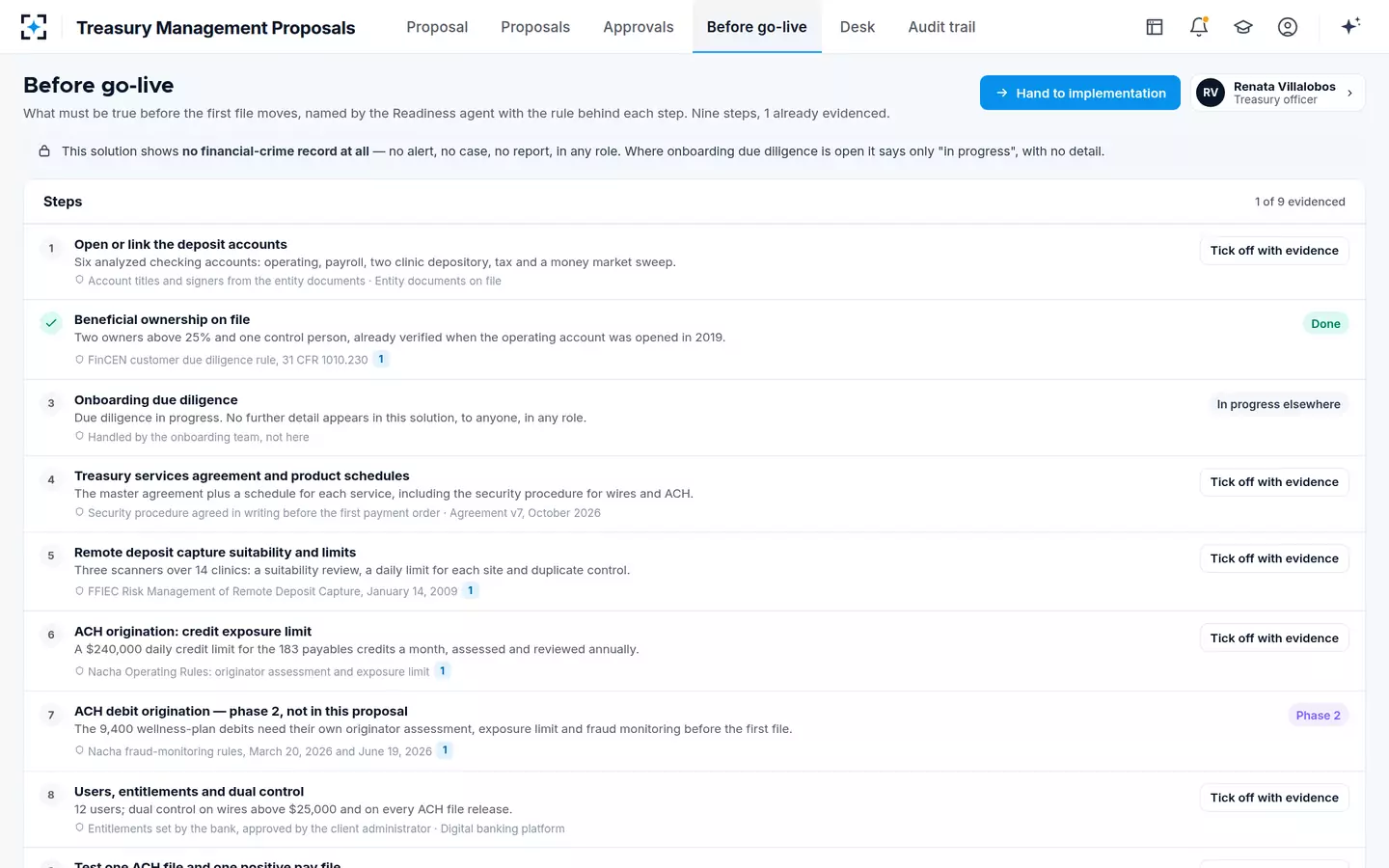
The readiness section names what must be true before each service goes live, and why. It turns a sale into an implementation plan, and it protects the bank from promising a service its own controls would hold up.
Remote deposit capture needs a suitability review. The interagency guidance expects a review of each new and existing customer's business, its own risk controls, where it operates and whom it serves (FFIEC, Risk Management of Remote Deposit Capture; the FFIEC remote deposit capture guidance sets out the criteria). For a practice with fourteen clinics and three scanners, that means a daily limit for each site and a control for duplicate deposits, written into the proposal as a condition.
ACH origination needs an exposure limit. The OCC expects banks to "implement credit-risk controls that establish underwriting standards, require analysis of originators' creditworthiness, and set appropriate credit exposure limits" (OCC Bulletin 2006-39), and Nacha's rules require banks to set and periodically review exposure limits for originators (Nacha). The sample sets a $240,000 daily credit limit for about 183 payables credits a month. The wellness-plan debits are a different exposure, which is why they wait for a second phase with their own assessment; Nacha's fraud-monitoring rules also reach the remaining non-consumer originators from phase 2, dated June 19, 2026 and in practice Monday, June 22 (Nacha Operations Bulletin #1-2024).
Wires and ACH need a security procedure agreed in writing. Under UCC Article 4A, whether a procedure is commercially reasonable depends in part on how large, what kind and how frequent the customer's usual payment orders are (UCC § 4A-202(c); the section is quoted in bank liability for wire fraud), which is exactly what the statements show. A proposal that sets dual control on wires above a threshold the prospect's own wire history justifies has started that conversation on the right foot.
Treasury Management Proposals names nine steps before go-live, each with the rule behind it
Section 7, validity and approval
The proposal should say how long the price holds and who approved it. The sample's price is valid for 60 days from approval, to December 20, 2026, and the proposal carries the approver's name and the time of approval. A price with no expiry becomes an argument at the next repricing; a price with no named approver becomes an argument the next time someone asks why it was given.
Who approves a treasury management proposal?
Someone other than the person who drafted it, every time, and the approver of a pricing exception when the discount is beyond the drafter's authority. In the sample the officer's authority is 10% of list; the package is 13.87% below list, so the treasury sales manager approved both the price and the proposal, with a reason code and his own note. A proposal the sales manager drafts goes to the head of treasury management instead.
The approval belongs in the document, not just in the bank's files. A prospect that sees "price approved by the treasury sales manager, valid to December 20" knows the price is real and when it lapses. How the authority should be set is the subject of relationship pricing in banking.
How to write a cash management proposal the prospect can argue with
Write it so every figure can be checked and every gap is named. The checklist below is the test to run on any draft, whoever or whatever wrote it.
Ten checks before a cash management proposal goes to a prospect
- Every figure has a line behind it
Page and cycle for each volume, fee and balance; nothing estimated without saying so.
- Annual figures say they are annualized
A quarter times four is an estimate, and the proposal should call it one.
- Fraud controls state exposure, not savings
The value of checks covered, never an invented loss avoided.
- The price list version is named
With its effective date, so the price can be honoured later.
- The discount is visible
List and proposed side by side, with the total discount stated.
- The balance arithmetic is shown
Balance, float, rate, days and the net position against the charges.
- What was left out is listed
With the document needed to count it.
- Go-live conditions are named
Exposure limits, remote deposit suitability, the security procedure, entitlements and a test file.
- The incumbent bank is not named
Its name and the prospect’s full account numbers stay off the page.
- A second person approved it
Named, with the date the price expires.
Formal requests from larger prospects ask for much of the same material in a set order; the cash management RFP template shows how to answer them from the prospect's own data. When the prospect's biggest opportunity is moving checks to electronic payment, ACH payment vs check covers how to price the conversion without an invented cost per check.
Questions people ask
Is there a cash management proposal template in Word?
Any word processor will do; the structure matters more than the file. Use the seven sections above as headings, and keep the pro forma as a table with service, code, volume, list, proposed and monthly columns so the prospect can compare it with its own account analysis statement.
What is a treasury management pro forma?
A priced estimate of what the prospect's activity would cost at the bank: every service at list with its code and the volume from the prospect's statements, the proposed price where it differs, and the monthly total. In the sample, nineteen services came to $1,145.00 a month against $1,329.41 at list.
How many months of statements does a cash management proposal need?
Three monthly cycles, as in the sample: enough to see a quarter's volumes and to annualize them, and few enough that a prospect will send them. Seasonal businesses may need a cycle from their busy period as well.
Should a proposal name the prospect's current bank?
No. The proposal should describe the prospect's activity and fees without naming the incumbent or showing full account numbers; the sample removes the other bank's name from every page before anyone sees it.
How long should a treasury proposal price be valid?
Long enough for the prospect to decide and short enough for the bank to honour. The sample bank's setting allows 30, 60 or 90 days and uses 60 days from approval, so a price approved on October 21 holds to December 20; state the expiry date in the document.