Yes, AI can analyze bank statements: current models read a PDF or a scan, find the balances, the checks paid, the wires and the fees, and group a quarter of activity in minutes. The U.S. Treasury's 2024 review of artificial intelligence in financial services lists document querying and extraction among the near-term uses firms reported. What decides whether the result can go in front of a business prospect is narrower: every figure must point back to the line it came from, and the system must refuse a page it cannot read instead of producing a confident number. Botminds' Treasury Management Proposals is built on that rule. Its agents read three cycles of a prospect's statements for a treasury management proposal, cite every value to its line, and when a page is photographed at an angle or a document is missing, they name what they need and ask.
The work matters because a treasury proposal is an argument about the prospect's own money. A wrong check count or an invented card rate does not stay inside the bank; it lands in front of a chief financial officer who knows the real number. The examples on this page come from a fictional sample bank and a fictional veterinary practice, as their statements run through the solution.
What reading a prospect's statements looks like when the AI is allowed to refuse
18pages
three monthly cycles of one sample prospect’s statements, read page by page
1page
refused: a photograph at an angle, read at confidence 0.42
0.90
the confidence threshold below which an agent asks instead of answering
Can AI analyze bank statements? Yes, if it shows its work and knows when to stop
AI can analyze bank statements reliably enough for business use when three conditions hold: it ties each extracted figure to a page and line, it reconciles its totals to the statement's own totals, and it declines to answer when its reading falls below a set confidence. Without the first, nobody can check it; without the second, small misreads add up unnoticed; without the third, the errors that do occur arrive looking exactly like the correct figures.
The third condition is the one most demonstrations skip. A model asked to summarise a statement will usually produce a summary, whether or not the right-hand column of page four was in the photograph. For a household budget that is a nuisance. For a treasury proposal it is a figure the bank puts its name to, and a prospect who finds it wrong has a reason to doubt every other line.
What Treasury, NIST and the OCC say about AI reading documents
The public record supports the use and names the risk in the same breath. In its December 2024 report, the Treasury summarised 103 comment letters and recorded document querying and extraction among the near-term uses respondents named for generative AI, beside risk assessment, code assistance and financial crime work (U.S. Treasury, AI in Financial Services; the full list is quoted in AI in banking operations). The same report warns that such models can hallucinate, stating wrong output with confidence.
The National Institute of Standards and Technology gives the risk a precise name. Its generative AI profile, published in July 2024, calls it confabulation: false or wrong content stated with confidence, the thing most people call a hallucination, which can mislead the person relying on it (NIST AI 600-1; the definition is quoted in a checked answer on sanctions). Read against a bank statement, the definition points at the failure that matters: not a model that says it cannot read, but one that reads what is not there.
Bank supervisors have not yet written rules for this. The interagency model risk guidance that replaced SR 11-7 on April 17, 2026 says plainly that generative and agentic AI models are too new and changing too fast to fall within it (OCC Bulletin 2026-13; Federal Reserve SR 26-2; its words are in the guide to AML risk rating models). The agencies said they plan a request for information on AI. Until then, a bank using AI to read statements has to supply its own controls, and the ones that hold up are the ones a reviewer can see.
Can ChatGPT analyze bank statements? A chat window versus a reading process
A general-purpose assistant can read a clean statement and answer questions about it, and for a one-off look that may be enough. A treasury proposal needs something different: the same reading applied to every page of three cycles, figures that stay attached to their source, a record of what was read and by whom, and a bank's own price list and catalogue on the other side of the calculation.
A chat answer and a proposal-grade reading differ in what they keep
A general chat assistant: A summary in prose, or a table typed into the conversation
A reading process built for proposals: Each figure with its page, line, cycle and reading confidence
A general chat assistant: Depends on the prompt; it may estimate or skip without saying so
A reading process built for proposals: Marked unreadable, nothing taken from it, a re-scan request drafted
A general chat assistant: Not checked unless someone asks
A reading process built for proposals: Every grouped flow reconciled to the cycle’s own total, or flagged
A general chat assistant: Whatever the conversation supplies
A reading process built for proposals: The bank’s own list, tiers and authority, with the version shown
A general chat assistant: Governed by the tool’s terms and the user’s settings
A reading process built for proposals: Held under the bank’s information security program, with retention set by the bank
A general chat assistant: A chat history
A reading process built for proposals: Who opened which figure, which agent read it, and who approved the price
None of this makes a chat assistant useless. It makes it the wrong tool for the step where a figure becomes a claim the bank makes. What to test before buying a tool for that step is set out in bank statement analysis software: how to tell its numbers are right.
What happens when a statement page is unreadable
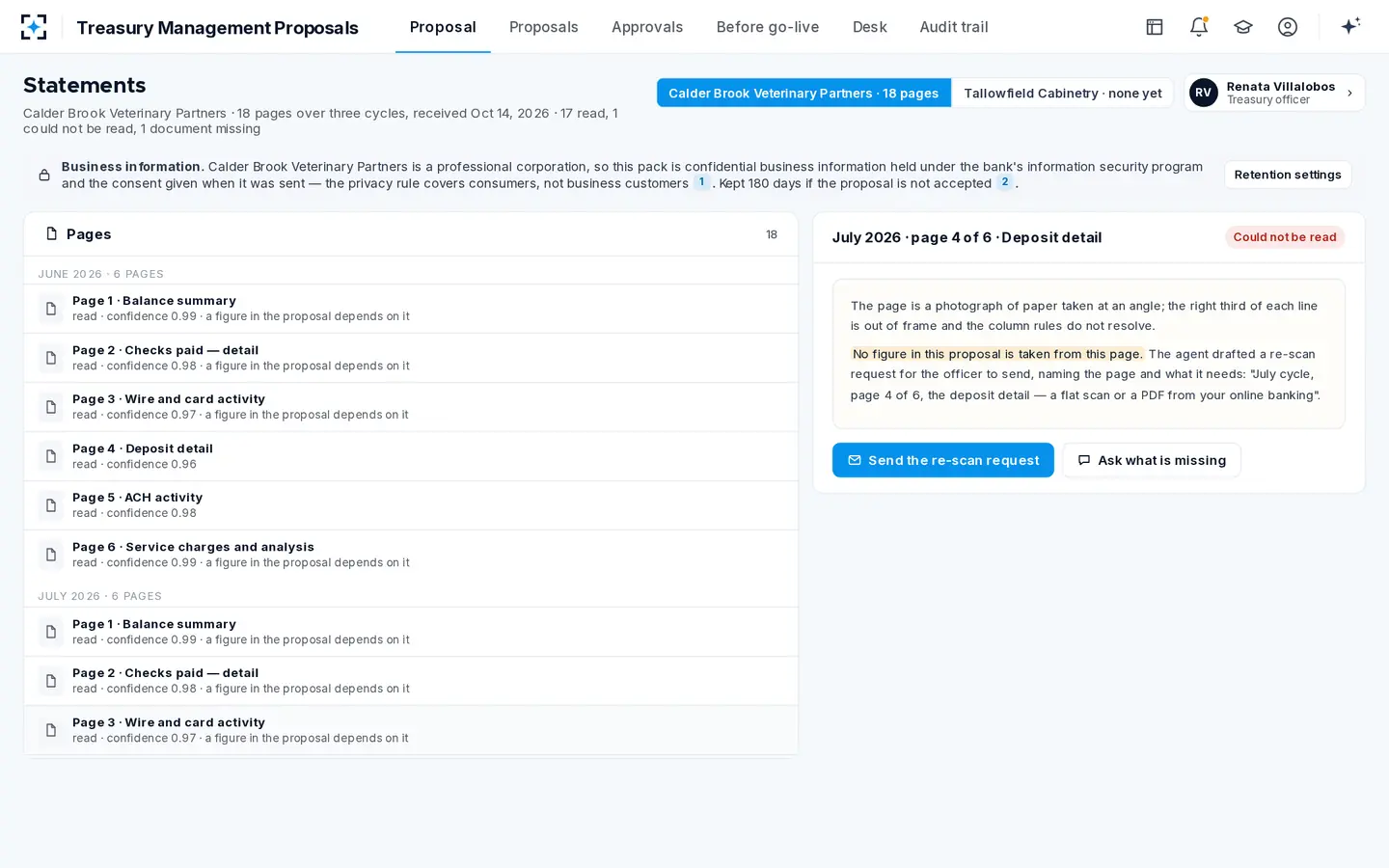
A well-built reading process stops at an unreadable page, says which page and why, takes nothing from it and asks for a better copy. The sequence below is how Treasury Management Proposals handles it; the person stays in the loop at the only step that reaches the prospect.
Read, refuse, ask, resume: how Treasury Management Proposals handles a page it cannot read
Agent
Reading agentReads every page of the three cycles and scores each line it extracts.
Never: Never guesses a figure it cannot read
Agent
Reading agentMarks July page 4 unreadable at confidence 0.42 and says why: the right third of each line is out of frame.
Never: Takes no figure from the page
Agent
Flows agentBuilds the flows from the other pages and reconciles each to its cycle’s total, or says it cannot.
Never: Never carries a figure the Reading agent flagged
A person decides
Treasury officerReads the drafted re-scan request naming the page and the copy needed, and sends it.
Never: Nothing goes to the prospect from an agent
Agent
Reading agentReads the new copy when it arrives; any figure that depends on it enters the proposal only then.
Two details make the refusal useful rather than merely cautious. The request names the page and what is wrong with it, "July cycle, page 4 of 6, the deposit detail", and asks for a flat scan or a PDF from online banking, so the prospect can fix it in one reply. And the rest of the work carries on: the other seventeen pages are read, and the proposal says which of its figures, if any, are waiting on the missing one.
Eighteen pages, one refused, and no figure taken from it
Can AI read an account analysis statement?
Yes, and it is often the most valuable document a prospect sends, because it shows what the business already buys. An account analysis statement lists the balances behind the earnings credit, the credit rate and amount, and each billable service with its volume, unit price and total, usually against a service code. Read correctly, it tells the officer what the prospect pays today without asking.
It is also where reading errors are most expensive. The statement mixes balance arithmetic (ledger balance, float, collected, investable), a rate and a day count, and dozens of fee lines whose codes differ from bank to bank. An agent has to keep three things apart: what the prospect's bank charged, what the same services would cost at the proposing bank's list, and what the earnings credit offsets. In the sample, the statement showed an average ledger balance of $1,462,000, an average float of $42,000 and a collected balance of $1,420,000 earning $0.00 of credit, the single line that changed the proposal. How that balance should be valued is the subject of ECR vs interest-bearing account.
Service codes deserve caution. Many banks map their services to the industry's standard codes, but a code on another bank's statement describes that bank's service, not yours. A good reading keeps the prospect's code and description as found, and maps them to the proposing bank's own catalogue as a separate, visible step.
The value an AI should refuse to count
The harder refusals are not unreadable pages but readable pages that do not contain the answer. A statement can show a figure clearly and still not support the conclusion a proposal wants to draw from it, and an AI that fills the gap with a typical rate has produced a number nobody can defend.
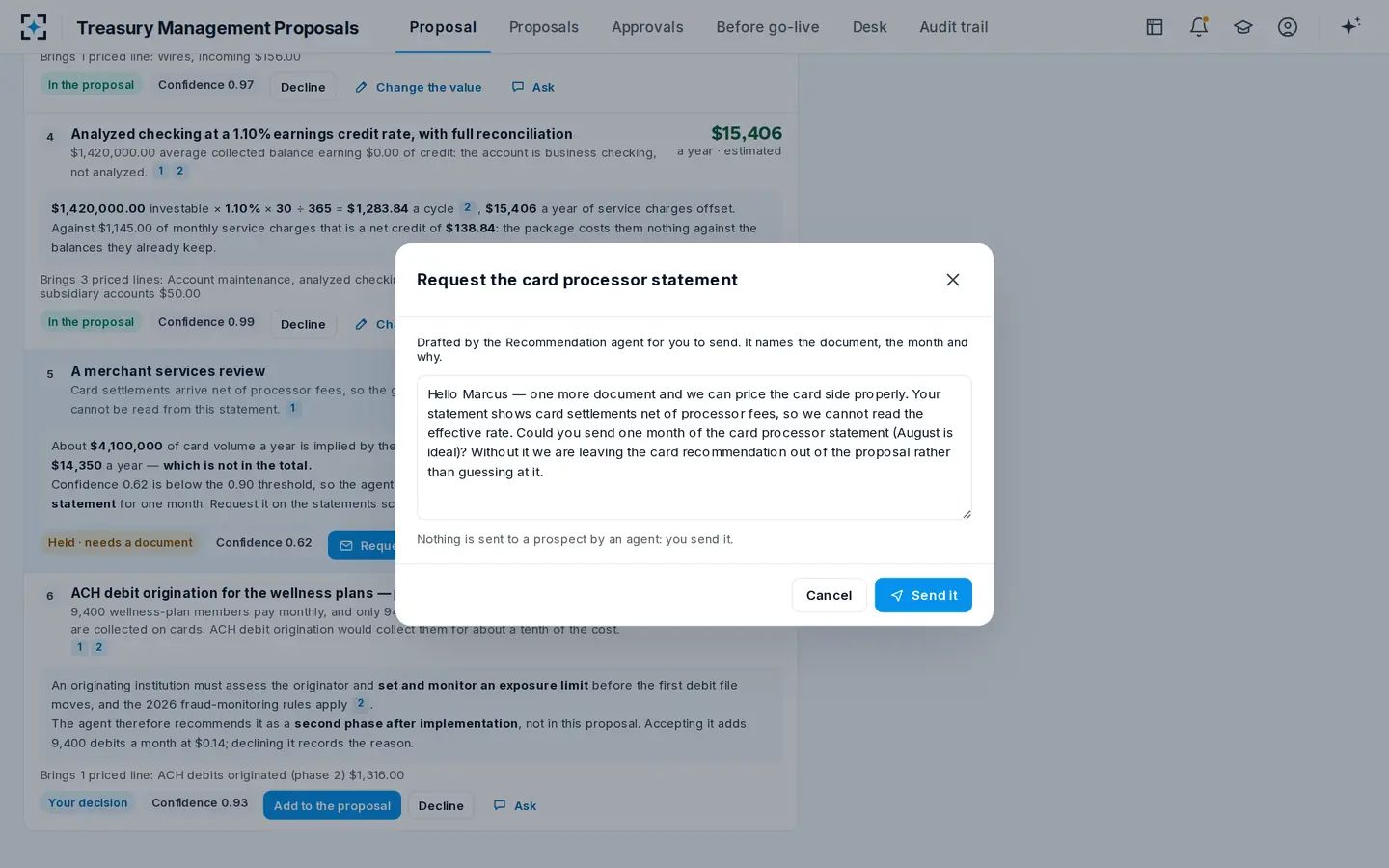
The sample prospect's card settlements are the example. They arrive net of processor fees, so the effective rate cannot be read from the bank statement. The agent's confidence fell to 0.62 against a 0.90 threshold, so instead of estimating, it held about $14,350 a year out of the proposal and drafted a request for one month of the card processor statement. The proposal tells the prospect the card side was left out "rather than guess at it", which is a sentence a chief financial officer tends to respect.
A value the agents will not count until the document arrives
Is it safe to upload bank statements to AI?
It is as safe as the controls around the system you upload them to, and for a bank the question is whose rules apply. The federal privacy rule protects consumers: Regulation P defines a consumer as "an individual who obtains or has obtained a financial product or service from you that is to be used primarily for personal, family, or household purposes" (12 CFR 1016.3). A company's statements fall outside that definition, which does not make them less sensitive. It means their protection rests on the bank's information security program, the consent the prospect gave when it sent them, and the contract with any provider that handles them.
For consumer data the interagency security guidelines spell out the vendor duty: each institution shall "Require its service providers by contract to implement appropriate measures designed to meet the objectives of these Guidelines" (12 CFR part 364, appendix B). A bank that applies the same discipline to business prospects' statements, with retention it sets and an audit trail of who opened what, is in a defensible position. A banker pasting a prospect's statements into a personal chat account is not.
Six questions to answer before a prospect's statements go into any AI tool
- Whose program covers the data?
The bank’s information security program, under a contract with the provider, not a personal account’s terms.
- Is the other bank’s name removed?
A proposal should never repeat the incumbent’s name or account numbers beyond the last four digits.
- How long are the statements kept?
A short period if the proposal is declined; the bank’s record-keeping period if the prospect becomes a client.
- Can every figure be traced?
Page, line, cycle and confidence, opened in one click by the officer or a reviewer.
- What happens below the threshold?
The system should refuse and ask, and say what it needs.
- Who sends anything to the prospect?
A named person. An agent drafts; it should never contact a prospect.
In the sample the defaults are written on the screen: statements kept 180 days if the proposal is not accepted, with 90 days or a year as alternatives, and five years from the end of the relationship if it is accepted. The banner on the statements page states which rule governs the pack, so nobody has to remember it.
What a confidence threshold does, and what it does not
A confidence threshold turns a model's uncertainty into a rule: below the line, the agent asks instead of answering. It does not make the readings above the line correct; it decides which uncertain readings reach a person as questions rather than as figures. That is why the threshold should be set by the bank, shown on the screen, and paired with the citations that let a person check a confident reading too.
Most readings clear the line with room; two fall below it and become questions
A bank choosing the setting is choosing between two costs. At 0.95 more readings come back as questions, and officers spend time confirming figures that were right; at 0.85 fewer questions arrive and more of the checking rests on the citations. Either way, the setting belongs to a named owner and every change to it should be on the record.
Where AI statement analysis fits, and where Treasury Management Proposals stops
AI statement analysis fits the step between "the prospect sent its statements" and "the officer decides what to recommend". It does the reading, the grouping and the arithmetic, and it makes the gaps visible. Treasury Management Proposals adds the bank's price list, the discount authority and two human approvals, so the reading ends in a proposal rather than a spreadsheet.
It does not decide what to recommend, set a price, approve a discount or contact a prospect; the officer and the sales manager do those. It does not perform due diligence or show any financial-crime information. And it is not a credit underwriting tool: reading statements to size a payments relationship is a different job from verifying income for a loan, with different rules. Where the reading feeds a written proposal, the cash management proposal template shows what each section should carry.
Questions people ask
Can ChatGPT analyze bank statements?
A general assistant can read a clean statement and summarise it. For a business proposal, check whether it ties each figure to a page and line, reconciles totals and refuses unreadable pages, and whether the data sits under your bank's security program; a personal chat account meets none of those by default.
How does AI handle a scanned or photographed statement?
It reads the image and scores each line it extracts. A well-built system marks a page whose confidence falls below a set threshold as unreadable, takes no figure from it and asks for a better copy; in the sample a photograph read at 0.42 against a 0.90 threshold.
Can AI analyze bank statements for fraud?
That is a different task from a treasury proposal. A proposal can state the exposure a control would cover, such as the $4,569,520 of checks a sample prospect issues a year without payee verification, but it should not claim a fraud saving, and statement reading for a proposal is not fraud detection.
Is it legal for a bank to use AI on a prospect's statements?
No federal rule forbids it, and the 2026 model risk guidance leaves generative and agentic AI outside its scope. The bank remains responsible for protecting the data, under its information security program and the prospect's consent, and for the accuracy of what it sends.
How many statements does an AI need for a treasury proposal?
Three monthly cycles is the common ask, enough to see a quarter's volumes and to annualise them. In the sample, three cycles of checks paid, 198, 210 and 204 items, became a quarter of 612 and an annual figure of 2,448.
What should happen to the statements after the proposal?
They should be kept only as long as the bank's policy says, with redaction applied. The sample keeps them 180 days if the proposal is declined and five years from the end of the relationship if it is accepted; both are settings the bank owns.