A cash management RFP template, the kind a city, a school district or a company's treasury department sends to banks, usually has the same parts: a description of the buyer's accounts and activity, a list of required services with yes-or-no answers and comments, a pricing form listing the buyer's own annual volumes for the bank to price, questions on balances and earnings credit, control and collateral requirements, and the criteria the answers will be scored on. A winning answer quotes the buyer's own volumes back, prices them at the bank's list with every assumption shown, and answers the control questions with the bank's real settings rather than marketing language. That is the same discipline Botminds' Treasury Management Proposals applies to a prospect's statements: every figure cited to its source, priced at the bank's list and tested against the drafter's authority before a second person approves it.
The best public examples are municipal depository requests, because they are published in full. This guide draws on two from Texas: the City of Helotes' 2026 request for applications for primary depository bank services and the City of Bellaire's 2023 request for proposals for depository services. Corporate RFPs differ in detail but ask for much the same, and the worked example uses the solution's fictional sample prospect.
What a cash management RFP asks for
A cash management RFP asks the bank to confirm it can provide each required service, to price the buyer's actual activity, to state its earnings credit and balance terms, and to accept the buyer's controls and contract terms. The Helotes request is typical in tone: "Any and all charges and fees associated with the Depository Bank Services Agreement must be clearly and accurately included in the RFA response", and "The City will not be obligated by any charges and fees not clearly and accurately presented in the RFA response" (City of Helotes, RFA 26-01).
The terms can bind for years. Helotes' agreement runs from June 1, 2026 to May 31, 2031, and the request states that "All fees, rates, and conditions shall be fixed for the entire contract period, including extensions." A bank that answers with an introductory price it does not mean to hold has made a five-year commitment by accident.
What do companies ask in a treasury RFP? The sections and the evidence each needs
Most RFPs, public or corporate, ask for the same eight things. The checklist pairs each with the evidence a strong answer carries.
Cash management RFP template: eight sections and the evidence a strong answer carries
- Required services, one by one
Yes or no for each, with a comment that names the product and its cut-off times, not a brochure line.
- The pricing form
Unit price for each service against the buyer’s own annual volumes, with monthly and annual fixed fees and a total.
- Account analysis
A sample statement showing balances, the earnings credit and each billed service with volume and unit price.
- Earnings credit and balance terms
The rate, how it is set, any reserve or deposit insurance charge, and the settlement period.
- Controls
Positive pay matching fields, ACH debit blocks, dual control, user administration and the security procedure for wires and ACH.
- Collateral and insurance
For public funds, the pledging the statute requires and who holds the collateral.
- Transition
How accounts, files and users move, and how long it takes, with a named implementation lead.
- The agreement
Exceptions to the buyer’s terms, stated with reasons and alternate language.
The required-services list is where a bank's real capabilities show. Helotes asks for online banking with intraday and previous-day reporting, ACH origination, ACH debit blocking, wires, "post no checks" on electronic-only accounts, zero balance accounts, positive pay, controlled disbursement with presentment information "accessible by 10:00 A.M. local time", same-day credit for deposits before 4:00 P.M., account analysis, and more: twenty-three items in all. Each "yes" with a vague comment invites a follow-up question; each "yes" with the product name and the bank's actual cut-off invites the next page.
The pricing form: the buyer's volumes in, the bank's prices out
The pricing form is the heart of the RFP. The buyer lists its annual activity by service, and every bank prices the same volumes, so the totals are comparable. Bellaire's form asks banks to "include either the applicable unit pricing or rate, fixed monthly fees, and fixed annual fees" and the "total estimated annual fees associated with each service based on the 2022 annual activity" (City of Bellaire, RFP 23-007).
Answering it well means mapping the buyer's service names to the bank's own catalogue, line by line, and saying where they differ. A buyer that lists "Positive Pay Exception Items" expects a unit price per exception; a bank whose positive pay prices per item presented must say so, or its total will be compared unfairly in one direction or the other. The same mapping problem appears when a prospect sends another bank's account analysis statement with service codes down one column, and the method is the same: keep the buyer's line as written, map it to your service, and show the mapping.
Mapping a buyer's pricing form to the bank's own price list
| Buyer’s line | Bank’s service and code | Volume | Unit price | Note in the answer |
|---|---|---|---|---|
| Positive pay maintenance | Positive pay with payee match, monthly base (POS PAY BASE) | 12 a year | $100.00 list | Payee match included; state the match fields |
| Positive pay exception items | Positive pay items presented (POS PAY ITEM) | Per item presented | $0.09 list | Priced per item presented, not per exception; say so |
| ACH credits originated | ACH credits originated (ACH CR ORIG) | Buyer’s annual count | $0.22 list | Same Day ACH priced separately if offered |
| Monthly account analysis fee | Account maintenance, analyzed checking (ACCT MAINT) | Per account per month | $18.00 list | Group analysis across accounts if the buyer asks |
The three balance questions: earnings credit, reserve requirement, deposit insurance
Most RFPs ask three questions about balances, and a bank's answers to them can move the comparison more than any unit price. Helotes asks the bank to "State how the Bank will treat the FDIC Insurance Assessment on balances", with options to waive it, waive it partly or pass it through in full; to "State whether or not the Bank imposes a reserve requirement on balances used in calculating earnings credit"; and to state the earnings credit rate it proposes.
The reserve question has a short honest answer. The Federal Reserve cut reserve requirements to zero from March 26, 2020 (Federal Reserve; the earnings credit rate calculator shows what that does to the formula), so any reserve deduction a bank still applies to an earnings credit calculation is its own pricing choice, not a regulatory cost, and the answer should say whether the bank applies one. The deposit insurance charge deserves the same candour: if the bank passes a balance-based charge through on the analysis statement, the proposed earnings credit rate is a gross figure and the answer should show the net.
The earnings credit itself is best answered with the buyer's own balances. A rate alone invites comparison with every other bank's rate; a rate applied to the buyer's average collected balance, against the priced services, shows the net position the buyer will actually see. How to present that, and when an interest-bearing account is the better answer, is set out in ECR vs interest-bearing account.
How evaluators score a banking services RFP
Price matters, but it is rarely the only criterion, and buyers say so in the request. Helotes lists twelve criteria "in no particular order of priority", from the ability to provide the required services, references and cost through funds availability, interest paid, "Earnings credit calculation on compensating balances", convenience of location and the institution's financial strength. Bellaire lists four, including "The cost-effectiveness of the depository services as reflected in the estimated cost of depository services and the earnings credit."
What two public buyers say they score, and where the answer wins or loses
| Criterion | Named by | Where answers usually lose | What wins it |
|---|---|---|---|
| Ability to provide the required services | Helotes, Bellaire | Yes to everything, with no product names or cut-offs | A specific comment per service, with cut-off times and file formats |
| Cost of services | Helotes, Bellaire | Prices that do not map to the buyer’s lines | Every line priced against the buyer’s volumes, totals shown |
| Earnings credit and interest | Helotes, Bellaire | A rate with no calculation | The allowance on the buyer’s own balances, net of any balance-based charge |
| Funds availability | Helotes | A reference to the availability policy | Deposit cut-offs and availability by deposit type |
| Transition | Helotes | Silence | A dated plan and a named lead |
| Financial strength and location | Helotes, Bellaire | Generic statements | The facts the buyer asked for, where the statute requires them |
Control questions: positive pay, dual control and the security procedure
RFPs increasingly specify controls rather than merely asking about them. Helotes requires positive pay on accounts that issue checks and states the match: "Payment verification criteria will be date, check number, amount, and payee name." Bellaire requires a three-way match on check number, payee and amount, with the issue file uploaded by secure link. An answer should confirm the exact fields the bank matches, the daily decision deadline and the default decision if the buyer does not respond.
Wire and ACH controls carry a legal consequence the answer should not gloss over. Under UCC Article 4A, a security procedure is deemed commercially reasonable if the customer chose it after refusing a reasonable one the bank offered, and agreed in writing to be bound by orders accepted under it (UCC § 4A-202(c); a corporate account takeover policy quotes the subsection). So when a buyer declines dual control, the RFP answer, and later the agreement, should record what the bank offered and what the buyer chose. That is a protection for both sides, not a sales obstacle.
Public funds: collateral and the statutes behind the request
Public-sector RFPs carry requirements that corporate ones do not, because public deposits above the insured limit must be secured. Helotes names its governing statutes, including Chapter 2256 of the Texas Government Code, the "Public Funds Investment Act", and Chapter 2257, the "Public Funds Collateral Act", and requires the bank to pledge collateral meeting them on a same-day basis. Bellaire sets the level: collateral that is "sufficient to always cover 103% of the combined balance (including any accrued interest on the combined balance)" less the FDIC insurance amount, held by an independent third-party custodian.
These requirements change the economics of the answer, because pledged collateral has a cost to the bank. They belong in the pricing conversation, not in an appendix, and a bank that cannot meet them should say so on the first page rather than in an exception table at the back.
How to answer a banking services RFP from the prospect's own data
Answer from the buyer's documents outward: read its activity, price its volumes, state the balance terms on its balances, then fill in the narrative. The sequence below is how the work flows when agents do the reading and pricing and people make the decisions.
Answering an RFP from the buyer's data with Treasury Management Proposals: who does what
Agent
Reading agentReads the buyer’s statements and its pricing form, pinning each volume to its source line.
Never: Never guesses a volume it cannot read
Agent
Pricing agentMaps each of the buyer’s lines to the bank’s services and prices them at list, with the earnings allowance on the buyer’s balances.
Never: Never goes below list without a reason code
A person decides
Treasury officerDecides the price, the comments on each required service and any exception to the buyer’s terms.
A person decides
Treasury sales managerApproves the price, and an exception beyond the officer’s authority, with a reason.
Never: Never approves a response they drafted
Agent
Readiness agentNames what must be true before go-live: exposure limits, deposit capture suitability, the security procedure, collateral.
The same RFP answer, written from a brochure and written from the buyer's data
From the brochure: We offer robust positive pay with payee match.
From the buyer's data: Payee positive pay matching date, check number, amount and payee name, as your item 8 requires; exceptions decided by the daily cut-off; default decision stated in the schedule.
From the brochure: Competitive pricing, see attached schedule.
From the buyer's data: Every line on your pricing form priced at our list against your annual volumes, with the total and the services mapped where our names differ.
From the brochure: Attractive tiered ECR.
From the buyer's data: At your average collected balance, our proposed rate gives an allowance against the priced services; we apply no reserve deduction.
From the brochure: Industry-leading security.
From the buyer's data: Dual control on wires and ACH file release; if you decline it, the agreement records the procedure offered and the one you chose.
A sample answer, annotated
The sample below answers one typical request, "describe your earnings credit and how it will be applied", for the solution's fictional prospect. Each sentence carries a figure the buyer can check or a term the bank will be held to.
One RFP answer on earnings credit, built in Treasury Management Proposals from the buyer's statements
The answer
Why it is written this way
Your average collected balance over June to August 2026 was $1,420,000: an average ledger balance of $1,462,000 less average float of $42,000.
The buyer's own figures, from its statements, with the arithmetic.
At our tier for that balance, 1.10%, the allowance for a 30-day cycle is $1,283.84, calculated on a 365-day basis.
The rate, the tier it comes from and the day basis, so it can be recomputed.
The services priced in our pricing form total $1,145.00 a month, so the allowance covers them with $138.84 a cycle to spare.
The net position, not the gross rate.
We apply no reserve deduction; reserve requirements have been zero since March 26, 2020.
Answers the reserve question before it is asked.
Our tiers are 0.85%, 1.10% and 1.25% by balance, set by our treasury product manager and versioned with our price list.
How the rate moves, and who owns it.
The earnings credit answer, worked on the buyer's own balances
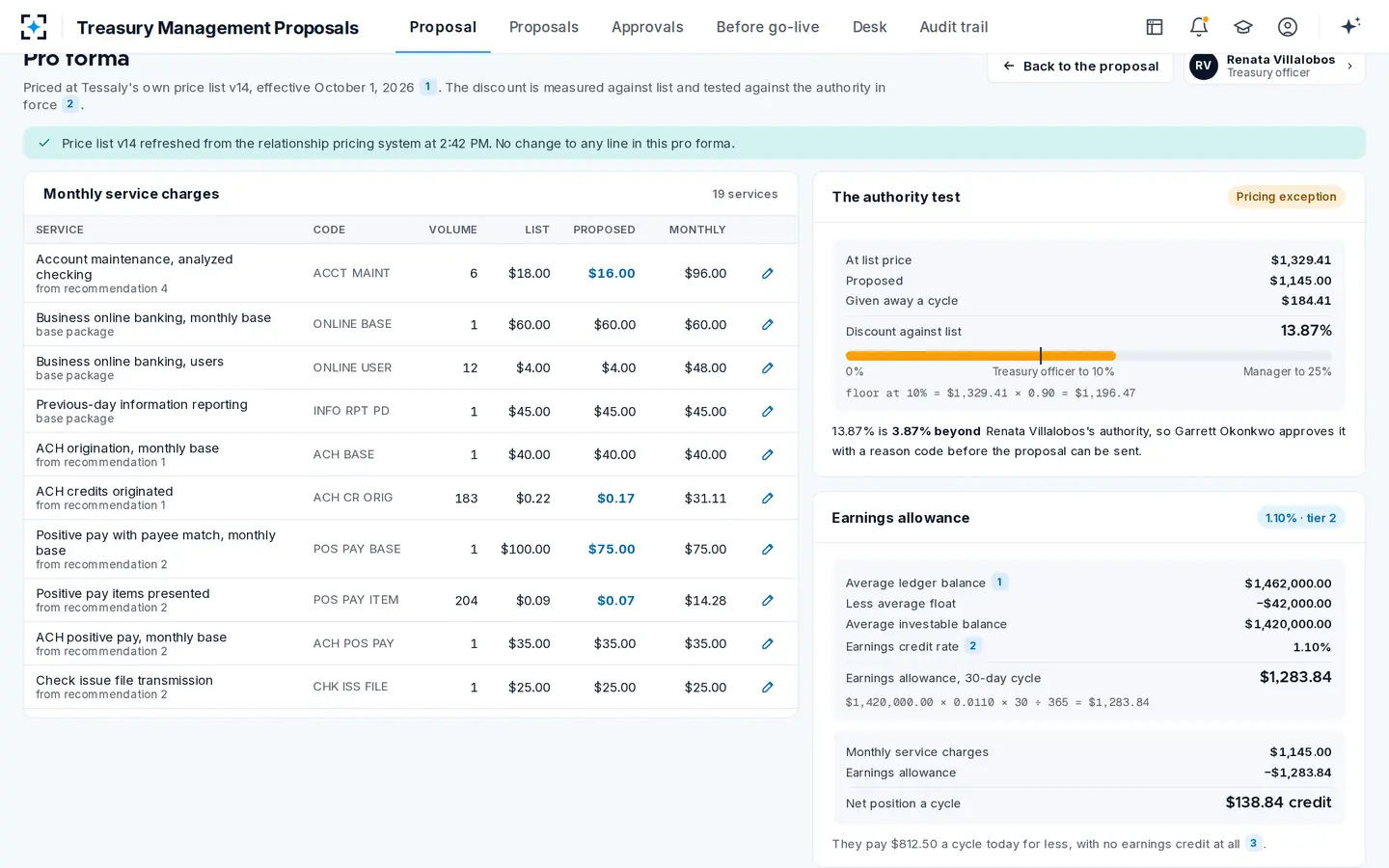
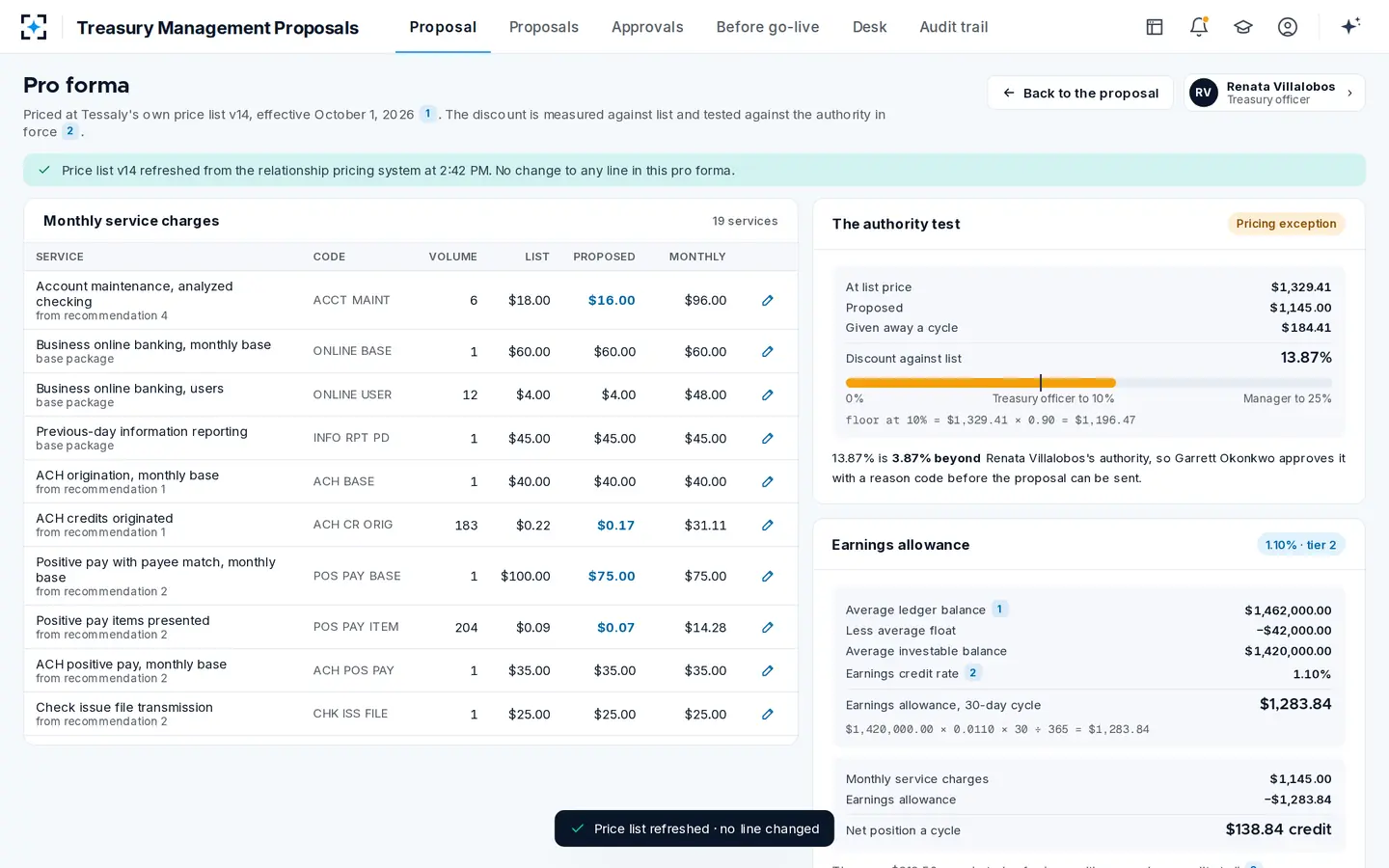
The pricing, at the bank's own list and tested against authority before it goes out
For prospects that send statements rather than a formal request, the same material goes into a proposal instead; the cash management proposal template shows the order. How to judge the software that reads the buyer's documents is covered in bank statement analysis software.
Questions people ask
Where can I find a sample RFP for banking and treasury services?
Public bodies publish theirs: city, county and school district depository requests are usually posted on the buyer's own website with the pricing form attached. The City of Helotes' 2026 request and the City of Bellaire's 2023 request are complete examples with required services, pricing forms and scoring criteria.
How long does a cash management RFP response take?
Public requests typically allow a few weeks between issue and due date, with a question deadline in between; Helotes set questions for early May and a due date of May 13, 2026. Most of the time goes to pricing the buyer's volumes and mapping its lines to the bank's services.
What is the difference between a treasury management RFP and a treasury management system RFP?
A treasury management RFP buys banking services from a bank: payments, collections, reporting and controls. A treasury management system RFP buys software a company's treasury department runs itself; the questions overlap only at the edges, such as file formats and reporting.
Should a bank take exceptions to an RFP's terms?
Where the bank cannot comply, yes, stated plainly with the reason and alternate language; Helotes asks for exactly that and treats unexcepted items as accepted. An exception discovered after award is worse for both sides than one stated in the answer.
How do buyers compare earnings credit rates across banks?
The careful ones compare net positions, not rates: each bank's allowance on the buyer's own balances, less any balance-based charge, against the same priced services. That is why pricing forms list the buyer's balances and why requests ask about reserve deductions and deposit insurance charges.