The difference between an ACH payment and a check is how the money moves and what can go wrong on the way. An ACH payment is an electronic entry sent through the ACH Network under the Nacha Operating Rules, settling on a known date, often the same day; a check is a paper order the payee must deposit and the bank must clear, governed by the Uniform Commercial Code and Regulation CC, and exposed to theft and alteration in the mail. For a business, moving suppliers from checks to ACH usually means fewer exceptions, faster and more predictable settlement and less fraud exposure, which is why a treasury management proposal often prices that conversion. Botminds' Treasury Management Proposals does it from the prospect's own statements: its agents count the checks paid over three cycles, group them by payee, find the payees who already accept electronic payment, and leave the rest on paper behind positive pay.
What the proposal should not do is quote a cost per check it cannot source. Public data on what checks cost businesses is thin; what is well documented is how fast checks are falling, how fraud has followed them, and what the government found when it moved its own payments. The sample figures here are from the solution's fictional prospect, a 14-clinic veterinary practice.
What the government found when it moved its own payments off paper
16×
more likely for a Treasury check to be reported lost or stolen, returned undeliverable, or altered than an EFT
18×
as expensive as an electronic disbursement, for Treasury’s own payments
30%
of fraud-related suspicious activity reports filed in 2023 involved check fraud
What is ACH vs check? The difference in one table
They differ in the rulebook, the timing, the way funds become available and the way fraud happens. The table puts the business-relevant differences side by side.
ACH payment vs check, as a business paying suppliers experiences them
Paper check: UCC Articles 3 and 4; Regulation CC for availability and returns
ACH credit: Nacha Operating Rules and the bank’s origination agreement
Paper check: Printed, mailed, deposited by the payee, cleared back to the paying bank
ACH credit: Sent in a file through the bank; settles on the date the business chooses
Paper check: Local checks: no later than the second business day after deposit, under Regulation CC
ACH credit: An electronic payment: no later than the business day after the bank receives it
Paper check: Theft from the mail, alteration, counterfeits, a late presentment
ACH credit: A wrong or changed account number, an unauthorized file
Paper check: Positive pay with payee match; a check issue file
ACH credit: Dual control on file release, an exposure limit, account validation, ACH debit blocks
Paper check: None; the payee controls when it deposits
ACH credit: Same Day ACH up to $1 million a payment today, $10 million from September 17, 2027
The availability row deserves a note. Regulation CC requires a bank to make funds from a local check available "not later than the second business day following the banking day on which funds are deposited" (12 CFR 229.12(b)), and funds from an electronic payment by the next business day after the bank receives it (12 CFR 229.10(b); ACH credit monitoring by receiving banks quotes the rule and its limits). For the paying business, the bigger difference is control: with a check, the payee decides when the money leaves; with ACH, the payer does.
Is a check the same as ACH?
No, although the two meet at the edges. A check can be converted into an ACH entry at a lockbox or a point of sale, and many payroll and vendor payments that used to be checks are now ACH credits. But a check written and mailed is a paper instrument governed by the law of negotiable instruments, and an ACH credit is an electronic entry governed by the network's rules and the business's agreement with its bank.
The distinction matters for disputes. A business that finds an altered check has duties under the UCC to examine its statements and report promptly, and a one-year outer limit to report an alteration or unauthorized signature. An ACH problem is handled under the Nacha rules and the origination agreement, with their own return windows. A treasury proposal that moves payments from one to the other moves the client from one set of rules to the other, and should say so.
Checks are falling, but more slowly in value than in number
Check payments fell from 42.6 billion in 2000 to 9.2 billion in 2024, while ACH grew almost sevenfold, according to the Federal Reserve Payments Study. The value carried by checks fell much less: from $40.30 trillion to $24.45 trillion. The checks that remain are larger, on average about $2,658 each in 2024 against about $946 in 2000, which is to say they are increasingly business payments.
Check volume has fallen by almost four fifths since 2000, while ACH has grown almost sevenfold
The Reserve Banks see the same trend in their own processing. In its December 2025 request for comment on the future of its check services, the Federal Reserve Board said: "Most recently in 2024, the Reserve Banks processed nearly 3.0 billion commercial checks, which is nearly 50 percent less than the 5.7 billion commercial checks the Reserve Banks processed a decade ago" (Federal Register, December 9, 2025). Comments closed on March 9, 2026, and the outcome will matter to any business that still writes checks.
Why are businesses still writing checks?
Mostly because of the payee, not the payer. A business can only pay by ACH a supplier whose bank account details it holds and trusts, and collecting and verifying those details for hundreds of small payees takes work. Some payees prefer checks; some processes, such as one-off refunds, never get converted; and a business that has always paid by check rarely has a reason to look until someone shows it its own numbers.
Business-to-business ACH is nevertheless growing quickly. Nacha reported close to 8.1 billion business-to-business ACH payments in 2025, and in the third quarter of 2026 it said B2B payments "showed a 9.7% increase this quarter to nearly 2.3 billion", adding that this was "as organizations continue to move away from checks" (Nacha, October 20, 2026). The federal government went further: Executive Order 14247 directed the Treasury to stop issuing paper checks for most federal disbursements from September 30, 2025.
Is ACH safer than a check?
For most business payments, yes, because checks carry exposures ACH does not: theft from the mail, alteration and counterfeiting. The interagency request for information on payments fraud stated that "FinCEN reports that check fraud accounted for approximately 30 percent of fraud-related SARs filed in 2023" (OCC, Federal Reserve and FDIC, June 20, 2025). The government's own experience points the same way: the executive order records that "Historically, Department of the Treasury checks are 16 times more likely to be reported lost or stolen, returned undeliverable, or altered than an electronic funds transfer (EFT)" (Executive Order 14247).
ACH is not risk-free, and its risks are different. Fraud against ACH payers tends to come through changed account details or a compromised user, so the controls are dual control on file release, verification of new payee accounts and limits. Since 2026, Nacha's rules also require originators to have processes in place: the fraud-monitoring rule requires participants to put in place risk-based processes meant to identify ACH entries initiated by fraud (Nacha, phase 1, March 20, 2026; the 2026 Nacha fraud monitoring rules sets out who must do what), and phase 2 reached all remaining non-consumer originators on June 19, 2026, in practice Monday, June 22 (Nacha bulletin). A proposal that recommends ACH payables should say that the client will need those processes.
How much does it cost to write a check?
There is no authoritative public figure for what a check costs a business, and a proposal should not pretend otherwise. The best government data is about the government's own payments: the Treasury's Financial Manual bulletin 2025-01 says federal paper checks "are 18 times more expensive and historically at least 16 times more likely to have an exception (e.g., reported lost or stolen, returned undeliverable, or altered) in comparison to electronic disbursements" (Treasury Financial Manual Bulletin 2025-01). That is a measure of federal disbursement costs, not of a mid-sized company's.
Even at 96.7% electronic, the Treasury's Fiscal Service "still printed more than 32 million paper checks in first three quarters of FY2024" (Bureau of the Fiscal Service). If the federal government finds the last few percent hard to convert, a business with hundreds of small suppliers will too, which is why a credible proposal converts the payees it can and protects the rest.
What a proposal can price with confidence is the bank's side: the ACH services the conversion needs at the bank's list, and the positive pay that protects the checks that remain. The prospect's own cost of printing, mailing and reconciling checks is a number the prospect knows better than any survey, and the honest move is to ask for it.
Convert paper checks to ACH: the proposal's arithmetic on one prospect
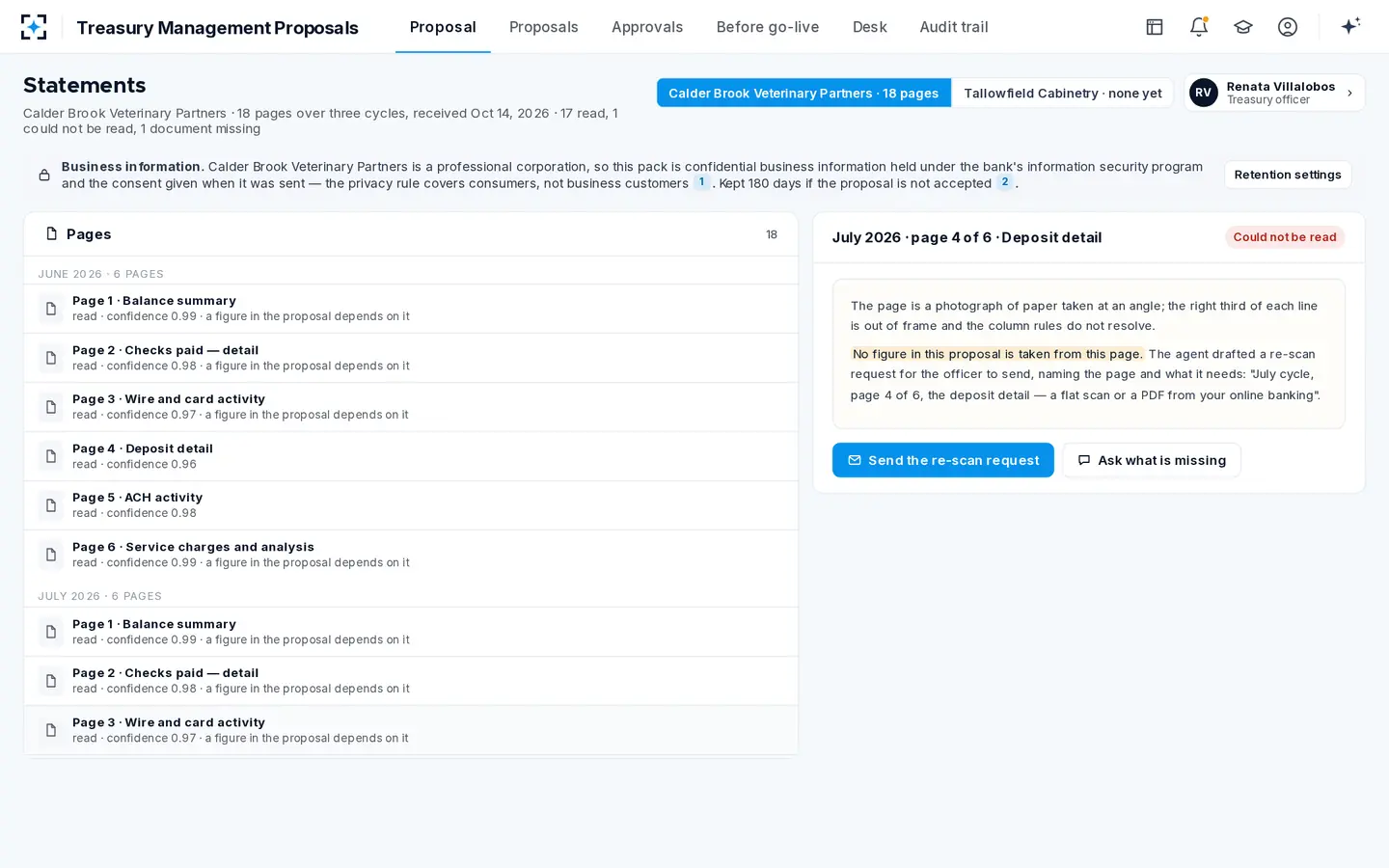
A conversion proposal starts from the prospect's check run, not from an industry average. In the sample, the agents counted the checks paid in each of three cycles, grouped them by payee and found which payees already accept an electronic payment; the remainder stays on paper behind positive pay.
One prospect's check run in Treasury Management Proposals, from statement lines to a conversion plan
| Step | From the statements | Result |
|---|---|---|
| Checks paid, three cycles | June 198, July 210, August 204 | 612 checks, $1,142,380.00 a quarter |
| Annualized | 612 × 4; $1,142,380 × 4 | 2,448 checks, $4,569,520 a year (an estimate) |
| Grouped by payee | Check detail pages of each cycle | 318 payees |
| Payees that already accept electronic payment | Found by the agents in the check detail | 184 payees, 2,200 of the 2,448 checks a year |
| Moved to ACH credits | About 183 a month | Priced at the bank’s list for ACH credits originated |
| Left on paper | 248 checks a year to 134 payees | Protected by positive pay with payee match |
Two features of the plan are deliberate. The checks that move are counted from the prospect's records, so the officer can show the controller the payee list. And the checks that stay on paper are not ignored: $4,569,520 of checks a year were issued with no payee verification, and positive pay with payee match covers that exposure. The proposal states the exposure and claims no dollar saving for it, because a fraud control prevents a loss nobody can count in advance. How those lines are written into the document is shown in the cash management proposal template.
The check detail pages the conversion is counted from
Same Day ACH, FedNow and wires: the faster options a proposal can offer
A business that moves off checks can choose how fast each payment settles. Standard ACH suits payroll and supplier runs; Same Day ACH settles within the day, with a per-payment limit Nacha is raising: "This rule amendment will raise the per-entry dollar limit for Same Day ACH from $1 million per payment to $10 million per payment", effective September 17, 2027; the same rule page notes that the FedNow Service raised its limit from $1 million to $10 million in November 2025 (Nacha). Wires remain the rail for the largest and most urgent payments.
The choice should follow the payment, and a proposal should not sell speed the client does not need. Most supplier payments are scheduled, and an ACH credit sent on the right day is as good as an instant one. What the client usually needs is the control a check never gave it: the payer picks the settlement date.
What converting checks to ACH needs before the first file
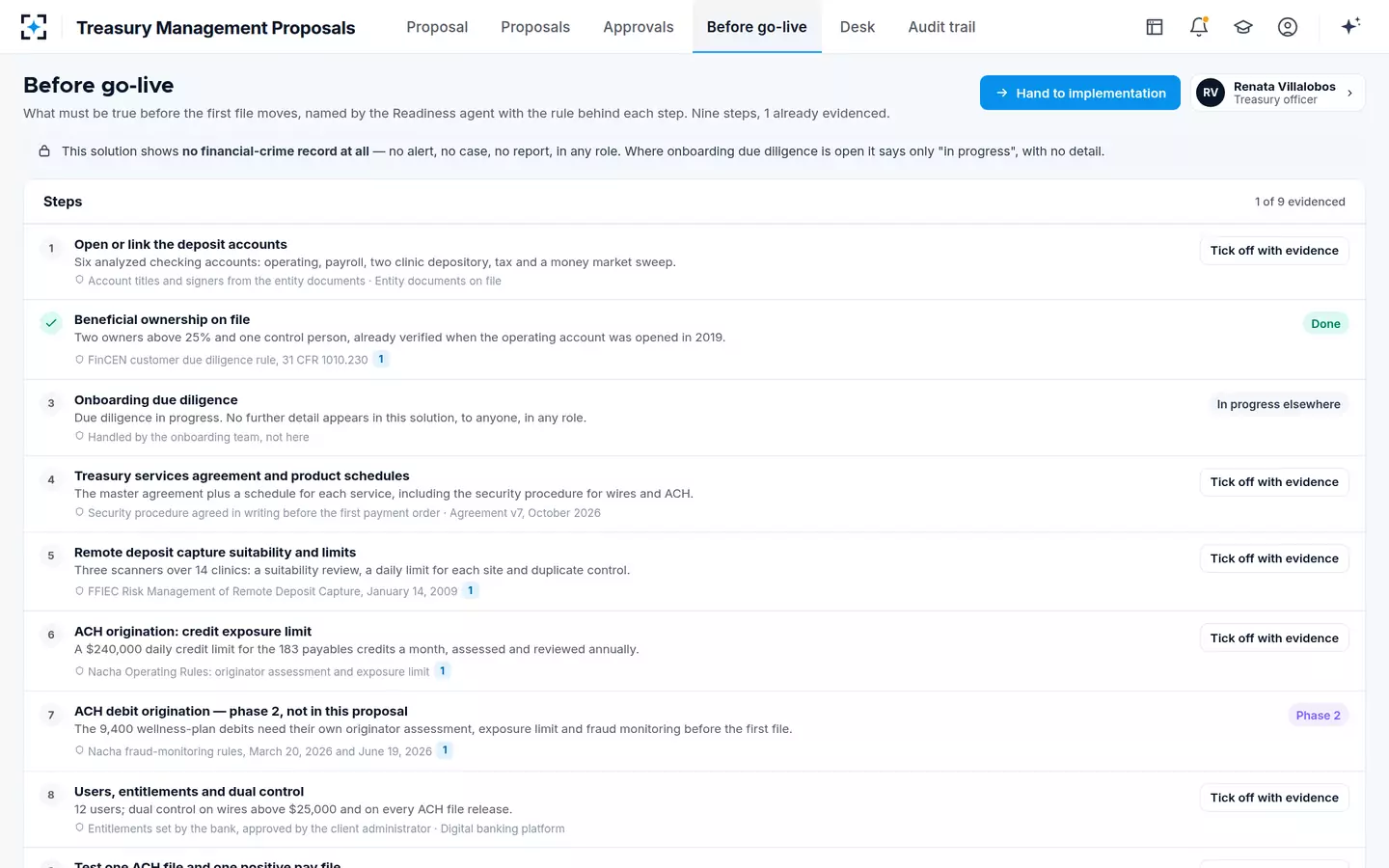
Originating ACH credits makes the bank responsible for the client's files, so the conversion needs credit and operational set-up before it starts. The checklist is what the sample proposal's readiness section names for the ACH side.
Before a business sends its first ACH payables file
- An exposure limit
Set by the bank on the client’s ACH credit origination; the sample sets $240,000 a day for about 183 credits a month.
- An origination agreement and security procedure
In writing, with dual control on file release where the client accepts it.
- Payee account details, verified
Collected from the payees and confirmed through a channel the business already trusts, never from the request itself.
- Fraud-monitoring processes
Risk-based processes to identify entries initiated by fraud, as Nacha’s rules now require of non-consumer originators.
- Positive pay for the checks that remain
With payee match and a check issue file from the client’s payables system.
- A test file
One ACH file and one positive pay file through the bank before live payments move.
The conversion's readiness list in Treasury Management Proposals, with the rule behind each step
The wider map of treasury services the conversion sits in is in what is treasury management in commercial banking.
Questions people ask
Is ACH faster than a check?
Usually. An ACH credit settles on the date the payer chooses, the same day with Same Day ACH, and Regulation CC requires electronic payments to be available no later than the next business day. A check depends on the mail and on when the payee deposits it, and local check funds need only be available by the second business day after deposit.
Can I stop an ACH payment like a check?
The mechanisms differ. Under UCC § 4-403 a customer may stop payment of a check by an order that reaches the bank in time to act on it; an ACH credit, once sent, is harder to recall, which is why controls such as dual control on file release matter before the file goes. Ask the bank how its reversal and recall process works under the Nacha rules.
Do suppliers have to agree to be paid by ACH?
In practice yes, because they must provide their bank account details. That is why a conversion proposal counts the payees who already accept electronic payment; in the sample, 184 of 318 payees, accounting for 2,200 of 2,448 checks a year.
Why are check payments still so large in value?
Because the checks that remain are mostly business payments. Federal Reserve data show 9.2 billion checks worth $24.45 trillion in 2024, an average of about $2,658 each against about $946 in 2000.
Is a business ACH payment covered by the same consumer protections as a personal one?
No. Regulation E's protections apply only to accounts held primarily for personal, family or household purposes (12 CFR 1005.2; Reg E and account takeover covers the line); a business's ACH payments are governed by the Nacha rules and its agreement with the bank. That makes the origination agreement and the security procedure the business's main protections.