A treasury management sales analyst supports the officers who sell a bank's cash management services: the analyst reads prospects' statements, builds the volume analysis and the pro forma, prepares pricing-exception requests and drafts proposals and RFP answers, so the officer can spend the time with the client. When agents can produce that draft in minutes, the analyst's value moves from building it to checking it, and the question every sales manager asks is whether the desk will trust an AI-drafted proposal. It should trust one only for reasons it can check: every value cited to the prospect's statement, every price tested against the drafter's authority, and a second person on the approval. Botminds' Treasury Management Proposals is built around those three, and this guide is about the habits that make them work on a real desk.
The examples come from a fictional sample bank, Tessaly Community Bank, whose desk carries about 260 proposals a year, and from its pipeline as it runs through the solution.
What does a treasury management sales analyst do?
A treasury management sales analyst does the analytical half of treasury sales: turning a prospect's documents into numbers an officer can stand behind. The usual tasks are statement and account analysis review, volume and fee modelling, pro forma pricing against the bank's list, exception packages for the sales manager, proposal and RFP drafting, and pipeline reporting.
The role sits between two Bureau of Labor Statistics descriptions without matching either. The nearest selling occupation lists duties such as "Contact prospective clients to present information and explain available services" and "Evaluate cost and revenue of agreements" (BLS, securities, commodities and financial services sales agents). The analyst does the second for the officer who does the first, and at many banks the analyst seat is how officers are trained.
The analyst's work, step by step, and which steps move to agents
Most of the analyst's hours go to steps that agents can now do: keying, grouping, valuing and building the first pro forma. What stays with the analyst is the checking, the judgement about what a figure means, and the conversation with the officer about what to recommend.
Where a treasury sales analyst's work goes once Treasury Management Proposals drafts it
| Step | By hand | With agents drafting | What the analyst keeps |
|---|---|---|---|
| Read the statements | Key three cycles into a template | Every page read, each figure pinned to its line | Open the figures that matter and check the line |
| Group the activity | Sort checks, wires and deposits by hand | Grouped into payables, receivables, balances and fees, reconciled to totals | Read any cycle that did not reconcile |
| Value each service | Spreadsheet arithmetic, inputs often unrecorded | Value, arithmetic and inputs shown with the citation | Challenge an input; refuse a value with no source |
| Build the pro forma | Paste the price list, apply tiers | Priced at the bank’s list and tiers with the version | Question a stale list; check the volumes used |
| Prepare an exception | Write an email to the manager | Discount, floor and authority computed; reason code required | Write the relationship case the manager will read |
| Draft the proposal | Write from the spreadsheet | Written from accepted services and the approved price | Edit for the client; never add an unsupported figure |
| Track the pipeline | A shared sheet updated weekly | Statements outstanding, approvals against the clock, prices expiring | Decide which prospect needs a call today |
The right-hand column is the job description of the analyst after the change, and it is not a smaller job. It asks for more judgement per proposal: a person who can open a figure, read the line behind it and say "that is not what this line means" is worth more than one who can key it quickly.
Will officers trust an AI-drafted proposal? Three habits that earn it
Officers trust a drafted proposal when they have checked enough of it to know where it is reliable, and not before. Trust built any other way, on a demonstration or on a polished draft, is the risky kind. Three habits build the right kind, and a sales manager can see each one happening.
Three habits that make a drafted treasury proposal trustworthy, and three that keep it so
- Spot-check citations every time
Open at least the three largest figures and read the statement line behind each. It takes a minute and catches the misreads that confidence scores miss.
- Refuse a value that cannot be shown
If a number has no line on the prospect’s statement behind it, it stays out of the proposal and the missing document is requested.
- Keep the maker off the checker’s seat
Whoever drafted the proposal does not approve it; a manager’s own draft goes one level up.
- Read the refusals first
The pages and values the agents would not count say most about the file, and are the ones a prospect will ask about.
- Give every override a reason
When a person changes an agent’s figure, the reason sits beside the original so the desk can learn which overrides were right.
- Review the exceptions monthly
Which discounts went above authority, why, and whether the relationship value they cited arrived.
Automation bias: the risk on the other side of trust
The opposite failure to distrust is over-trust, and it has a name. NIST's generative AI profile calls it automation bias and warns that it makes a system's other failures, invented content among them, more likely to slip through (NIST AI 600-1, section 2.7). The same section notes the reverse risk, that human experts may be "unnecessarily “averse” to GAI systems" and lose their benefits.
Humans may over-rely on GAI systems or may unjustifiably perceive GAI content to be of higher quality than that produced by other sources.
NIST AI 600-1, Human-AI Configuration
On a sales desk the two show up in recognisable ways. Aversion looks like an analyst who rebuilds every figure in a spreadsheet "to be sure", doubling the work. Over-reliance looks like a well-formatted proposal sent with a figure nobody opened. The three habits above are designed against both: citations make checking cheap enough to do, refusals make gaps visible, and the second person makes sure someone other than the drafter has looked.
Bank supervisors have not set rules for this yet. The April 2026 interagency model risk guidance leaves generative and agentic AI outside its scope (OCC Bulletin 2026-13), so the controls a desk adopts are its own. That is an argument for choosing controls a reviewer can see, rather than a policy that says "staff will review AI output".
Who checks a proposal before it is sent?
Two people check every proposal before it reaches a prospect: the officer who drafts it, and a different person who approves it. When the discount is beyond the drafter's authority, the approver also approves the price, with a reason code; when the approver drafted it, it goes one level up.
Two names on every proposal in Treasury Management Proposals: who checks what before it is sent
Agent
Pricing agentPrices at the list, measures the discount and tests it against the drafter’s authority: 13.87% against 10% in the sample.
Never: Never approves its own exception
A person decides
Treasury officerAccepts or declines each recommendation with a reason, and sends the price for approval with reason PX-2 and a note.
Never: Cannot approve a proposal she drafted
A person decides
Treasury sales managerSees the discount, the earnings allowance and the net position, and approves as priced (AP-1) with his own reason.
Never: A proposal he drafted routes to the head of treasury management
Agent
Proposal agentWrites the proposal only from accepted services and the approved price, with the citations attached.
Never: Released only by the approval
A person decides
Treasury officerReads it and sends it to the prospect.
Never: No agent ever contacts a prospect
The authority test runs before the officer can send anything
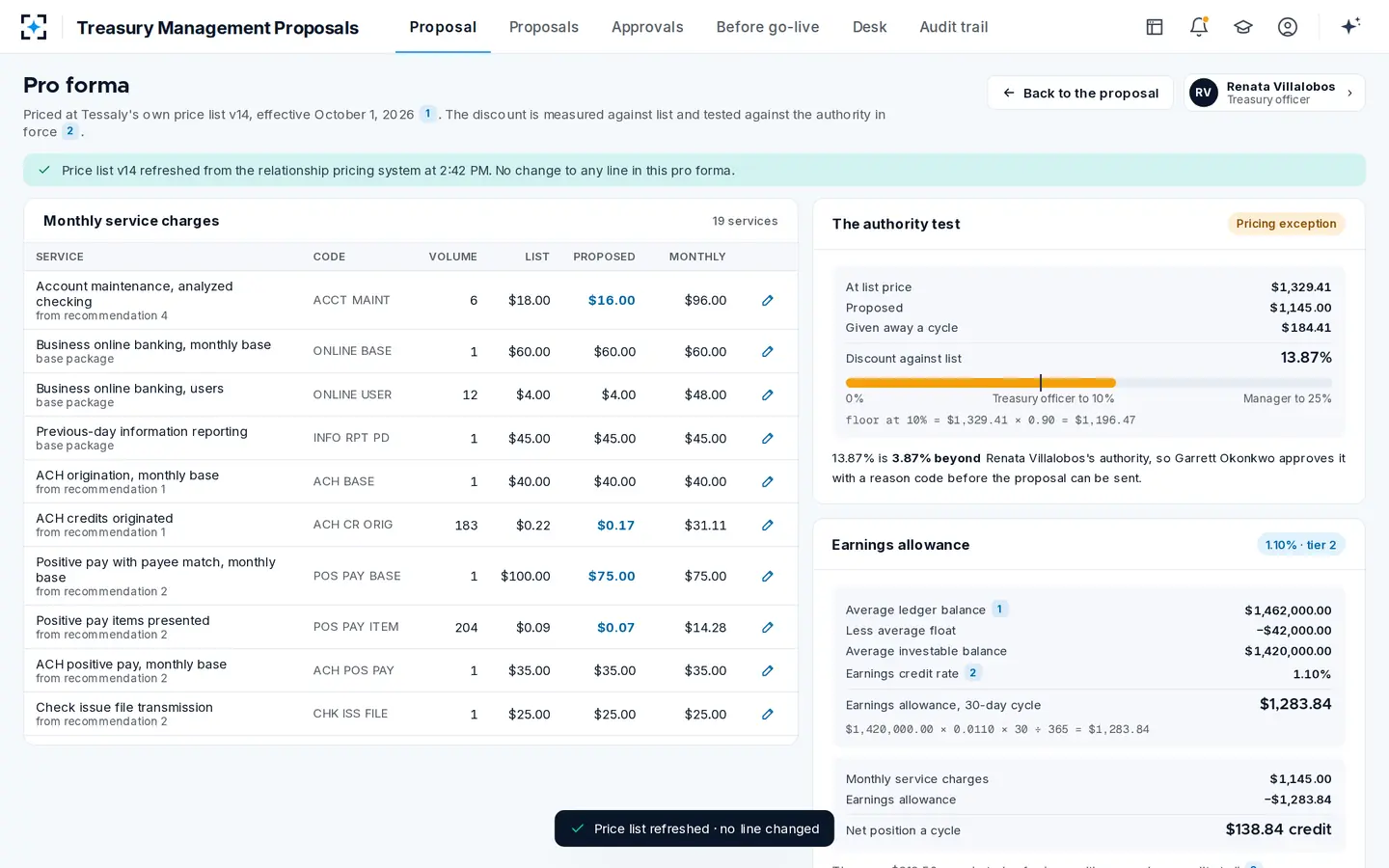
How the authority itself should be set, and what to write down when it is exceeded, is the subject of relationship pricing in banking.
The first eight weeks on a treasury sales desk
Adoption goes best when the desk sees the agents fail safely before it relies on them. The plan below starts with the bank's own past proposals, runs the agents alongside the analysts, and only then moves new prospects onto the drafted path.
Eight weeks from the price list to drafted proposals the desk relies on
- Load list, tiers, authority, clockswk 1–2
- Replay past proposalswk 3–4
- Live, every figure checkedwk 5–6
- Live, sampled checkswk 7–8
The replay weeks do most of the persuading. An analyst who sees the agents reach the same check count she reached by hand, and refuse the same photographed page she struggled with, has evidence of her own. The test design is set out in bank statement analysis software: how to tell its numbers are right.
What a sales manager measures in the first quarter
Measure the things the habits produce, not usage. A desk that uses the drafts and stops checking them will look like a success on a usage chart for a quarter and like a failure the first time a prospect finds a wrong number.
First-quarter measures for a desk adopting drafted treasury proposals
| Measure | Why it matters | Where the sample bank stands |
|---|---|---|
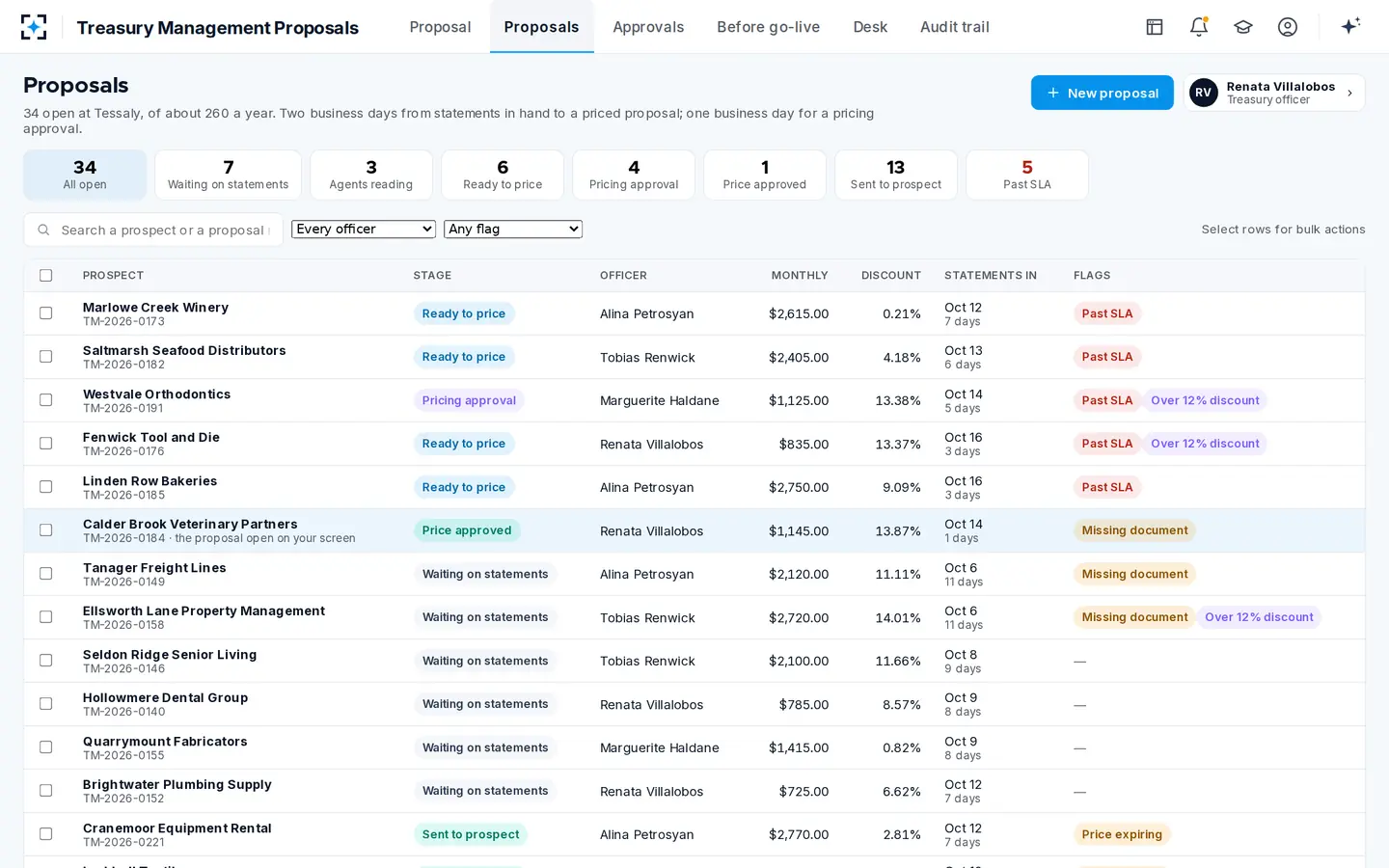
| Days from statements in hand to a priced proposal | The time the prospect waits | Clock set at two business days; five proposals past it |
| Hours to a pricing decision | The step that used to take longest | Clock set at one business day |
| Share of proposals above the drafter’s authority | Whether the list and the authority fit the market | 13 of 34 open proposals carry a discount above 12% |
| Overrides with a reason, and how many proved right | Whether people are checking, and learning | Every override takes a reason beside the agent’s figure |
| Refusals resolved before sending | Whether gaps are closed, not ignored | One unreadable page and one missing document on the Calder Brook file |
The pipeline a sales manager reads each morning
Sales associate, sales support analyst, sales consultant: the titles
Banks use several titles for the seats around the treasury officer, and they rarely mean the same thing from one bank to the next. The useful distinction is which decisions each seat owns.
Titles around the treasury officer, by the decisions each usually owns
Analyst and associate seats: Treasury management sales associate, sales support analyst, sales analyst
Officer and consultant seats: Treasury management officer, sales officer, sales consultant
Analyst and associate seats: The figures: statement analysis, pro forma, draft, RFP answers
Officer and consultant seats: The client: what to recommend, the price within authority, what is said
Analyst and associate seats: A discount or the approval of a proposal
Officer and consultant seats: The approval of their own draft or their own exception
Analyst and associate seats: Checks figures, writes the relationship case, edits for the client
Officer and consultant seats: Spends the saved days with prospects and on the harder decisions
How to sell treasury management services with a draft the prospect can argue with
Treasury services sell best when the proposal starts from the prospect's own statement and lets the prospect check every number. A list of services with prices persuades nobody; a page that says "you paid 612 checks last quarter, here are the payees who already take electronic payment, and here is what your balances would earn" starts a conversation the bank is ready for.
Three choices make a draft arguable in the good sense. State the exposure a fraud control covers rather than claiming a saving: the sample proposal says positive pay covers $4,569,520 of checks issued a year and claims no dollar figure for it. Show the balance arithmetic, because the earnings allowance against the fees is often the strongest line. And defer what the bank cannot yet do safely: the sample officer held ACH debit collection for 9,400 wellness-plan members for a second phase, because an exposure limit has to be set before the first debit file. A prospect that sees the bank decline to oversell tends to believe the rest.
Questions people ask
What is the difference between a treasury management sales analyst and a treasury management officer?
The analyst owns the figures and the officer owns the client. The analyst builds the statement analysis, the pro forma and the draft; the officer decides what to recommend, prices within authority and signs what goes out, and neither approves their own exception.
What does a treasury management sales support analyst do?
Usually the same work as a sales analyst, often for several officers at once: statement analysis, pro formas, exception packages, RFP answers and pipeline reports. Where agents draft the proposals, the seat shifts toward checking figures and writing the relationship case for exceptions.
Will an AI-drafted proposal replace the sales analyst?
It replaces the keying and the first draft, not the checking. Somebody has to open the largest figures, read the refusals and write the case for an exception, and the analyst is the person best placed to do it.
How long does it take a desk to trust drafted proposals?
A plan of about eight weeks is realistic: two to load the price list and authority, two replaying closed proposals, and four live with every figure checked at first and sampled later. The replay on the bank's own past work does most of the persuading.
What is a treasury management sales consultant?
At most banks a senior selling role, close to a treasury management officer, often covering larger or more complex clients. Titles vary; what matters is whether the role prices within an authority and who approves above it.