Bank statement analysis software reads statements, extracts balances, transactions and fees, and turns them into figures someone will rely on; for a treasury team that figure becomes a line in a proposal to a business prospect. The way to tell whether its numbers are right is to test it on statements you have already analyzed and score four things: accuracy field by field, the share of output values cited to a page and line, whether it refuses pages it cannot read, and whether its groupings reconcile to each statement's own totals. Botminds' Treasury Management Proposals was designed around those four measures, because in a proposal a figure without a source is a liability, not a convenience. This guide sets out the scorecard and how to run it.
The stakes are specific. A treasury officer who quotes a prospect's check volume, wire fees or idle balance back to its chief financial officer is making a claim the prospect can check against its own records in minutes. Software that reads well on a vendor's demonstration files and poorly on a photographed page from a regional bank produces exactly the kind of error that loses the meeting. The examples here use fictional sample data from the solution.
What bank statement analysis software has to prove before you buy
It has to prove that every figure it produces can be traced, that it knows the difference between reading and guessing, and that its arithmetic ties to the document. Speed and coverage of formats matter, but they come after those three, because a fast tool that is quietly wrong one figure in fifty is slower than a person once the errors are found.
The usual sales demonstration answers a different question: can the tool read a clean PDF from a large bank. Almost any modern tool can. The statements a treasury officer actually receives include scans, photographs of paper, multi-page account analysis statements with another bank's service codes, and months where a page is missing. The evaluation has to be run on those.
How accurate is bank statement analysis software? Ask per field, on your own statements
A single accuracy percentage tells you little; accuracy has to be measured per field, on a test set that looks like your real intake. The National Institute of Standards and Technology's AI Risk Management Framework puts it directly: an accuracy figure means something only beside a stated, realistic test set that looks like the conditions of use and a description of how the test was run, and results can be broken out by segment (NIST AI RMF 1.0; the passage is quoted in testing AI email triage at a bank). For statements, the segments that matter are bank, format and scan quality.
For bank statements the useful segments are field types and document quality. A tool can be near-perfect on ledger balances, which are printed large and once per cycle, and weak on per-item fees in a dense analysis section. It can be excellent on native PDFs and poor on phone photographs. A vendor figure such as "99% accurate" averages those together, and the average hides the segment that hurts you.
A refused page is a pass. A confident figure taken from a page the tool could not read is the most serious failure a statement reader can make.
The four measures that decide whether a figure can go in a proposal
Four measures cover what matters for a treasury proposal. Each is a ratio a bank can compute on its own test set, and each answers a question a sales manager or an examiner would ask about a specific figure.
Four measures for bank statement analysis software, each a ratio you can compute yourself
Field accuracy
correct fields ÷ fields in the answer key
Reported separately for balances, item counts, amounts, fees, rates and dates, and for clean and poor-quality pages.
Scored by the treasury analyst against past work
Citation coverage
values with a page and line ÷ values in the output
Anything below 100% means some figures cannot be checked without redoing the reading.
Checked by the sales manager on a sample
Refusal recall
unreadable pages refused ÷ unreadable pages seeded
A refusal is a safe answer. A guessed figure on a bad page is the worst error the tool can make.
Seeded by whoever builds the test set
Reconciliation rate
flows that tie to the cycle total ÷ flows built
Grouped checks, wires and deposits should sum to the statement’s own totals to the cent, or be flagged.
Computed automatically, reviewed by the analyst
Two of the four are unusual in vendor comparisons, and both earn their place. Citation coverage is what lets a person check a confident figure without rereading the statement. Refusal recall measures the failure NIST calls confabulation, a confident answer about content that is not there; the only way to measure it is to plant pages the tool should not be able to read and count how often it says so.
A scorecard for comparing bank statement analysis tools
The scorecard below turns the four measures into questions for a vendor and the evidence to ask for. It adds the two things a treasury proposal needs beyond reading: the bank's own prices, and a second person on the price.
Bank statement analysis software scorecard for a treasury team
| What to test | How to test it | What good looks like | In Treasury Management Proposals |
|---|---|---|---|
| Field accuracy | Run 20 or more past prospects’ statements; score each field against your team’s figures | Reported by field and by page quality, not one number | Each reading carries a confidence; the test is run on the bank’s own past statements |
| Citation coverage | Open 25 random output values and find the line | Every value opens its page, line and cycle | A value with no citation cannot be added to a proposal |
| Refusals | Seed a photographed page and remove a document | The page is named as unreadable and nothing is taken from it | Below the threshold the agent asks, with the request drafted |
| Reconciliation | Compare grouped totals with each cycle’s printed totals | Ties to the cent, or flags the cycle | Flows reconcile to each cycle’s own total, or say they cannot |
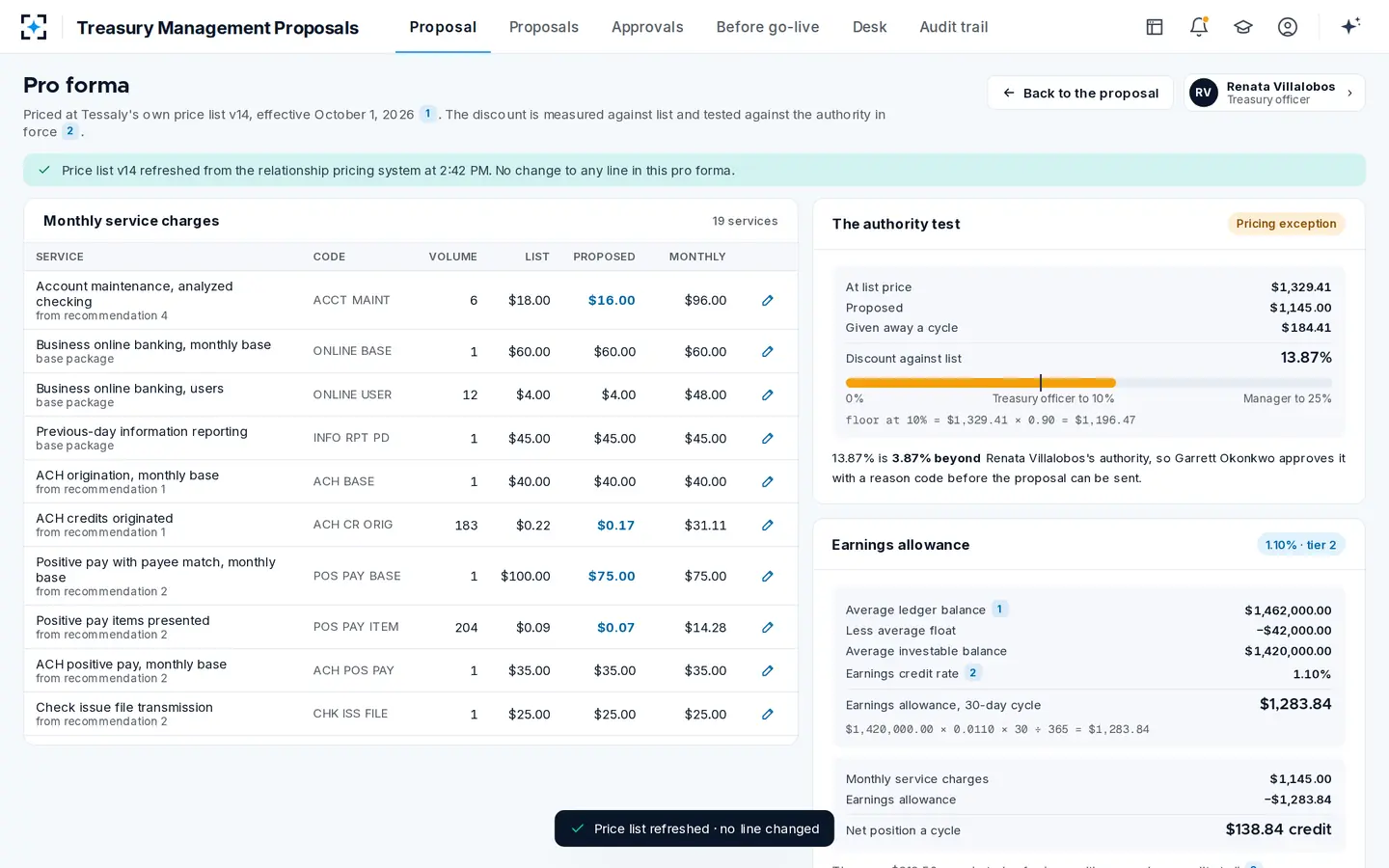
| Prices | Ask which price list a pro forma used, and how old it is | Your list, your tiers, version and age shown | Priced at the bank’s list with its version; never on a stale list without saying so |
| Approval | Try to approve a discount you drafted | Refused; a second named person approves | The drafter cannot approve; a manager’s draft routes one level up |
Every page with its confidence, and whether a proposal figure depends on it
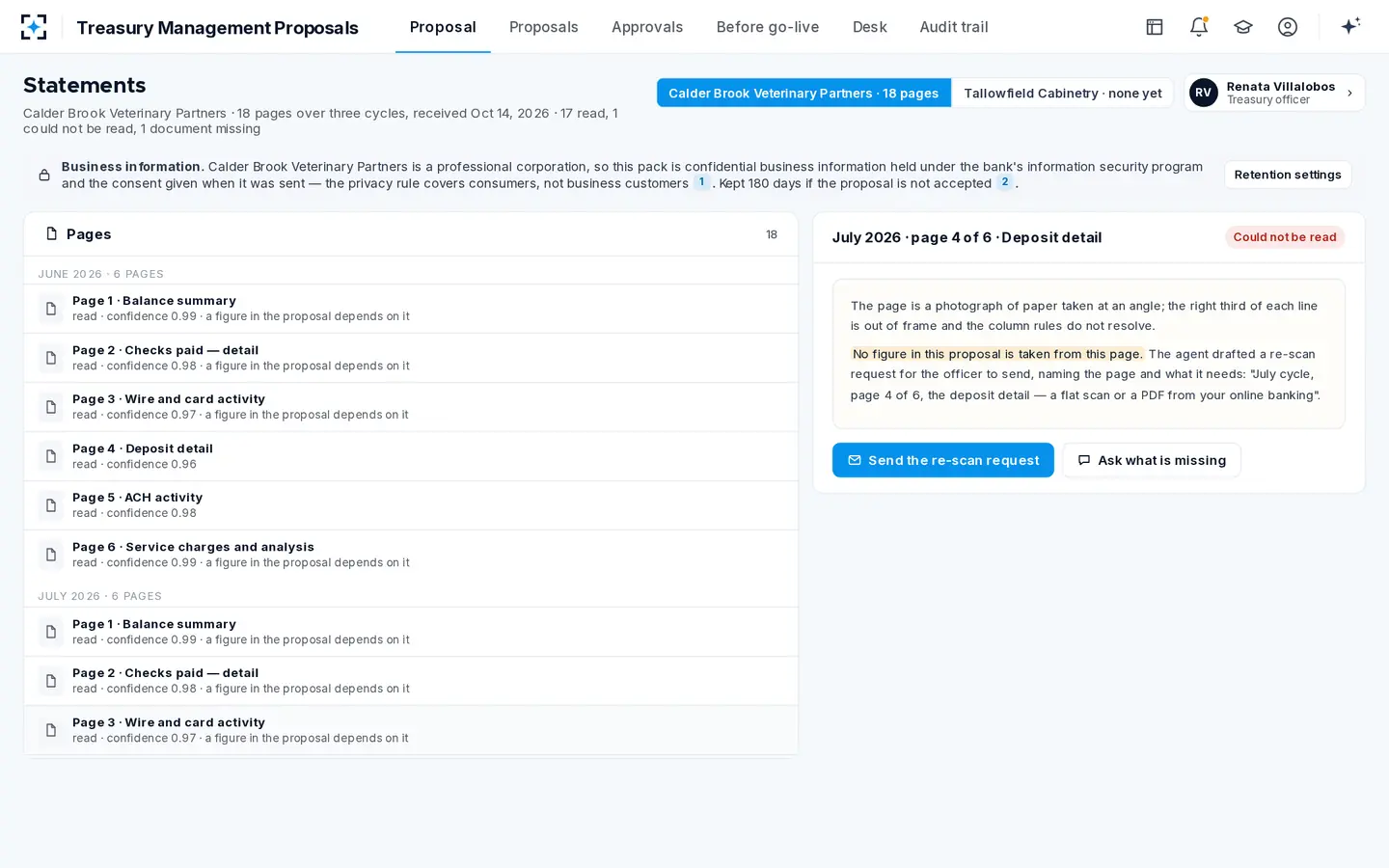
How to check extracted bank statement data: reconcile to the statement's own totals
The fastest check on extracted data is the one the statement provides: its own totals. If the extracted items in a category do not sum to the printed total for the cycle, something was missed, duplicated or misread, and the tool should say so before anyone builds on the figure.
Checks paid over three cycles, reconciled before anything is annualized
| Cycle | Items read | Amount read | Printed on the statement | Ties? |
|---|---|---|---|---|
| June 2026 | 198 | $374,210.00 | $374,210.00 | Yes |
| July 2026 | 210 | $386,710.00 | $386,710.00 | Yes |
| August 2026 | 204 | $381,460.00 | $381,460.00 | Yes |
| Quarter | 612 | $1,142,380.00 | Sum of the three cycles | Yes |
| Annualized (× 4) | 2,448 | $4,569,520.00 | Our arithmetic, shown | Stated as an estimate |
Reconciliation catches the errors that confidence scores miss. A tool can read every line on a page with high confidence and still drop a line that ran across a page break; the total will not tie, and the mismatch tells the reviewer where to look. It is also the cheapest control to run, because the answer key is printed on the document.
Building a test set from statements your team already analyzed
The best test set is the work your team has already done: prospects whose statements an officer or analyst read by hand, with the figures that went into the proposal. Those figures are your answer key, and the statements are the realistic test set NIST describes.
How to build a fair test of bank statement analysis software in two weeks
- Pick 20 to 30 past prospects
Across sizes and incumbent banks, including at least five whose statements were hard to read.
- Seal the answer key
The figures your team used, by field. The vendor never sees them.
- Keep the ugly files
Photographs, scans, multi-page analysis statements with other banks’ service codes.
- Seed the failures
Plant a photographed page with a column cut off, and remove one document a value depends on.
- Score per field
Balances, counts, amounts, fees, rates and dates separately; clean and poor pages separately.
- Count refusals as safe
A refused bad page is a pass. A figure taken from it is the most serious failure.
- Open citations at random
Twenty-five values, each traced to its line by someone who did not set up the test.
- Price one package
Check that the pro forma used your list, your tiers and your authority, and showed the version.
Run the same test on the tool you have today, even if that tool is a spreadsheet and an analyst. The comparison that matters is not software against perfection; it is software against the error rate and the hours of the current process.
Bank statement analysis in Excel, and when software is worth it
Many treasury teams analyze bank statements in Excel, and for a handful of proposals a year it works: an analyst types three cycles of volumes into a template, sums them, annualizes, and prices against a list pasted into another tab. The method fails quietly as volume grows, because a spreadsheet keeps the number and loses the source.
A spreadsheet keeps the figure; software built for proposals keeps the figure and where it came from
Excel template, keyed by hand: Typed from the PDF, one cycle at a time
Bank statement analysis software: Read from every page, each figure pinned to its line
Excel template, keyed by hand: A second person re-keys or spot-checks against the PDF
Bank statement analysis software: Reconciled to each cycle’s total; any figure opens its source
Excel template, keyed by hand: The analyst decides, often without leaving a note
Bank statement analysis software: Refused, named and requested again
Excel template, keyed by hand: Pasted in, and out of date when it changes
Bank statement analysis software: Read from the pricing system with the version shown
Excel template, keyed by hand: An email
Bank statement analysis software: A named approver and a reason code on the record
Excel template, keyed by hand: A file, if someone saved it
Bank statement analysis software: The figures, sources, price list version, approver and reason
The break-even is not mostly about speed. It is the point at which a sales manager can no longer say, for a given proposal, where each figure came from and who approved its price. In Botminds' own estimate for a mid-market proposal, keying the volumes takes about two of the bank's working days by hand and about a tenth of a day with the agents reading, but the larger change is that the figure arrives with its source.
Buying from a vendor: what the interagency guidance expects in 2026
A bank that buys statement analysis software takes on the vendor's errors as its own. The interagency guidance on third-party relationships, issued in June 2023, holds a bank as responsible for work a third party does for it as it would be if the bank did the work itself (Interagency Guidance on Third-Party Relationships; the guide to that guidance quotes the sentence). It expects contracts to address, among other things, the right to audit and the handling of the bank's data.
That guidance may change soon. On September 15, 2026 the OCC, the Federal Reserve, the FDIC and the NCUA proposed new third-party risk management guidance and said they "plan to rescind and replace existing guidance", with comments due by November 16, 2026 (Proposed Third-Party Risk Management Guidance). The proposal leans toward tailoring oversight to the risk of each relationship. For a tool that reads prospects' confidential statements and produces figures sent under the bank's name, the risk is not small, whichever version is in force when you buy.
Model risk guidance answers a narrower question. The April 2026 interagency guidance defines a model as a quantitative method built on statistical, economic or financial theory and leaves out simple spreadsheet arithmetic and fixed, rule-based processing (OCC Bulletin 2026-13; the definition is quoted in the guide to AML risk rating models); it also places generative and agentic AI outside its scope. So the pro forma's arithmetic is not a model under that guidance, and the reading itself is not covered by it either. Either way the testing above is the bank's own to do, and the Treasury's 2024 review of AI in financial services records document extraction among the near-term uses firms reported (U.S. Treasury).
Where Treasury Management Proposals fits among bank statement analysis tools
Bank statement analysis software serves several different jobs, and the scorecard weights change with the job. Lenders use statement analysis to verify income and cash flow for credit; for that job, see bank statement verification software. Treasury Management Proposals is built for the treasury desk: reading a business prospect's statements to recommend and price payment, collection and fraud-control services.
For that job it does the reading with every figure cited, refuses what it cannot read, prices at the bank's own list and tests the discount against the drafter's authority, and holds the proposal until a second person approves. It does not underwrite credit, perform due diligence or replace the account analysis system that bills the client once it is live. The behaviour of the reading under poor inputs is shown in can AI analyze bank statements, and how a priced answer is assembled for a formal request in the cash management RFP template.
Treasury Management Proposals prices at the bank's own list, with the version and the authority test on screen
Questions people ask
What is the best bank statement analysis software?
The one that passes your own test on your own statements. Score field accuracy by field type, the share of values cited to a line, whether seeded unreadable pages are refused, and whether totals reconcile; a tool that guesses on a bad page should fail regardless of its average accuracy.
Is there free bank statement analysis software?
There are free converters that turn a statement into a spreadsheet. For a proposal sent under the bank's name, the question is not cost but control: whether the figures stay traceable, whether the data sits under the bank's security program, and whether the tool refuses what it cannot read.
How do you analyze bank statements in Excel?
Key each cycle's balances, item counts and fees into a template, reconcile each category to the printed totals, then annualize and price against the list. Record the page each figure came from in a column beside it; without that column, nobody can check the analysis later.
Can bank statement analysis software read account analysis statements?
Good tools can, and for treasury work they should: the analysis statement shows balances, the earnings credit and each billed service with its volume and unit price. Check that the tool keeps the prospect's bank's codes as found and maps them to your catalogue as a separate, visible step.
Does a bank need to validate statement analysis software as a model?
The April 2026 interagency model risk guidance excludes generative and agentic AI and simple spreadsheet arithmetic from its scope, so it does not settle the question. Third-party risk guidance still applies to the vendor, and a bank should test accuracy on its own data before relying on the output.
How many statements should a test set include?
Enough to cover the variety you receive: 20 to 30 past prospects is a practical start, with several hard-to-read files and at least one seeded unreadable page and one missing document. Score each field type separately so a weak segment cannot hide in an average.