Bank statement verification software exists because a statement is the most useful document in a consumer credit file and the most tedious to read. Ninety days of one account is three or four hundred lines, and the answers a lender needs — did the pay arrive, what is paid out every month, is anything missing, is this document real — are spread across all of them. Software earns its place on six checks that a person cannot do reliably at volume, and loses it the moment it classifies a transaction without showing the line it came from. Botminds’ Income and Document Verification runs all six on every statement in a referred loan or card file: pages, carried balances, every credit classified, the recurring debits nobody declared, the deposit behind each pay stub, and the integrity of the file itself.
This page is for whoever is comparing tools, and for the analyst who will live with the output. The worked examples come from the fictional sample files in the solution — the applicants, employers and banks are invented. Rules, research and figures are linked under each figure.
What one sample file’s statements held
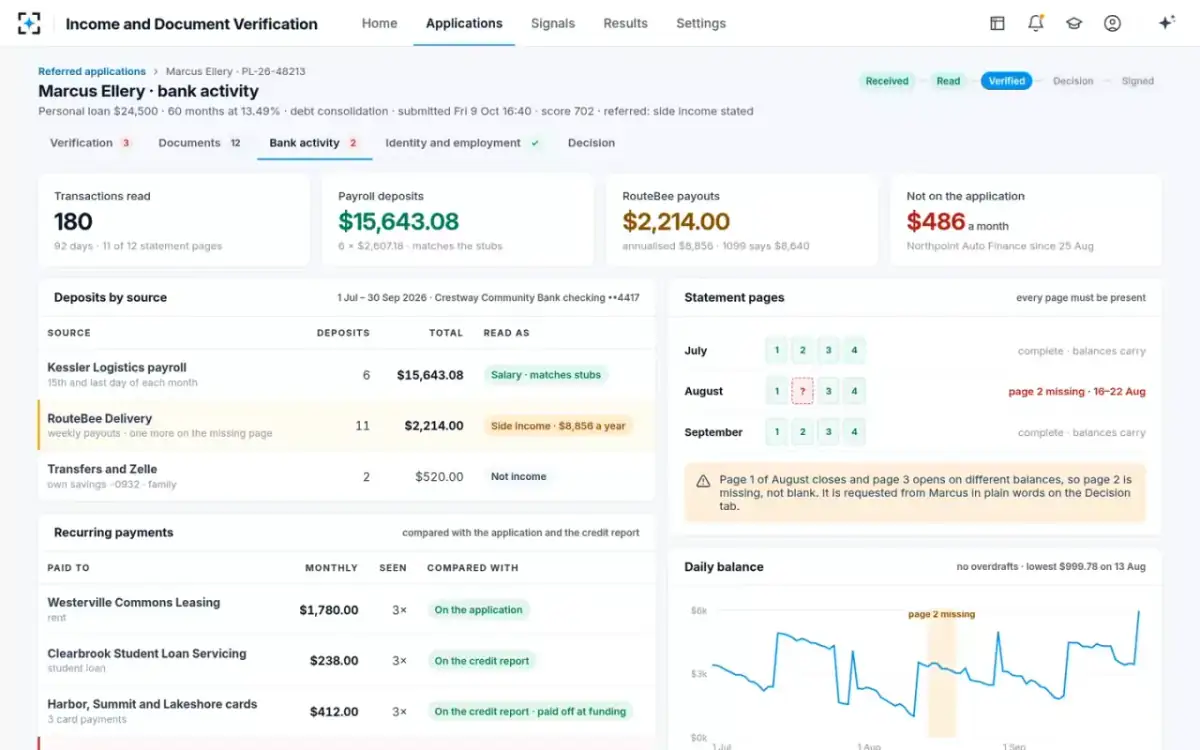
180
transactions across 92 days, on 11 of 12 statement pages — one page was missing
$486/mo
a car loan found only in the debits: not on the application, not yet on the credit file
6of 6
pay dates in the period matched to the credit that paid them
What bank statement verification software is for
The regulation that matters here names the document in one phrase. Regulation Z lists “financial institution records” among the third-party records a creditor may use to verify income (12 CFR 1026.43(c)(4)), and for credit cards Regulation Z requires an issuer to consider ability to pay “based on the consumer’s income or assets and the consumer’s current obligations,” with policies that weigh at least one of “the ratio of debt obligations to income; the ratio of debt obligations to assets; or the income the consumer will have after paying debt obligations” (12 CFR 1026.51(a)). Read those two together and the statement is doing double duty: it is evidence of income and the only document in the file that shows current obligations as they are actually paid.
That dual role is what separates a good tool from a transaction categoriser. A categoriser answers “how much came in”. A verification tool has to answer “how much came in, from whom, how much goes out every month, to whom, is any of it missing, and is this document what it claims to be” — and has to show its working on each, because an analyst who cannot audit a classification will either trust it blindly or ignore it.
The six checks to score every statement tool against
- Page completeness
Every page of every statement, numbered, present and in order — and a named gap where one is not.
- Carried balances
The closing balance of each page and each month must be the opening balance of the next, to the cent.
- Every credit classified
Not just the payroll ones: side income, transfers in, refunds, loan proceeds, and anything unclassified shown as unclassified.
- Recurring debits against the declared debts
Every repeating payment compared with the application and the credit file, and the ones that appear on neither listed.
- The deposit behind each pay stub
Net pay on each stub matched to a credit on the pay date, and every unmatched pay date named.
- The document itself
Typography, layout and file history, on the same footing as any other document in the file.
How do lenders verify bank statements today?
By eye, mostly, and selectively. The ordinary practice on a referred file is to scan the deposits for the salary, glance at the balance for signs of distress, and move on — because reading 180 lines properly takes twenty minutes and the queue does not allow twenty minutes. The checks that get dropped are the structural ones: nobody adds up whether all twelve pages are there, and nobody compares the closing balance on page 3 with the opening balance on page 4.
That selectivity is the opening a forged statement needs. A page edited to remove a payment, or a month rebuilt in a PDF editor with a higher balance, survives a scan of the deposits and fails the arithmetic of the carried balances. So the first two checks are not administrative hygiene; they are the fraud checks, and they are the two a tool can do perfectly and a person cannot.
Check 1: every page, in order
Statements are numbered — “page 2 of 4” — and the numbering is the check. A file is complete when every month in the required period is present and every page of every month is there. The output has to be a specific absence: not “incomplete”, but “page 2 of 4 of the August statement, covering 16 to 22 August, is missing”.
Specificity matters because it decides what the gap costs. In the sample file the missing page covers 16 to 22 August, and the applicant is paid on the 15th and the last day of the month — so no pay date falls inside the gap, and the deposit match is unaffected. A recurring debit could fall inside it, which is why the page is still requested. On a two-weekly pay calendar the same gap would have swallowed a pay date, and the match for that date would have been unknown rather than absent. A tool that cannot tell those two situations apart makes an analyst re-read the statement to find out.
Check 2: the balances that carry
A statement is a running balance, and a running balance is an equation: opening balance, plus credits, minus debits, equals closing balance — on every page and in every month. Three failures show up here. A page removed from the middle of a month leaves a jump between a closing and an opening balance. A transaction edited to a different amount leaves the running balance wrong from that line to the end of the page. And a whole month rebuilt at a flattering balance disagrees with the month before it.
How the carried-balance check reads, page by page
| Page | Opening balance | Credits − debits on the page | Closing balance | Carries? |
|---|---|---|---|---|
| July, page 1 of 4 | $2,418.07 | +$4,106.22 | $6,524.29 | Opens the period |
| July, page 2 of 4 | $6,524.29 | −$3,880.14 | $2,644.15 | Yes — matches page 1’s close |
| July, page 3 of 4 | $2,644.15 | +$1,962.00 | $4,606.15 | Yes |
| August, page 1 of 4 | $4,606.15 | +$2,607.18 | $7,213.33 | Yes — July’s close opens August |
| August, page 2 of 4 | missing | unknown | unknown | Unknown — the page is not in the file |
| August, page 3 of 4 | $5,902.41 | −$1,120.00 | $4,782.41 | Cannot be checked across the gap |
The distinction in that caption is the one to test in a demonstration. Ask what the tool reports when a page is absent. “Balances carry” is the wrong answer, because it is reporting a pass on an equation it could not solve.
Check 3: every credit classified, not just the payroll ones
Verified income is built from the credits, so every credit has to be given a category and each category has to have a rule. Payroll from the named employer is income. Side income from a platform or a client is income, usually counted at less than its face value. A transfer from the applicant’s own savings account is not income. A refund is not income. Loan proceeds are not income — and are often the most interesting line on the page, because they indicate a debt.
The requirement is that nothing is quietly dropped. A tool that classifies 94% of credits and silently ignores the rest has made a decision about the other 6% without telling anyone. The honest output has an “unclassified” category with a count, so an analyst can see how much of the income picture rests on a guess.
Credits by source on one sample file’s 92 days, as Income and Document Verification classifies them
Counted as income
- Employer payroll, six pay dates · 85%
- Side income from one payer · 15%
Not counted as income
- Transfers from the applicant’s own account · 62%
- Refunds and reversals · 38%
The side-income line is where classification turns into a policy question rather than a reading one. Three months of payouts from one platform can be annualised, and annualising one quarter is not the same as observing a year. The sample lender’s rule counts the lower of last year’s 1099 figure and the annualised deposits, which on this file means $8,640.00 rather than the $22,000 the applicant stated — a difference that moves verified income below the lender’s tolerance and changes the decision.
Check 4: the recurring debits nobody declared
This is the check that pays for the software, and it is the one that has nothing to do with income. The application lists the applicant’s debts; the credit file lists the ones that have been reported. Neither is current. A loan taken out six weeks ago has a payment history in the statements and no entry in the credit file, because furnishing runs on a monthly cycle and a new account takes time to appear.
The OCC describes the gap from the other end: “credit bureaus reliably identify debt owed, but monthly payment information is not always available,” so “most banks have business rules to estimate monthly payment amounts, for example, using 1.5 percent to 2.5 percent of the outstanding balance” (OCC, Retail Lending, version 2.0). An estimate spanning 1.5% to 2.5% of a balance is a range of 67% on the number that goes into the ratio. The statements hold the actual payment, to the cent, on the day it was made.
One sample file’s recurring debits, against what the applicant and the credit file said
| Recurring payment | On the application? | On the credit file? | In the statements | What the lender does |
|---|---|---|---|---|
| Rent | Yes | No — rent is not generally reported | Monthly, as stated | Counted as stated |
| Student loan | Yes | Yes | Monthly, as stated | Counted as stated |
| Three credit cards | Yes | Yes | Monthly, as stated | Counted as stated |
| Car finance, $486.00 a month | No | No — too new to have been reported | 25 August and 25 September, after a $3,000 payment to a dealer on 28 July and an auto credit inquiry on 24 July | Added to the monthly obligations; the ratio recomputed |
A good tool distinguishes a debt from a subscription and a transfer, and shows which it decided. The test to put to a vendor is not “can you find undisclosed debt” but “show me a payment you classified as a subscription and tell me why” — because the cost of this check going wrong is a ratio that is too high, an applicant declined for a payment that was a gym membership, and an adverse action reason that cannot be defended.
Check 5: the deposit behind each pay stub
The fifth check is the bridge between the statements and the rest of the file: every pay stub’s net pay should appear as a credit on its pay date. It is the only check in the file where one document the applicant sent can contradict another, which is why it is worth more than any amount of document forensics. The method, and the five honest reasons a match can legitimately fail, are set out in pay stub verification against bank deposits.
For the purposes of choosing a tool, the question is whether it builds the pay calendar at all. A tool that matches the stubs it was given has matched two dates. A tool that works out every pay date inside the statement period — from the pay frequency and the salary, whether or not a stub covers it — has four to six. On the sample file that is the difference between confirming two deposits and reporting 6 of 6 pay dates found.
Check 6: the document itself
A bank statement is a document, and the same integrity checks that apply to a pay stub apply to it: one font family per document, columns that line up, no re-save by an editing tool after the day it was created, and a layout that matches the issuing bank’s template. NIST’s identity guidance states the general principle for all documentary evidence — that it must not “show signs of being counterfeit or tampered with,” and that core attributes should be validated “with an authoritative or credible source” (NIST SP 800-63A). For a statement the authoritative source is the bank, which is what a data connection provides and a PDF does not.
In practice the strongest statement-integrity check is still the arithmetic, because a forger who gets the typography right usually leaves the running balance wrong. The document checks are a reason to look harder; the balance equation is a result. The full set of document-level checks, and what each is worth, is in how to identify fake pay stubs.
Ninety-two days, read: the bank activity screen in Income and Document Verification
How far back do lenders check bank statements?
Two months is a common minimum and three is better, and the reason is arithmetic rather than caution. A recurring payment needs three occurrences before it is reliably recurring; two could be a coincidence. A semi-monthly pay calendar gives four pay dates in two months and six in three. And a debt taken out in the last six weeks appears once in two months of statements and twice in three — which is the difference between a question and a pattern.
The sample lender in the solution offers two months, three months, or a 90-day bank-data connection as settings its credit policy manager owns, and the sample file was read over 92 days. Going further back buys less than it costs: a payment that stopped four months ago is not an obligation, and the volume of lines to classify grows linearly while the information does not.
Statements, or a bank-data connection?
A connection to the applicant’s bank removes the document from the problem entirely: the data comes from the institution, so there is nothing to forge, no page to be missing and no balance to carry. It is the better evidence where it is available. It is not available for everyone, and the law around it is moving.
The CFPB’s Personal Financial Data Rights rule, finalised in October 2024, “requires data providers to make covered data regarding covered financial products and services available to consumers and authorized third parties in an electronic form, subject to a number of requirements” (CFPB). The Bureau opened a reconsideration of parts of the rule in August 2025 and is “seeking comments and data to inform its consideration of four issues related to implementation of section 1033”, including who may act as a consumer’s representative and how costs may be charged. Compliance timing has moved more than once; treat any date you are quoted as provisional and ask your counsel rather than your vendor.
A statement PDF against a bank-data connection, for the same ninety days
Statement PDFs: The applicant’s hands, which is why it needs six checks.
A bank-data connection: The institution, which is why checks 1, 2 and 6 become unnecessary.
Statement PDFs: Any account the applicant can download a statement for, including small institutions.
A bank-data connection: Institutions the provider reaches. Coverage is good and not complete.
Statement PDFs: Anyone with an account and a printer.
A bank-data connection: Applicants willing and able to authenticate to their bank in the moment.
Statement PDFs: Accounts the applicant does not send.
A bank-data connection: Accounts the applicant does not connect — the same problem, with a better interface.
Statement PDFs: The document itself, which is sometimes the evidence.
A bank-data connection: Balances and transactions in a consistent shape, and no page to go missing.
Statement PDFs: Required, because some applicants will only ever have PDFs.
A bank-data connection: Preferred, where the applicant can and will use it.
What to put in the pilot, and what to measure
Statement software is easy to demonstrate and hard to evaluate, because the demonstration uses a clean file. Run the pilot on files you have already decided, so you know the answer before the tool gives you one.
A statement-verification pilot that produces a number
| What to run | How much | What to measure | What a pass looks like |
|---|---|---|---|
| Referred files you already decided | 150–300 files, across at least two quarters | Agreement with the analyst’s own classification of each credit | Disagreements are explainable, and the tool shows its line for every one |
| Files where a debt was later found | Every one you can identify | Whether the tool finds the undeclared recurring payment | Found, with the date and amount, before the credit file had it |
| Files with a missing page | At least 20 | Whether the gap is reported as a named gap, not a pass | The page number and the dates it covers are both named |
| Files you know were altered | Every confirmed case you hold | Whether the carried-balance check fires | It fires, and it shows which page and which line |
| Files from small institutions | 20–30, from as many banks as you can | Page and balance extraction accuracy on unusual layouts | No silent failures: an unreadable statement is reported as unreadable |
One research finding is worth holding in mind while reading any accuracy claim. A study of marketplace consumer lending built an index of inaccuracy from the shape of what borrowers stated — the roundness of a reported income, the roundness of the loan amount, the consistency of the amount with existing balances — and found it “predicts the likelihood of default, and the additional default risk is not compensated by higher interest” (Pursiainen, Review of Corporate Finance Studies). Twenty-nine per cent of borrowers in that sample stated an income divisible by $10,000. The point for a buyer is that the value of verification is not only in catching forgeries; it is in replacing round numbers with real ones.
Where this software does not help
Four limits, stated plainly. It cannot see accounts the applicant does not send or connect, so an applicant with income in a second bank looks poorer than they are and one with debts in a second bank looks safer. It cannot tell whether income will continue, which is the question that actually decides a long loan. It cannot read cash, which matters for a minority of applicants and matters a great deal to them. And it cannot make the decision: a classification is an input, and somebody has to own the figure.
That last limit is a design choice rather than a shortcoming. In the solution the agent that reads the statements “never reads beyond the statements provided”, every classification shows its line, and the analyst approves, requests a document or refers the file and signs for it. What that arrangement costs and how to price it is in income verification software: nine questions before you buy.
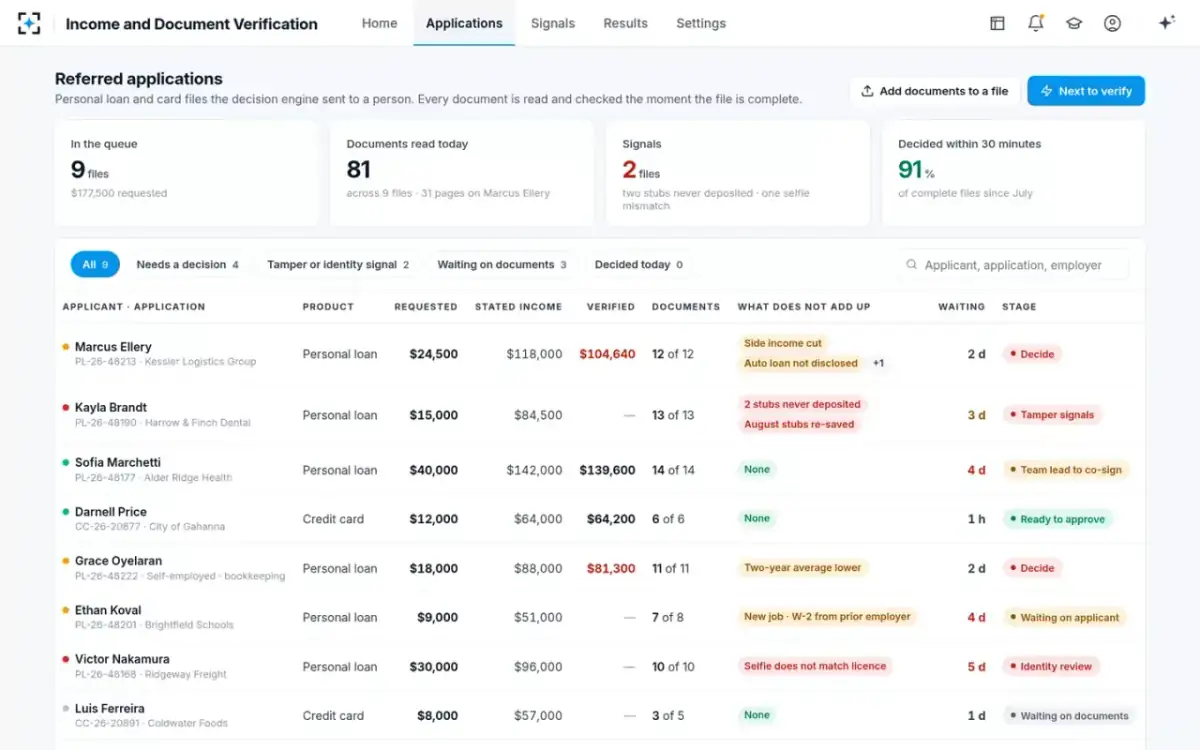
Every referred file, with what does not add up
Questions people ask
Can bank statement verification find undisclosed debts?
Yes, and it is usually the strongest reason to buy it. A loan taken out in the last few weeks has payments in the statements and no entry in the credit file, because furnishing runs on a monthly cycle. In the solution’s sample file a $486.00 monthly car finance payment appears on 25 August and 25 September, preceded by a $3,000 payment to a dealer and an auto credit inquiry in late July, and is on neither the application nor the credit file. Added to the monthly obligations, it takes debt to income to 35.2% at verified income.
How do you know if a bank statement is real?
Mostly by arithmetic, not by eye. The closing balance of each page must be the opening balance of the next, and every page’s credits less its debits must produce its closing balance — an equation a forger who edits one transaction almost always leaves broken. After that come the document-level signs: one font family, aligned columns, a layout matching the bank’s template and no re-save by an editing tool. A connection to the bank removes the question, because the data does not pass through the applicant.
What is a missing page on a bank statement, and does it matter?
Statements are numbered “page n of m”, so a missing page is an absence you can name — for example page 2 of 4 of an August statement, covering 16 to 22 August. Whether it matters depends on what falls inside it. If a pay date is in the gap, the deposit match for that date is unknown rather than absent. If a recurring payment is in the gap, an obligation may be hidden. Either way it should be requested, and the gap should be reported as a gap rather than as a pass.
How much does bank statement verification software cost?
Pricing is usually per file or per statement, and the number only means something next to the hour it replaces. The honest business case is the analyst time on a referred file — reading 180 lines properly is twenty minutes, and the six checks together are more than an hour — plus the decisions that change when an undeclared debt is found. Build the case on those two, not on an estimate of fraud prevented, which nobody can measure on their own book.
Bank statements or open banking data: which should a lender ask for?
Ask for the connection and accept the PDFs. A data connection comes from the institution, so there is no document to forge, no page to go missing and no balance to carry — but coverage is not universal, and 4.2% of US households had no bank or credit union account at all in 2023. A process that only works with a connection will turn away applicants it should be serving.
How far back do lenders check bank statements?
Two to three months for most consumer lending, and three is better: a recurring payment needs three occurrences before the pattern is reliable, and three months of a semi-monthly calendar gives six pay dates to match rather than four. Going back further adds lines to classify without adding much information, because a payment that stopped months ago is not a current obligation.