A loan stipulation — a stip, in underwriting — is a condition attached to a credit decision that must be satisfied before the loan funds. Most of them are documents: a missing statement page, a second pay stub, a letter explaining a deposit, proof that an old account was closed. The meaning is simple enough; what is routinely missed is that the sentence asking for one is not administration. Regulation B shapes what it must say, two separate clocks run from the moment it is sent, and its wording decides whether the applicant answers at all. In Botminds’ Income and Document Verification the request is drafted from the gap that caused it — naming the document, the dates and the reason — and goes out only when the analyst sends it.
The worked request below comes from the fictional sample files the solution ships with; the applicant and the bank in it are invented. The rules come from the regulation and the Official Interpretations that sit under it, linked where they are quoted.
What does a loan stipulation mean?
It means a condition. The decision has been made subject to something arriving — usually a document, sometimes an action such as paying off a balance or signing a correction. Until the condition clears, the approval is not a funded loan, and the file sits in a state that is neither approved nor declined.
Three terms get used interchangeably and should not be. A stipulation is the condition itself. A conditional approval is the decision that carries one or more of them. And a notice of incompleteness is a specific regulatory communication that a lender may send when an application cannot be assessed at all — a different object with its own rules, covered further down. A file can have a stip without anybody ever sending a notice of incompleteness, and a file can get a notice of incompleteness without ever having been approved.
The practical distinction is whether you have enough to decide. If you do, decide, and attach the condition. If you do not, you are in the incomplete-application part of the regulation, and the clock and the wording are different.
Conditional approval, and where a stip sits inside it
A conditional approval is a real decision with real consequences for the applicant, who will start planning around it. That makes the precision of the conditions attached to it a service question as well as a compliance one. “Subject to verification of income” is not a condition anybody can satisfy; “page 2 of your August statement from Crestway Community Bank” is.
It also matters that a condition is genuinely a condition. A file carrying six stips, four of which nobody will actually chase, teaches an operations team that stips are optional and teaches the applicant that the lender does not know what it wants. The OCC’s examiners treat documentation exceptions as one of the three categories of policy exception a retail lender must track, alongside credit policy and credit scoring overrides, and expect that “exception types and volumes should be controlled, with appropriate reporting to identify and track exceptions and appropriate analysis to determine causes, impact, and any need for corrective action” (OCC, Retail Lending, version 2.0). A stip that is waived without a record is a documentation exception that nobody counted.
The decision, and the request that goes with it
The three things Regulation B makes the notice say
When a lender cannot act on an application because something the applicant can supply is missing, it has a choice: act anyway, or send a notice of incompleteness. If it sends one, the regulation specifies the contents exactly. The creditor “shall send a written notice to the applicant specifying the information needed, designating a reasonable period of time for the applicant to provide the information, and informing the applicant that failure to provide the information requested will result in no further consideration being given to the application” (12 CFR 1002.9(c)(2)).
The regulation’s three requirements, against the sample request line by line
| What the regulation requires | What that means in a sentence | The sample request |
|---|---|---|
| Specify the information needed | Name the document precisely enough that the applicant can find it without asking you back | “All four pages of your August statement from Crestway Community Bank … page 2, which covers 16 to 22 August” |
| Designate a reasonable period of time | A date, chosen by the lender, that an ordinary person could meet | Due Thursday 22 October — the lender’s standard 10 days, set as a policy |
| Inform the applicant of the consequence | Say in plain words that nothing further happens if they do not answer | The notice that follows a non-answer says so; the request itself should say it too |
There is a fourth element the regulation does not require and every answered request contains: the reason. Nothing in Regulation B obliges you to explain why you want page 2. But a request that explains itself is answered far more often than one that does not, because the applicant can see that the lender has read their file rather than generated a form.
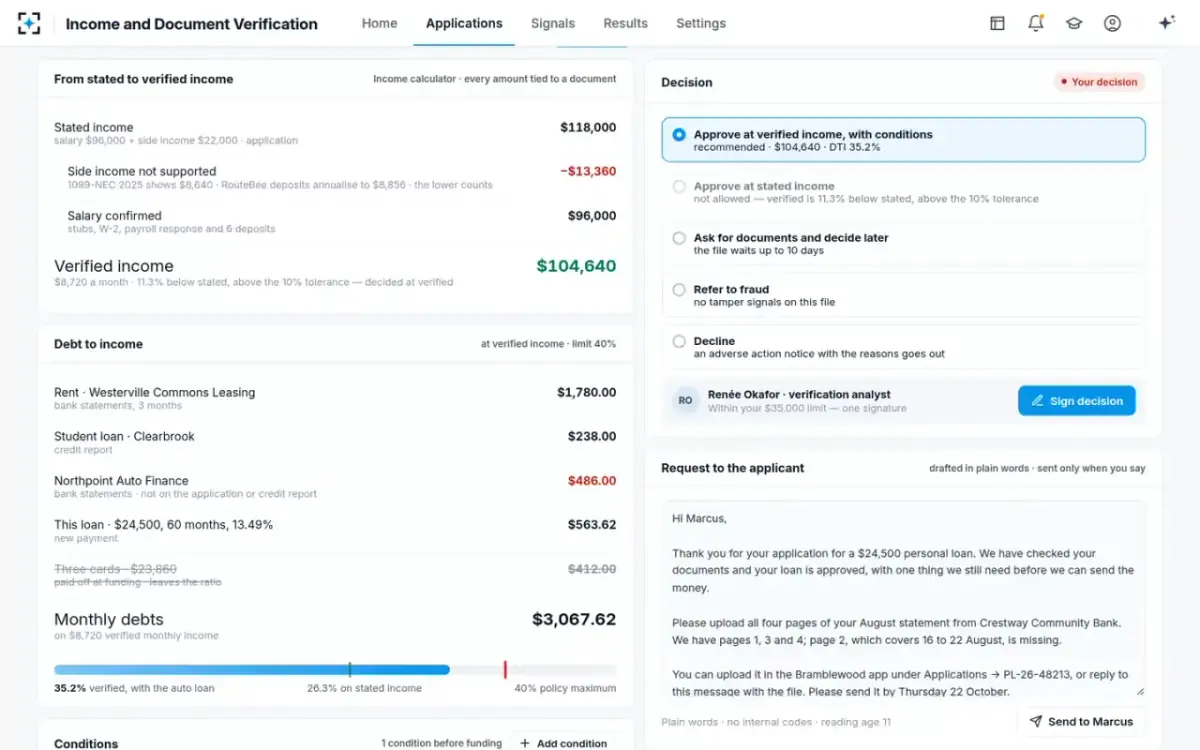
“Please upload all four pages of your August statement from Crestway Community Bank. We have pages 1, 3 and 4; page 2, which covers 16 to 22 August, is missing.”
The request drafted on one sample file, in Income and Document Verification
Read it against the three requirements. It names the document, the institution, the month and the exact missing page with the dates that page covers. It tells the applicant what the lender already holds, which saves them sending the whole file again. It contains no internal codes, no abbreviations and no reference number the applicant has never seen. And it is one sentence long, because the gap it came from was one gap.
How many days does a lender have to decide?
Thirty, counted from completeness rather than from receipt. A creditor must notify an applicant of action taken within “30 days after receiving a completed application concerning the creditor’s approval of, counteroffer to, or adverse action on the application” (12 CFR 1002.9(a)(1)(i)). The Official Interpretations define the starting line: “once a creditor has obtained all the information it normally considers in making a credit decision, the application is complete and the creditor has 30 days in which to notify the applicant of the credit decision” (Official Interpretations to 12 CFR 1002.9(a)(1)).
Two more thirty-day clocks run alongside it and are easy to confuse. A creditor that takes adverse action on an incomplete application must notify within 30 days of doing so, “unless notice is provided in accordance with paragraph (c)”. And the choice itself has a 30-day limit: within 30 days of receiving an application that is incomplete regarding matters the applicant can complete, the creditor must notify the applicant either of action taken or of the incompleteness (12 CFR 1002.9(a)(1)(ii) and (c)(1)).
So the practical reading is that an incomplete file cannot simply sit. Within thirty days of its arrival somebody has to either decide it on what is there or formally tell the applicant what is missing. A file quietly ageing in a queue while nobody chases the document is the common failure, and it is a failure against the regulation as well as against the applicant.
The reasonable period the lender designates inside it
This is where a widespread confusion lives, and it is worth stating plainly because it appears in the sample solution’s own description of itself. Regulation B does not set a ten-day, seven-day or fourteen-day deadline for an applicant to answer a document request. It requires the lender to designate “a reasonable period of time”, and leaves the length to the lender. The thirty days in §1002.9 are the lender’s clock for notifying; the shorter period is the lender’s own policy choice, which it designates inside that framework.
Getting the relationship right matters in both directions. A lender that tells an applicant “the regulation gives you 10 days” has misdescribed its own policy as law. A lender that sets no period at all has failed a requirement the regulation does make. And the length has consequences: if information arrives after the designated period, “the creditor may require the applicant to make a new application” (Official Interpretations to 12 CFR 1002.9(c)(2)) — a severe outcome to hang on a deadline chosen without thought.
- Application received; file assembled
- Gap found, request sent the same day
- The designated period: 10 days
- Page arrives on day 6; balances re-checked; decision
- Application received; file assembled
- Gap found, request sent
- The designated period: 10 days, unanswered
- Notice of incompleteness; the file stops
Naming the document, the dates and the reason
A request that comes back is specific in four dimensions, and a request that does not is usually vague in at least one of them. The four are worth checking mechanically before anything is sent.
What a request that gets answered actually names
- The document, as the applicant’s own provider calls it
“Your August statement from Crestway Community Bank”, not “bank statement, most recent”. The applicant has to find it in an app that uses the bank’s words, not yours.
- Exactly which part is missing, and what you already hold
“We have pages 1, 3 and 4; page 2 is missing.” This halves the work and prevents the applicant re-sending the whole file.
- The dates it covers
“16 to 22 August.” Statement periods do not align with calendar months, and the applicant cannot tell which download you mean without them.
- Why you need it, and the date you need it by
A reason converts a demand into a request. A date converts a request into something that can be planned around.
Two things should never be in it. Internal reference codes, queue names and condition numbers mean nothing to an applicant and make a reasonable request look like a system error. And speculation about what the document will show — “to confirm the undisclosed obligation” — turns a routine ask into an accusation before anybody has read anything.
Asking once, and asking fully
The most expensive pattern in document chasing is the second request. Each round costs the applicant a day or two of attention and costs the lender a fortnight of calendar time, and the probability of an answer falls with every round. The discipline is to finish reading the whole file before asking for anything, so that one message covers every gap.
Two requests for the same missing page
The request that stalls: “Please provide your bank statements.”
The request that comes back: “All four pages of your August statement from Crestway Community Bank.”
The request that stalls: Nothing — the applicant assumes you have none.
The request that comes back: “We have pages 1, 3 and 4; page 2 is missing.”
The request that stalls: Unstated, so the applicant guesses the month.
The request that comes back: “Page 2 … covers 16 to 22 August.”
The request that stalls: Absent, or an internal condition code.
The request that comes back: Plain: the statement must be complete for the balances to carry.
The request that stalls: “As soon as possible.”
The request that comes back: A named date, with what happens if it passes.
The request that stalls: A partial answer, then a second request a week later.
The request that comes back: The right file, once.
The request that stalls: A template, chosen from a list of conditions.
The request that comes back: The gap itself, drafted into words and reviewed by the analyst.
The counterpart discipline is not to ask for what you do not need. Every condition on a file is a chance for the applicant to go elsewhere, and a request for a document that would not change the decision is a self-inflicted delay. The test is simple: write down, before asking, what each possible answer would do to the decision. If no answer changes it, the condition is not a condition.
The notice of incompleteness, and what happens when nobody answers
If the designated period passes with no answer, the regulation is clear about where the lender stands: “the creditor shall have no further obligation under this section if the applicant fails to respond within the designated time period” (12 CFR 1002.9(c)(2)). The file stops, and no adverse action notice is owed for the non-response itself.
The alternative route is to decide the file as it stands, and the Official Interpretations draw a sharp line through the middle of it. Where an application “is incomplete regarding information that the applicant can provide and the creditor lacks sufficient data for a credit decision, the creditor may deny the application giving as the reason for denial that the application is incomplete”. But where the application “is missing information but provides sufficient data for a credit decision”, the creditor may decide it — and if credit is denied, “missing information or ‘incomplete application’ cannot be given as the reason for the denial” (Official Interpretations to 12 CFR 1002.9(a)(1)).
That is the trap. A lender that has enough to decline on the merits, and declines citing incompleteness because it is the easier sentence to write, has given a reason that is not the principal reason — against a rule that requires the statement of reasons to “be specific and indicate the principal reason(s) for the adverse action” (12 CFR 1002.9(b)(2)). Deciding which of the two situations a file is in is a judgement, and it should be recorded as one.
Two smaller provisions are worth knowing. A lender may ask orally, but “if an applicant fails to provide the information in response to an oral request, a creditor must send a written notice to the applicant within the 30-day period” (Official Interpretations to 12 CFR 1002.9(c)(3)) — so a phone call does not replace the notice, it only postpones it. And the incompleteness notice is not required for preapprovals that constitute applications under §1002.2(f).
Clearing the condition when the page arrives
When the document arrives, the obligation turns back on: if the applicant supplies the requested information within the designated period, “the creditor shall take action on the application and notify the applicant in accordance with paragraph (a)” (12 CFR 1002.9(c)(2)). The thirty-day decision clock is live again.
Clearing well means checking the arrival rather than filing it. A statement page that arrives has to be the right page, for the right period, from the right account, and its balances have to carry from the page before it to the page after it — which is the whole reason the gap was raised. On the sample file the arriving page is checked exactly that way before the condition clears, and the funding follows. The method behind the carried-balance check is in bank statement verification software.
A second kind of arrival deserves more care: the document that answers the question in a way nobody expected. A statement page sent to fill a gap can show a recurring payment to a finance company that the application never mentioned, which is not a reason to refuse the page but is a new fact in the file. What to do with one is set out in how to find debts a credit report does not show.
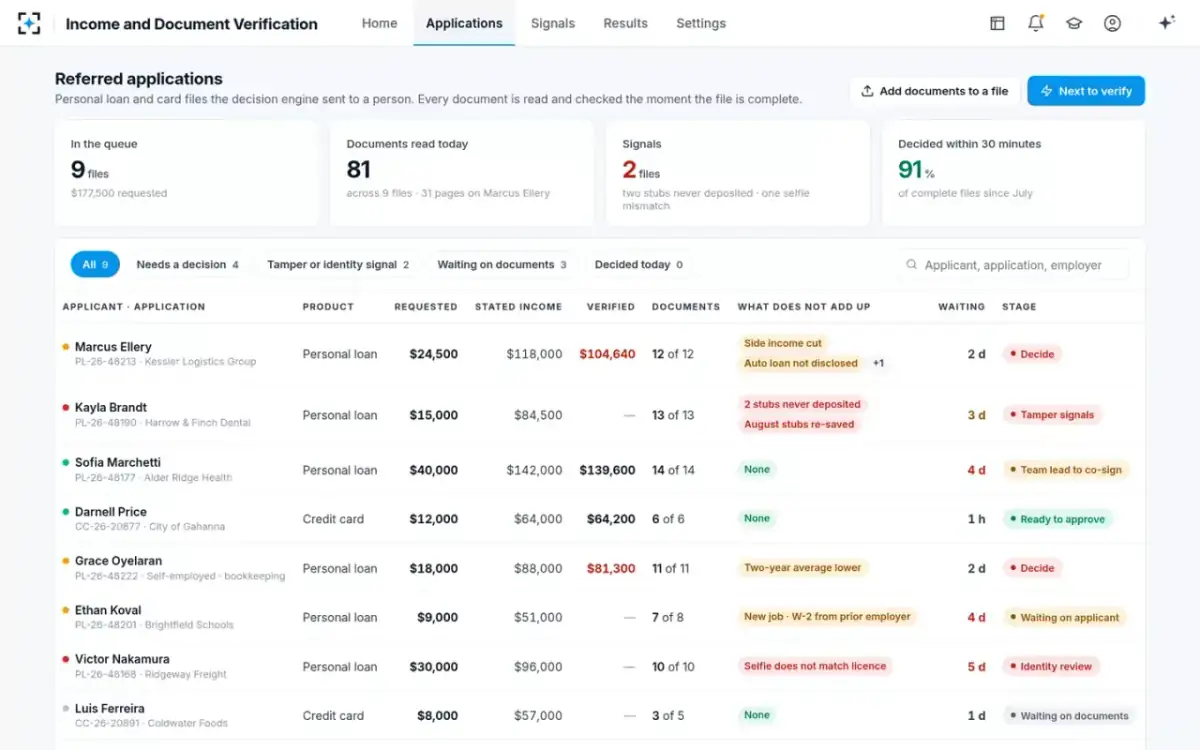
Every open file, with what it is waiting for and how long it has waited
Documents that go stale while you wait
The slowest version of a stip failure is the file that does eventually answer, by which time the rest of its evidence has aged out. Mortgage rulebooks set the sharpest published version of the limit, and consumer lenders generally borrow the idea: when “consecutive credit documents are in the loan file, the most recent document is used to determine whether it meets the age requirement”, and “if the credit documents are older than allowed, the lender must update them” (Fannie Mae Selling Guide B1-1-03).
That has an unpleasant arithmetic. A file that waits a fortnight for one page, then a week for a clarification, then another fortnight while the applicant travels, can need a fresh pay stub by the time it is ready to decide — which is a new request, a new designated period, and a new chance for the applicant to take a faster offer somewhere else. The chasing is not the cost; the compounding is.
Three habits contain it. Ask once and fully, so there is one wait rather than three. Measure waiting time on the queue rather than on individual files, so a stalled file is visible as a stalled file. And set the designated period deliberately: long enough that an ordinary person can meet it, short enough that the file’s other documents are still good when the answer arrives. On the sample lender that setting is 10 days, with 7 and 14 as the alternatives, and it is owned by the credit policy manager rather than by whoever is chasing the file.
Questions people ask
What are stips in underwriting?
Stips are stipulations: conditions attached to a credit decision that must be satisfied before the loan funds. Most are documents — a missing statement page, a second pay stub, a letter explaining a large deposit — and some are actions, such as closing an account or paying down a balance. A conditional approval is the decision that carries them; the stip is the individual condition, and the file is not funded until every one has cleared.
How long do you have to satisfy a loan stipulation?
Whatever period the lender designates, not a period set by regulation. Regulation B requires a lender sending a notice of incompleteness to designate “a reasonable period of time” and leaves the length to the lender; 7, 10 and 14 days are common settings. If the information arrives after the designated period, the Official Interpretations allow the creditor to require a new application — so the date on the request is worth reading carefully.
What is a notice of incompleteness?
A written notice under 12 CFR 1002.9(c)(2) that specifies the information needed, designates a reasonable period of time to provide it, and informs the applicant that failing to provide it will result in no further consideration being given to the application. It is one of two routes open to a lender holding an incomplete file; the other is to decide the application on what is already there.
What happens if you do not respond to a lender’s request for documents?
If the lender sent a proper notice of incompleteness and the designated period passes, it “shall have no further obligation under this section” — the application stops, and no adverse action notice is owed for the silence. Information sent later may be treated as requiring a new application. If instead the lender had enough to decide, it may decide and must give a specific principal reason, which cannot be “incomplete application” when the file in fact held enough.
Can a lender deny a loan for missing documents?
Yes, where the missing information is something the applicant can provide and the lender genuinely lacks sufficient data to decide: the Official Interpretations allow denial “giving as the reason for denial that the application is incomplete”. What is not allowed is using incompleteness as the stated reason when the file did contain enough to decide — in that case the real principal reason must be disclosed, because a statement of reasons must be specific.
How should a lender word a document request?
Name the document as the applicant’s own provider names it, say exactly which part is missing and what you already hold, give the dates it covers, say why you need it, and give the date you need it by along with what happens if it passes. Leave out internal codes and any speculation about what the document will show. One request covering every gap beats three requests covering one each, because each round costs a fortnight of calendar time and some share of the applicants.