Self-employed income verification is the work of establishing two separate things: that the money arrived, and that it is likely to keep arriving. A salary needs only the first, because an employer stands behind it. Self-employed income has no such guarantor, so a lender proves it from two directions at once — the tax record that says what was earned last year, and the bank account that says what is being earned now — and counts the figure that both support. Botminds’ Income and Document Verification does that comparison on every referred file where the applicant states side, freelance, gig or business income, and shows the two figures side by side rather than merging them into one.
The worked example is Marcus Ellery, a fictional sample applicant the solution ships with, who stated $22,000 of freelance delivery income on top of a $96,000 salary. The people and companies in his file are invented; the rules and research figures come from the agencies that publish them, linked beneath each figure.
Why this income is treated differently, in the lender’s own evidence
58%
of self-employed adults said their income varied from month to month
28%
of those working for someone else said the same
22%
of the self-employed struggled to pay bills because their income varied — against 10% of employees
What counts as self-employed income, and what does not
In a consumer file the category is wider than the phrase suggests. It covers the sole trader with a registered business, the freelancer invoicing a handful of clients, the delivery and rideshare driver paid by a platform, the person who sells online, the landlord with a second property, and the salaried employee who does any of these at the weekend. What they share is that the money is paid without withholding and without an employer who will confirm it.
That last point is what matters operationally. A salary can be settled with one phone call or one payroll response. For this income there is nobody to call, so every record has to be assembled from things the applicant already has: tax forms, bank credits, invoices, platform statements. Secondary work is not rare. In September 2026, 5.5% of employed people in the United States held more than one job, up from 5.4% a year earlier, with the rate at 6.4% among employed women and 4.7% among employed men (BLS, Employment Situation, table A-16). A verification process that handles only one employer per applicant misses the second job that roughly one employed person in eighteen holds.
Two things are routinely miscategorised. A pension, an annuity and most benefit income are not self-employed income and must not be treated as if they were — they are among the most predictable money in any file. And a one-off payment, however large, is not income at all: a sold car, a gift, a tax refund or a transfer between the applicant’s own accounts is a credit in the bank that belongs nowhere near an annual figure.
What documents prove self-employed income?
Four records do most of the work, and each settles a different question. The mistake that creates bad files is asking for all four and then reading them as four votes on the same question; they are not interchangeable.
The four records, and the one question each of them answers
| Record | Where it comes from | What it settles | What it cannot settle |
|---|---|---|---|
| Form 1099-NEC or 1099-K | The payer, with a copy to the IRS | What one payer reported paying in one completed tax year | Anything about this year, or about payers who issued no form |
| Tax return, with schedules | The applicant | Income after the applicant’s own expenses, as declared | Nothing independently — it is the applicant’s own document until a transcript confirms it |
| IRS transcript | The IRS, with the applicant’s consent | That the return filed matches the return shown, and what information returns the IRS received | The current year, before the filing season has run |
| Bank statements, 60–90 days | The applicant’s bank | What is being received now, by payer, date and amount | Whether it will continue, and what expenses sit behind it |
The transcript deserves a note because it is the least used and the most misunderstood of the four. The wage and income transcript “shows data from information returns we receive such as Forms W-2, 1098, 1099, and 5498”, is available for the current and nine prior tax years, and information for the current processing year “will generally be available in the first week in February” (IRS, Transcript types). In other words, the IRS can confirm the 1099 itself — not just the return that reports it — which settles the most common doubt about this income without involving the payer. Its limits are consent and the calendar: the applicant must authorise the request, and in October a transcript tells you about last year.
How do lenders verify 1099 income?
By treating the form as a historical fact and the bank as a current one, and then reconciling them. A 1099-NEC is a report by one payer of what it paid one person in one completed calendar year. It is useful precisely because the payer, not the applicant, produced it, and because a copy went to the IRS — which is what a wage and income transcript will show.
It is also narrow in four ways worth stating to any applicant who is surprised by the result. It covers one payer, so an applicant with four clients may hold four forms or none. It covers a completed year, so in October it describes a period that ended nine months ago. It reports gross payments, before the expenses that the applicant’s tax return deducts. And it is not universal: a payer below the reporting threshold, a foreign payer or a cash customer issues nothing, and the absence of a form is not evidence that the income is absent.
So the question “can a 1099 be used as proof of income” has a precise answer. It is proof that a named payer paid a named amount in a named year. It is not proof of what the applicant earns now, and a policy that counts the 1099 alone will overstate a shrinking income and understate a growing one with equal confidence.
What probable continuance of income means
It is the standard a lender is actually applying, and it comes from Regulation B. A creditor “may consider the amount and probable continuance of any income in evaluating an applicant’s creditworthiness” (12 CFR 1002.6(b)(5)). Amount and probable continuance — two tests, and only the first is a document question.
The mortgage rulebooks put the same idea in operational language. “A stable and predictable flow of income is a foundational element in loan underwriting,” and the borrower must be qualified with income “the lender can reasonably expect to continue for the foreseeable future”; where income has a defined expiry or depends on depleting an asset, the lender must establish that it will last at least three years from the application date (Fannie Mae Selling Guide B3-3.1-01). Consumer lenders are not bound by that guide, but it is the clearest published articulation of the test, and most consumer credit policies are a simplification of it.
Continuance is why recurrence beats documentation. Twelve monthly credits of roughly similar size from the same payer is evidence about the future. A single large 1099 from a contract that ended in March is evidence about the past, and the file should say which one it is relying on.
The lower-of rule, worked on one file
The commonest policy for this income is to count the lower of two independent estimates: what last year’s tax forms say, and what this year’s deposits say when annualised. It is not sophisticated and that is its virtue — it is reproducible, it is explainable to an applicant, and it fails safe.
One sample applicant’s side income, by each measure
| Measure | Figure | Period it describes | Independence |
|---|---|---|---|
| What he stated on the application | $22,000 | Unspecified — a year, in round numbers | None: the applicant’s own assertion |
| 2025 Form 1099-NEC from RouteBee | $8,640.00 | Calendar 2025, complete | The payer, with a copy to the IRS |
| RouteBee credits, July to September | $2,214.00 | 3 months, observed | His bank |
| The same credits, annualised ×4 | $8,856 | A projection from 3 months | Arithmetic on his bank |
| Counted under the lower-of rule | $8,640 | The 1099, because it is the lower figure | The payer |
Two details in that table do more work than the headline. The first is that $8,856 is one quarter multiplied by four, not a year observed; it is stated that way in the file and should be stated that way to the applicant, because a projection dressed as a measurement is how annualising goes wrong. The second is that $22,000 is a round number: a figure the applicant estimated rather than read off a document, which is exactly what verification exists to test.
The gap matters beyond this one figure. Verified income of $104,640 is 11.3% below the $118,000 stated, and this lender’s policy sets a stated-versus-verified tolerance of 10% — so the file cannot be approved at stated income, and the analyst must decide on the verified figure or not at all. The tolerance is a setting, not a law, and it is the single most consequential number in a verification policy.
How to annualise income from bank deposits honestly
Annualising is where a careful file and a flattering one part company, because every shortcut in it pushes the number the same way. Five steps keep it defensible.
Annualising deposits, step by step
- Take only credits you can attribute to the payer
Match on the payer’s name as it appears in the account, not on amount or timing. An unattributed credit is not income until someone says what it is.
- Remove what is not income
Transfers between the applicant’s own accounts, refunds, reimbursements, loan drawdowns and one-off receipts all look like credits and none of them is earnings.
- Use whole periods, and say how many
Three complete months annualise by four. A period that starts mid-month or ends mid-month does not, and the file should record the exact window it used.
- Do not annualise a season
Delivery, retail, construction and tax-preparation income are not flat across a year. Three good months times four is an overstatement, and three quiet months times four is the opposite.
- Compare the projection with last year before counting it
The annualised figure is a hypothesis. The 1099 or the return is the control. When they disagree by more than a little, that is the finding, not a rounding problem.
The seasonality point deserves its own sentence because it is the most common honest error in this work. A courier’s November and December are not a model for their February. Where a policy allows only three months of statements, the right response is not to pretend the projection is a year — it is to count the lower of the projection and the completed tax year, which is exactly what the lower-of rule does.
One year of self-employment history, or two?
Two is the conventional answer, with a documented exception. The mortgage rulebook is explicit that it “generally requires lenders to obtain a two-year history of the borrower’s prior earnings as a means of demonstrating the likelihood that the income will continue to be received”, and allows a one-year history where “the borrower’s most recent signed personal and business federal income tax returns reflect a full year (12 months) of self-employment income from the current business” and the file documents prior earnings at the same or greater level in a similar field (Fannie Mae Selling Guide B3-3.2-01).
The logic transfers to consumer credit even where the rule does not. Two years is not a magic number; it is the shortest span over which a second observation can confirm the first. What the exception shows is that the requirement is really about continuance rather than duration — a year of full-time self-employment preceded by five years of employed work in the same trade is a better continuance case than two years of an unrelated new venture.
Side income sitting on top of a salary is the gentlest version of the problem, because the salary carries the loan and the side income only moves the ratio. That is why the sample lender counts side income on a lower-of rule with no minimum history at all, while requiring two years of history before it counts overtime or a bonus. Those are policy choices, and they are set where every other verification rule is set.
The income-counting rules, written once and applied to every file
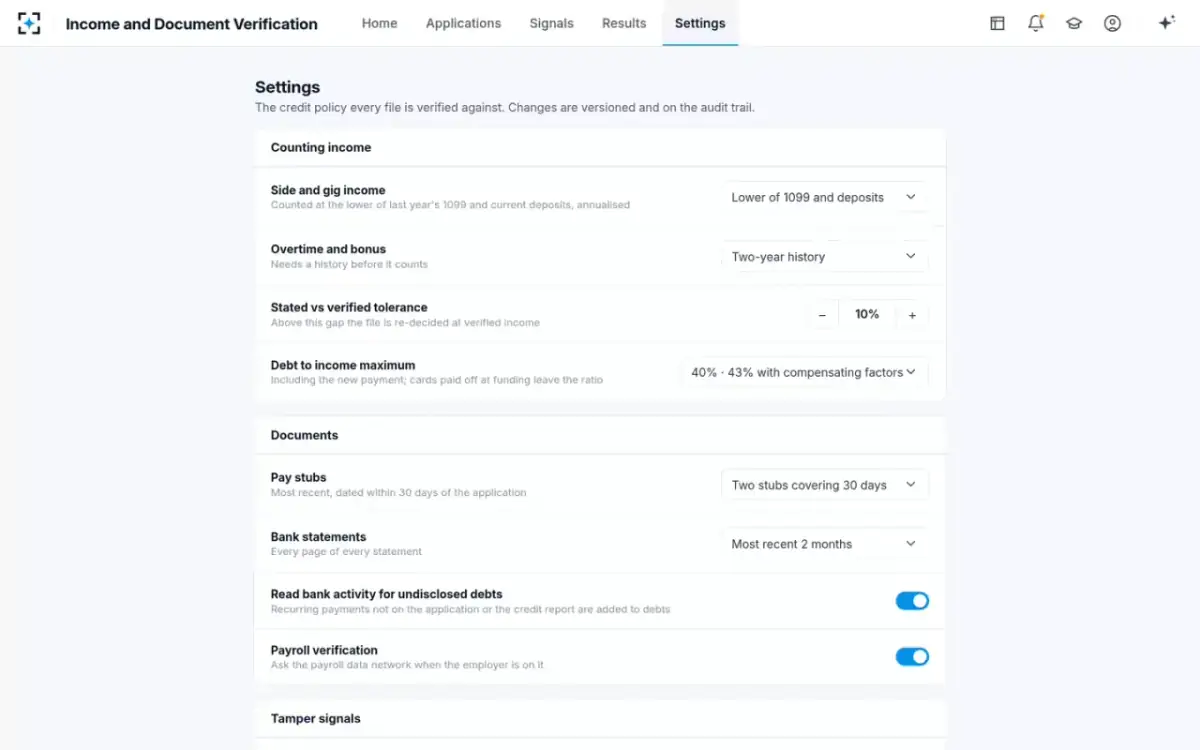
The three ways a credit policy can count side and gig income
Lower of the 1099 and the annualised deposits: The smaller of a completed year and a current run rate.
The 1099 alone, over two years: Two completed years, averaged or taken at the lower.
Lower of the 1099 and the annualised deposits: Current: the deposit side is this quarter.
The 1099 alone, over two years: Stale by up to 22 months in the worst case.
Lower of the 1099 and the annualised deposits: Conservative — the 1099 usually caps it.
The 1099 alone, over two years: Very conservative; a growing business qualifies on its smallest year.
Lower of the 1099 and the annualised deposits: Catches the fall, because deposits catch it first.
The 1099 alone, over two years: Misses the fall entirely until a new form is issued.
Lower of the 1099 and the annualised deposits: Nobody with a bank account and one tax form.
The 1099 alone, over two years: Anyone under two years of trading, and anyone whose payers issue no form.
Lower of the 1099 and the annualised deposits: Classification of 60–90 days of credits, per file.
The 1099 alone, over two years: Almost nothing — two documents and an average.
Why gig income is treated as less certain
Not because of a prejudice about the work, but because of what the evidence behind it supports. The OCC tells banks that policies “should specify how to treat income other than normal salary, including income from self-employment or ‘gig’ work, investments, commissions, and bonuses, to promote consistent calculations”, and adds the part that explains the discount: “consideration can vary, but banks that place less emphasis on demonstrated recurring cash flow patterns tend to need stronger offsetting risk management practices” (OCC, Retail Lending, version 2.0).
Read that sentence backwards and it is permission rather than a restriction. A bank that does demonstrate recurring cash flow — which is to say, a bank that reads the deposits — needs less compensating conservatism elsewhere. The discount is a substitute for evidence. Where the evidence exists, the substitute is not needed, and a policy that applies a flat haircut to gig income after reading ninety days of its arrival is charging the applicant twice for the same uncertainty.
The OCC’s point about consistency is the other half. Whatever the rule is, it has to be the same rule at nine in the morning and five in the afternoon, and the same rule for two applicants whose files look alike. That consistency is far easier to achieve when the rule is a setting applied by the same process to every file than when it is a convention each analyst carries in their head.
What a lender may not do to this income
Regulation B draws a hard line, and it is drawn around the source of the income rather than its reliability. A creditor “shall not discount or exclude from consideration the income of an applicant or the spouse of an applicant because of a prohibited basis or because the income is derived from part-time employment or is an annuity, pension, or other retirement benefit” (12 CFR 1002.6(b)(5)).
The Official Interpretations are more specific than the rule, and they are the text worth putting in front of whoever writes the policy. A creditor “may score or take into account the fact that an applicant has more than one source of earned income — a full-time and a part-time job or two part-time jobs”, and “may also score or treat earned income from a secondary source differently than earned income from a primary source”. But it “may not, however, score or otherwise take into account the number of sources for income such as retirement income, social security, supplemental security income, and alimony”, nor “treat negatively the fact that an applicant’s only earned income is derived from, for example, a part-time job”. And on income the rule protects: “any discounting or exclusion must be based on the applicant’s actual circumstances” (Official Interpretations to 12 CFR 1002.6(b)(5)).
Where a $22,000 stated side income ends up
Stated on the application
- Supported by the 1099 — $8,640 · 39%
- Not supported by any record — $13,360 · 61%
Total income, stated $118,000
- Salary, verified five ways — $96,000 · 81%
- Side income counted — $8,640 · 7%
- Removed — $13,360 · 12%
Three rules follow for anyone writing this part of a credit policy. Discount for evidence, never for category: “this income is annualised from three months” is a reason, “this is gig income” is not. Apply the same rule to the same facts, and write it down so that sameness can be checked. And make the reason specific enough to put in a decision notice — which is a legal requirement the moment the decision goes against the applicant.
When the 1099 and the deposits disagree
Disagreement is normal and informative, and the useful first move is to work out which of five ordinary explanations fits before treating it as a discrepancy at all.
Five ordinary reasons the tax form and the bank do not match
- The year moved
Payments earned in December are often banked in January. A 1099 is a calendar year; a bank statement is whatever window you asked for.
- A payer is missing from one side
A client below the reporting threshold issues no form but still pays into the account, so deposits exceed the forms you hold.
- The money went somewhere else
Platform earnings paid to a second account, a business account, or a payment app never touch the statements you were sent.
- Fees came out first
Some platforms report gross and remit net. The 1099 is larger than the deposits by exactly the commission, and neither number is wrong.
- The work genuinely changed
A contract ended, a new one started, hours moved. This is the one that is not a reconciliation problem — it is a continuance finding.
When the disagreement survives all five, ask — and ask for the specific thing that would resolve it, which is usually the statements of the account the money actually went into. A well-drafted request names the document, the dates and the reason; what the regulation requires of it, and the clock it runs against, is in loan stipulations. And when a tax form or a stub itself looks wrong rather than merely inconsistent, the arithmetic that tests it is in how to identify fake pay stubs.
The gap, numbered, with both records behind it
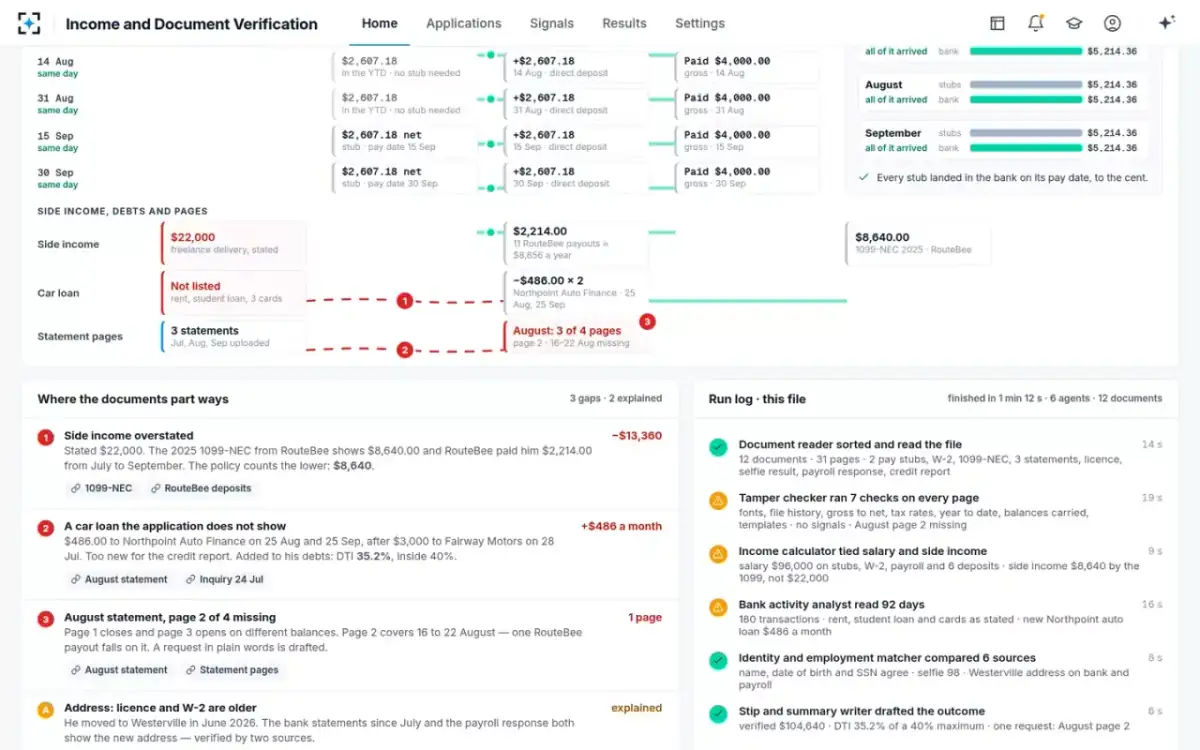
Questions people ask
How do you verify self employed income?
With two independent records at once: a completed tax year from a 1099 or a return, ideally confirmed by an IRS transcript, and 60 to 90 days of bank credits classified by payer. The tax record is independent but historical; the deposits are current but unaudited. Most policies count the lower of the two, which on the sample file in Income and Document Verification meant counting $8,640 from a 1099 rather than $8,856 annualised from one quarter of deposits.
Can a 1099 be used as proof of income?
Yes, within its limits. A 1099-NEC proves that one named payer paid one named amount in one completed calendar year, and the IRS received a copy — a wage and income transcript will show it. It does not prove what the applicant earns now, it does not cover payers who issued no form, and it reports gross payments before the expenses a tax return deducts. Used alone it will overstate a shrinking income and understate a growing one.
How many years of self employment income do lenders need?
Two is the usual requirement. Fannie Mae’s guide “generally requires lenders to obtain a two-year history of the borrower’s prior earnings as a means of demonstrating the likelihood that the income will continue”, with a one-year exception where the most recent returns show a full twelve months from the current business and the file documents earlier earnings at the same or greater level in a similar field. Consumer lenders often set a shorter requirement for side income that sits on top of a verified salary.
How do you annualise income from bank deposits?
Attribute every credit to a payer, remove transfers, refunds and one-off receipts, use whole periods and record the exact window, then multiply by the number of those periods in a year. Three complete months multiply by four. Two cautions decide whether the answer is honest: do not annualise a season, and treat the result as a projection to be compared with the last completed tax year rather than as a measurement of a year.
Can a lender refuse to count part-time or gig income?
Not for being part-time. Regulation B forbids discounting or excluding income “because the income is derived from part-time employment or is an annuity, pension, or other retirement benefit”, and the Official Interpretations add that any discounting of that protected income “must be based on the applicant’s actual circumstances” and that a creditor may not treat negatively the fact that an applicant’s only earned income comes from a part-time job. A lender may treat secondary earned income differently from primary earned income, and may decline to count income it cannot verify at all — but the reason has to be the evidence, not the category.
How do lenders treat gig income?
Usually more conservatively than salary, and the OCC explains why: banks “that place less emphasis on demonstrated recurring cash flow patterns tend to need stronger offsetting risk management practices”. The discount substitutes for evidence of recurrence. A lender that actually reads ninety days of arrivals has that evidence and needs less of the substitute, which is the argument for classifying deposits rather than applying a flat haircut to the whole category.