Lenders verify income by comparing what an applicant stated with records that did not come from the applicant’s memory: pay stubs, W-2s and tax returns, bank statements, a payroll or employment response, a tax transcript ordered from the IRS, and — for the identity behind all of it — a government ID. Regulation Z names eight such records for mortgage lending, and consumer lenders borrow the list. They are not interchangeable: each answers a different question, only two of them come from a third party that the applicant cannot edit, and the one in almost every file, the bank statement, is the one least often read line by line. Botminds’ Income and Document Verification reads all of them on a referred loan or card file, lines them up fact by fact, and ties every verified figure to the document and page it came from.
This page is written for the credit policy manager deciding what the document rules should say, and for the applicant who wants to know what a lender can and cannot see. The sample figures come from the fictional files in the solution — Marcus Ellery and his employer Kessler Logistics are invented. Rules and research are linked under each figure.
Why the records matter more than the application form
30%
of US adults had income that varied at least occasionally through 2025
5.5%
of employed people held more than one job in September 2026 — income the main employer cannot confirm
11%
of adults struggled to pay bills in the previous year because their income varied
What “verified income” means, in the words of the rule
The phrase has a definition, and it is narrower than it sounds. Regulation Z requires a creditor to “verify the amounts of income or assets that the creditor relies on … to determine a consumer’s ability to repay a covered transaction using third-party records that provide reasonably reliable evidence of the consumer’s income or assets” (12 CFR 1026.43(c)(4)). Three words carry the weight. Third-party: the record has to come from someone other than the applicant. Reasonably reliable: not certain, not notarised, reasonable. And relies on: only the income the decision actually uses has to be verified, so a lender that ignores a bonus does not have to prove it.
The rule governs mortgages. Personal loans and credit cards are covered by a different and much shorter requirement: a card issuer “must not open a credit card account for a consumer … unless the card issuer considers the consumer’s ability to make the required minimum periodic payments under the terms of the account based on the consumer’s income or assets and the consumer’s current obligations,” and its policies must consider at least one of “the ratio of debt obligations to income; the ratio of debt obligations to assets; or the income the consumer will have after paying debt obligations” (12 CFR 1026.51(a)). That rule says consider, not verify — which is precisely why consumer lenders set their own documentation rules, and why those rules vary so much between two lenders looking at the same applicant.
Where the supervisors fill the gap is on consistency. The OCC expects a bank to verify directly “current employer, primary income (amount, frequency, and type)” and “supplemental sources of income (source, amount, and likely recurrence),” and is blunt about the alternative: banks “relying on customer assertions rather than direct verifications face greater uncertainty, assume an inherently higher quantity of credit risk, and should have enhanced risk management practices to compensate” (OCC, Retail Lending, version 2.0).
What documents do lenders accept as proof of income?
Regulation Z’s list is the most authoritative enumeration a US lender has, and it is worth reading in full rather than in summary, because two of its eight entries surprise people. A creditor “may verify the consumer’s income using a tax-return transcript issued by the Internal Revenue Service,” and the examples of other records it gives are these:
The eight records Regulation Z names, and what each one settles
| The record, in the regulation’s words | The question it answers | What it cannot tell you |
|---|---|---|
| A tax-return transcript issued by the IRS | What the applicant reported to the government last year, from the government’s own file. | This year. A transcript is history, and it lags by a filing season. |
| “Copies of tax returns the consumer filed with the IRS or a State taxing authority” | The full picture of self-employment, rental and investment income, with its schedules. | Whether the copy you hold is the return that was filed. It came from the applicant. |
| “IRS Form W-2s or similar IRS forms used for reporting wages or tax withholding” | Last calendar year’s wages from one employer, as reported to the IRS. | A pay rise, a job change or a bonus since 31 December. |
| “Payroll statements, including military Leave and Earnings Statements” | Current pay, the pay frequency, the deductions, and year-to-date earnings. | Whether the pay arrived. The stub is a statement of intent. |
| “Financial institution records” | Whether the money arrived, which debts are paid each month, and what else comes in. | Income that is never deposited, and anything outside the statement period. |
| “Records from the consumer’s employer or a third party that obtained information from the employer” | Employment status, start date, salary — from the employer, not the applicant. | Most small employers, who are not in any payroll data network. |
| “Records from a Federal, State, or local government agency stating the consumer’s income from benefits or entitlements” | Benefit and entitlement income, which Regulation B forbids discounting. | Anything about employment or self-employment. |
| “Receipts from the consumer’s use of check cashing services” and “receipts from the consumer’s use of a funds transfer service” | Income for applicants outside the banking system — the rule’s acknowledgement that not everyone has an account. | A reliable total. Receipts are a sample, not a complete history. |
Read down the middle column and the structure appears. Four of the records establish a figure; three establish that a figure is real; one, the bank statement, does both and is the only one that also reveals what the applicant pays out each month. That is why a verification method built only on stubs and W-2s is weaker than it looks, and why the statements are where the time should go.
How do lenders verify income on a referred file?
Most consumer applications are never verified at all. A decision engine scores the application against a credit file and approves or declines in seconds, and the documents are only asked for when the engine refers — because the stated income is high relative to the credit profile, because the income type is awkward, or because a rule fired. So the practical question is not how lenders verify income in general; it is what happens to a referred file.
The sequence is the same almost everywhere, and the differences are in how much of it gets done under time pressure. Sort the documents and read every page. Establish current pay from the stubs. Confirm it against something outside the applicant’s hands: the payroll response if the employer is reachable, the W-2 for last year, the deposits for the last three months. Count the income types separately, because the rules for salary, overtime, bonus, commission and self-employment differ. Read the statements for debts the application and the credit file do not show. Match the identity across every document. Then compute a verified income, a monthly debt figure and a ratio, and write down what did not add up.
The two halves of the file: what the applicant hands you, and what comes from elsewhere
From the applicant’s hands: The application, pay stubs, copies of tax returns, bank statement PDFs, a photograph of a licence.
From a third party: An IRS transcript, a payroll data response, the credit file, the identity check result.
From the applicant’s hands: A stub builder costs a few dollars; a statement can be edited in a PDF tool.
From a third party: Not by the applicant. The lender orders it directly, with consent.
From the applicant’s hands: Always. The applicant wants the loan.
From a third party: Unevenly. Transcripts take days; payroll networks miss small employers.
From the applicant’s hands: Establishing the figures to test, and the month-by-month detail nothing else holds.
From a third party: Settling a disagreement, and anchoring the identity.
From the applicant’s hands: Test it against itself and against the money, and cite the page for every figure.
From a third party: Order it when the file is close to a limit, or when the left-hand column disagrees with itself.
What each record proves, and what it cannot
Three pairings do most of the work in a real file, and each has a failure mode worth naming.
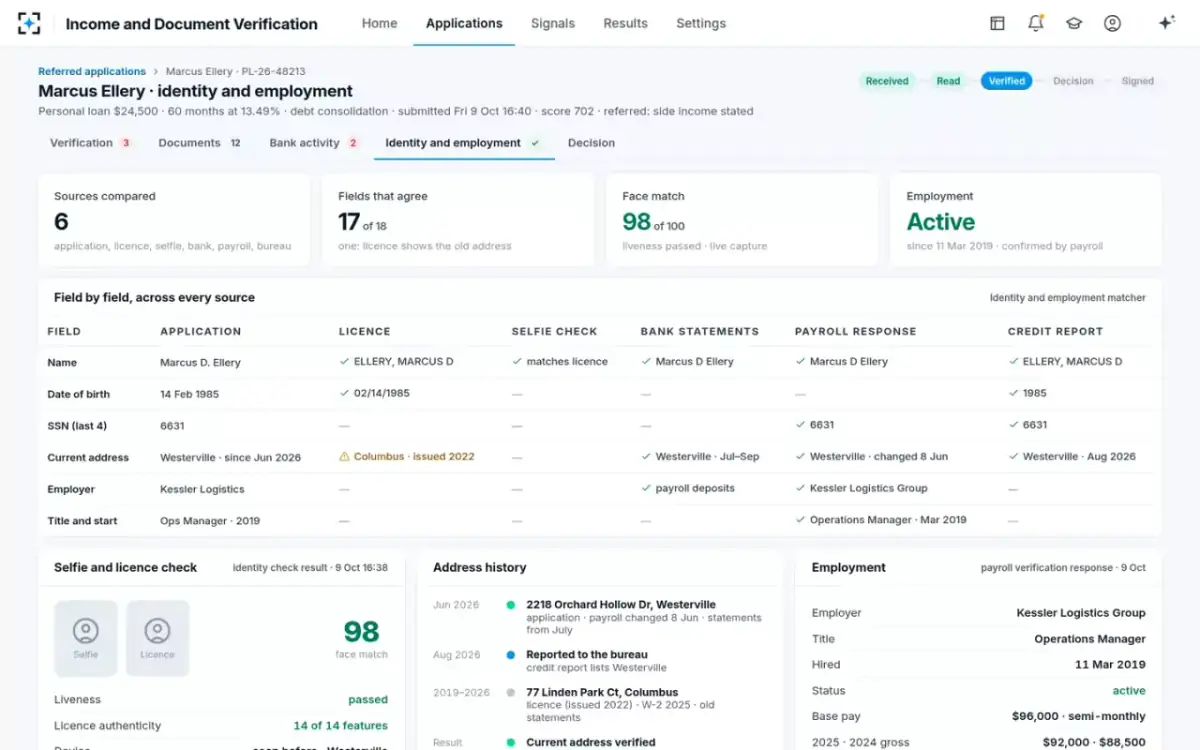
The stub and the W-2. A W-2 is last calendar year, from the employer, reported to the IRS; a stub is now, from the employer, reported to nobody. Together they show whether current pay is consistent with a full year of it. The failure mode is a mid-year change: a January pay rise makes a stub honestly exceed the W-2 by a wide margin, and a job change makes the W-2 irrelevant. In the sample file the old Columbus address on the applicant’s 2025 W-2 and his licence disagrees with his current address — explained, because he moved in June, and shown as explained rather than cleared away.
The stub and the deposit. The stub says what the net pay was; the statement says whether it arrived. This is the only pairing in which a forged document is contradicted by a document the applicant also sent, and it is worked through in pay stub verification against bank deposits. The failure mode is an applicant who is unbanked, paid into an account the lender was not sent, or paid late.
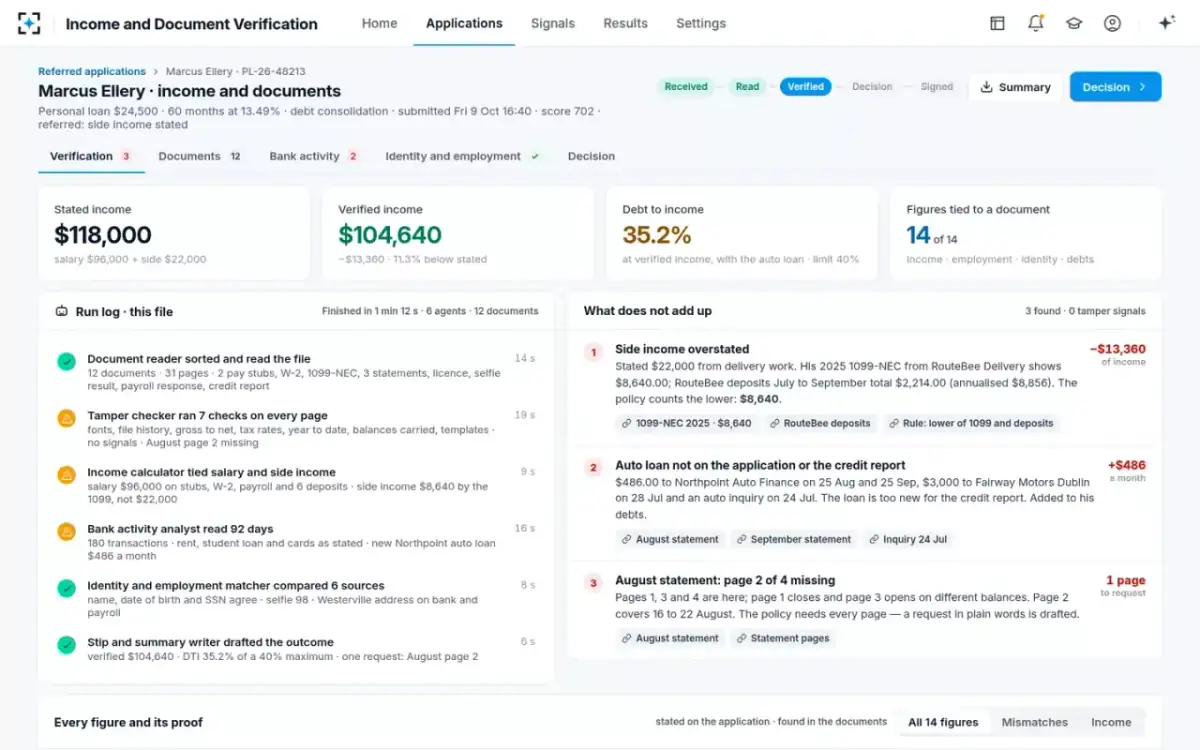
The application and the statements. The application states the debts; the statements show the payments. A recurring debit to a lender the application does not list and the credit file has not yet picked up is a debt, and it changes the ratio. In the sample file that is $486.00 a month to a car finance company, appearing on 25 August and 25 September after a deposit to a dealer in late July — too new for the credit file, and found only because somebody read the debits.
Tax transcripts: what a 4506-C is, and what consent it needs
A tax transcript is the strongest income record a US lender can obtain, because it comes from the IRS rather than from the applicant. The mechanism is the Income Verification Express Service: “the IRS Income Verification Express Service (IVES) lets you authorize banks and lenders to access your tax records when you apply for a mortgage, loan, or other service,” and the request is made on Form 4506-C by a lender enrolled in the programme (IRS). The limit is consent: “the IRS only provides tax records to a third party with the consent of the taxpayer.”
Ordering a transcript: the sequence, and where each step can fail
- The lender is enrolled in IVES
Participation is an application process. A lender not enrolled must work through one that is, or do without.
- The applicant signs Form 4506-C
The consent is specific: the years, the forms and the transcript type are named on the form. A mismatch between the form and the request is the most common rejection.
- The name, address and taxpayer number match the IRS file
A recent move or a name change after marriage will fail the match, and the applicant has to be asked for the details the IRS holds.
- The years requested exist
A return filed late, or an extension, means the year you asked for may not be there. For a current-year figure, nothing in the tax system can help.
- The transcript is read against the return you were given
The point of ordering it is comparison. A transcript filed away unread has cost days and proved nothing.
What a transcript does not do is tell you about this year. For a salaried applicant whose pay rose in March, the transcript is a historical check on a figure the stubs and the deposits already establish. For a self-employed applicant it is often the only independent evidence there is, which is why document rules usually require it there and not elsewhere.
Do lenders call your employer?
Sometimes, and less often than applicants expect. Large employers are mostly reachable through a payroll data network, which answers an automated request with the employment status, the start date and the salary; Regulation Z names this explicitly as “records from the consumer’s employer or a third party that obtained information from the employer.” Small employers are mostly not in any network, and a telephone call to a business with four staff may reach the applicant’s relative.
So a payroll response is treated as what it is: strong where it exists, absent where it does not, and never a substitute for the deposits. In the sample file the response confirms a base salary of $96,000 — and in the second file it does something more useful, recording unpaid leave from 3 to 28 August, which is why two stubs claiming a full month of August pay have no deposit behind them. An employment response is as valuable for what it says about absence as for what it says about salary.
Can lenders see your bank account?
Only what you show them, and only for the period you show them. A lender working from statements sees exactly the pages you sent: every credit, every debit and the running balance, for those weeks and no others. A lender working from a bank-data connection sees a window you authorise — commonly 90 days of transactions — and nothing before or after it. Neither arrangement gives a lender a view of your account after the decision unless you agreed to that separately.
What a lender does with that window is the part worth knowing. It classifies the credits to work out which are income; it reads the recurring debits to find obligations the application did not list; it checks that the pages are all there and that the balances carry from one to the next; and it compares the pay dates with the stubs. The agent that does this in the solution is limited by design — it “never reads beyond the statements provided” — and every classification it makes is shown with the line it came from, so an analyst can disagree with it.
One file, every figure tied to the page it came from
Stated income, and the narrow places it is still allowed
Stated income — a figure a lender uses without a supporting record — is not illegal in consumer lending, and it is not rare. Credit cards are opened on it routinely, because Regulation Z asks an issuer to consider income rather than to verify it, and small instalment loans often follow the same pattern. What the supervisors ask is that a lender know which of its loans rest on stated figures and manage them accordingly: the OCC’s own grading puts “unverifiable income” among the characteristics of a near-prime borrower, alongside “credit problems recently resolved” and exceptions to the bank’s underwriting criteria.
The research on what stated figures are worth is unflattering and consistent. Studies of marketplace consumer lending find that the roundness of a stated income figure — a salary divisible by $10,000 — is itself a predictor of default, and that the extra risk is not priced. Work on the mortgage market before 2008 found the correlation between income growth reported on applications and income growth reported to the IRS fell to zero in the market segment where nobody checked. Neither finding says stated income is always wrong. Both say that a lender who does not check cannot tell which half of its book is which.
The honest middle position is a tolerance, written down. The sample lender in the solution counts a file as needing a decision at verified income when verified falls more than 10% below stated, measured against the stated figure, and it can be set anywhere from 5% to 25%. On the sample file verified income is $104,640 against a stated $118,000 — $13,360, or 11.3% of stated — so approving at the stated figure is not available, and the decision is taken at the verified one.
How long income documentation stays good
Every record has two clocks: how recent it must be when it arrives, and how old it may be when the loan is made. Both matter in a referred file, because a file that waits for one missing page ages all of its other evidence while it waits.
The life of one referred file’s evidence, in days
- Within 30 days of application30 days
- Stale: ask for a newer oneask again
- The 2–3 months the statements cover2–3 months
- A gap the lender cannot seegap
- Good for the whole year it coversthe prior year
- No more than four months old on the note date120 days
The identity documents have their own version of the same question, and the standard there is not recency but strength. NIST’s identity guidelines set the goal as determining “that the collected identity evidence is genuine and valid,” requiring that evidence be in the correct format, complete, and that it not “show signs of being counterfeit or tampered with,” with the applicant’s core attributes validated “with an authoritative or credible source” (NIST SP 800-63A). A driver’s licence photograph in a loan file is weak evidence on its own and strong when it agrees with the name on the payroll response, the address on the statements and the result of a live identity check — which is how the solution shows it, field by field across six sources rather than as a pass.
Identity and employment, matched field by field
What this adds up to for a lender choosing its rules
Three decisions follow from the list. Which records you require, by income type — and the answer should differ, because salary, bonus and self-employment are established by different evidence. What you do when the records disagree, which is a tolerance and a named decision-maker, not a judgement made differently each Friday. And where you spend the records that cost money and time: a transcript on every file is waste, and a transcript on no file is a gap.
Regulation B sets the floor under all of it. A creditor “may consider the amount and probable continuance of any income” — but it may not “discount or exclude from consideration the income of an applicant or the spouse of an applicant because of a prohibited basis or because the income is derived from part-time employment or is an annuity, pension, or other retirement benefit” (12 CFR 1002.6(b)(5)). A rule that counts a salary in full and a pension at half is not a prudence rule; it is a compliance problem.
What it costs to run all of this on every referred file, rather than on the ones that look odd, and how to test a tool that claims to do it, is set out in income verification software: nine questions before you buy. The document checks that run before any of the records are compared are in how to identify fake pay stubs.
Questions people ask
Do lenders check tax returns with the IRS?
They can, through the Income Verification Express Service, by having the applicant sign Form 4506-C and ordering a transcript of the return directly from the IRS. The IRS “only provides tax records to a third party with the consent of the taxpayer,” so a lender cannot do it without a signature naming the years and forms. In practice it is ordered where it changes the decision — self-employment, large side income, or a stated figure the other records do not support — because it takes days rather than minutes.
What is stated income, and is it still legal?
Stated income is a figure a lender uses without a supporting document. It is legal in consumer lending: Regulation Z requires a card issuer to consider income rather than verify it, and small instalment loans often follow. It is not legal in the same way for most mortgages, where Regulation Z requires verification against third-party records. Bank supervisors treat unverifiable income as a risk characteristic rather than a prohibited one, and expect a lender to know how much of its book rests on it.
How do lenders verify income for self employed applicants?
With tax returns and their schedules, a transcript ordered from the IRS to confirm the returns were filed as given, and the bank deposits that show the money arriving. 1099 forms show what one payer reported, not total income. Most policies require one or two years of history, because the question with self-employment is continuance rather than amount — and continuance is only visible over time.
Can a lender refuse to count part-time or benefit income?
No, not for being part-time or a benefit. Regulation B forbids discounting or excluding income because it comes from part-time employment, an annuity, a pension or another retirement benefit, and forbids discounting income because it derives from a public assistance programme. What a lender may consider is “the amount and probable continuance of any income” — so a short, unstable history is a legitimate concern, and the income’s category is not.
How long is income documentation good for?
A pay stub is generally expected within 30 days of the application, a W-2 covers the prior calendar year, and the outer limit on the whole file is commonly four months: the mortgage rulebooks require credit documents, meaning “credit reports and employment, income, and asset documentation,” to be “no more than four months old on the note date.” Consumer lenders set their own, but a file that waits weeks for one missing page may need its other evidence refreshed.
What should a verification summary contain?
A verified income figure; the income types that make it up, each with the records behind it; the monthly obligations and the ratio they produce; every disagreement between documents, with the pages; and the name of the person who decided. The test of a good summary is whether a second person can re-derive the figure from it without opening the file — which is why every figure on the solution’s screens opens at the page it was read from.