To find debts a credit report does not show, read the applicant’s bank statements for payments the report cannot explain. A credit report is a voluntary, monthly, partly-complete file: lenders choose whether to furnish at all, those that do send a batch once a month, and a loan taken out six weeks ago may still be nowhere in it. The bank account has no such lag. Every obligation the applicant is actually servicing leaves a debit on a fixed day for a fixed amount, and comparing ninety days of those debits with the application and the credit report is the only reliable way to find the payment nobody declared. That comparison is what the bank activity analyst in Botminds’ Income and Document Verification does on every referred loan and card file.
The worked file below is Marcus Ellery, one of the fictional sample applicants the solution ships with; the people, employers and banks in it are invented. The facts about how credit reporting works come from the agencies that supervise it, linked under each figure.
The shape of the file a credit report is built from
10,000
furnishers of data, approximately, send information to each nationwide credit reporting company
76%
of the trade lines in those databases come from just the top 100 furnishers
monthly
the cycle on which furnishers typically send trade line updates, in batch files
What an undisclosed debt is, and why it is the expensive kind
An undisclosed debt is an obligation the applicant is paying that appears neither on the application they filled in nor on the credit report you pulled. It is not usually concealment. Most of the time the applicant forgot, or did not think a lease counted, or signed for a car the week before applying and genuinely does not know whether it has reached a bureau yet.
It is expensive because it enters the decision at the worst possible place: the denominator-and-numerator arithmetic that the whole approval rests on. Every other verification error moves a figure you are looking at. An undisclosed debt moves a figure you are not looking at, in the direction that makes the file look better, and nothing in the file contradicts it. The ratio you calculated was right for the obligations you knew about, and wrong about the applicant.
Bank supervisors frame this as an information-quality problem rather than a fraud one. The OCC’s examiners tell banks that “sufficient due diligence should support credit information before it is used”, and that banks “relying on customer assertions rather than direct verifications face greater uncertainty, assume an inherently higher quantity of credit risk, and should have enhanced risk management practices to compensate” (OCC, Retail Lending, version 2.0). A stated debt list is a customer assertion. A ninety-day run of statements is a direct verification of it.
Why a debt is not on a credit report
There are four distinct reasons, and they call for different responses. Two are about time, two are about coverage.
Four reasons a real obligation is missing, and what each one means for the file
- The lender never furnishes at all
Reporting is voluntary. A lender that has chosen not to invest in furnishing systems appears nowhere, no matter how long the loan has run.
- The lender furnishes some products and not others
The same institution may report its consumer cards monthly and not report its small-business cards, its instalment plans, or its dealer paper.
- The loan is newer than one furnishing cycle
The account was opened, but its first monthly batch has not been sent, or has been sent and not yet loaded. This is the common case on a referred file.
- The obligation is not a credit account at all
Rent, utilities, insurance, childcare, a court-ordered payment and most instalment-at-checkout plans are real monthly money that no trade line describes.
Do all lenders report to credit bureaus?
No, and nothing requires them to. The rule that governs what a lender does when it furnishes is explicit that furnishing itself is optional: the requirements for designating and reporting credit information “apply only to creditors that opt to furnish credit information to credit bureaus or to other creditors; there is no requirement that a creditor furnish credit information on its accounts” (Official Interpretations to 12 CFR 1002.10).
The Bureau’s own study of the system says the same thing in the language of market behaviour: “Reporting to credit bureaus and other consumer reporting agencies by creditors is voluntary and historically has been. Not all creditors report information about their borrowers. Some creditors report information about users of some of their credit products, but not others” — and gives as its example card issuers who “usually report trade line information monthly on consumer cards but are less likely to report on small business cards even when these are owed by, and underwritten based on, the personal credit history of the business owner” (CFPB).
So the honest description of a credit report is not “what this person owes”. It is “what the subset of this person’s lenders who choose to furnish said, as of their last monthly file”. Treated that way it is still the most useful single document in an underwriting file. Treated as a complete liabilities list it quietly understates every ratio built on it.
How long before a new loan shows on a credit report?
Long enough to matter on a file you are deciding today. Furnishers “typically report trade line updates monthly in batch files transmitted electronically”, in a standard format, and most of the largest “report all or nearly all of their trade lines” (CFPB). That monthly rhythm sets the floor. A loan has to be booked, its first cycle has to close, the lender’s next batch has to go out, and the bureau has to load it before a human pulling a report can see it.
- Loan opened — nothing yet
- First cycle closes
- Monthly batch sent and loaded
- Down payment leaves the account
- First instalment debits on its fixed day
- Second instalment, same day, same amount
One part of the report does keep up, and it is the part underwriters under-use. A consumer’s file lists every entity that accessed it, each listing carrying “the date and type of inquiry”, and “only hard inquiries will appear in credit reports obtained by creditors” (CFPB). An inquiry is recorded by the bureau at the moment it happens, so it does not wait for anybody’s batch. A hard auto-finance inquiry dated eight weeks ago with no matching trade line is not noise; it is a question with an answer somewhere in the statements.
Does buy now pay later show on a credit report?
Usually not, and the regulator has measured how comprehensively not. Studying six large instalment-at-checkout lenders against matched credit records, the Bureau found that “lenders have typically not reported BNPL loans to the nationwide consumer reporting companies”, with the consequence that “the loans have not appeared in credit records in large enough volumes for external observers to measure key statistics relevant to consumers in this market, including overall persistence in use, loan stacking across firms and total unsecured consumer debt balances” (CFPB, Consumer Use of Buy Now, Pay Later and Other Unsecured Debt).
The scale of what that hides is in the same study. In 2022, roughly 63% of borrowers originated more than one simultaneous loan at some point in the year, and 33% did so across more than one firm. The same report notes that “other products that generally do not furnish consumer debt obligations” include paycheck advance products “as well as some rent and utility payments”.
For an underwriter this settles a practical question. A pay-in-four balance is not a trade line you can look up, and asking the applicant to list them produces a number nobody can check. What you can check is the account: four equal debits a fortnight apart to the same payee, repeating, is a payment obligation whether or not anything calls it credit. Whether your policy counts it in the ratio is a decision for your credit policy; seeing it is not optional.
Reading ninety days of payments for what the application left out
The method is mechanical. Classify every debit in the statement period, then subtract everything the file already explains. What is left is the list to work through.
Start by pulling out the obligations the application declares and the trade lines the credit report carries, and match each to a debit. Rent, the student loan, three cards — each should be findable at roughly the right amount on roughly the right day. A declared debt with no debit behind it is its own question, usually benign: a deferred student loan, a card paid from a different account, a debt that has just been settled. Then look at what is left over and recurring.
One sample file's recurring debits, classified against what the applicant and the credit report said
| Recurring debit | On the application? | On the credit report? | What it is |
|---|---|---|---|
| Rent, monthly | Yes | No — rent is not a trade line | Declared and confirmed; not a credit obligation |
| Student loan, monthly | Yes | Yes | Agrees on all three |
| Card payments, three issuers | Yes | Yes | Agrees on all three |
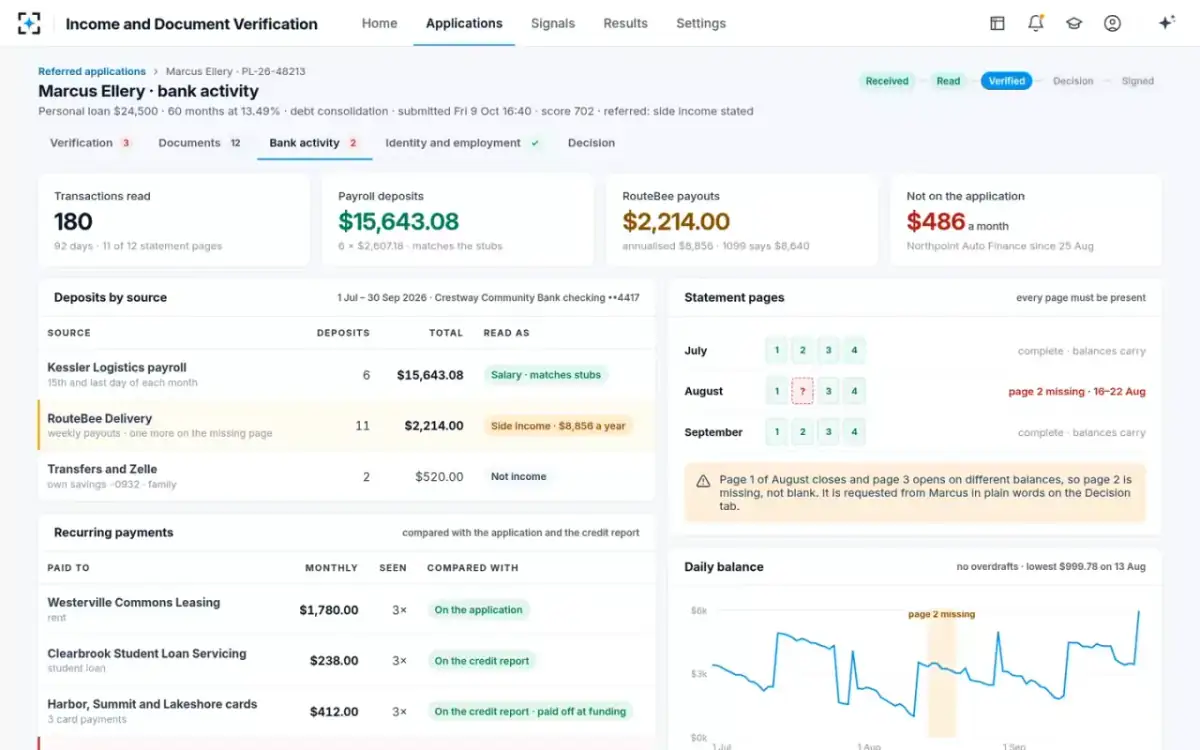
| Northpoint Auto Finance, $486.00 on 25 Aug and 25 Sep | No | No | The finding: a new auto loan, too recent to have been furnished |
| Fairway Motors, $3,000.00 on 28 Jul, once | No | No | Not a debt — the down payment that explains the loan |
| Subscriptions and insurance | No | No | Living expenses, not obligations the ratio counts |
The chronology of those two rows is what turns a suspicion into a finding. A hard auto inquiry on 24 July, a $3,000 payment to a motor dealer on 28 July, then $486.00 on 25 August and $486.00 on 25 September. Four facts from three different documents that only have one explanation, and none of which is a trade line. How the statements themselves are checked for completeness and alteration first — because a classification is only as good as the pages it ran on — is set out in bank statement verification software.
Ninety-two days of activity, classified and compared
Telling a debt from a transfer, a subscription or a bill
Every recurring debit is not a debt, and a tool that treats them alike produces a ratio that is wrong in the other direction. Four tests separate them, and they are worth applying by hand the first few times so that you trust the classification afterwards.
How to classify a recurring debit before it goes into the ratio
- Is the amount fixed to the cent, month after month?
An amortising loan or lease payment is identical every period. A utility bill, a card payment and a grocery subscription move.
- Is the date fixed?
Loan payments fall on a contractual day — the 25th, the first business day — and are collected by direct debit. Discretionary spending drifts across the month.
- Does the payee name a finance company, or a shop?
A lender, a servicer, a captive finance arm or a credit union is a strong signal. A retailer is not, unless the instalments say otherwise.
- Does the money leave the applicant, or move between their own accounts?
A standing transfer to a savings account or a second account in the same name is not an obligation, and counting it is the most common false finding.
One more case deserves naming because it is common and easily mishandled: the obligation that is being paid by somebody else. A car loan in the applicant’s name whose payment arrives from a parent, or a jointly held debt serviced from a partner’s account, is contractually the applicant’s and practically not. Policies differ on it. What should not differ is that the decision is recorded with its reason, because it is exactly the kind of judgement a later reviewer will want to see argued rather than assumed.
How do banks estimate a monthly payment from a credit report?
With a rule of thumb, because the report often does not carry the payment. The OCC describes the practice plainly: “credit bureaus reliably identify debt owed, but monthly payment information is not always available. Most banks have business rules to estimate monthly payment amounts, for example, using 1.5 percent to 2.5 percent of the outstanding balance.” Banks also have rules for “eliminating monthly payments when only a few payments remain, or incorporating payment estimates on deferred debt such as student loans” — and the examiners add the warning that matters: “in general, the more assumptions necessary, the stronger the risk management practices that are needed to mitigate uncertainties” (OCC, Retail Lending, version 2.0).
The width of that band is the argument for reading the bank. On a $20,000 balance the estimate runs from $300 to $500 a month, a $200 spread on one obligation, chosen by a policy parameter rather than by anything about the borrower. The statement does not estimate: it shows the payment that actually left the account. Where both exist, the debit is the better figure and the estimate is the fallback.
What the bureau holds about an obligation, and what the statement holds
The credit report: As of the furnisher’s last monthly batch, for furnishers who send one.
Ninety days of bank activity: As of the last statement date, for every obligation actually being paid.
The credit report: Lenders that opt in, on the products they opt in for.
Ninety days of bank activity: Everything that debits the account, including rent, instalment plans and court orders.
The credit report: Often absent; estimated at 1.5–2.5% of the balance by the lender’s own rule.
Ninety days of bank activity: The exact amount that left the account, on the exact day.
The credit report: Reported, and the one thing the statement cannot tell you.
Ninety days of bank activity: Not visible — a $486 debit says nothing about how many are left to pay.
The credit report: Years of it, including delinquency.
Ninety days of bank activity: Only the 60 or 90 days you were sent.
The credit report: That an obligation exists and how it has been paid.
Ninety days of bank activity: That an obligation is being paid, now, at a known amount.
What one found debt does to the ratio
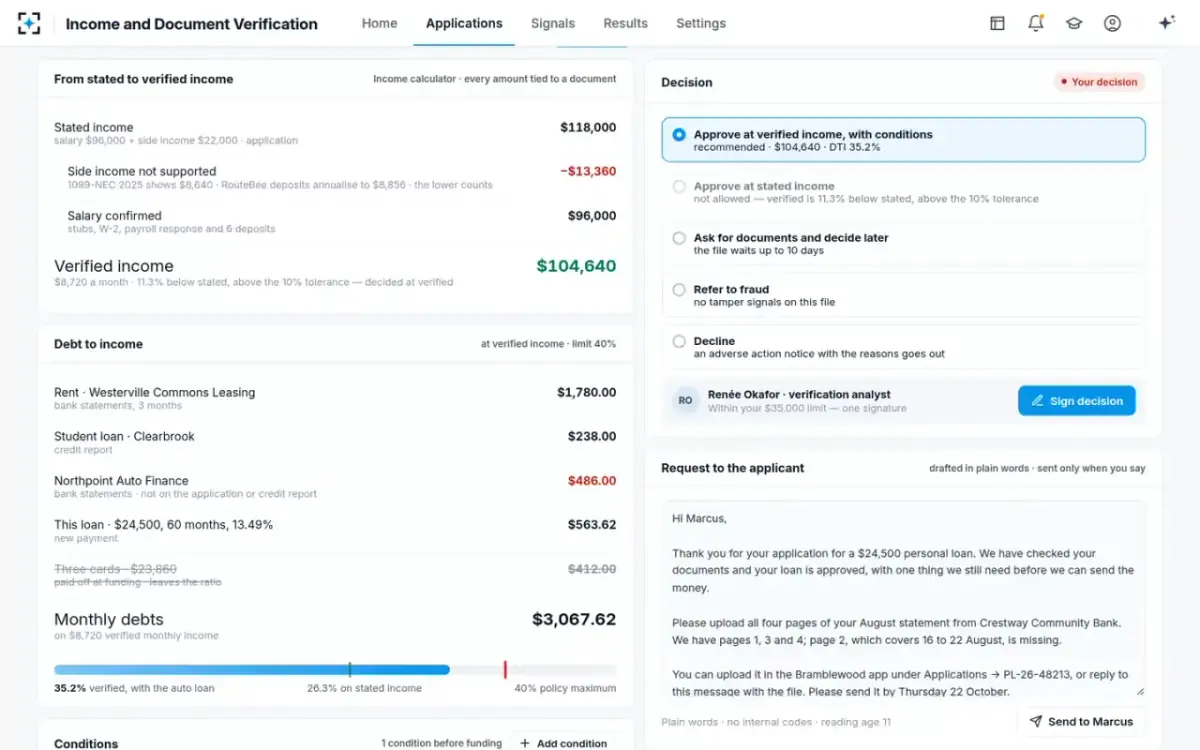
On the sample file, enough to change the conversation. Marcus Ellery stated $118,000 of income and a debt list that did not include a car. Verification cut the income to $104,640 — $8,720 a month — because his side income was counted at the lower of his 1099 and his actual deposits, and added $486.00 of monthly obligation because the statements showed it twice.
The same applicant, four ways of calculating one ratio
Three things are worth reading off that chart. The file still approves: 35.2% is inside the 40% maximum, and the found debt did not cost this applicant his loan. The gap between the first bar and the last is 8.9 points, which on a portfolio is the difference between a stated-income book and a verified one. And the two corrections compound in the same direction, because they usually do — an applicant who has understated an obligation is rarely the same applicant who has understated their income.
Card lenders are under an explicit version of this requirement. A card issuer must consider “the consumer’s ability to make the required minimum periodic payments under the terms of the account based on the consumer’s income or assets and the consumer’s current obligations”, and reasonable policies include “the ratio of debt obligations to income; the ratio of debt obligations to assets; or the income the consumer will have after paying debt obligations” (12 CFR 1026.51(a)). Current obligations is the operative phrase. A list that is two months stale is not current, and the regulation does not care whose batch file was late.
What you owe the applicant once you find one
Two things, and the order matters. First, ask. A recurring debit is evidence of a payment, not proof of a contract: you do not know the balance, the term, whether it is a lease or a loan, or whether the applicant is the borrower or the person who happens to pay. Asking for the finance agreement converts a classification into a fact, and occasionally retires the finding entirely.
Second, if the answer changes the decision, say so specifically. A statement of reasons for adverse action “must be specific and indicate the principal reason(s)”, and statements that the decision rested on “the creditor’s internal standards or policies” are insufficient (12 CFR 1002.9(b)(2)). “Debt-to-income too high” is on the edge of that standard. “Monthly obligations of $3,067.62 against verified monthly income of $8,720” is not, and it has the useful property of being checkable by the person who receives it — who may know something about the $486.00 that you do not.
Asking well is its own skill, and a request that names the document, the dates and the reason comes back far more often than one that does not. The regulation that shapes those requests, and the clock they run against, is worked through in loan stipulations. The wider question of which records a lender may rely on at all is in how lenders verify income.
From stated to verified, with the found debt in the arithmetic
Questions people ask
How do you find debts not on a credit report?
Classify every recurring debit in 60 to 90 days of bank statements, then subtract the obligations the application declares and the trade lines the credit report carries. What is left and repeats on a fixed day for a fixed amount to a finance company is an undeclared obligation. On the sample file in Income and Document Verification that method found $486.00 a month to an auto lender, corroborated by a hard inquiry eight weeks earlier and a $3,000 payment to a motor dealer four days after it.
Why is a debt not on my credit report?
Most likely one of four reasons: your lender does not furnish data to the bureaus at all, which is allowed because furnishing is voluntary; it furnishes some products and not the one you have; the account is newer than one monthly reporting cycle; or the obligation — rent, utilities, instalment-at-checkout, a court-ordered payment — is not a credit account that any bureau would carry. None of them means the debt is not real, and none of them means it will not be found.
Do all lenders report to credit bureaus?
No. The Official Interpretations to Regulation B state that the reporting rules “apply only to creditors that opt to furnish credit information to credit bureaus or to other creditors; there is no requirement that a creditor furnish credit information on its accounts.” The CFPB’s study of the system found furnishing to be highly concentrated: the top 100 furnishers supply 76% of the trade lines in the nationwide databases, and plenty of lenders behind them furnish nothing.
Does buy now pay later show on a credit report?
Generally no. The CFPB found that lenders “have typically not reported BNPL loans to the nationwide consumer reporting companies”, and only by matching six large lenders’ own data to credit records could the Bureau see that about 63% of borrowers held more than one loan at once at some point in 2022. Four equal debits a fortnight apart to the same payee is what one looks like on a bank statement, and that is where an underwriter will find it.
How do underwriters find undisclosed debt?
By reading the account rather than the report. The practical sequence is: match every declared debt and every trade line to a debit; look at what recurs and is unmatched; test each survivor for a fixed amount, a fixed date, a finance-company payee and whether the money actually leaves the applicant; then ask the applicant about what survives all four. Hard inquiries with no matching trade line are the best place to start looking.
Does rent show up on a credit report?
Usually not. Rent is not a credit account, and while some tenant-screening and rent-reporting arrangements do furnish it, the CFPB lists some rent and utility payments among the obligations that generally are not furnished to the nationwide companies. For an underwriter that cuts both ways: a monthly rent debit will not be in the trade lines, and it will be unmissable in the statements, which is one reason the statement period is the better evidence of what an applicant’s month actually costs.