A treasury management officer job description, written honestly, describes one person who sells a bank's cash management services to businesses from the first conversation to the hand-off: the officer asks a prospect for three months of statements, reads them, recommends payment, collection, information and fraud-control services, prices the package against the bank's list, negotiates within a discount authority, writes the proposal and hands the signed client to implementation. The hard part is that most of the hours go to clerical work in the middle, keying volumes and rebuilding a pro forma, while the decisions that need judgement get squeezed. Botminds' Treasury Management Proposals exists for that middle: agents read the prospect's statements, value each service and price it at the bank's list, and the officer keeps every decision that carries the bank's name.
The job is also hard to describe because no official occupation matches it. The Bureau of Labor Statistics publishes no category for treasury management officers, so salary benchmarks borrow from neighbouring occupations, and a description copied from a competitor's posting usually lists tasks rather than the authority the bank actually grants. The sample figures on this page come from a fictional bank, Tessaly Community Bank, and its fictional officer, as they run through the solution.
No official occupation fits the job, so the benchmarks are borrowed
$78,660
median pay, securities, commodities and financial services sales agents, May 2025
54%
of those sales agents work in credit intermediation, which includes banks
$61,720
their median pay inside credit intermediation, May 2025
What does a treasury management officer do?
A treasury management officer finds out how a business pays, collects and holds money, and proposes the bank services that do it better and more safely. In practice that means four kinds of work: analysis (reading the prospect's statements and account analysis), design (choosing services from the bank's catalogue), pricing (building a pro forma against the list and deciding whether to discount) and assurance (making sure the controls each service needs are in place before the first file moves).
At a large bank those four can sit with four people: a sales officer, a sales analyst, a product or pricing desk and an implementation team. At most community and regional banks they sit with one officer, perhaps with part of an analyst. That is why job descriptions for the role read so differently. One bank advertises a salesperson with a quota, another an analyst who also sells, and both are describing the same desk at a different size.
The officer also works alongside a commercial relationship manager, who usually owns the credit relationship. The relationship manager knows that a loan request is in process and what the client cares about; the treasury officer knows what the client's payments look like. In the sample, the relationship manager referred a 14-clinic veterinary practice with a $6.4 million request in process, and the treasury officer's proposal had to carry that context into the price without the relationship manager ever setting the price.
Treasury management officer responsibilities, decision by decision
The useful way to list the responsibilities is by the decision each one ends in, because a decision is what a manager can check and an examiner can ask about. The table pairs each responsibility with the decision and with the rule or document that stands behind it.
Treasury management officer responsibilities, and the decision each one ends in
| Responsibility | The decision the officer makes | What stands behind it |
|---|---|---|
| Discovery | Which statements to ask for, and how many cycles | Three cycles is the common ask; the prospect consents to their use |
| Statement analysis | What the prospect pays, collects and keeps, by flow | The prospect’s own statements and its current bank’s account analysis |
| Service design | Which services to recommend, and which to decline or defer | The bank’s service catalogue and its eligibility rules |
| Pricing | Price at list, or discount within personal authority | The price list in force and the bank’s authority matrix |
| Pricing exceptions | Whether to ask for more, and the reason to give | A named approver above the officer’s authority |
| The proposal | What to say, and what to leave out until it can be supported | Only figures the officer can show on the prospect’s statements |
| Readiness and hand-off | What must be true before the first payment file | Exposure limits, remote deposit suitability, a written security procedure |
| Pipeline | Which prospect to chase, and when a price expires | The bank’s service-level clocks and proposal validity |
Two rows deserve a second look. The pricing exception is where most officers lose a week, because the request goes to a manager in an email and the answer comes back without a reason anyone can find later. And the readiness row is where a proposal that looked finished meets the bank's own controls: a prospect that wants to collect from customers by ACH debit needs an exposure limit before it can originate, which is a credit decision the officer can start but not make.
Where one proposal's working days go
By hand, a mid-market treasury proposal takes about twelve of the bank's working days, and most of them go to keying, rebuilding and waiting. The estimate below splits those days by task; the longest single block is not analysis but waiting for a discount to be approved.
Most of a proposal's days are keying, rebuilding and waiting for a discount
- Keying volumes2 d
- Valuing each service2.5 d
- Pro forma1.5 d
- Discount approval3 d
- Writing1.5 d
- Go-live needs1.5 d
- People decide1.5 d
The split explains a pattern most sales managers recognise. An officer with six proposals in flight spends the week in spreadsheets and email threads, and the conversations that win business, the ones about why a controller still writes 600 checks a quarter, happen late or not at all. A job description that lists "analyse prospect statements" as a duty without asking how long it takes is describing the bottleneck as if it were the job.
The rules a treasury management officer works inside
A treasury officer is a salesperson whose products carry legal obligations, and three sets of rules reach the desk directly. None of them is a licensing rule; all of them shape what the officer may promise.
The first is remote deposit capture. The interagency guidance, first issued by the FFIEC in 2009 and revised on the FDIC's copy in June 2026, names the sales desk as a party to the risk work: depending on the institution, the people involved can run from information technology and deposit operations through treasury or cash management sales to audit, compliance, accounting and legal (FFIEC, Risk Management of Remote Deposit Capture; the full list is in the treasury management implementation specialist guide). An officer who offers a scanner on the first call has, in effect, promised a suitability review the bank has not yet done.
The second is ACH origination. The OCC's ACH bulletin, still active with its reputation-risk references struck in March 2025, expects banks to treat originators as a credit exposure, with underwriting standards that guide how exposure limits are set, including when to require prefunding or collateral (OCC Bulletin 2006-39; an ACH limit increase shows those standards at work). The officer does not set the limit, but the proposal has to say that one is needed before a debit file moves.
The third is how the officer talks about price. Banks may condition a price on other traditional bank products, but the Federal Reserve's proposed interpretation of the anti-tying statute singled out the people who sell: "persons with authority to approve credit extensions or establish pricing policies for the bank and other personnel that have direct contact with customers for purposes of marketing or selling the bank's products, for example, should receive comprehensive and regular anti-tying training" (Federal Reserve, 2003 proposed interpretation of section 106). Relationship pricing in banking works through what that allows. Wire and ACH services add a fourth: under UCC § 4A-201 a security procedure is one established by agreement of the customer and the bank, so the officer is usually the first person to put it in front of the client.
Treasury management officer salary: what the public data can and cannot say
There is no official salary figure for a treasury management officer, and anyone quoting one is quoting a job board or a survey, not the government. The Bureau of Labor Statistics publishes neighbouring occupations, and read carefully they bracket the job: the selling half sits near the sales agents, the analytical half near financial analysts, and the senior end of the career near financial managers, the occupation that includes treasurers and cash managers on the corporate side.
The nearest BLS occupations bracket the job; none of them is the job
Two details matter for a bank setting pay. The BLS notes that sales-agent wages "include sales commissions and bonuses for meeting production targets", and the spread is wide, from under $48,040 at the tenth percentile to over $212,880 at the ninetieth (BLS). A treasury officer paid largely on fee revenue has a reason to discount to win and a reason not to, and the pay plan decides which wins. The other detail is the industry gap: inside credit intermediation the sales-agent median is $61,720, well below the all-industry figure, which tells a community bank that its posted salary will be compared with brokerage and insurance roles that pay more.
What the public data cannot show is the authority premium. An officer allowed to discount 10% below list is worth something different from one who must ask for every cent, and no occupation code captures it. That is a reason to put the authority in the job description itself, where a candidate can see it and a manager can be held to it.
Sales officer, sales analyst, implementation specialist: where the job splits
As a bank grows, the officer's job splits along its decisions. The sales officer keeps the relationship and the price, the sales analyst takes the statement work and the pro forma, and an implementation specialist takes the hand-off. The split helps only if each seat knows which decisions it owns, and the treasury management sales analyst seat is where the boundary is most often blurred.
Three seats, one proposal: who decides what
Treasury management officer: Asks for them and explains why; reads the findings
Sales analyst and implementation: The analyst keys or checks the volumes and builds the flows
Treasury management officer: Chooses what to recommend and what to defer
Sales analyst and implementation: The analyst values each service; implementation says what it takes to switch on
Treasury management officer: Sets it within authority, or asks for an exception with a reason
Sales analyst and implementation: The analyst builds the pro forma; neither seat approves a discount
Treasury management officer: Signs what goes to the prospect
Sales analyst and implementation: The analyst drafts; implementation checks the readiness section
Treasury management officer: Stays the client’s contact
Sales analyst and implementation: Implementation sets limits, entitlements and test files
A treasury management officer job description that names the authority
A job description earns its keep when a candidate can read what they will decide and a manager can measure it. The checklist below is a template a bank can adapt; every line is either a decision, an authority or a measure, and none is a task an agent could do without the officer.
Eight lines every treasury management officer job description should carry
- The book
Prospects and clients by segment and size, and the expected number of proposals a year.
- The decisions
Which services to recommend, decline or defer, and what the proposal says.
- The pricing authority
The discount the officer may give without approval, as a share of list, and who approves above it.
- The maker-checker rule
Every proposal is approved by someone other than the person who drafted it.
- The controls the officer must raise
Exposure limits for ACH origination, remote deposit suitability, a written security procedure.
- The measures
Days from statements in hand to a priced proposal; share of proposals priced inside authority; win rate.
- The partners
Relationship managers, the product manager who owns the price list, implementation and client services.
- The training
Anti-tying and the bank’s pricing policy, refreshed on a schedule.
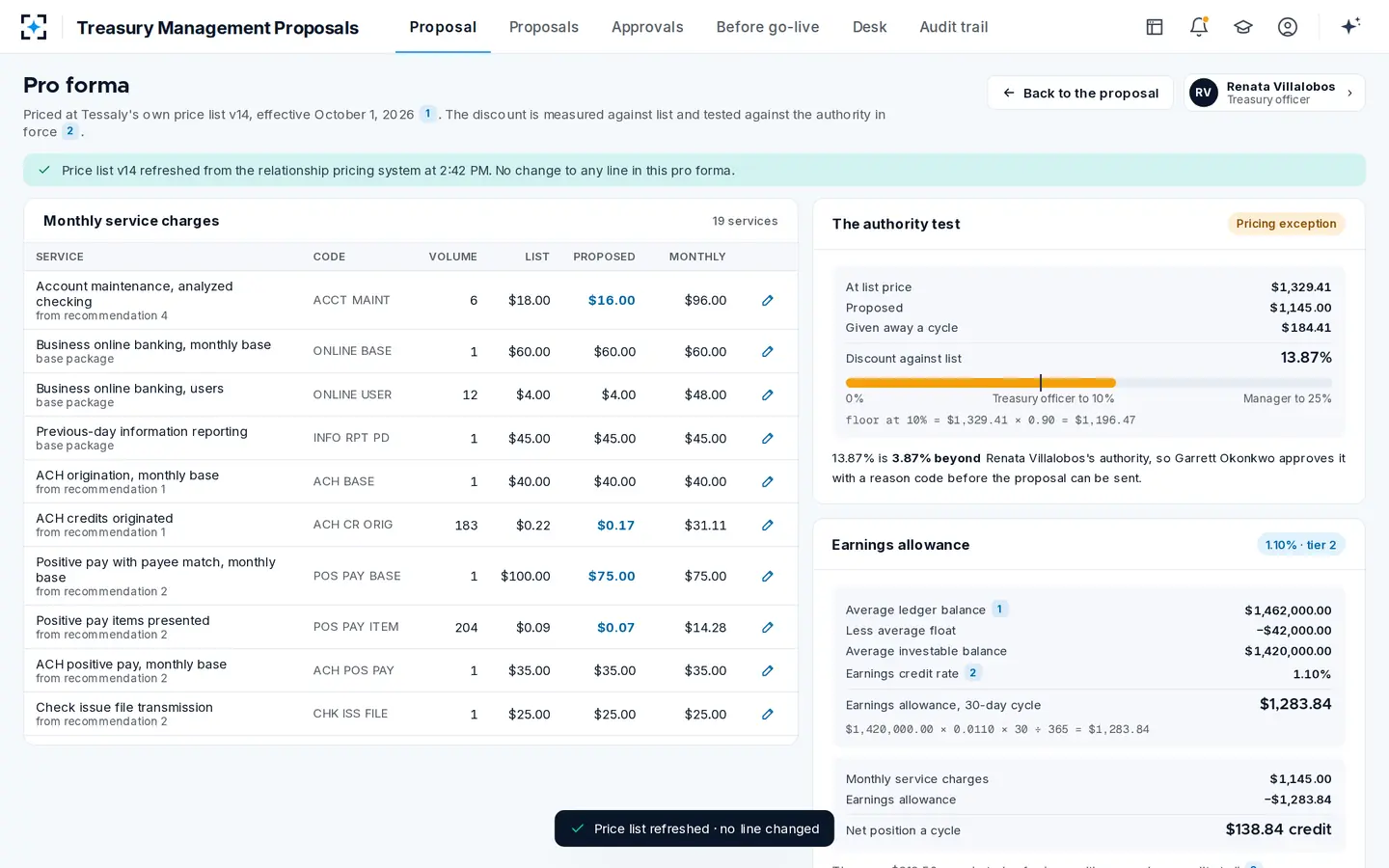
The authority line is the one most postings leave out, and it changes behaviour more than any other. At the sample bank an officer may discount up to 10% of list; the product manager can set that at 5%, 10% or 15%, and the manager and the level above follow the same matrix. A candidate who knows the number knows how much of the job is selling and how much is asking.
In Treasury Management Proposals, the pro forma flags a price outside authority before it is sent
Treasury management officer interview questions that test the real job
The best interview questions for this role hand the candidate a document and ask for a decision. Generic questions about closing techniques tell a hiring manager little; a statement, a price list and an authority limit tell a great deal in twenty minutes.
- Read this statement. Give the candidate one cycle of a business checking analysis and ask what the prospect pays for, what it keeps idle and which line they would ask about first. Strong candidates find the balance earning no credit and the incoming wire fees before they look at the check count.
- Price this package. Hand over a list and a target price 14% below it, with a 10% authority. The answer you want is the reason they would give for the exception, not a promise to "get it done".
- Defer something. Ask what they would do if the prospect wants to collect 9,400 monthly payments by ACH debit. A good officer says the bank must set an exposure limit before the first debit file, and offers it as a second phase.
- Explain an earnings credit. Ask what happens to a credit larger than the month's fees. The candidate should know it offsets fees and usually goes no further, which is the subject of ECR vs interest-bearing account.
- Say no to a number. Ask what they would write when a value cannot be shown on the prospect's statement. The right answer is to leave it out and ask for the document.
What changes in the job with Treasury Management Proposals
With the reading done by agents, the officer's job description loses its clerical lines and keeps every decision. The solution's seven agents read the statements, group the activity, recommend services from the bank's catalogue, price at the list, write the draft, name the go-live controls and watch the pipeline; none of them prices below list without a reason, approves, sends or contacts a prospect.
Four people on one treasury proposal, before and after the agents read
Today
Keys three months of volumes into a spreadsheet, guesses at each service’s value and builds the pro forma by hand.
With agents
Opens a statement already annotated, every value cited; spends the time on which services to put in and what to say about the price.
Still theirs: Every recommendation, every word sent, and pricing within authority
Today
Approves discounts in an email thread, with no view of what the relationship is worth.
With agents
Sees the discount, the value found and the reason in one place, and approves with a reason of his own.
Still theirs: Every exception, and the approval of every proposal he did not draft
Today
Waits for a proposal that arrives after the credit conversation has moved on.
With agents
Adds the relationship context the price needs, in the same week as the credit request.
Still theirs: The relationship; never the price
Today
Publishes a price list and learns months later how much of it was given away.
With agents
Owns the list, tiers and authority in one versioned place, and sees every price below the line and why.
Still theirs: The list, the tiers and the earnings credit rates
The sample shows the shape of the change. Renata Villalobos, the fictional officer, opened the Calder Brook statements at 2:26 on an October afternoon, declined one recommendation, sent the price for approval at 2:31 and had a proposal approved by 2:48 and out by 2:53. The work that was left was the work in her job description: what to recommend, what to defer, and why the price was right. Writing it down is covered in the cash management proposal template.
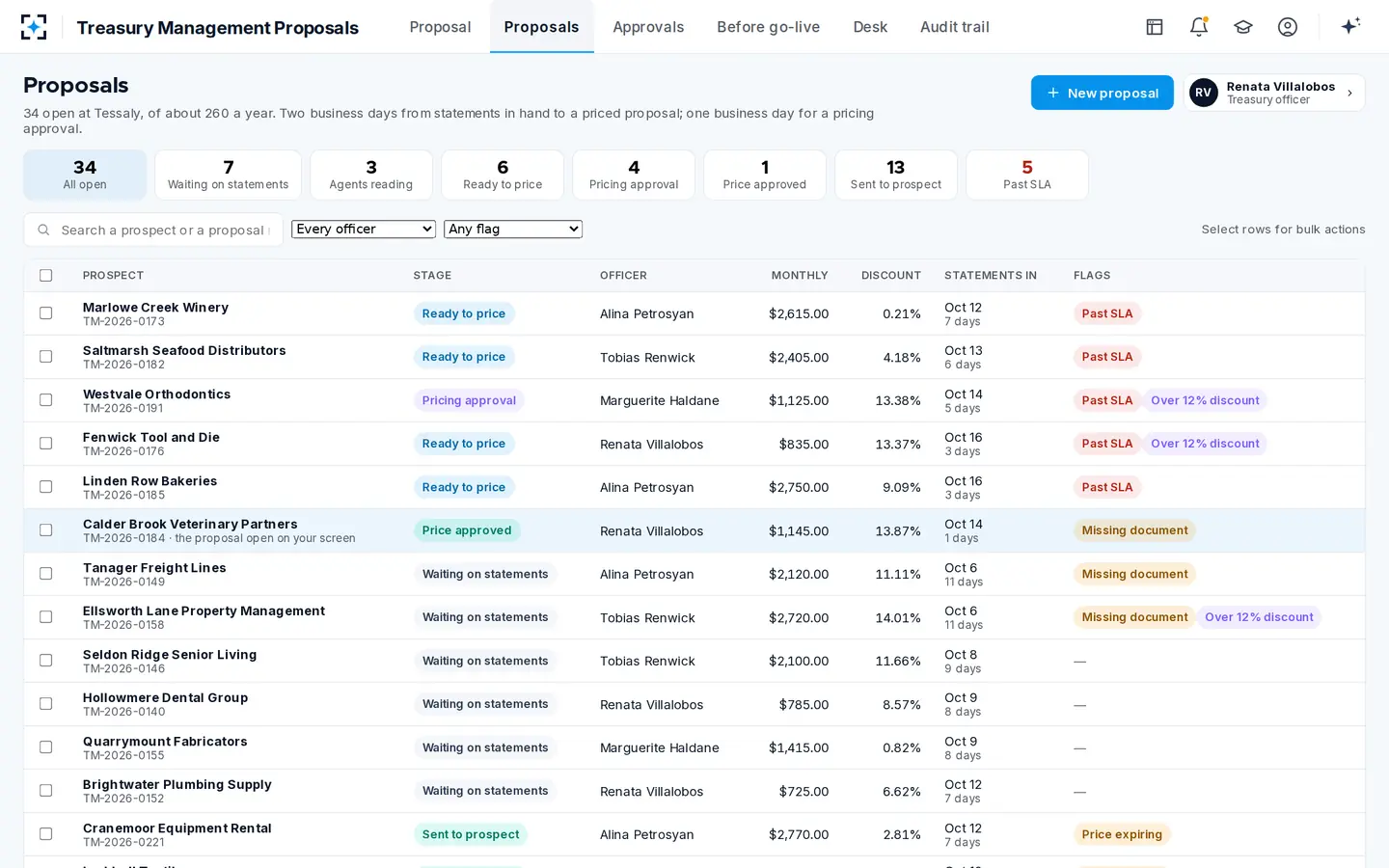
The desk's pipeline: 34 open proposals and the flags that need a person today
Questions people ask
What are a treasury management officer's main responsibilities?
Analysing a business prospect's statements, recommending the bank's payment, collection, information and fraud-control services, pricing them against the bank's list, negotiating within a discount authority and handing the client to implementation. At smaller banks one officer does all of it; larger banks split the analysis and implementation into separate seats.
How much does a treasury management officer make?
No official figure exists, because the Bureau of Labor Statistics has no treasury management officer occupation. The nearest selling occupation, securities, commodities and financial services sales agents, had a median of $78,660 in May 2025 and $61,720 inside credit intermediation; financial analysts had a median of $103,570.
What is the difference between a treasury management officer and a treasury management sales officer?
Usually the title only. Both carry a book of business clients and a revenue target; "sales officer" tends to be used where the bank also employs sales analysts and implementation staff, so the officer's own job narrows to the relationship and the price.
What qualifications does a treasury management officer need?
Banks commonly ask for a bachelor's degree in business or finance, which is also what the BLS reports as typical entry-level education for the nearest sales occupation. Experience in deposit operations, payments or commercial lending helps, because the job turns on reading statements and understanding the controls each service needs.
Is a treasury management officer a sales job?
Partly. Most officers carry a revenue goal, but the work that decides a proposal is analytical: what the prospect's statements show, what each service is worth and whether a discount is justified. Pay often includes commissions or bonuses, which the BLS notes are part of the nearest occupation's reported wages.
Who does a treasury management officer report to?
Typically a treasury sales manager or a head of treasury management, who also approves pricing exceptions. Good practice separates the two roles on each proposal: the person who drafts it does not approve it, and a proposal the manager drafts goes one level up.