A treasury management implementation specialist is the person at a bank who turns a business client's signed treasury proposal into working services: configuring ACH origination, positive pay, wires and remote deposit capture, setting up the client's users and entitlements, testing the client's first files, and confirming that every prerequisite is signed before go-live. The job is hard less because of any one task than because the specialist is the hub of five queues, and the two steps that in our estimate most often set the go-live date, the ACH exposure limit and the client's first passing test file, are ones the specialist cannot complete alone. Botminds' Treasury Management Onboarding is built around that seat: agents draft the setup, explain failed files and assemble the limit request, so the specialist's day is spent deciding rather than decoding.
The examples come from a fictional sample bank and client running through the solution, Corvane National Bank and Halvorsen Freight Systems, and the four people who carry the implementation there. The rules and guidance are linked where they appear.
Four people carry one implementation, and only one of them configures it
Today
Six to eight clients at once. Reads 94-character records to see why a file failed, then writes the same email again in bank vocabulary.
With agents
Opens a failed file with each error already placed on its record and the controller's fix drafted, and decides whether to send it.
Still theirs: Every message to the client goes under the specialist's own name.
Today
Knows what is live, but not what is stuck or why, until a client calls.
With agents
Sees every implementation by days since the signed proposal, with its blocker in one sentence.
Still theirs: Approves the setup and confirms go-live.
Today
Builds the exposure case by hand from statements; the next review lives in a diary note.
With agents
Decides on arithmetic the agents assembled, and sets the review dates in the same step.
Still theirs: The limit, and the reason for it.
Today
Checks entitlements from memory against a signed form in another system, under time pressure.
With agents
Reads each user, entitlement, limit and security procedure beside the page it was configured from.
Still theirs: The right to remove what does not match.
What does a treasury implementation specialist do?
A treasury implementation specialist owns a client's implementation from the signed proposal to the first live file, and is accountable for its pace without controlling most of its steps. In job descriptions the role appears as treasury management implementation specialist, treasury onboarding specialist, cash management implementation specialist or implementation liaison. The duties underneath are consistent, and they make a better job description than most postings do.
A treasury management implementation specialist job description, in duties that can be checked
- Read the signed proposal and every product schedule
Each service ordered has a schedule: permitted entry classes, cut-offs, approval limits, file layouts. The setup must match it, not the template.
- Configure two systems, or prepare the configuration
Users, entitlements and approval limits in the digital banking platform; company IDs, formats and cut-offs in the payments hub.
- Chase the three steps owned elsewhere
Beneficial ownership from KYC operations, the exposure limit from treasury credit, and the client's test file from its own systems.
- Test every file and deposit the client will send
An ACH file, a positive pay issue file, a wire template, a test deposit. Each tested against the format and against the schedule.
- Explain failures in the client's words
The controller who fixes the file does not read Nacha field names. The fix has to say what to change, where, and what stays the same.
- Hand a complete file to a second implementer
Entitlements, limits and security procedures checked by someone who did not configure them.
- Keep the evidence
Signed schedules, the security procedure accepted in writing, the approved limit, the passing test file, the second check: kept together, retrievable for audit.
What the list leaves out is as telling. The specialist does not approve the setup, set the exposure limit, certify ownership or turn services on. Those belong to the implementation manager, the credit officer, the BSA program and, at go-live, a named approver. A well-run desk writes those boundaries into its procedures, because a specialist under deadline pressure is the person most likely to be asked to cross them.
Five queues, one specialist
Most of a specialist's elapsed time is spent waiting on other people's queues: the client's own IT or accounting team, KYC operations, treasury credit, digital banking administration and payments operations. The regulators expect this breadth. The interagency guidance on remote deposit capture, for example, says a bank should involve "all potential stakeholders" and lists them: "staff from information technology, deposit operations, treasury or cash management sales, business continuity, information security, audit, compliance (including BSA/AML), management, accounting, and legal" (FFIEC, Risk Management of Remote Deposit Capture, FDIC copy revised June 2026). That is one service. A four-service implementation touches most of those desks more than once.
Who the specialist waits on, for what, and what ends the wait
| Queue | What the specialist needs | What usually holds it | What ends the wait |
|---|---|---|---|
| The client's finance and IT team | A test file from the client's own accounting or payroll system; signed forms | The person who configures the ACH profile is not the controller who signed | A fix written so that person can apply it without a call |
| KYC or onboarding operations | Beneficial owners and control person verified | An ownership certification that is missing or that the bank's policy treats as stale | A signed certification and a person's release of the hold |
| Treasury credit | An approved daily credit and debit exposure limit | Statements and financials assembled by hand | A decision with a reason and a review date |
| Digital banking administration | Users, entitlements, approval limits and dual control configured | Re-keying from the signed authorized-representative form | Configuration that matches the form, checked by a second person |
| Payments operations | Company ID, permitted entry classes, cut-offs, positive pay file layout | A template setting that does not match this client's schedule | A setup approved against the signed schedule |
The critical path runs through two steps the specialist cannot sign
Of the five queues, two set the go-live date in our estimate of the sample bank's month: the ACH exposure limit and the client's first passing test file. Both are outside the specialist's authority. The limit is a credit decision. The file is produced by the client's systems, and the bank can only read it and explain what to change. Everything else, from configuration to entitlements, can be worked in parallel while those two run.
Two long lanes set the date; the rest run alongside them
- Request and statements gathered2 d
- Analysis written up2 d
- Credit officer decides1 d
- First file from the client3 d
- Fails; specialist decodes and writes2 d
- Client fixes and resends3 d
- Fails again on something else2 d
- Passes2 d
- Due diligence4 d
- Configuration in two systems6 d
- Second check and sign-off4 d
The lesson for a desk is about where to spend effort. Shaving a day from configuration rarely moves the go-live date, because configuration is not on the critical path. A day saved on each test-file round trip, or a limit request that arrives on the credit officer's desk complete, does. That is also why two causes of the sample client's failed first file, a company ID carried over from the client's previous bank and a vendor batch coded for consumer accounts, are worth knowing by heart.
Who sets the ACH exposure limit for a new client?
The bank's treasury credit officer, or whoever its credit policy names, sets the ACH exposure limit, not the implementation specialist and not the client. Nacha's risk staff summarize the obligation plainly: every bank must set, apply and periodically review a limit for each originator and each third-party sender it serves (Nacha, Why are Exposure Limits So Important?, March 26, 2025; how to calculate an ACH exposure limit works one through).
The examiners' procedures show why the decision sits in credit. They ask whether qualified credit staff monitor originators independently of ACH operations, and whether each limit makes sense against everything else the bank has extended to the client, from loans to foreign exchange (FFIEC IT Handbook, Retail Payment Systems, Appendix A; the ACH risk manager describes that independent seat). An implementation specialist sees one client's ACH request. A credit officer sees its loans, its foreign exchange lines and its other exposures, and can size the ACH limit inside them.
The specialist's part is to make the request complete: the payroll and vendor runs the client will actually send, how often they land on the same day, the client's return history at its previous bank, and its financial statements. In the sample, the client asked for $1,200,000 of daily credit. The assembled request showed a $266,410.00 payroll and a $146,450.00 vendor run, $412,860.00 on a day when both land, and the credit officer approved $900,000, about 2.2 times that peak, with a reason code and a first review 90 days out.
How many clients does an implementation specialist handle?
No regulator, rule-maker or academic study publishes a caseload figure for treasury implementation, so a bank has to measure its own. In the sample, each specialist carries six to eight clients at once and the team has 220 implementations in flight. The right number depends less on headcount than on two ratios a desk can measure: test-file round trips per client, and days each implementation waits on a queue outside the team.
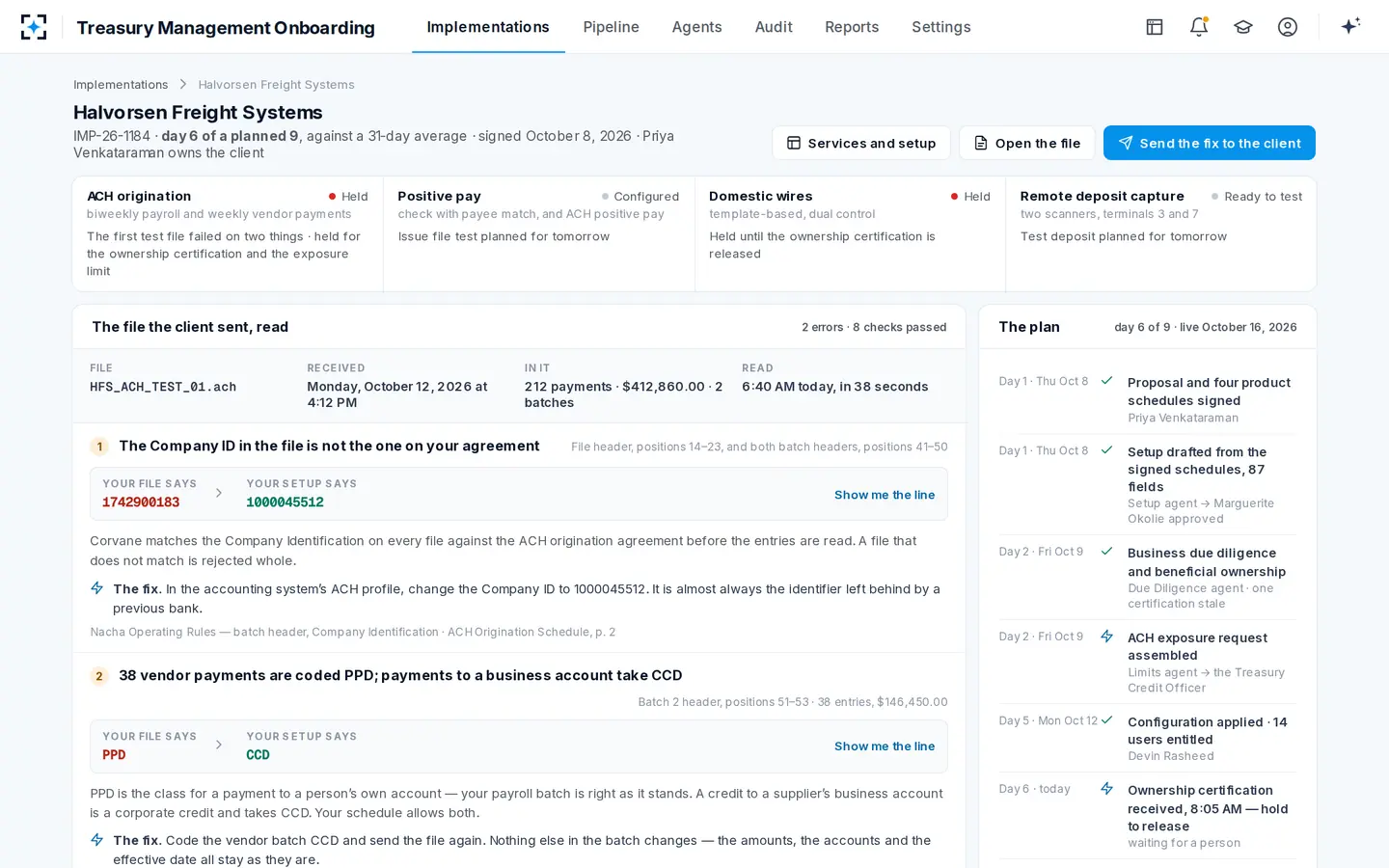
A specialist with eight clients each on their second or third failed file is overloaded at a caseload that would be comfortable if files passed on the first or second attempt. That is why the useful management view is not a list of clients but a list of blockers. The sample desk's overnight summary reads like this: the agents read 37 client test files, drafted 9 messages to clients and 4 new setups; 11 implementations need a person today, and 6 are past day 20.
One client's implementation, organized around the file that stalls go-live
Treasury onboarding specialist vs implementation specialist: one job or two?
Often the two titles describe the same seat, and the difference is local naming. Where a bank does split them, the onboarding specialist usually gathers documents, agreements and due diligence, and the implementation specialist configures and tests. The split helps at volume, but it adds a handoff in the middle of the critical path, so it pays only when the first half rarely sends work back.
Whatever the titles, two duties should never sit with the person who configured the setup. One is the check of entitlements, limits and security procedures before anything is turned on: the FFIEC's 2021 guidance singles out the business customer's system administrators, whose power to add an employee with payment rights calls for extra controls (FFIEC, Authentication and Access to Financial Institution Services and Systems; the business banking administrator quotes it). The other is go-live itself. The treasury management checklist sets out who signs what.
What a treasury implementation specialist needs to know in 2026
Three things changed for the role this year, and each shows up in a new client's first weeks.
First, every business client that originates ACH is now itself covered by Nacha's fraud-monitoring rules: phase 2, dated June 19, 2026, took effect in practice on Monday, June 22, 2026 because June 19 was a federal holiday, and extended the rules to all non-consumer originators regardless of volume (Nacha, Fraud Monitoring Phase 2). The specialist is well placed to be the first bank employee to ask the client how it controls changes to payee and payroll instructions.
Second, payroll credits now carry a required description, "PAYROLL", in the batch header, which old exports may not produce. Third, FinCEN's February 2026 order lets a bank rely on a client's earlier beneficial ownership information for a new account if the client confirms it, which can shorten the KYC queue when the bank chooses to use it.
Underneath all three is the file itself. An ACH file is fixed-width text in which each line is "exactly 94 characters in length", organized in records that "must follow a specific order" (Nacha, ACH Guide for Developers). A specialist who can read a batch header at a glance resolves a failure in minutes; one who cannot spends the morning on it. The guide to Nacha file validation tools covers what a validator does and does not catch.
Where agents change the specialist's day
Agents take the reading and drafting out of the specialist's day; they leave every decision with a named person. In Treasury Management Onboarding, the Setup agent drafts each field from the signed schedules with its source page, the File agent places each error on the exact record of a failed test file, the Client agent drafts the controller's fix, and the Limits agent assembles the exposure request with its arithmetic. None of them changes a client's file, writes a live configuration, sets a limit or sends a message.
In the sample, the first test file arrived on Monday afternoon and was read at 6:40 the next morning, with two errors placed on their records. The fix went to the client at 10:38 under the specialist's name; the corrected file came back at 11:40 and passed at 11:52. The same morning the credit officer approved the limit and a second implementer checked the entitlements, removing one that had come from the template rather than from the client's signed form.
A second implementer checks what the specialist configured
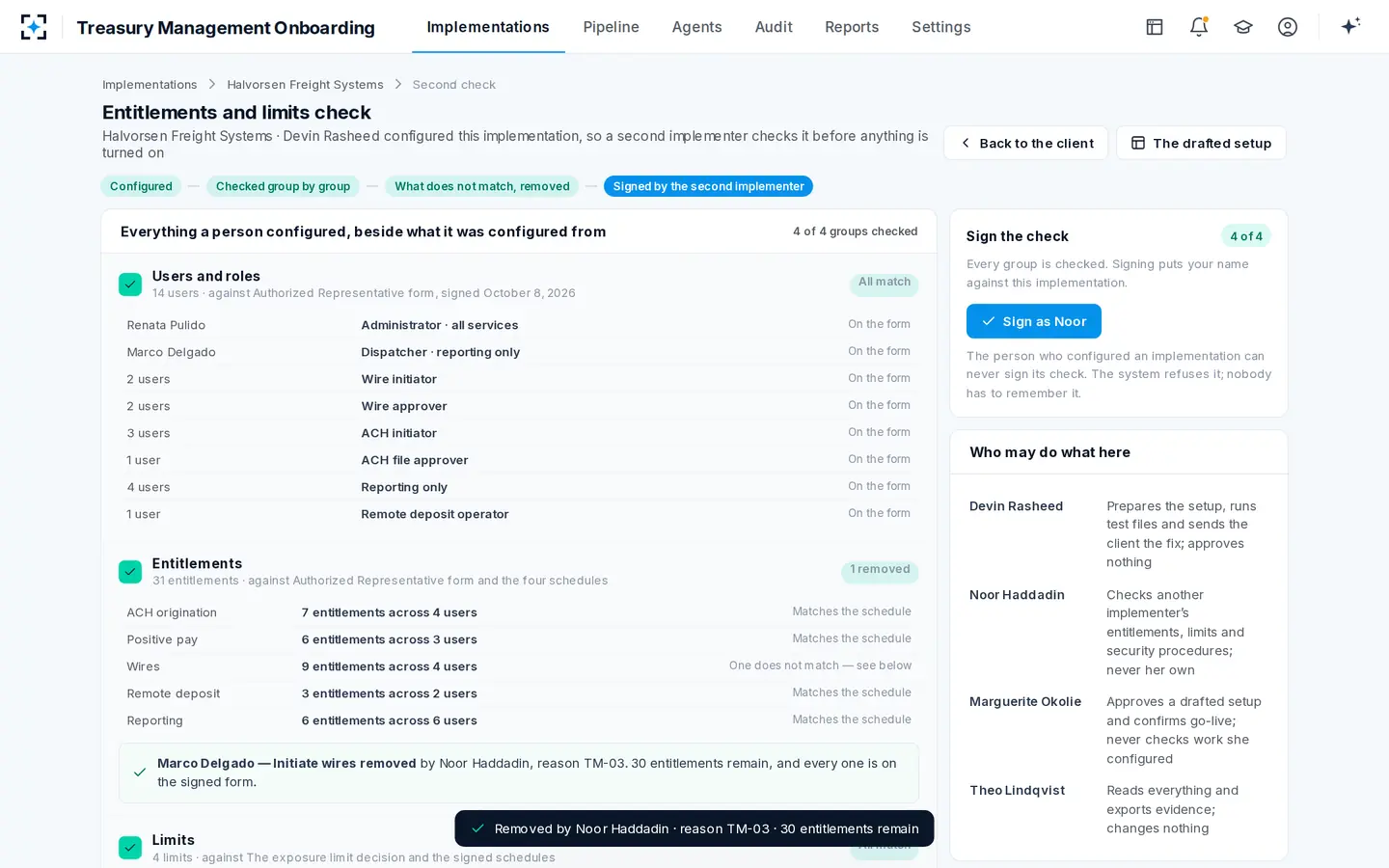
The effect on the role is a change of verb: from reading and re-keying to checking and deciding. To see that day from the specialist's seat, start from Treasury Management Onboarding; for what the waiting costs the bank, see the steps, the days and their cost.
Questions people ask
What is the treasury management implementation process?
It runs from the signed proposal through due diligence and beneficial ownership, the exposure limit, configuration in digital banking and the payments hub, the client's written acceptance of a security procedure, test files, and a second check before go-live. The specialist coordinates all of it, but the limit and the client's test file usually set the date.
Is a cash management implementation specialist the same job?
Yes, in substance. Cash management and treasury management name the same family of business services at many banks, and the implementation work, configuring and testing ACH, positive pay, wires and deposit capture for a business client, is the same under either title.
Does the implementation specialist approve the client's setup?
It should not. The specialist prepares and tests; an implementation manager approves the setup, and a second implementer who did not configure it checks entitlements, limits and security procedures. Keeping approval away from the person who configured the work is the control the FFIEC's 2021 guidance points to for administrator changes.
What skills does a treasury implementation specialist need?
Reading a Nacha file and a positive pay layout, knowing which entry class fits which payment, configuring entitlements and dual control, and writing to a client's controller in plain words. Since 2026 it also helps to know the Nacha fraud-monitoring rules that now apply to every business originator.
Why does an implementation wait on treasury credit?
Because the OCC expects the bank to set ACH limits and obtain approvals before a client initiates its first entry, and examiners check that the limit is reasonable against the client's exposure across all the bank's services. That view sits in credit, not in the implementation team.