Treasury management onboarding is the work a bank's implementation team does between a business client's signed treasury proposal and the client's first live payment: business due diligence and beneficial ownership, a signed schedule for each service, an ACH exposure limit from treasury credit, users and entitlements in digital banking, formats and cut-offs in the payments hub, a security procedure the client accepts in writing, and the client's own test files. It is hard because eight workstreams belong to five or six different teams, the setup is re-keyed from signed PDFs into two systems, and the client's first file often fails for reasons a specialist has to decode by hand. Botminds' Treasury Management Onboarding puts agents in front of that work: they draft every setup field from the signed schedules, propose the exposure limit, and explain each failed test file in plain words, while named people approve, decide and turn the services on.
The worked examples on this page come from one fictional sample client, Halvorsen Freight Systems, as it runs through the solution at a fictional bank, Corvane National Bank. The rules come from the regulators and rule-makers that wrote them, linked where they appear.
One sample implementation, before and after the agents
31days
the sample bank's 2025 average from signed proposal to first live file
9days
the design target, met by the sample client ordering four services
87fields
drafted from the signed schedules, each one citing its page
22days
of fee income billed earlier per client: our estimate, 31 less 9
What is treasury management onboarding?
Treasury management onboarding, also called treasury implementation or cash management implementation, turns a sold relationship into working services. The client has signed a proposal for, say, ACH origination, positive pay, domestic wires and remote deposit capture. Before the first payroll file can leave the bank, the bank has to know who owns the client, decide how much ACH credit it will extend, configure four products in at least two systems, agree how payment orders will be verified, and see a test file from the client's own accounting system pass.
Onboarding is not account opening. The deposit account usually exists, or opens in parallel through the bank's business account process, which the business account opening guides cover. Treasury onboarding starts where that ends: entitlements, limits, file formats and the agreements that decide who bears a loss when a payment order goes wrong.
The eight workstreams between signature and first file
Every treasury implementation runs the same eight workstreams, each owned by a different desk and each closed by a piece of evidence. The table names them in the order the evidence usually arrives, with the rule or guidance that makes each one more than a courtesy.
Eight workstreams, each closed by evidence someone signs
| Workstream | Owner | Closed by | The rule or guidance behind it |
|---|---|---|---|
| 1. Agreement and product schedules | Treasury officer, client | Master agreement and one signed schedule per service | UCC Article 4A: the security procedure is "established by agreement" |
| 2. Business due diligence and beneficial ownership | KYC or onboarding operations | Verified owners and control person | 31 CFR 1010.230, with FinCEN's February 2026 relief for later accounts |
| 3. ACH exposure limit | Treasury credit officer | An approved daily credit and debit limit, with a review date | Nacha Rules; OCC Bulletin 2006-39 |
| 4. Setup in digital banking | Implementation specialist | Users, entitlements and approval limits configured | FFIEC 2021 authentication guidance (administrator and dual controls) |
| 5. Setup in the payments hub | Implementation specialist, payments operations | Company ID, permitted entry classes, cut-offs, positive pay layout | Nacha file specifications; the ACH origination schedule |
| 6. Security procedure accepted | Client, treasury officer | Written acceptance, and any written refusal of a stronger option | UCC § 4A-202(c) |
| 7. Test files and test deposits | Client, implementation specialist | A file that passes the format and the client's own setup | Bank policy; the ODFI, not the client, warrants the entries it originates |
| 8. Second check and go-live | Second implementer, implementation manager | Entitlements checked by someone who did not configure them; go-live confirmed | Bank policy; FFIEC RDC guidance for deposit capture clients |
Three of the eight sit outside the implementation team's control. The exposure limit is a credit decision. Beneficial ownership belongs to the bank's BSA program. And the test file is produced by the client's own accounting or payroll system, often configured by someone the bank has never spoken to. In our estimate the critical path runs through those three, which is why the implementation specialist's job is mostly about who waits on whom.
How long does treasury management onboarding take?
No regulator, rule-maker or academic study publishes how long treasury onboarding takes, so any figure you read is a bank's own or a vendor's claim. The honest answer is that it takes as long as the slowest of the eight workstreams, and that in our estimate the slowest are the client's test file and the exposure limit.
The sample bank in the solution averaged 31 days in 2025 from signed proposal to first live file. The split below is our estimate of where those days went on one four-service implementation, by hand and with the agents. The phases overlap in practice; they are drawn end to end to show each one's share.
Most of the month is the test-file loop, not the setup
- Due diligence and ownership4 d
- Drafting four services in two systems6 d
- Exposure limit5 d
- Test files, one round trip at a time12 d
- Second check, sign-off, go-live4 d
- Due diligence, drafting, limit1 + 2 + 1.5 d
- Test files, second check, go-live3 + 1.5 d
Why does commercial onboarding take so long? The test-file loop
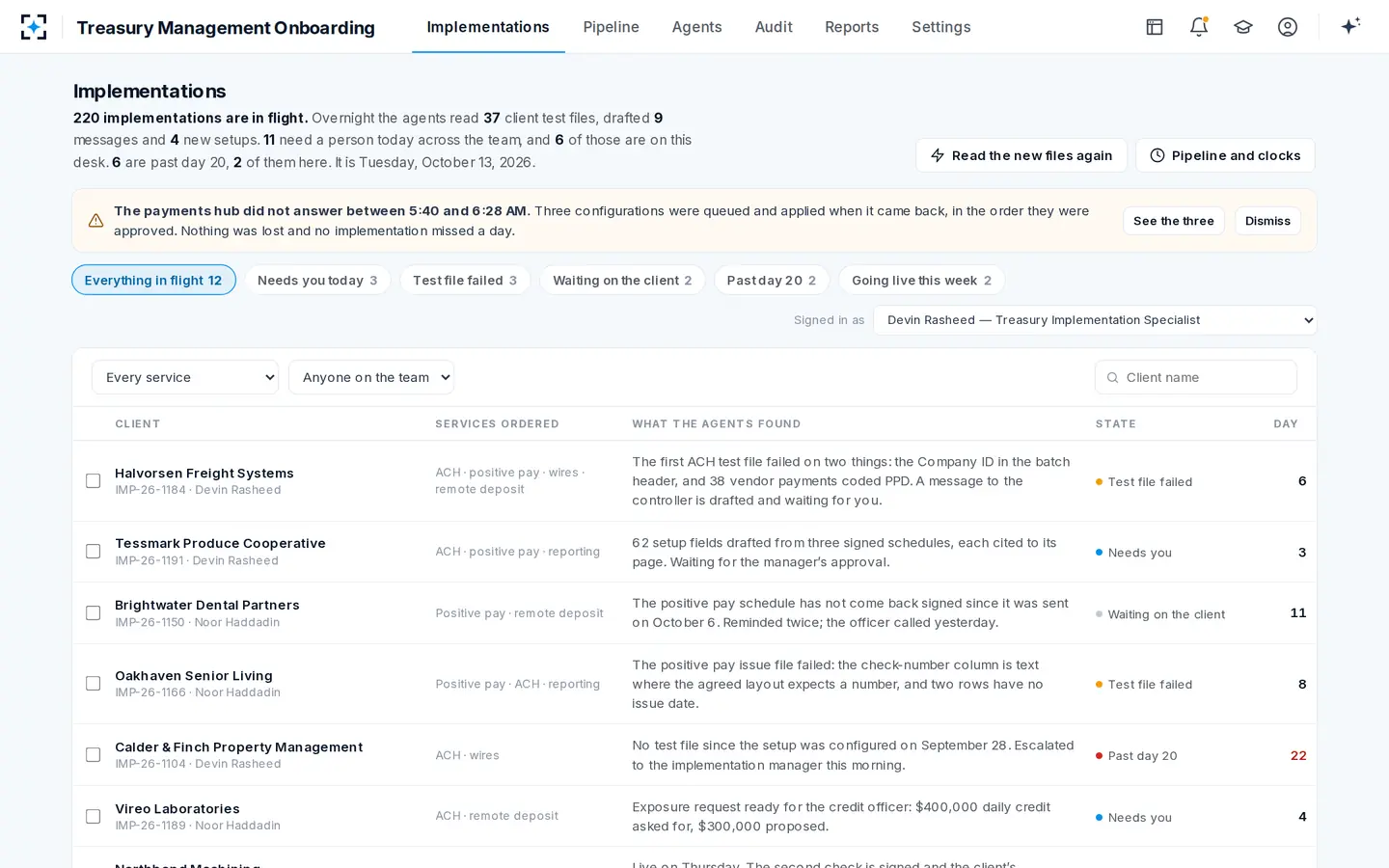
Commercial onboarding takes long largely because each failed test file costs a round trip measured in days, not minutes. The client's controller exports a file on Monday afternoon, the bank's validator rejects it overnight, a specialist reads 94-character records on Tuesday morning to work out why, and an email in bank vocabulary reaches the client by lunch. The fix waits for whoever configures the accounting system's ACH profile. Then the file comes back and the cycle starts again.
The causes repeat. In the sample, the client's first file carried a Company ID from its previous bank, and 38 vendor payments worth $146,450.00 were coded PPD, the consumer class, instead of CCD. Both are explained in their own guides: what the ACH company ID means and why a new client brings the wrong one, and why a PPD vendor batch can pass a format check and still be wrong. Neither error is exotic. Each costs a day when it is found by a validator that can say which record broke but not why, in words the client's controller can act on.
The second slow step is the limit. The OCC's guidance, still in force, is direct about the order of events.
Set limits and obtain appropriate internal approvals before allowing ACH transactions to be initiated.
OCC Bulletin 2006-39, ACH Activities: Risk Management Guidance
So the limit cannot be a formality filled in on go-live morning. The same bulletin asks the bank to keep a credit file on each originator that records its approved daily and multi-day exposure limits, and to underwrite ACH as it would any other credit (the ACH originator annual review lists what that file holds). Assembling that file from statements and audited financials by hand is where the five days in the timeline go.
When does a bank start billing treasury services?
Billing usually starts when a service is turned on and used, so every day between the signed proposal and go-live is fee income the bank has sold and not yet earned. There is no rule on this; it follows from how business account analysis works. Business accounts sit outside Regulation DD, which applies to accounts "held by or offered to a consumer", so the terms are whatever the bank's agreement and fee schedule say, and services that do not yet exist generate no activity to charge.
That makes the cost of delay concrete in a way most implementation metrics are not. A day of waiting is not an abstract service-level miss. It is a known number of service units, at prices the client has already accepted, that will not appear on this month's analysis statement.
Pricing one waiting day from your own fee schedule
A waiting day costs the bank three things that can each be priced from its own data: the fees it has not billed, the hours its staff spend on rework, and, harder to see, the client's patience. The formula below keeps them separate, so nobody can hide a large guess inside a small total.
The cost of one waiting day, from numbers the bank already holds
Fees not yet billed
monthly fees at proposal ÷ 30.4
From the signed proposal's pro forma analysis: the service units the client expects and the prices it agreed.
Treasury officer
Rework hours
round trips × hours per trip × loaded hourly cost
Reading the file, writing the client, re-testing. Count it from the implementation log, not from memory.
Implementation manager
Relationship risk
not priced: recorded as days past target
A delay the client notices. Without a sourced attrition rate, record it as days past the bank's own target rather than inventing a percentage.
Head of treasury management
A worked illustration, with numbers chosen only to show the arithmetic: if a client's signed proposal shows $3,040 a month in analysis fees for its four services, each waiting day is worth $100 of unbilled fees. Twenty-two days is $2,200 for one client; across 220 implementations in flight, the same arithmetic is large enough to justify a project on its own. Use your own proposal figures. The point of the exercise is that the bank already has every input, and that the result can be set directly against the cost of the people working the backlog.
Two cautions keep the calculation honest. First, earlier billing is not new revenue; it is the same revenue sooner, plus any months a client would otherwise have spent with its old bank. Second, do not borrow an industry attrition rate to price the relationship risk. The figures in circulation come from vendors, and a bank that cannot source a number should record days past target and leave the rest to judgement.
Every client in flight, with its day count and what is blocking it
What the 2026 rules added to every new ACH originator
Three changes in 2026 put new items into every treasury implementation that includes ACH origination. None of them is optional, and the first two land on the client as well as the bank.
Fraud monitoring by originators. Nacha's risk management rules took effect for all ODFIs, and for non-consumer originators with 2023 volume of six million entries or more, on March 20, 2026. Phase 2 extended them to all other non-consumer originators, third-party service providers and senders on June 19, 2026; because that was a federal holiday, Nacha set the practical effective date as Monday, June 22, 2026. Each must run risk-based processes designed to catch ACH entries initiated by fraud, and review them at least annually. Nacha's FAQ lets an ODFI lean on another participant's processes when the reliance is reasonable and clear, for example set out in a contract and checked by oversight (an ACH fraud monitoring policy quotes the FAQ). Onboarding is where that allocation gets written down.
The PAYROLL description. Since March 20, 2026, originators must use "PAYROLL" as the Company Entry Description for PPD credits paying wages, salaries and similar compensation. A client migrating an old payroll export may still be sending "SALARY" or "PAY", which a format check will accept.
Beneficial ownership for later accounts. The CDD rule still requires a bank to identify the beneficial owners of a legal entity customer whenever it opens a new account (31 CFR 1010.230). FinCEN's February 13, 2026 order lets a bank instead rely on information the customer gave for earlier accounts, "provided the customer certifies or confirms that the information is still accurate", and the bank must keep a record of that confirmation. Using the relief is at the bank's discretion. For a treasury client that needs new operating or controlled-disbursement accounts, it can take days out of workstream 2, and the beneficial ownership guide on the 2026 relief sets out how banks are applying it.
Where Treasury Management Onboarding takes the days out
The solution shortens the two long steps and leaves every decision where it was. The Setup agent drafts all 87 fields for the sample client's four services from the signed proposal and schedules, each with the schedule and page it came from, so the specialist checks values against their source instead of re-keying them. The File agent reads each client test file against the Nacha format and against what this client actually agreed, and the Client agent drafts the controller a fix in the words a controller uses. A specialist decides whether to send it, and the message goes out under that person's name.
The Limits agent assembles the exposure request from what the client will actually originate. In the sample, the client asked for $1,200,000 of daily credit; the agents measured a $266,410.00 payroll and a $146,450.00 vendor run, $412,860.00 on a day when both land, and proposed $900,000. The treasury credit officer approved that figure with a reason code, and the review dates were set in the same step. Under the bank's own setting the first review falls 90 days later and then yearly, a cadence that fits the OCC's expectation that lending and ACH staff consult "at least annually" on each originator's condition.
Nothing is turned on while a prerequisite is open
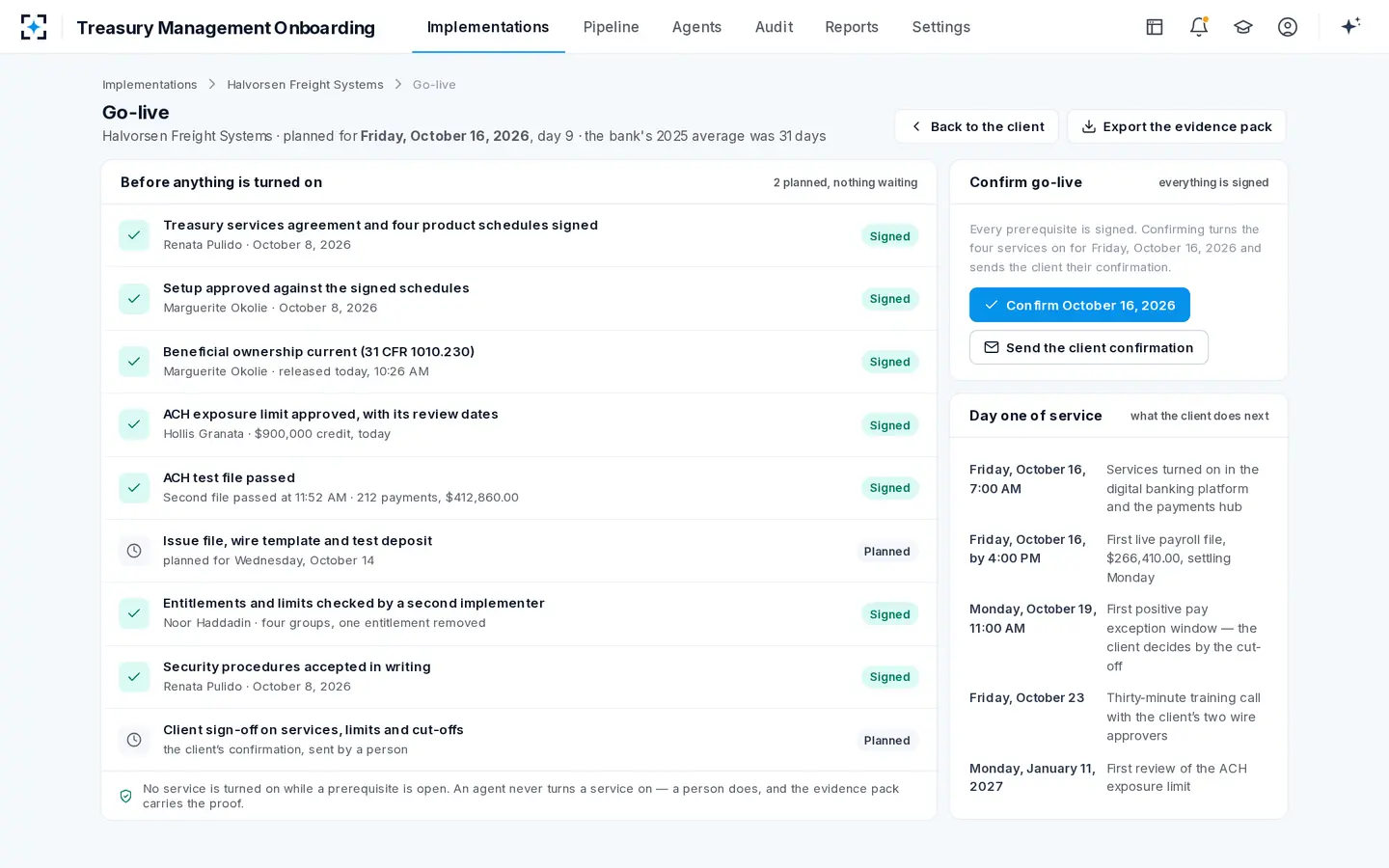
The order of evidence, and who signs each item, is set out in the treasury management checklist of eight sign-offs before go-live. Under Article 4A, the security procedure in workstream 6 is "deemed to be commercially reasonable" when a client refuses a reasonable procedure the bank offered and "expressly agreed in writing" to the one it chose (UCC § 4A-202(c)), which is why the solution keeps the signed acceptance with the go-live evidence rather than in a filing cabinet. For deposit capture clients, the FFIEC asks banks to set risk-based criteria for which customers qualify (Risk Management of Remote Deposit Capture; which clients qualify for remote deposit capture), so that decision is made and signed before the scanner ships.
To see the drafted setup, the explained test file and the limit with its arithmetic on one implementation, start from Treasury Management Onboarding.
Questions people ask
What is the treasury onboarding process?
It is eight workstreams run in parallel: agreement and schedules, business due diligence and beneficial ownership, the ACH exposure limit, digital banking setup, payments hub setup, the client's written acceptance of a security procedure, test files, and a second check before go-live. Each closes with a signed piece of evidence, and the slowest one sets the go-live date.
Who does treasury management onboarding at a bank?
A treasury management implementation specialist, sometimes titled onboarding specialist or cash management implementation specialist, coordinates it under an implementation manager. Credit, KYC operations, digital banking administration and payments operations each own a step, and the treasury officer owns the client relationship.
What slows down treasury implementation most?
In our estimate for the sample bank, test files take 12 of 31 days, more than any other step, because each failed file is a round trip through the client's own systems. The exposure limit is next, because the OCC expects it set and approved before the first ACH entry is initiated.
Do the 2026 Nacha fraud monitoring rules apply to a bank's business clients?
Yes, for those that originate ACH entries and are not consumers. Large originators were covered from March 20, 2026; all others from phase 2, dated June 19, 2026 and effective in practice on June 22, 2026. Each must run risk-based processes to identify entries initiated by fraud and review them at least annually.
Can a bank skip beneficial ownership for a treasury client it already knows?
For a new account, FinCEN's February 13, 2026 order lets the bank rely on ownership information the client gave for earlier accounts if the client certifies or confirms it is still accurate, and the bank records that confirmation. The relief is optional; a bank may still collect the information again under its own policy.