An earnings credit rate calculator turns a business client's balances into the earnings allowance that pays for its bank services: average ledger balance, less float, gives the collected balance; less any reserve deduction, the investable balance; times the earnings credit rate (ECR), times the days in the period, divided by the year basis, the allowance. Charges above the allowance are billed; credit beyond them usually lapses or carries forward under the bank's rules. Every input is set by the client's agreement, and three of them, the reserve deduction, the tier structure and the day basis, are where errors hide. The calculator below shows each line. Botminds' Account Analysis Fee Leakage Review recomputes the earnings credit for every analyzed relationship each month from the balances, the days and the agreed tiers, and flags any month where the statement's credit differs.
Earnings credit rate calculator
The default figures are an illustration, not sample client data: a $2,000,000 average ledger balance, $150,000 of float, no reserve deduction, a flat 2.00% ECR, a 30-day month on a 365-day basis and $4,000 of service charges. The allowance is $3,041.10, so the client pays $958.90; it would need about $2.43 million of collected balance for the credit to cover the month.
The earnings credit rate formula, term by term
The earnings allowance formula has five inputs and one rule, and each input is defined by the agreement, not by the analysis system. Written out: earnings allowance = (average ledger balance − average float) × (1 − reserve deduction) × ECR × days in period ÷ year basis.
The earnings allowance, line by line: the recomputation Account Analysis Fee Leakage Review runs, on illustrative figures
| Line | What it is | Illustration |
|---|---|---|
| Average ledger balance | The daily book balance averaged over the period. | $2,000,000 |
| − Average float | Deposited items not yet collected; the allowance should apply only to collected funds, unless the agreement says ledger balance. | $150,000 → $1,850,000 collected |
| × (1 − reserve deduction) | A deduction older formulas carry for the reserve requirement; the requirement has been zero since March 26, 2020. | 0% → $1,850,000 investable |
| × ECR | The rate in the client's exhibit, flat or tiered, fixed or tied to an index. | 2.00% |
| × days ÷ year basis | The days in the statement period over 365 (or 360, if the agreement says so). | 30 ÷ 365 |
| = Earnings allowance | The credit available to offset this period's service charges. | $3,041.10 |
| Charges − allowance | Billed if positive; if negative, excess credit that lapses or carries forward per the agreement. | $4,000 − $3,041.10 = $958.90 due |
Two terms are often confused. The earnings credit rate is the rate; the earnings credit allowance (or earnings allowance) is the dollar amount the rate produces in a period. A client comparing banks should compare allowances on its own balances, not rates, because float, reserve and basis conventions can move the allowance more than a few basis points of rate.
Does the earnings credit deduct reserves?
It should deduct nothing for reserves today. The Federal Reserve states that "the Board reduced reserve requirement ratios to zero percent effective March 26, 2020. This action eliminated reserve requirements for all depository institutions" (Federal Reserve Board, Reserve Requirements). A formula that still multiplies by (1 − 10%) is deducting a requirement that no longer exists.
The same month with a stale reserve line and without it
Formula still deducting 10%: $1,850,000
Formula with the reserve at zero: $1,850,000
Formula still deducting 10%: $1,665,000
Formula with the reserve at zero: $1,850,000
Formula still deducting 10%: $2,736.99
Formula with the reserve at zero: $3,041.10
Formula still deducting 10%: $1,263.01
Formula with the reserve at zero: $958.90
Formula still deducting 10%: $304.11 a month against the client, about $3,650 a year at the same balance
Formula with the reserve at zero: None
Whether a bank may still apply a deduction is a contract question: an agreement can define the allowance any way both parties accept. Public-sector clients ask directly. Delaware's 2025 banking request for proposals includes the question "Does a reserve requirement apply on balances?" (Delaware Office of the State Treasurer, RFP TRE25101-BANKINGSVC). If a client's exhibit says the credit is computed "net of reserves", the honest reading since 2020 is that the reserve is zero.
Tiered rates: where hand calculations go wrong
A tiered ECR pays different rates on different balance bands, and the agreement must say whether each band earns its own rate or the whole balance earns the rate of the band it reaches. The two readings differ by real money on a large balance, and a rate table that applies a flat rate ignores the tiers altogether.
One $7 million balance, three readings of a tiered rate, one month
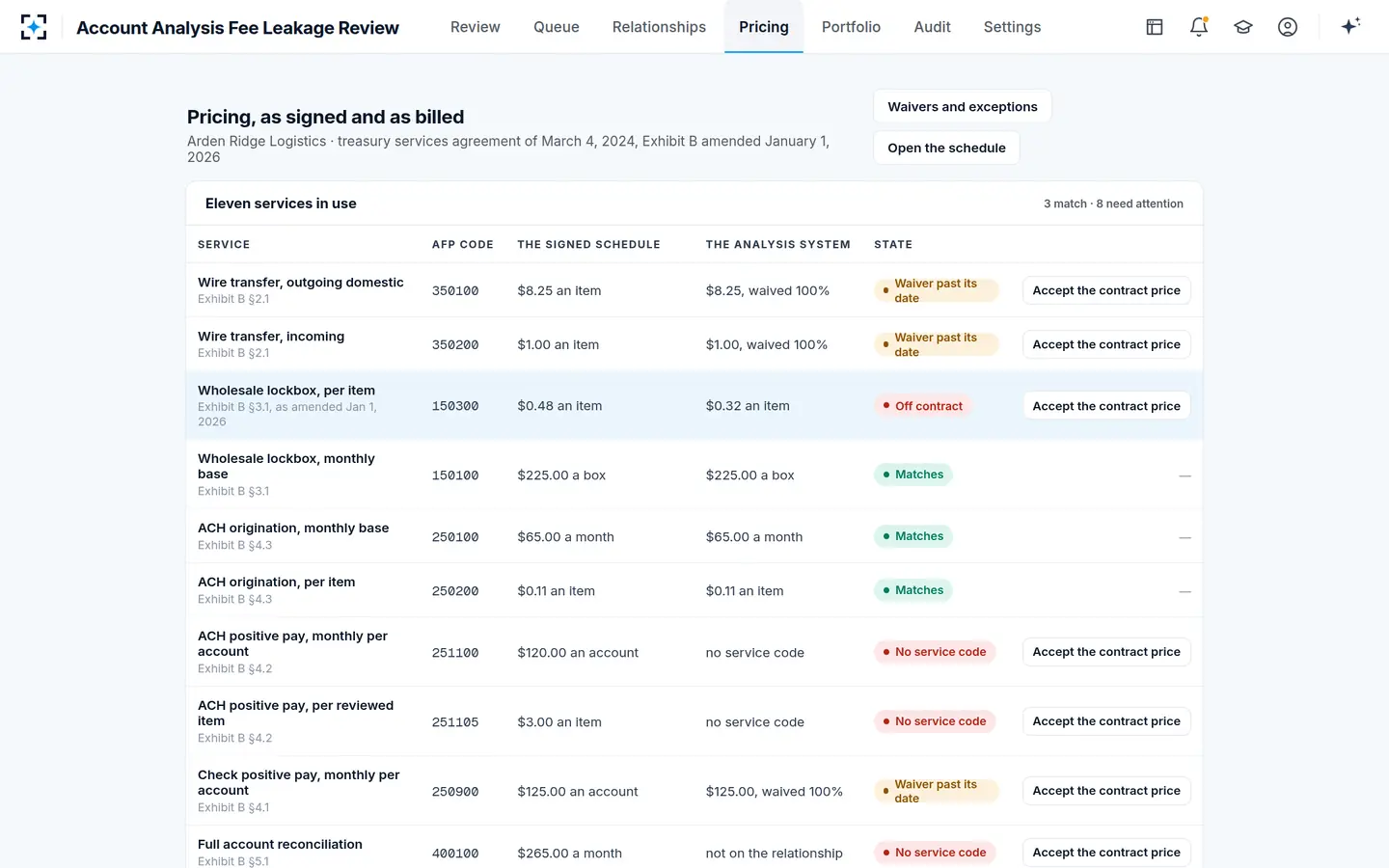
The sample relationship in Account Analysis Fee Leakage Review shows the third case. Arden Ridge Logistics' exhibit sets 1.85% up to $5 million and 2.10% above; the analysis system applied a flat 2.35% to a $4.1 million average collected balance. Below $5 million the tier rule does not matter, only the rate does, and the client was credited at 2.35% for a balance the agreement prices at 1.85%. Over-crediting is leakage for the bank, and it is the kind of difference a client is unlikely to report.
The signed schedule, including the earnings credit exhibit, beside what the system applies
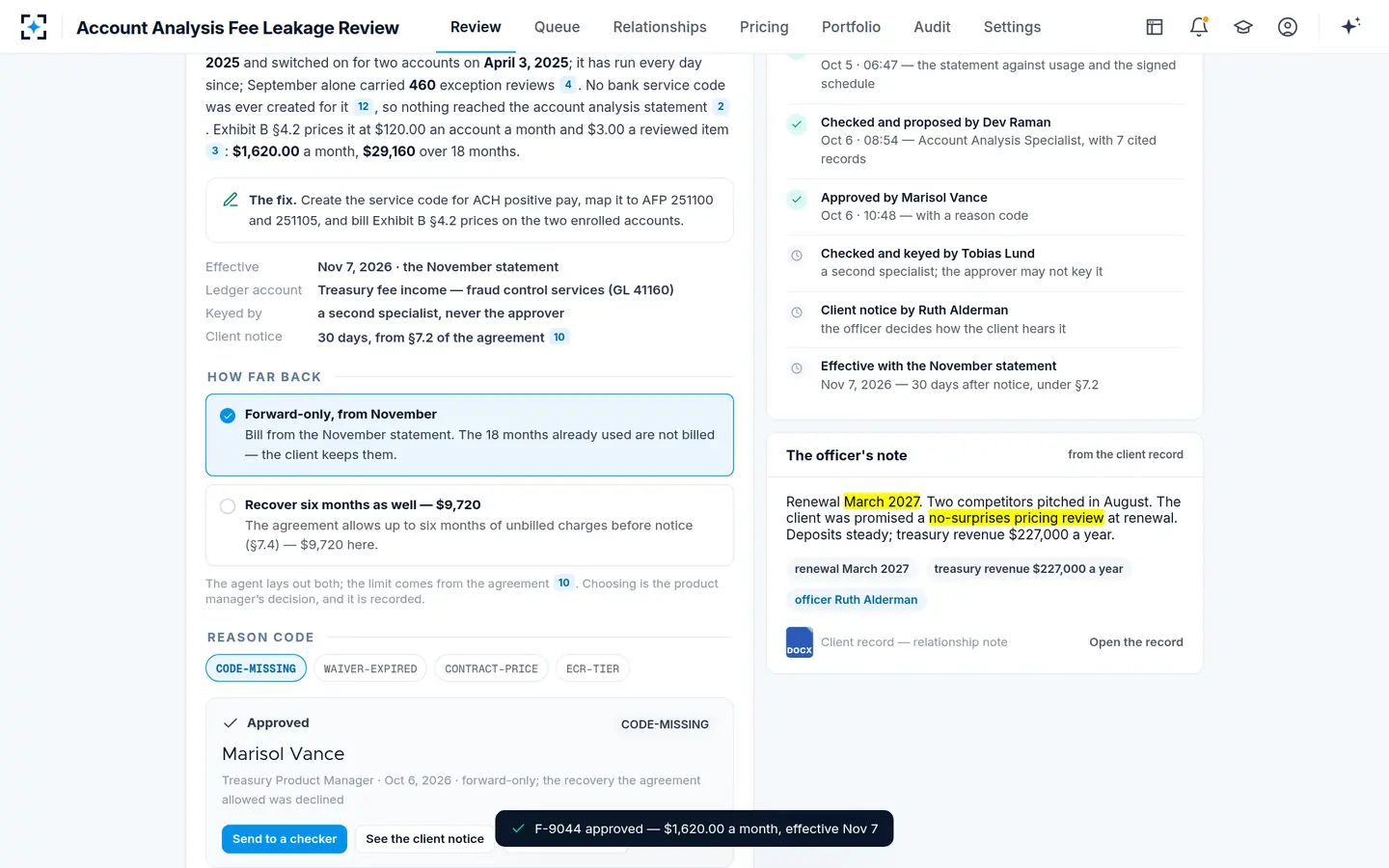
In Account Analysis Fee Leakage Review an earnings credit correction is decided like any other fix
What is the current earnings credit rate?
There is no single current earnings credit rate. Each bank sets its own, whether as a managed rate or as a spread to an index, and negotiated relationships carry their own in the exhibit. What can be stated is where the reference rates stand. On October 26, 2026 the 13-week Treasury bill was quoted at a 4.05% bank discount (4.15% coupon equivalent), up from 3.54% on January 2, 2026 (U.S. Treasury, Daily Treasury Bill Rates), and on September 16, 2026 the Federal Open Market Committee raised the federal funds target range "by 1/4 percentage point to 3-3/4 to 4 percent" (FOMC statement).
Reference rates an ECR can be set against, October 2026
How much of a rate move reaches business balances is a bank decision. In the Federal Reserve's March 2024 survey of senior financial officers, respondents reported average cumulative betas of 58% on wholesale operational deposits from March 2022 to March 2024 (Federal Reserve, March 2024 SFOS), a measure that covers deposit pricing generally, not ECRs alone. Clients who want certainty ask for an index link: Delaware's 2025 request asks bidders to provide "the earnings credit rate history for the 5-year period from January 2020" through December 2024, month by month, and whether the bank is willing to link the ECR to a market index.
How the Federal Reserve ran its own earnings credit
The Federal Reserve Banks once paid earnings credits themselves, and their rules are a clean model of the mechanism. Banks could hold contractual clearing balances at the Fed "in exchange for earnings credits", which "could be used to offset Federal Reserve priced services, such as Fedwire® funds transactions", at a rate "set by the Federal Reserve at a level comparable to the rates offered by private sector banks on their own compensating balances" (FEDS Notes, January 4, 2017).
The Federal Reserve's own earnings credit, 1980s to 2013
- Effective federal funds rate, from the start of the programto Jan 2003
- January 2003 to January 2004
- A fraction of the three-month Treasury billJan 2004 – Jul 2012
- Remaining credits run off, to 2013
Two features carry over directly to commercial account analysis. The rate was tied to an index that moved, the federal funds rate and later "a fraction of the three-month Treasury bill." And unused credits did not last forever: the Fed's earnings credits "expired 52 weeks after they were granted" (Federal Reserve, 2013 Annual Report). The Federal Reserve's 1992 survey found the same index in private banks' hands: "to calculate earnings credits, banks still predominantly use the three-month Treasury rate" (March 1992 SFOS).
Carryover and expiring credits
Excess credit is worth only what it can pay for. The 1992 survey found that "roughly 90 percent of the banks allow at least some of their customers to carry account surpluses or deficiencies into the next accounting period" and that "over 85 percent of the banks place limits on these carryovers." Those shares are three decades old; the questions are not. Whether excess credit carries forward, for how many months and whether it expires at year end are terms in the agreement, and Delaware's request asks both: whether excess credits can be carried forward, and "Is there a limit on how far forward excess earnings credits can be carried?"
For the bank, carryover is another place the engine and the agreement can diverge: an engine that carries credit indefinitely where the agreement caps it at twelve months is over-crediting, and one that lapses credit the agreement says carries is under-crediting. Both are findings in a review that recomputes the allowance from the agreement.
Earnings credit vs interest, briefly
An earnings credit pays for services; interest pays cash. The distinction is a relic of the ban on paying interest on business demand deposits, repealed in 2011. In the Federal Reserve's final rule, commenters expected clients to be offered a choice between earnings credits and interest paid in cash, and one pointed out that credits are worth nothing beyond the fees they pay (Federal Register, July 18, 2011; commenters' views, not the Board's findings; ECR vs an interest-bearing account quotes them and runs the comparison). That last point is the practical one: a client with more balance than fees gets nothing for the excess unless the agreement carries it forward or pays interest on it.
How to check the credit every month
Recompute it from the agreement, not from the statement. Take the average balances and days from the core banking system, the rate, tiers, basis, deductions and carryover rule from the exhibit, and compare the result with the credit on the statement. In Account Analysis Fee Leakage Review the Billing agent does this for every analyzed relationship each month; a difference above the materiality threshold, $50 a month in the sample settings, becomes a finding with an ECR-TIER reason code for the product manager to decide.
The earnings credit is one line of a statement whose other lines are annotated in account analysis statement vs bank statement, and its terms are part of the inputs listed in what you bring to start a review. To see the recomputation on sample data, start from Account Analysis Fee Leakage Review.
Questions people ask
How is earnings credit calculated?
Average collected balance (ledger balance less float), less any reserve deduction, times the earnings credit rate, times the days in the period, divided by the year basis, usually 365. On $1,850,000 collected at 2.00% for 30 days that is $3,041.10.
What is the earnings credit allowance formula?
Earnings allowance = (average ledger balance − average float) × (1 − reserve deduction) × ECR × days ÷ year basis. The allowance is set against the period's service charges; the client pays any shortfall, and any excess lapses or carries forward under the agreement.
Is the earnings credit rate the same as an interest rate?
No. Interest is paid in cash and is income to the client; an earnings credit can only offset the bank's service charges. Since the 2011 repeal of the ban on interest on business demand deposits, banks can offer either, or both on hybrid accounts.
Why does my ECR differ from the Treasury bill rate?
Because the ECR is the bank's own rate, usually set below its reference index or managed independently, and the agreement decides any link. The Federal Reserve's own earnings credit was "a fraction of the three-month Treasury bill" from January 2004 until the program ended in 2012.
Can excess earnings credits be carried forward?
Only if the agreement allows it. Carryover terms vary by bank and by client; ask how many months credit can be carried and whether it expires at year end, as Delaware's 2025 request for proposals does.