Bank fee recovery means collecting fees that were billed wrongly, and on business accounts it runs both ways: a corporate client recovers overcharges from its bank, and a bank recovers charges for services it provided and never billed. For analyzed business accounts no federal rule sets the lookback in either direction; the treasury services agreement does, and so do the relationship and the proof behind each claim. Botminds' Account Analysis Fee Leakage Review finds both kinds of difference each month, proves each with the usage, the statement and the signed clause, and for every undercharge lays out two options side by side, fixing forward only or recovering what the agreement allows, while a named product manager chooses and records why.
The worked figures below are sample data from a fictional bank, Corvane National Bank, and its fictional client Arden Ridge Logistics. The rules are quoted from their sources.
Two recoveries on the same analysis statement
The client recovers an overcharge: A price above the signed schedule, a waived service billed, a volume counted twice, an earnings credit below the agreed tier.
The bank recovers an undercharge: A service used with no service code, a waiver applied past its end date, a price an amendment raised but the system did not, a credit above the agreed tier.
The client recovers an overcharge: The client's treasurer, reviewing the monthly statement against the negotiated pricing.
The bank recovers an undercharge: Nobody, unless the bank compares usage and the agreement with the statement.
The client recovers an overcharge: The agreement's terms on statement review and disputes, and the relationship.
The bank recovers an undercharge: The agreement's clause on unbilled or underbilled charges, and the relationship.
The client recovers an overcharge: A refund, which the Call Report nets out of service charges on deposit accounts.
The bank recovers an undercharge: Forward-only: future fee income. Recovery: a one-time charge, and a conversation.
The client recovers an overcharge: For consumer accounts, Regulation DD governs disclosures and notice; for business accounts, the contract.
The bank recovers an undercharge: The same: Regulation DD only where an account is held by a consumer.
Can a bank bill back fees it forgot to charge?
Yes, if the client's agreement allows it, and only as far as it allows. National banks set their non-interest charges at their own discretion, within safe and sound banking principles (12 CFR 7.4002), and for a business relationship the agreement is where those decisions are written down and accepted by the client. A well-drafted treasury services agreement says whether the bank may bill a service it failed to charge, for how many months, and with how much notice.
In the sample, §7.4 of Arden Ridge's agreement allows the bank to bill unbilled charges for up to six months before notice, and §7.2 requires 30 days' notice before any billing change. Those two clauses, not a regulation, are what the Fix agent reads when it computes the recovery option.
The exception is a consumer account inside a commercial relationship. Regulation DD requires advance notice of any change in a disclosed term "if the change may reduce the annual percentage yield or adversely affect the consumer", and "the notice shall be mailed or delivered at least 30 calendar days before the effective date of the change" (12 CFR 1030.5(a)). A charge billed back on a consumer account raises questions the business agreement does not answer, which is why the solution routes any relationship with such an account through a conduct review before a notice goes out.
How far back can a bank recover fees?
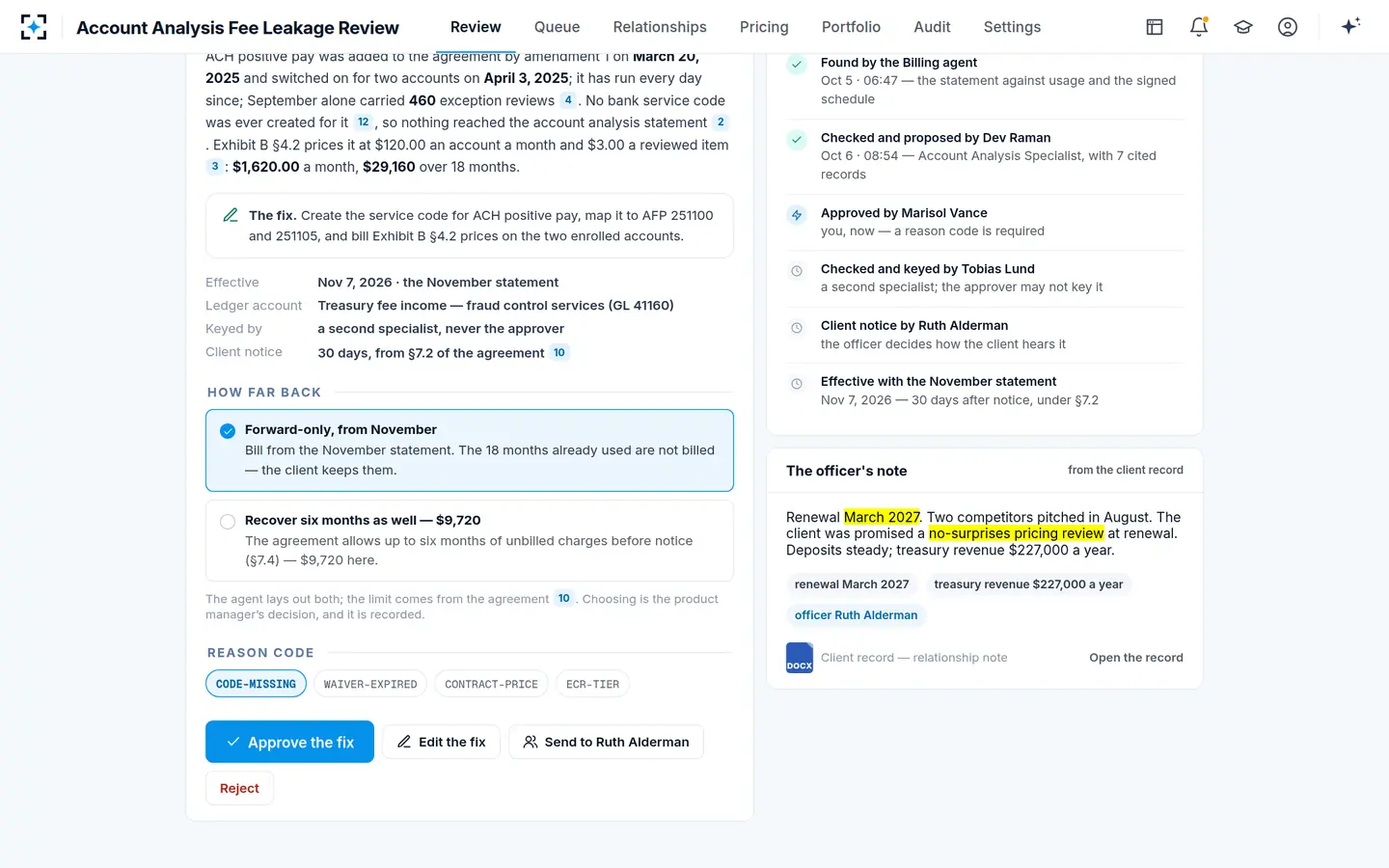
As far back as the agreement allows, and usually less far than the error runs. The sample's ACH positive pay finding shows the gap: the service ran for eighteen months with no service code, but the agreement allowed only six of them to be billed.
Eighteen months of an unbilled service, and the six the agreement lets the bank recover
- Amendment signed Mar 20, enrolled Apr 3, 2025: two weeks
- Used every day, never billed: no service code18 months
- Found Oct 5, approved Oct 6, effective Nov 7, 2026: five weeks
- Older than six months: not recoverable12 months · $19,440
- Recoverable under §7.46 months · $9,720
- Billed forward from the November 7 statement
The arithmetic matters less than what it shows. Two-thirds of this finding's value was gone before anyone looked, and it was gone because of the calendar, not the contract. A review that runs once a year on the largest relationships will find most errors after the agreement's lookback has expired; a review that runs every month finds them while the lookback still covers almost all of the loss. The Watch agent in the solution goes further and flags a service switched on in a platform with no service code within two business days, the sample bank's setting.
When the client is the one recovering: refunds and reversals
Clients run their own recovery, and public-sector treasurers are told to. The Government Finance Officers Association's best practice on bank due diligence recommends checking every monthly analysis statement for volumes that look wrong and contract prices that were not applied (GFOA, Due Diligence on Bank and Treasury Management Providers; the audit your clients run on you walks through it). A treasurer who finds an overcharge asks for a credit, and the bank's agreement decides how far back the request reaches.
For the bank, every such refund is a direct reduction of reported income: the Call Report counts service charges on deposit accounts after refunds (FFIEC 031/041 Schedule RI instructions; revenue leakage in banking quotes the definition). It is also a credibility cost. A bank that sends a client a bill-back for an undercharge in the same quarter that client found an overcharge has lost the argument before it starts. A review that reads every service, in both directions, and never nets an undercharge against an overcharge, is what lets a bank go to the client with a clean account of both. The client's side of that exercise is the subject of the audit your clients run on you.
Why time weakens a recovery claim
Every month an error runs, it becomes harder to call it an error. A first-year waiver that stays in place for nineteen months, as one did in the sample, starts to look less like a mistake and more like the price both sides accepted. Whether that argument would succeed depends on the agreement and the governing law, and it is a question for counsel, but the Uniform Commercial Code shows its shape for the transactions it governs.
"A course of performance is relevant to show a waiver or modification of any term inconsistent with the course of performance."
Uniform Commercial Code § 1-303(f), via Cornell LII
The Code defines a course of performance as conduct under an agreement with repeated occasions for performance, where the other party, "with knowledge of the nature of the performance and opportunity for objection to it, accepts the performance or acquiesces in it without objection" (UCC § 1-303(a)). Nineteen statements showing wires at zero, accepted by both sides, are repeated occasions. A treasury fee schedule is not a sale of goods and may not be governed by the Code at all; the point for a product manager is practical. The longer a difference runs, the stronger the client's position and the weaker the case for billing back, which is one more reason the waiver register needs end dates that someone watches. The waivers that never expire follows one waiver through its nineteen months.
Replay closed months before you send a letter
Before any client hears about a recovery, the bank should know how often its own findings are wrong. The way to learn that is to run the review over months that are already closed, where specialists can check each finding against what they know, and measure how many survive. In the sample bank's September cycle, about a third of findings were dismissed with a reason.
Where one Account Analysis Fee Leakage Review cycle's 3,106 findings stood: a third dismissed with a reason
Dismissal is information, not failure. The solution's rejection reason codes say why a finding did not stand: WAIVER-STILL-VALID (an extension the register did not show), AMENDMENT-PENDING (a signed change not yet loaded), DATA-INCOMPLETE, RELATIONSHIP-HOLD and IMMATERIAL. Each is recorded with the person, so the next cycle does not raise the same finding twice. On a replay, the mix of those codes tells the bank where its documents, not its billing, are the problem; a high AMENDMENT-PENDING count, for instance, says signed exhibits are reaching document imaging long before they reach the analysis system.
A replay also prices the recovery question honestly. Sum the approved findings on closed months, apply each relationship's own lookback clause, and the bank has a figure for what recovery could bring, set against a list of the clients who would receive a bill-back. That list, not the figure, is usually what decides the policy.
How to prove an unbilled service
An unbilled service is proved with three documents and a date order. The usage must come from the system that ran the service, the absence from the statement must be shown, and the price must be in a signed document that was in force when the service ran.
What a recovery file needs before any client sees it
- Usage from the source system
The platform's own report, with file name and record count: for ACH positive pay, two enrolled accounts and 460 exception reviews in September.
- The statement, showing the gap
The service code billed, or the line that is missing because no code exists.
- The signed price, with its clause
Exhibit B §4.2: $120.00 an account a month and $3.00 a reviewed item.
- The date order
The amendment adding the service was signed March 20, 2025, two weeks before enrollment on April 3, 2025; a price signed after the usage cannot be billed back to before it.
- The lookback and notice clauses
§7.4 (six months of unbilled charges) and §7.2 (30 days' notice), read from the client's own agreement, not a template.
- Any consumer account in the relationship
Flagged for a conduct review, because Regulation DD's notice rule applies to an adverse change on it.
- The relationship context
Renewal date, open pricing promises, workout status: the Fix agent skips relationships in workout or exiting.
The date order is the item most often skipped by hand. An amendment that adds a price on the first of a month and a service enrolled the month before produce a finding that is real going forward and unrecoverable backward, and only the dates tell them apart. In the solution every price carries its amendment date, and the Pricing agent reads amendments in date order so a later price never reaches back past its own signature.
Forward-only or recovery: a worked decision
The sample decision shows why the larger number does not always win. Arden Ridge had two approved findings: wire fees billed at zero under a first-year waiver that ended February 28, 2025 ($3,412.00 a month) and ACH positive pay with no service code ($1,620.00 a month). The agreement allowed $30,192 of recovery across the two. Beside the option sat the officer's note: renewal in March 2027, two competitors had pitched in August, and the client had been promised a no-surprises pricing review.
Two ways to correct the same two findings
| Forward-only | Forward plus the recovery §7.4 allows | |
|---|---|---|
| From the November 7, 2026 statement | $5,032.00 a month, $60,384 a year | $5,032.00 a month, $60,384 a year |
| One-time bill-back | None | $30,192: six months of each finding |
| Client letter | States plainly that earlier months are not billed | Explains a back-bill and its clause |
| Relationship | Keeps the no-surprises promise before renewal | Arrives with competitors in the room |
| Decision recorded | Approved, reason code, and the declined recovery on file | Approved, reason code, and the recovery amount on file |
In Account Analysis Fee Leakage Review: forward-only, or the recovery the agreement allows
The notice is part of the recovery
A recovery the client hears about from an invoice is a dispute; one it hears about from its officer, with the clause and the dates, is a conversation. In the solution no billing change takes effect before the notice period in the client's own agreement, 30 days in the sample under §7.2, and the notice is drafted for and sent by a named officer, never by an agent.
The letter the client receives, thirty days before the change
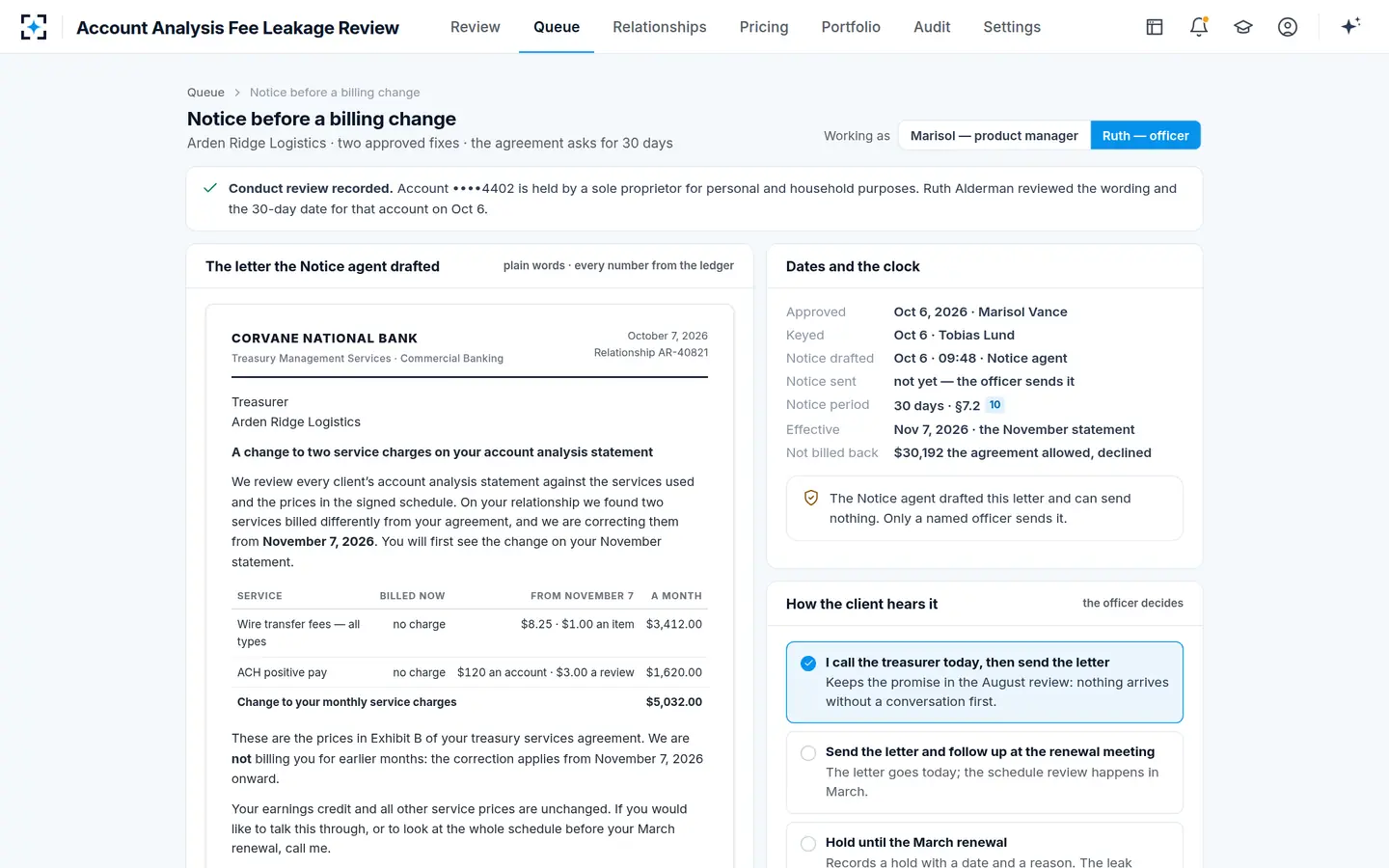
The letter carries one more decision: whether to mention what was not billed. Saying so plainly, as the sample letter does, turns a price increase into a correction with a concession attached, and the concession is real money on the record. To see the whole path from finding to letter on sample data, start from Account Analysis Fee Leakage Review.
Questions people ask
Can a bank charge back fees it forgot to bill?
On a business account, only if the agreement allows it and only for the period it allows; the sample agreement permits six months of unbilled charges before notice. On an account held by a consumer, Regulation DD's notice rules apply to any adverse change, and a back-bill needs a conduct review first.
What is the bank fee refund process for a business client?
The client identifies the overcharge from its analysis statement, by comparing volumes and prices with its negotiated schedule, and asks its treasury officer for a credit. The bank checks the claim against its own records and agreement and, if it stands, posts a credit, which the Call Report nets out of service charges on deposit accounts.
What is a bank fee reversal?
It is a credit that cancels a charge already posted, for example a wire fee billed while a waiver was still valid. In account analysis a reversal usually appears as an adjustment on a later statement; the solution's findings run in both directions, so an overcharge is a finding just as an undercharge is.
Does a bank have to give notice before raising fees on a business account?
No federal rule requires it for business accounts; the agreement does, if it sets a notice period. The sample agreement requires 30 days under §7.2. For an account held by a consumer, Regulation DD requires notice at least 30 calendar days before an adverse change takes effect.
Is it better to bill back or fix forward only?
It depends on the amount, the client and the timing. A replay of closed months gives the bank both the recoverable total and the list of clients it would affect; one defensible policy is to fix forward on relationships near renewal and recover where the agreement allows and the relationship can carry it, recording the reason either way.