An account analysis statement and a bank statement answer different questions. The bank statement is the record of an account's money: opening and closing balances, every deposit, check, ACH entry and wire, day by day. The account analysis statement is the monthly invoice for the business client's banking services: its balances averaged for the month, the earnings credit those balances earned, each service with its code, volume, unit price and charge, and the net amount due. The two meet at one line: the account analysis settlement charge, the net fee the bank debits from the client's account, which appears on the bank statement as a single transaction. A bank statement that reconciles proves the money is right; an analysis statement that adds up proves only that its own arithmetic is right. Botminds' Account Analysis Fee Leakage Review checks the second against the signed schedule and the platforms' usage every month, because an analysis statement can balance perfectly and still bill the wrong thing.
The annotated example below is built from a fictional sample client, Arden Ridge Logistics, and its September 2026 statement in the solution.
Bank statement and account analysis statement, side by side
Bank statement: What money moved through this account?
Account analysis statement: What did the client's banking services cost this month, and what did its balances earn?
Bank statement: Daily transactions and balances.
Account analysis statement: Average balances, earnings credit, each service with volume, unit price and charge, net due.
Bank statement: One account.
Account analysis statement: Usually a relationship: several accounts analyzed together, sometimes with per-account detail.
Bank statement: Monthly activity statements by the third business day of the following month.
Account analysis statement: Detailed and consolidated analysis statements by the tenth business day of the month.
Bank statement: One debit: the account analysis settlement charge.
Account analysis statement: The net due line that produces that debit.
Bank statement: Review with reasonable promptness for unauthorized items (UCC § 4-406).
Account analysis statement: Whatever the treasury agreement says; no statute sets it.
Account analysis statement vs bank statement: the short answer
The bank statement is a cash record and the analysis statement is a bill. One tells a treasurer whether payments cleared and balances are what the books say; the other tells the treasurer what the bank charged for making that happen. A business client needs both, and reconciling one does nothing to check the other.
The legal weight differs too. Under the Uniform Commercial Code, a customer who receives a bank statement must examine it promptly for items paid on an altered check or a signature it did not authorize (UCC § 4-406(c); how that duty plays out in a claim is in check fraud claim time limits). No statute imposes a similar duty for the analysis statement, and no federal rule prescribes its content for business accounts. The client's treasury agreement decides what the statement must show and how long the client has to dispute a charge.
What is an account analysis settlement charge?
It is the net fee for the month: total service charges less the earnings allowance, debited from the client's designated settlement account. On a bank statement it is often the only sign of account analysis, a single debit with a description along the lines of "account analysis settlement" or "analysis service charge", and it is the line clients search for when it surprises them. For the sample client in September it was $11,020.82: $18,940.00 of service charges less a $7,919.18 earnings credit.
When the earnings allowance exceeds the charges, there is no settlement debit at all, and the excess either lapses or carries into the next period under the agreement. That is why a client with large balances may see no analysis charge for months and then one appears: balances fell, rates fell, or a waiver ended and the charges rose.
Anatomy of an account analysis statement, section by section
Every analysis statement has three sections, whatever the bank's layout: balances and the earnings credit, service detail, and settlement. The example below uses the sample client's September figures, with notes on what each part can hide.
One account analysis statement, annotated: Arden Ridge Logistics, September 2026
1 · Balances and earnings credit
2 · Service detail (excerpt)
3 · Settlement
- A. Collected, not ledger balance: float is excluded. The reserve deduction should be zero; reserve requirements were cut to zero on March 26, 2020.
- B. The rate must match the client's exhibit. Here the exhibit sets 1.85% up to $5 million and 2.10% above, so 2.35% over-credits the client.
- 3. A waived line is only right while the waiver is. The wire waiver ended February 28, 2025; the check positive pay courtesy waiver ended June 30, 2025.
- 4. The unit price must be the latest signed one. An amendment of January 1, 2026 sets $0.48 an item, not $0.32.
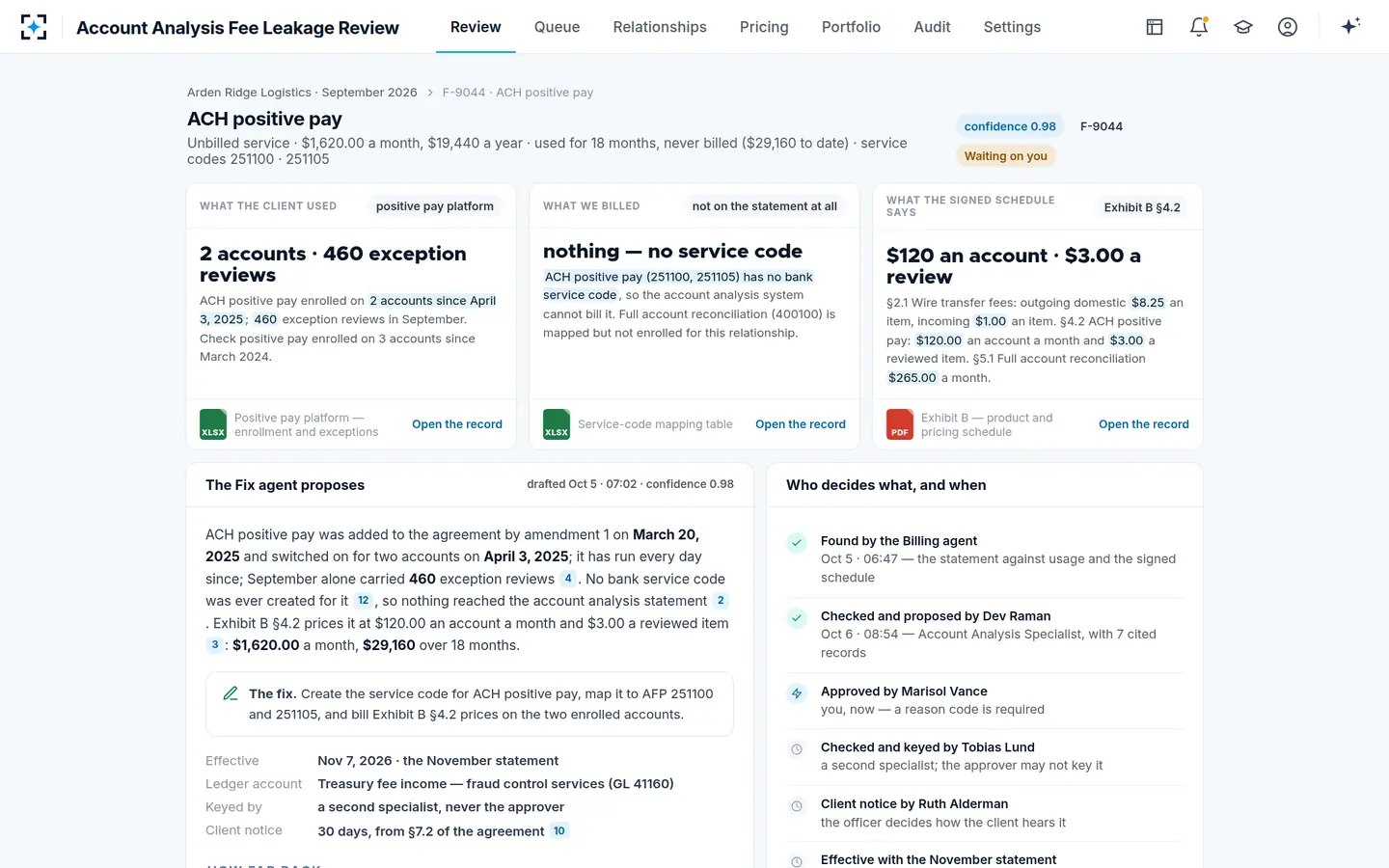
- 5. What is absent cannot be questioned from the statement. ACH positive pay ran on two accounts with no code; account reconciliation was also used and not billed.
- 6. The settlement balances, so the bank statement reconciles. None of the differences above affects either reconciliation.
Every number in the example reconciles: the charges add up, the allowance is arithmetically correct for the rate shown, and the settlement debit matches the bank statement. Six of the eleven services in use still differed from the signed schedule, and the month was about $9,200 short. None of that is visible from inside the statement. The earnings credit line is worked through in the earnings credit rate calculator, and the reserve deduction behind note A is confirmed by the Federal Reserve.
How to read an account analysis statement against the schedule
Read it with the signed exhibit open, not the bank's standard price list, and read it for what is missing as well as what is there. The Government Finance Officers Association tells public treasurers to check each monthly analysis statement for its volumes and for whether the contract prices were applied (GFOA, Due Diligence on Bank and Treasury Management Providers; its words are in bank fee analysis software); the checklist below applies the same review from either side.
Reading an analysis statement against the signed schedule
- Balances: collected or ledger balance, as agreed
And any reserve or deposit-insurance deduction shown as its own line, at the rate the agreement allows.
- Earnings credit rate and tiers
The rate on the statement against the exhibit, applied band by band if the agreement says so.
- Each unit price
Against the exhibit as amended, from each amendment's effective date.
- Each waived or discounted line
Against the waiver's end date and approver; a waiver past its date is a finding, whichever side you sit on.
- Volumes
Against your own records or the platforms' reports: wires sent, items processed, accounts maintained.
- What is not there
Every service you use that has no line, and every line for a service you do not use.
- Settlement
The net due on the analysis statement against the debit on the bank statement, and any carryover the agreement allows.
Why is there an account analysis fee on my statement?
Because the month's service charges exceeded the earnings allowance on your balances, and the bank debited the difference. Four things make the fee appear or grow: lower balances, a lower earnings credit rate, more activity, or a waiver that ended. The last is the one clients notice most, because it can add a whole service's charges in a single month.
From the bank's side, the same question has a fairness edge. A client who sees a new charge should be able to trace it to a clause, a date and a volume, and should have heard about it before the statement arrived. In the solution, a billing change takes effect only after the notice period in the client's own agreement, 30 days in the sample, and the client hears it from its officer.
What Account Analysis Fee Leakage Review sees on the same month: the price signed beside the price billed
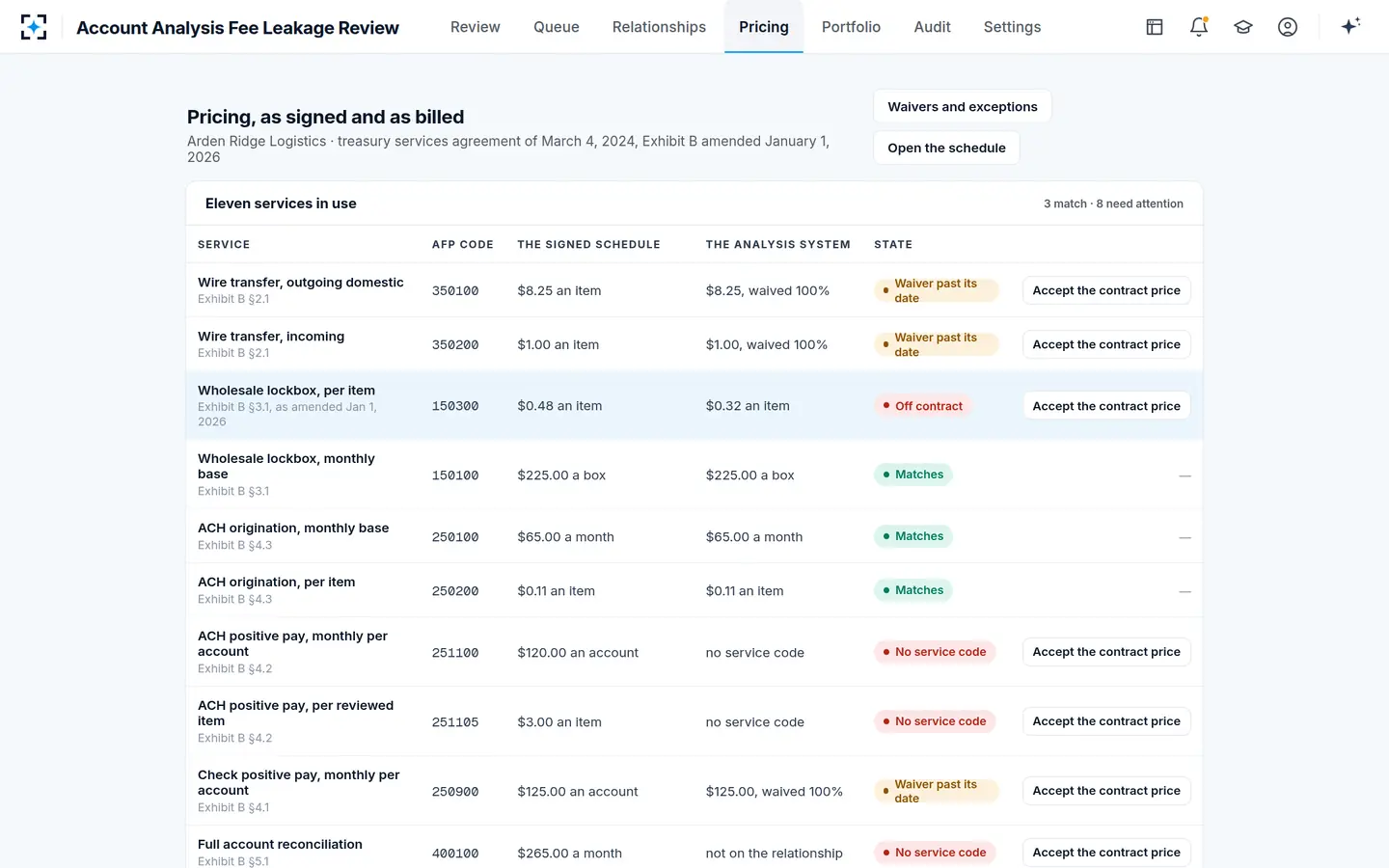
Where a difference can hide on a statement that balances
In four places, and only one of them is a number you can see. The table maps each to what to compare it with.
Where differences hide on an analysis statement, and what Account Analysis Fee Leakage Review compares
| Where | What it looks like on the statement | What reveals it | Sample |
|---|---|---|---|
| A missing line | Nothing at all | Usage from the platform that ran the service | ACH positive pay, $1,620.00 a month |
| A waived line | A charge at $0.00, marked waived | The waiver's end date and approver in the register | Wires, $3,412.00 a month, 19 months past the end date |
| A unit price | An ordinary charge | The exhibit as amended | Lockbox items, $1,840.00 a month |
| The earnings credit | A rate and an allowance | The tiers in the earnings credit exhibit | 2.35% against 1.85% |
The first two are the hardest to see because they look intentional or do not look like anything. In the sample bank's cycle they were also the two largest kinds of finding by value, and each has its own guide: the services in use that have no code and the waivers that never expire.
One difference, opened: the platform's usage, the empty statement line and the signed clause
Who reads each statement, on both sides of the relationship
Different people, on different clocks. On the client's side, the bank statement goes to whoever reconciles cash, sometimes daily through balance reporting and formally each month, because the law puts a clock on it: an unauthorized signature or alteration not reported within a year of the statement can no longer be asserted against the bank (UCC § 4-406(f); what a late report does to a claim). The analysis statement goes to the treasurer or a treasury analyst, and the cadence is a matter of practice; GFOA's best practice recommends a monthly review of it and quarterly relationship reviews with large banks.
On the bank's side the split mirrors the client's. Operations answers for the bank statement: posting, returns, disputes. The analysis statement belongs to the account analysis specialist and the treasury product manager, who own the prices, waivers and codes behind it, and to the treasury officer, who hears about it first when a client is unhappy. A review that puts usage, the statement and the signed schedule on one screen gives all three the same facts at the same time, which is the point of the solution's single view per relationship.
Statements as files: the 822 and the global format
A treasurer does not have to read the analysis statement as a page; it can arrive as a file. ASC X12's 822 account analysis transaction set "can be used to transmit detailed balance, service charge and adjustment detail primarily from a bank to its corporate clients" (X12, Transaction Sets), and Delaware's 2025 banking RFP asks bidders whether they can send one (Delaware RFP TRE25101-BANKINGSVC), a question bank fee analysis software answers from the client's side. Outside the U.S., bank-fee statements travel in the camt.086 format, with their own eight-digit service codes.
"Can the account analysis details be downloaded into Microsoft Excel?"
Delaware Office of the State Treasurer, RFP TRE25101-BANKINGSVC (June 9, 2025)
A file makes the client's review faster and the bank's errors easier to find. The same structured detail that lets a treasurer's tool line up volumes and prices month by month lets a bank's review compare them with platform usage and the signed schedule. To see that comparison on sample data, start from Account Analysis Fee Leakage Review.
Questions people ask
What is an account analysis statement?
It is the monthly statement a bank gives a business client for its analyzed services: average balances and the earnings credit they earned, each service with volume, unit price and charge, and the net due. It is an invoice, not a record of transactions.
What does "analysis charge" mean on a bank statement?
It is the net service fee from the month's account analysis: total service charges less the earnings allowance, debited from the settlement account. If the allowance covered the charges, there is no analysis charge that month.
Does an account analysis statement show transactions?
It shows volumes, not transactions: 400 outgoing wires at a unit price, not each wire. The transactions themselves are on the bank statement and in the platforms' own reports.
When does the account analysis statement arrive?
After the month closes, on the bank's schedule or the agreement's. Delaware's 2025 RFP asks for detailed and consolidated analysis statements by the tenth business day of the month, against activity statements by the third business day.
Can an account analysis statement be wrong if it balances?
Yes. Balancing proves the arithmetic, not the inputs: a missing service code, a waiver past its end date, an outdated unit price or an earnings credit outside the agreed tiers all produce a statement that balances. In the sample, a balanced statement was about $9,200 short for the month.