Bank fee analysis software is what corporate and public treasurers use to audit the fees their banks charge: it loads monthly account analysis statements, often as electronic files, maps each bank's service codes to a common standard, compares volumes and unit prices with the pricing negotiated in the last request for proposals, tracks the earnings credit, and flags anything that changed. The audit is aimed at the bank, and it finds what a client can see: prices above the agreed schedule, waived services that started being charged, volumes that look wrong. It cannot see what the bank's own platforms recorded or what its waiver register says, so it rarely finds what the bank under-billed. Botminds' Account Analysis Fee Leakage Review is the bank-side counterpart: it compares every analyzed relationship's statement with platform usage and the signed schedule each month, finds the differences in both directions before the client's audit does, and leaves every decision to a named person at the bank.
This guide is written for the bank's treasury product team, from the client's side of the table. The worked figures are sample data from a fictional bank, Corvane National Bank, and its fictional client Arden Ridge Logistics.
The client's fee audit and Account Analysis Fee Leakage Review, side by side
The client's bank fee analysis: The analysis statement or 822 file, the negotiated pricing, the client's own records.
The bank's review in Account Analysis Fee Leakage Review: The statement, usage from the payments hub, lockbox, positive pay and core banking, the signed agreement with every amendment, the waiver register.
The client's bank fee analysis: Prices above the schedule, charges for waived services, volume spikes, earnings credit changes.
The bank's review in Account Analysis Fee Leakage Review: All of those, plus services used with no code, waivers past their end date, prices below an amendment, credits above the agreed tiers.
The client's bank fee analysis: Usage the bank never billed; the bank's waiver register and approvers; the amendment loaded or not.
The bank's review in Account Analysis Fee Leakage Review: The client's internal view of value, and services run on systems the bank has not connected.
The client's bank fee analysis: Mostly overcharges: the client has no reason to report an undercharge.
The bank's review in Account Analysis Fee Leakage Review: Both, never netted against each other.
The client's bank fee analysis: A dispute, a credit request, or evidence for the next RFP.
The bank's review in Account Analysis Fee Leakage Review: A finding per difference, decided with a reason code, keyed by a second specialist, told to the client by its officer.
What does bank fee analysis software do?
It turns a stack of bank invoices into a single, comparable dataset. The core steps are the same whatever the tool: ingest statements from every bank, as PDFs, spreadsheets or electronic files; map each bank's service descriptions and codes to a standard; compare each month's volumes and unit prices with the agreed pricing and with prior months; check the earnings credit; and report by bank, by service family and by account.
Electronic statements make this practical. ASC X12's 822 account analysis transaction set carries the statement's balances, service charges and adjustments in a form a client's software can read (X12, Transaction Sets; account analysis statement vs bank statement reads one), and public clients write the requirement into their RFPs; Delaware's 2025 banking request asks, "Is the Firm able to send analysis statements in an 822 file?" (Delaware Office of the State Treasurer, RFP TRE25101-BANKINGSVC). A bank that cannot send structured statements is asking its clients to audit it by hand, which slows their audit without stopping it.
How do companies audit bank fees?
Against the contract, month by month, and against the market every few years. Public-sector treasurers have the most explicit guidance. The Government Finance Officers Association recommends that governments monitor their banks with a review of the monthly analysis statement, conduct quarterly relationship review meetings with large banks, and re-bid: "GFOA recommends that governments review their financial services contracts every five years and use a competitive process for the procurement of financial services" (GFOA, Procurement of Financial Services).
"A Review of the monthly account analysis statement or invoice to determine if volume counts are appropriate and consistent and to be sure that contract pricing is properly applied to the account analysis or invoice."
Government Finance Officers Association, Due Diligence on Bank and Treasury Management Providers (board approval May 31, 2014)
The RFP sets the baseline that every later statement is audited against. Delaware's 2025 request asks bidders to complete a schedule of fees and to "provide a sample analysis statement that uses the Firm's actual service names and expected volumes and pricing" (Delaware RFP), so the client can compare the pro forma with the first real statements. Corporate treasurers follow the same pattern with less formality: a pricing exhibit at onboarding or renewal, then a monthly or quarterly comparison of statements with it.
What a public treasurer is told to check
Volumes, contract pricing, and whether the services still make sense. GFOA's best practice asks the treasurer to "use the account analysis/invoice as well as internal knowledge to determine if product usage is appropriate from month to month", and to ask whether newer products should replace existing ones, whether "less expensive ways" exist to process the same transactions, and "Can transactions be processed more safely?" (GFOA, Due Diligence). The first two questions are an audit of the bank's billing; the last three are a review of the bank's proposition, and they arrive at renewal.
For a bank, that list is a forecast of the conversation. A client who has checked volumes and prices every month arrives at renewal with a file of discrepancies, and every overcharge in it weakens the bank's position on price. A bank that has already found and corrected them, and told the client, arrives with a cleaner file than the client's.
Can a company dispute account analysis fees?
Yes, under the terms of its treasury services agreement. For business accounts no federal rule sets the dispute process: Regulation DD's disclosure and notice rules apply to accounts that individuals hold primarily for personal, family or household purposes (12 CFR 1030.2; account analysis in banking quotes the definition). A business client raises the dispute with its treasury officer, citing the statement line and the agreed price, and the agreement decides how far back the claim reaches.
For the bank, a successful dispute is a refund, and refunds come straight off reported fee income: the Call Report records service charges on deposit accounts "net of amounts refunded to depositors" (FFIEC 031/041 Schedule RI instructions). It is also evidence, in the client's file, that the bank's billing needs watching. Bank fee recovery covers how far back each side can go, and why time favours the client.
Bank fee benchmarking and its limits
Benchmarking compares one bank's prices with others', and it is only as good as the code mapping underneath. The standard service codes help, but banks use them differently. In one public cost schedule from a New Jersey state authority's banking RFP, a single code, 050400, labels three different lockbox services, and 999999 sits beside five electronic lockbox charges filed as "Undefined services" (HESAA, Depository Banking Services RFP, Exhibit K). A benchmark that compares code by code will compare unlike services.
Why two banks' fees are harder to compare than they look
| Difference | Effect on a benchmark | What a careful comparison does |
|---|---|---|
| One code for several services | Prices for different services averaged together | Compares by service description and unit, not code alone |
| Catch-all codes | Charges drop out of the comparison | Maps each catch-all line by hand |
| Different pricing units | Per item at one bank, per file or per month at another | Prices the client's own volumes under each schedule |
| Different earnings credit terms | A lower fee offset by a lower credit | Compares net cost: charges less the allowance on the same balances |
| Waivers and exceptions | A low price that ends after year one | Compares the price after every waiver ends |
The last row is where a client's benchmark and a bank's billing meet. A bank that wins a relationship with a first-year waiver is betting the client will pay the full price in year two; a client benchmarking on year-one statements will overrate the bank, and a bank whose waiver never ends will under-bill it. The waivers that never expire follows one such waiver through nineteen months.
The same statement, read from the bank's side
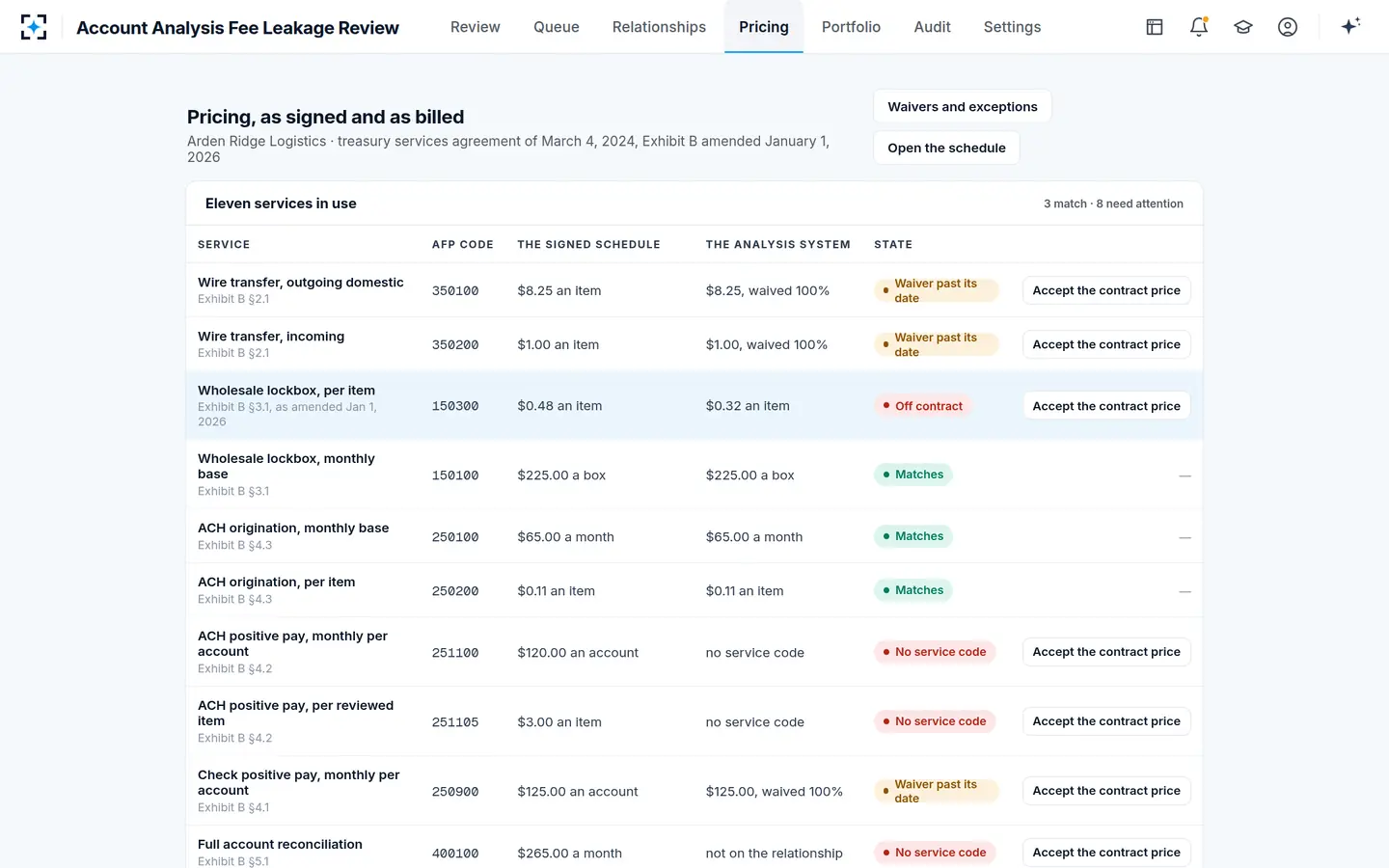
The bank can see everything the client's tool sees and three things it cannot: what the platforms recorded, what the signed exhibit says as amended, and what the waiver register says about approvers and end dates. That is why the bank's review finds what the client's misses, and why it should run first. In the sample, the client's statement for September was arithmetically perfect, and the bank's review found six of eleven services in use priced differently from the schedule, about $9,200 for the month, every one of the six against the bank.
The signed schedule beside what the analysis system holds: the view a client's tool never has
Who reads the statement on each side, before and with Account Analysis Fee Leakage Review
Today
Loads each bank's analysis statements, maps the bank's codes to standard ones, and compares volumes and prices with the pricing negotiated at the last RFP.
With agents
Sees fewer surprises: price changes arrive with a letter from the officer, with the clause and the date, before the statement does.
Still theirs: The right to dispute any line, and the next RFP.
Today
Answers the client's questions line by line, after the client has found the problem.
With agents
Has already compared every line with platform usage and the signed schedule, in both directions, and can show the source for each number.
Still theirs: Judgement on each difference, and keying of approved changes made by someone else.
Today
Learns of an overcharge from a client's audit and of an undercharge almost never.
With agents
Decides each difference with a reason code: fix, recover within the agreement, refund, or dismiss.
Still theirs: Every pricing decision.
Today
Hears about a billing problem when the client calls.
With agents
Tells the client first, with a drafted letter and the dates already checked.
Still theirs: The relationship conversation.
What to look for in bank-side fee review software
The client's tool is the benchmark: the bank's review should find at least what a client's audit would find, plus what only the bank can see. These are the questions to ask.
Questions for software that reviews a bank's own analysis billing
- Does it find overcharges as readily as undercharges?
A review that only finds money for the bank will not survive the first client conversation.
- Does it read usage from the platforms?
Only platform usage reveals services with no code, which no client audit can find.
- Does every price carry its clause and amendment date?
So the officer can show the client exactly what was signed.
- Does it read waivers with approver and end date?
And refer, not reprice, a waiver with no approver.
- Does it keep each difference separate?
Never netting an undercharge against an overcharge.
- Who approves, who keys, who tells the client?
Three different people; the software should make the separation impossible to skip.
- Does the client hear it before the statement?
A drafted notice, with dates from the client's own agreement, sent by a named officer.
- Can it start on closed statements?
So the first findings are the bank's own, before any client is involved.
A complete evaluation of the agents and their limits is in account analysis software that checks the contract.
Where the bank-side review fits, and where it does not
It fits where clients audit their statements, and where the bank's agreements, amendments and waivers live in documents rather than the billing engine. It does not replace the client's audit, and it should not try to: the client's tool is the client's control. Nor is it a benchmarking or pricing tool; it returns the price the client signed, never a price it thinks the market will bear.
The client hears it from its officer, thirty days before the statement changes
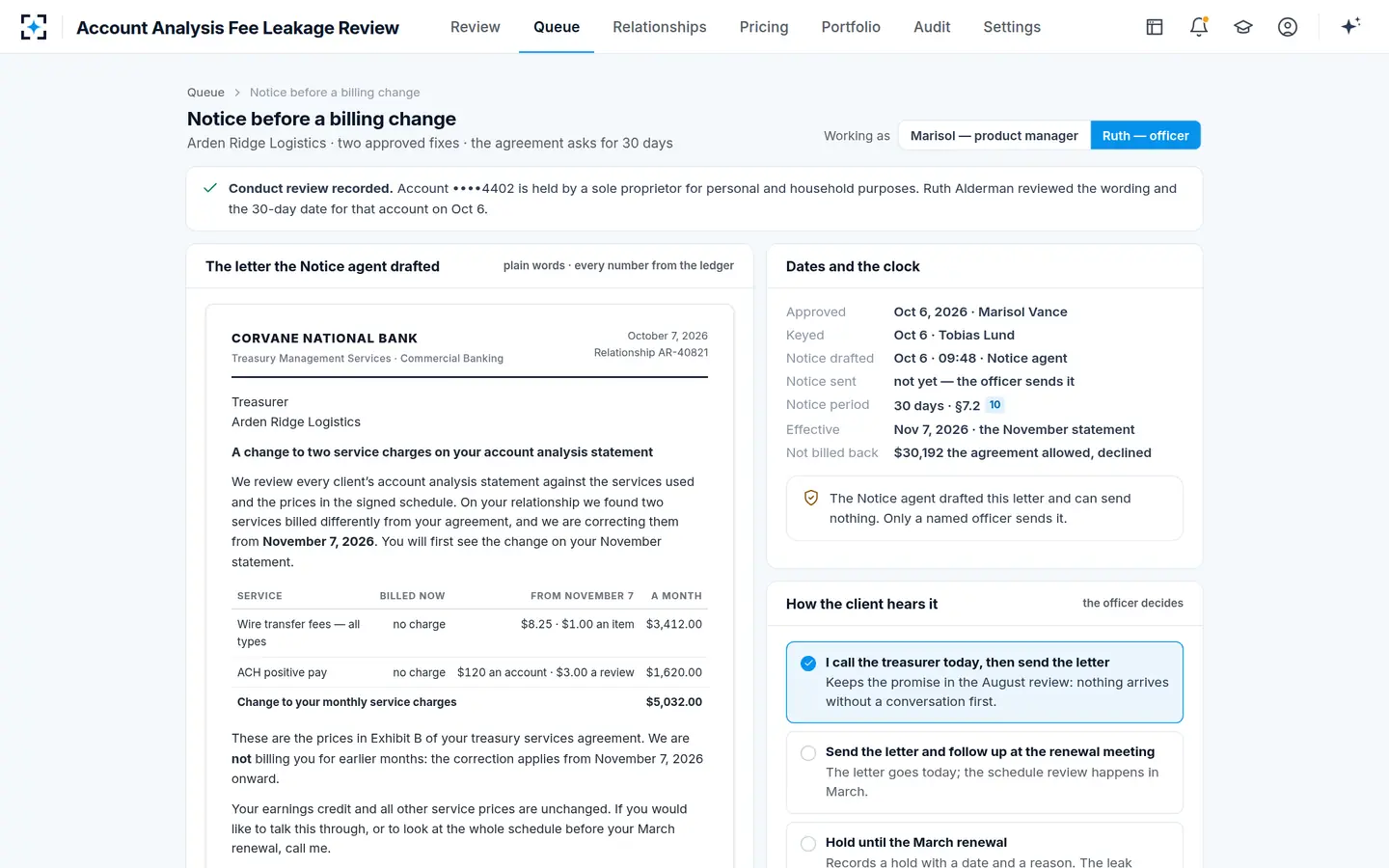
The sample shows the trade. The bank found $5,032.00 a month of services the client used at signed prices but was not being billed for, ended them forward-only after 30 days' notice, and declined the $30,192 the agreement would have allowed it to bill back, because the relationship was renewing in March 2027. The client's own audit would have found none of it. To see the review on sample data, start from Account Analysis Fee Leakage Review.
Questions people ask
What is a bank fee analysis template?
A spreadsheet that lists each service with its standard code, pricing unit, agreed price and monthly volume, so a treasurer can compare each statement with the contract. Public RFP pricing schedules, such as HESAA's published vendor cost schedule, show the usual layout: code, service description, charge basis and price.
What should a treasurer check on an analysis statement?
Volumes against the company's own records, unit prices against the signed schedule, waived lines against their end dates, the earnings credit rate and balance basis against the agreement, and the settlement debit against the bank statement. GFOA recommends the review monthly.
What does a bank fee analysis tool not catch?
Anything the statement does not show: a service the bank never billed, a waiver that should have ended, an amendment the bank never loaded at a higher price. Those favour the client, so the client has little reason to look for them; only the bank's own review finds them.
Should a bank tell a client about an undercharge?
Yes, before the bill changes. In the solution a billing change takes effect only after the client's notice period, 30 days in the sample, and the letter states what will be billed, from when, and what earlier months are not being billed.
Is bank fee benchmarking reliable?
Only after careful mapping. Banks apply standard codes unevenly, price in different units and offset fees with different earnings credit terms, so a reliable benchmark prices the client's own volumes under each schedule and compares net cost after the earnings allowance.