Treasury management fees are the charges a bank makes to business clients for cash management services: account maintenance, deposits and items, ACH origination, incoming and outgoing wires, lockbox processing, positive pay, account reconciliation and information reporting. Most are priced per item or per account a month, billed once a month through account analysis, and paid either directly or with the earnings credit on the client's balances. The price on the signed schedule is often not the price billed, because negotiated relationships carry waivers and pricing exceptions: a first-year waiver at onboarding, a courtesy after an outage, a discount at renewal. Each has an end date, and the analysis system keeps applying it until someone removes it. Botminds' Account Analysis Fee Leakage Review reads every waiver's approver and end date, warns the officer before it ends, and turns one that has run past its date into a finding a person must decide.
The examples come from a fictional bank, Corvane National Bank, and its fictional client Arden Ridge Logistics, as their register and statements run through the solution.
What treasury management fees are charged for, and how each is counted
| Service family | Typical pricing unit | Where the volume comes from |
|---|---|---|
| Account maintenance | Per account, per month | Core banking system |
| Deposits and items | Per deposit, per item, per check paid | Core banking and item processing |
| ACH origination | Monthly base, per file, per item | Payments hub |
| Wire transfers | Per incoming and per outgoing wire | Payments hub |
| Lockbox | Monthly per box, per remittance item | Lockbox platform, including late files |
| Positive pay | Per account a month, per exception reviewed | Positive pay platform |
| Reconciliation and reporting | Per account a month, per report or module | Core banking and reporting platforms |
What are treasury management fees?
They are the bank's charges for moving, collecting and protecting a business client's money, and when levied on deposit accounts they are reported as deposit service charges. The Call Report's "service charges on deposit accounts" line includes maintenance charges, charges driven by the checks and deposits on an account, and wire transfer charges, all counted after refunds (FFIEC 031/041 Schedule RI instructions, item 5.b; the definition is quoted in account analysis in banking).
A treasury fee has three parts, and all three are written in the client's agreement: the service (with its code), the pricing unit, and the unit price. A change to any of them, a new service sold, a unit redefined, a price amended, has to be carried into the analysis system before it reaches a statement. A fee that is correct on paper and wrong on the bill is a change that did not make that trip, or a waiver that outlived its date.
How treasury management fees are charged: hard and soft dollars
Through account analysis, once a month. The bank counts each service's volume, prices it, totals the charges, and offsets them with an earnings allowance on the client's collected balances; the client pays only the shortfall. Paying through the credit is called paying in soft dollars, paying the fees directly in hard dollars, and sophisticated clients ask whether the price depends on the choice. Delaware's 2025 banking request for proposals asks: "Does the State have the choice of paying the Firm by either “hard dollars” or “soft dollars”? Is the pricing the same for either option?" (Delaware Office of the State Treasurer, RFP TRE25101-BANKINGSVC).
The earnings credit side has its own errors, covered in the earnings credit rate calculator. The rest of this guide is about the charge side, and specifically the part of it that is switched off.
Who decides the price of a treasury service?
The bank does, and then the client agrees to it. For national banks, 12 CFR 7.4002 makes the amount of a fee and how it is calculated "business decisions to be made by each national bank, in its discretion", and lists the factors a bank considers, starting with "the cost incurred by the national bank in providing the service", "the deterrence of misuse by customers of banking services" and the bank's competitive position under its business plan (12 CFR 7.4002, as amended effective June 30, 2026).
A waiver is the competitive-position factor at work: the bank gives up a fee for a period to win or keep a relationship, and relationship pricing in banking sets out what an approved exception should record. Clients know this and plan around it. The Government Finance Officers Association tells governments to re-bid their banking contracts competitively every five years (GFOA, Procurement of Financial Services; what a public treasurer is told to check), and every competitive process produces a new set of concessions with new dates.
Where the discount lives: waivers and pricing exceptions
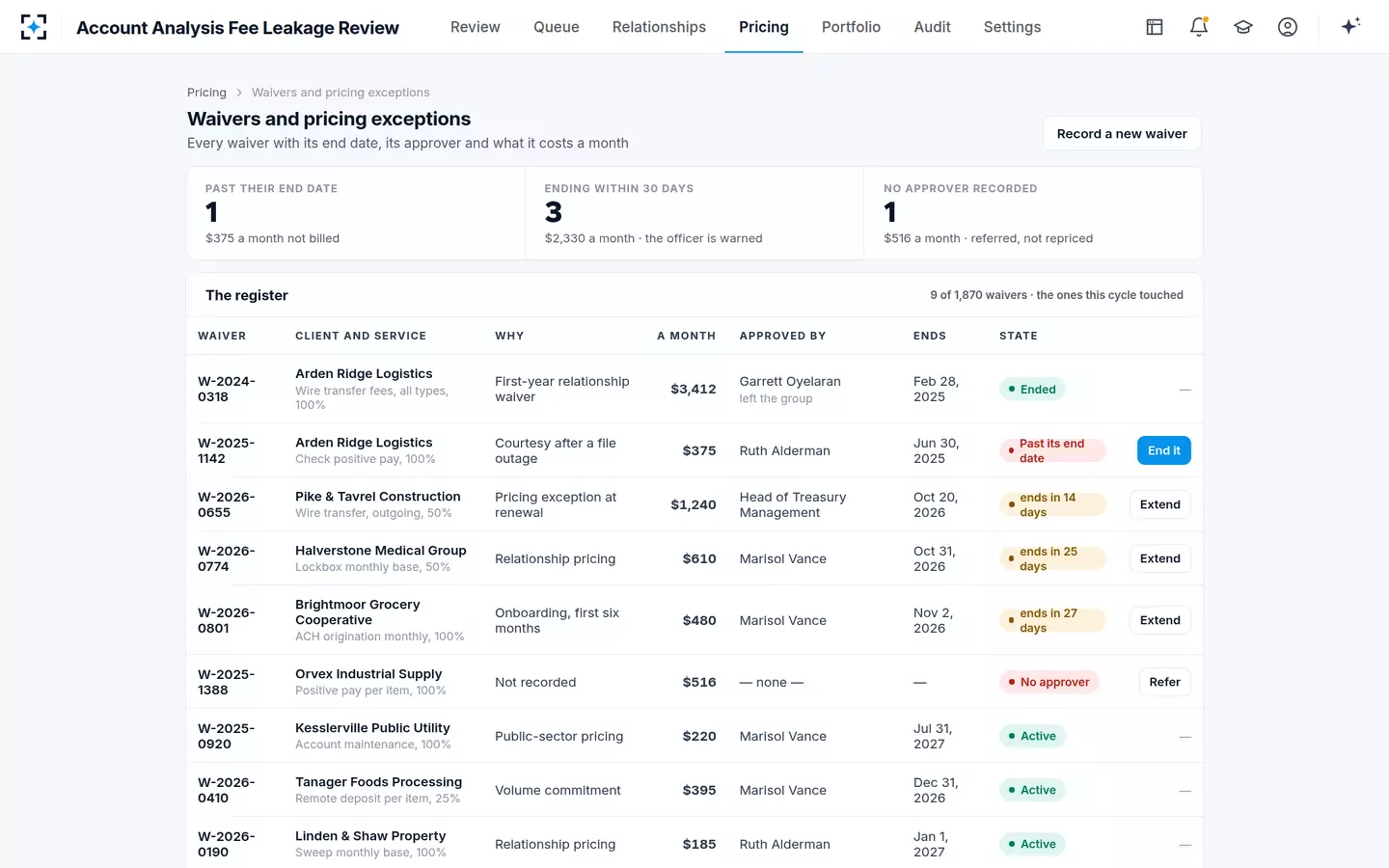
In the analysis system a waiver is usually a percentage on a service; everything else about it lives elsewhere. Who approved it, why, and until when are in an email, a pricing committee note or a register. The sample bank keeps a register of 1,870 waivers, and the reasons on it are the familiar ones: first-year relationship waivers, onboarding waivers for the first six months, relationship pricing, a pricing exception granted at renewal, a volume commitment, public-sector pricing, and a courtesy after a file outage.
What one September cycle's waiver checks found, in dollars a month
The categories behave differently. A first-year or onboarding waiver has a natural end date and is, in our view, the likeliest to be forgotten, because nobody involved in granting it is thinking about the relationship a year later. A courtesy waiver after an incident is small and short, which makes it easy to leave on. Relationship pricing and volume commitments can be tied to renewal, which at least gives them a moment when someone looks.
What happens when a fee waiver expires?
Nothing, unless someone ends it. The analysis system applies the waiver percentage it holds; an end date in an approval email does not reach the engine on its own. The sample's first-year wire waiver shows the result: granted when Arden Ridge Logistics became a client in March 2024, ending February 28, 2025, and still applied nineteen months later.
One first-year wire waiver in Account Analysis Fee Leakage Review: twelve months agreed, nineteen more applied
- First-year waiver, as approved12 months
- Past its end date, still applied19 months · $64,828
- Found, approved, noticed in five weeks; billed from Nov 7, 2026
Nineteen months is long enough to change the conversation with the client. After a year and a half of free wires, the waiver looks less like a concession that ended and more like the price, and billing back the difference becomes a negotiation rather than a correction; bank fee recovery covers why time weakens that claim. In the sample, the product manager ended the waiver forward-only from the November statement, and the client heard it from its officer first, with a letter saying plainly that earlier months were not being billed.
The waiver register: every waiver with its end date, its approver and what it costs a month
Who approves a treasury fee waiver?
Whoever the bank's pricing policy names, and the register must show who that was. In the sample register, approvers include the treasury product manager, relationship officers and, for a renewal exception, the head of treasury management. Two cases need special handling. A waiver whose approver has left the bank is still valid until its end date, but nobody is watching it; and a waiver with no approver recorded at all is not evidence of a price, so the solution refers it for review and removes it from client-facing views rather than repricing it.
The control principle is the same as for any change to a client's account. The FDIC's examination manual asks management to divide duties so that no one person handles a transaction from start to finish (FDIC RMS Manual, Section 4.2; dual control in banking quotes it). For waivers that means the person who grants one is not the person who keys it, and the person who keys it is not the only one who knows when it ends. In the sample settings, any fix above $5,000 a month also needs a second approver.
"The enhancement of the competitive position of the national bank in accordance with its business plan and marketing strategy"
12 CFR 7.4002(c)(2)(iii), as amended effective June 30, 2026
That factor justifies a waiver; it does not justify an indefinite one. A waiver granted for competitive position has a business plan behind it, a first year to win the relationship or a renewal to keep it, and the end date is part of the plan.
How to track bank fee waivers
Track each waiver as a dated decision, with an owner and a warning before it ends. A spreadsheet can hold the fields; what it cannot do is compare them with the analysis system every day and tell the right person in time.
What a fee waiver tracker needs for each waiver, as Account Analysis Fee Leakage Review reads it
- Client, service and service code
So the waiver can be matched to the line it suppresses on the statement.
- Percentage and dollars a month
At current volume, so the cost of the waiver is visible: $3,412 a month for the sample wire waiver.
- Reason
First year, onboarding, renewal exception, courtesy, volume commitment, public sector.
- Approver, by name and role
And a flag when the approver leaves the bank or the role.
- Start and end dates
A waiver without an end date is a permanent price change, and should be approved as one.
- A warning before the end date
Thirty days in the sample settings, to the officer and the product manager.
- A daily comparison with the analysis system
Any waiver applied past its date becomes a finding; any waiver in the system but not in the register is referred.
- The decision at expiry
End, extend with a new date and approver, or refer; each with the person and the reason on file.
The Watch agent runs this check every morning in the solution, and it never ends or extends a waiver itself. In the sample cycle it reported three waivers ending within 30 days, worth $2,330 a month, so each officer could decide before the date rather than after it.
Treasury management fee disclosure for consumer accounts
For business accounts the agreement is the disclosure; for consumer accounts Regulation DD is. If a commercial relationship includes an account held by an individual primarily for personal, family or household purposes, that account's fees must be disclosed, each fee's amount or how it will be worked out (12 CFR 1030.4(b)(4); the rule's words are in the account analysis fee schedule), and ending a waiver on it is a change that "may ... adversely affect the consumer", which needs notice at least 30 calendar days before it takes effect (12 CFR 1030.5(a)).
A first-year waiver still applied long after its end date, as the review shows it
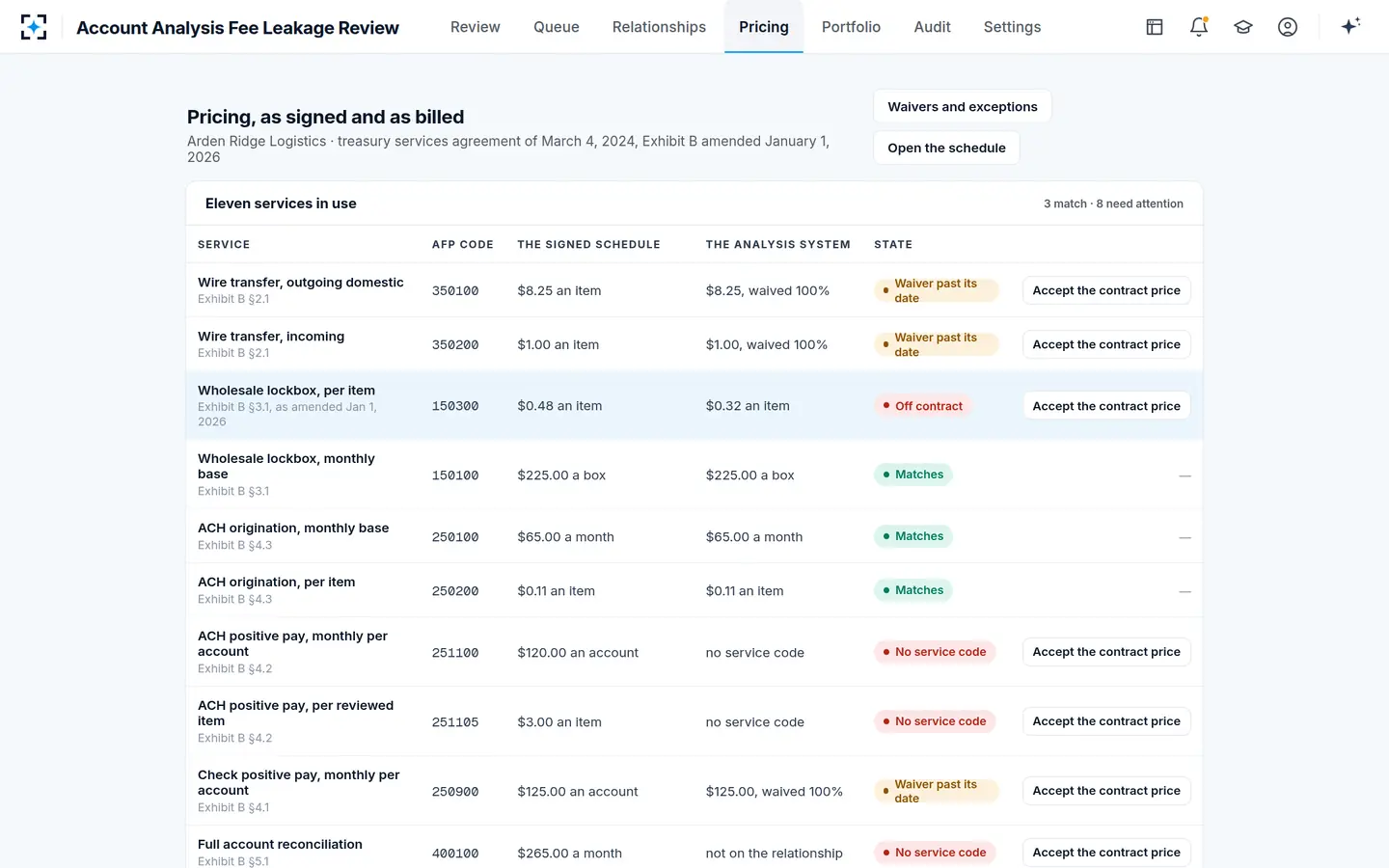
The sample relationship had one such account among nine, so the letter ending the wire waiver went through a conduct review of its wording and date before the officer sent it. To see the register, the warning and the letter together on sample data, start from Account Analysis Fee Leakage Review; what you bring to start a review lists the register fields a first cycle needs.
Questions people ask
What is a treasury management service fee?
It is a charge for one cash management service, such as an outgoing wire, an ACH file, a lockbox item or a positive pay exception review, priced per item or per account a month. On an analyzed account it appears as a line on the monthly account analysis statement and is settled against the earnings credit.
How long should a first-year waiver last?
As long as the approval says, usually twelve months from the start of the relationship, and not a day longer without a new decision. The sample waiver was approved for the client's first year and ended on February 28, 2025; its cost came from the nineteen months it ran after that.
Can a bank raise treasury management fees during a contract?
Only as the agreement allows, usually on notice; the sample agreement requires 30 days under §7.2. Ending an expired waiver is not a price increase but a return to the signed price, though the client will see it as one.
Are treasury management fees negotiable?
Yes. Negotiated relationships carry their own pricing exhibits, and public-sector clients are advised to re-bid: GFOA recommends governments review financial services contracts every five years through a competitive process. Waivers and exceptions are one form the negotiation takes.
Who should be warned before a waiver ends?
The officer who owns the client conversation and the product manager who owns the price. In the sample settings both are told 30 days before the end date, so the decision to end or extend is made in time and recorded with a reason.