Revenue leakage in banking is income the bank earned under its own agreements and never collected: a service provided but never billed, a discount that outlived its terms, a price below the signed schedule, an earnings credit above the agreed rate. In treasury management it concentrates in account analysis, the monthly billing of business clients, because the statement balances whether or not it matches the contract. There is no public measure of how much of it banks carry, and any rate quoted in a sales deck is an estimate, not a measurement. What a bank can measure is its own: how many relationships it compares each month, what the comparison finds, how much survives review and how quickly it is decided. Botminds' Account Analysis Fee Leakage Review is built to produce exactly those numbers, every month, with each finding opened to its evidence.
The figures below are sample data from a fictional bank, Corvane National Bank, with 21,400 analyzed relationships, as its September 2026 cycle runs through the solution. They show what the measures look like, not what any real bank will find.
One monthly cycle in Account Analysis Fee Leakage Review, on a fictional book
21,400
analyzed relationships compared with their signed schedules
3,106
findings, on 1,284 of those relationships
$225,300
a month: the sum of the findings, each one opened to its evidence
$103,900
a month approved by the product manager by month end
What is revenue leakage in banking?
Revenue leakage is the gap between what the bank's agreements entitle it to bill and what it bills, and it is different from two things it is often confused with. It is not a discount: a waiver granted on purpose, approved by the right person and still inside its term, is pricing, not leakage. And it is not under-pricing: a fee set too low against cost is a pricing decision the bank is entitled to make. For national banks the regulation says so directly: the amount of a fee and the way it is calculated are left to each bank's own judgment (12 CFR 7.4002; the rule is quoted in who decides the price of a treasury service).
Leakage starts where the bank's own decision stops being applied. A product manager who approves a 100% wire waiver for a client's first year has made a pricing decision; the same waiver still running in its nineteenth month is leakage, because nobody decided to extend it. That definition matters for measurement: every finding should be traceable to a signed document or an approval that says what the bill should have been.
Revenue leakage examples in treasury billing
Four kinds of difference account for the findings in an account analysis review, and each has a different cause and a different fix. The examples are from the sample bank's cycle.
Four kinds of treasury fee leakage, with one sample example of each
| Kind | What it is | Sample example | Sample cycle total |
|---|---|---|---|
| Unbilled service | A service the client uses that has no service code, so it never reaches the statement. | ACH positive pay on two accounts since April 2025, $1,620.00 a month at the signed price. | 1,142 findings · $96,400 a month |
| Expired waiver | A waiver still applied after its end date. | A first-year wire waiver ended February 28, 2025 and still applied in September 2026: $3,412.00 a month. | 806 findings · $71,800 a month |
| Off-contract price | A unit price in the analysis system that differs from the signed exhibit or its latest amendment. | Lockbox items at $0.32 against $0.48 after a January 2026 amendment: $1,840.00 a month. | 884 findings · $41,300 a month |
| Earnings credit | An earnings credit computed at a rate or tier outside the client's agreement. | A flat 2.35% applied where the exhibit sets 1.85% on a balance below $5 million. | 274 findings · $15,800 a month |
Overcharges belong in the same review. A price above the schedule or a waiver ignored is the client's money, and a bank that measures only undercharges is measuring half its billing accuracy. The solution never nets one service against another, so an overcharge is its own finding with its own decision, and bank fee recovery covers how each direction is settled.
Why nobody publishes a leakage rate
Because nothing a bank reports would show it. The Call Report records "service charges on deposit accounts" as "amounts charged depositors, net of amounts refunded to depositors" (FFIEC 031/041 Schedule RI instructions, item 5.b). That line totalled $34.99 billion across FDIC-insured institutions in 2025, up from $32.14 billion in 2024 (FDIC BankFind Suite), and it includes consumer accounts. It captures what was billed and what was refunded. A service never billed is in neither number; there is no line for income the bank was owed and did not collect.
No regulator collects it either. Business account fees are set by contract and by the bank's own business judgement, not by a disclosure rule, so there is no supervisory return that asks how often a bank's billing matched its agreements. We found no government, academic or non-profit study that measures fee leakage in treasury management. Rates that circulate in the industry come from vendors and consultancies, whose samples and methods we could not verify; this series quotes none of them.
That absence is the argument for measuring. A bank that cannot cite an industry benchmark has to establish its own baseline, and the only honest baseline is the one its first full review of its own book produces.
What to ask anyone who quotes you a leakage rate
Ask what the rate is a share of, how it was found, and what happened next. A percentage of "fee income" means little until you know whether the denominator is all noninterest income, deposit service charges or treasury fees alone, and whether the numerator is findings, approved findings or dollars actually billed. Those three numerators differ by a factor of two or more in the sample cycle above.
Then ask for the method. A credible estimate names its sample (which banks, how many relationships, which months), says whether usage was read from the platforms or inferred from the statements, and separates undercharges from overcharges. If it cannot, treat it as a sales figure. The better use of a vendor's time is a test on the bank's own closed statements, where every finding can be checked by the bank's own specialists against its own agreements; that is also how account analysis software that checks the contract should be evaluated.
How to measure fee leakage: six numbers
Measure coverage, yield, survival, speed, age and recurrence. Together they describe a review programme the way a credit portfolio is described by exposure, delinquency and loss: none of them alone tells the story.
A fee leakage scorecard: six measures, how to compute them, and the sample values
| Measure | How to compute it | Why it matters | Sample, September 2026 |
|---|---|---|---|
| 1. Coverage | Relationships compared with their signed schedule ÷ relationships analyzed | Unreviewed relationships are where long-running leaks live. | 21,400 of 21,400 (target: all, every month) |
| 2. Yield | Findings and dollars a month, by kind | Shows where the book leaks and whether fixes are reducing it. | 3,106 findings · $225,300 a month |
| 3. Survival | Approved ÷ decided, in count and dollars; dismissals by reason code | A finding is not a fee; low survival means data or documents need fixing first. | 1,418 approved and 1,062 dismissed with a reason; $103,900 and $26,000 a month |
| 4. Speed | Business days from finding to decision; findings past the clock | Every month undecided is a month more of leakage. | 5-business-day clock; 2 past it and escalated |
| 5. Age at discovery | Months a difference had run when found | Older findings fall outside the agreement's recovery window. | ACH positive pay found after 18 months; a wire waiver after 19 |
| 6. Recurrence | Findings raised again after a decision | A dismissed finding raised twice wastes review time; a fixed one raised twice means the fix failed. | Each decision's reason code suppresses the repeat |
Age at discovery is the measure most programmes leave out and the one that most changes the economics. A difference found in its second month can usually be recovered in full if the bank chooses; the same difference found in its nineteenth is mostly beyond a six-month recovery clause. A programme whose median finding age is falling is one that is catching leaks before they become permanent.
Found is not recovered: the path from a finding to a fee
Found money becomes fee income only after a decision, a keying, a client notice and a statement. At any moment in a cycle most of the dollars are somewhere in that path, and reporting only the found total overstates what the programme has delivered.
Where $225,300 a month of findings stood at the end of one cycle
Value of findings
- Approved · 46%
- With an officer · 20%
- Waiting on the product manager · 17%
- Dismissed with a reason · 12%
- In the checker queue · 5%
Even approved findings are not yet income. An approved fix takes effect after the client's notice period, 30 days in the sample settings, and a forward-only approval bills the client correctly from the next statement while the months already lost stay lost. The honest annual figure for a programme is therefore the approved monthly amount, times the months remaining in the year after each fix's effective date, plus any recoveries actually billed.
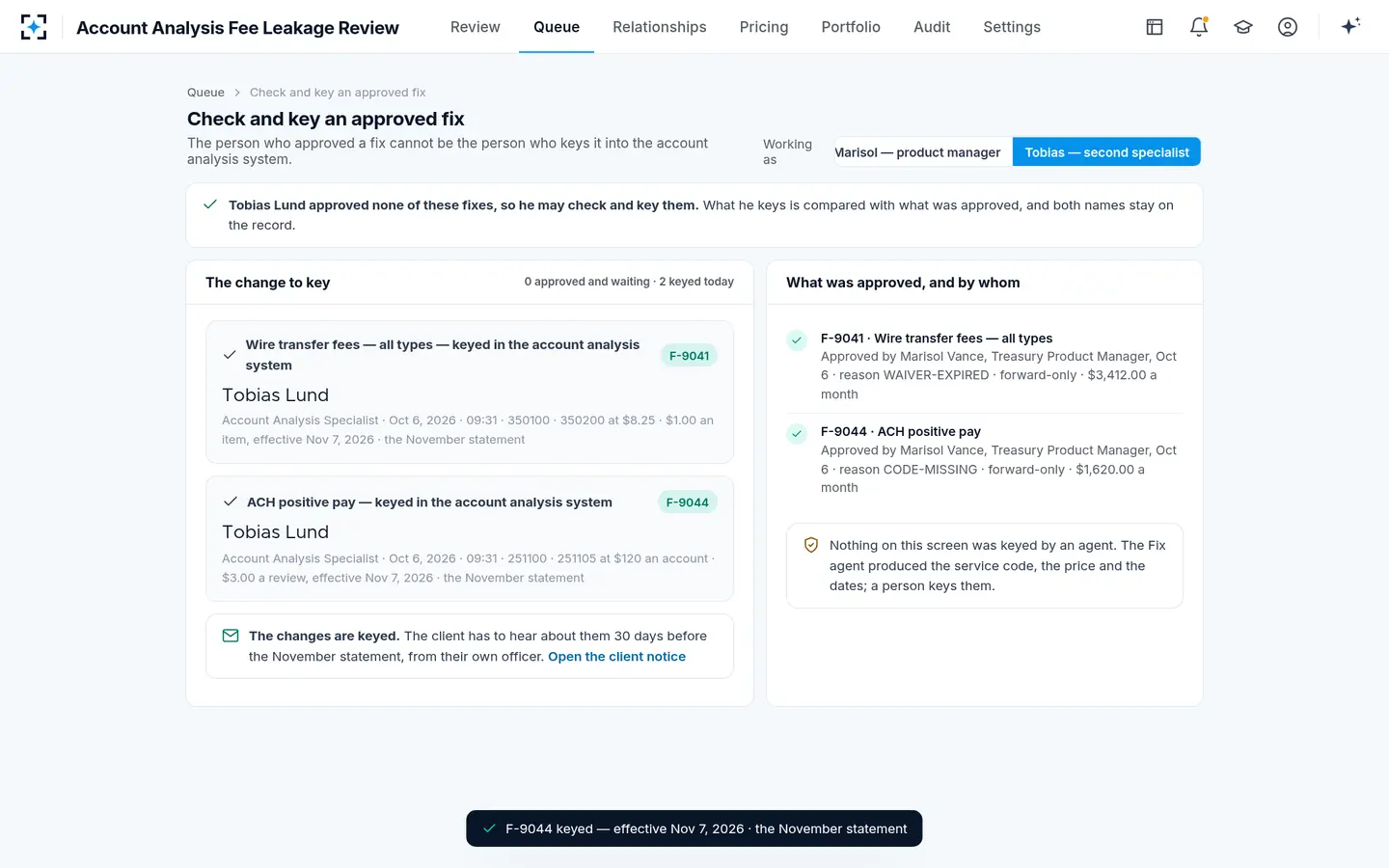
An approved finding becomes fee income only when a second person keys it
What causes revenue leakage in treasury management?
Hand-offs cause it. Every kind of finding traces back to a change made in one place and not carried to the analysis system: an implementation team switches on a service, an officer grants a waiver, a product manager signs an amendment, a pricing committee sets new earnings credit tiers. Each change is correct where it is made and incomplete where it is billed.
Where one Account Analysis Fee Leakage Review cycle's findings came from, by kind, in dollars a month
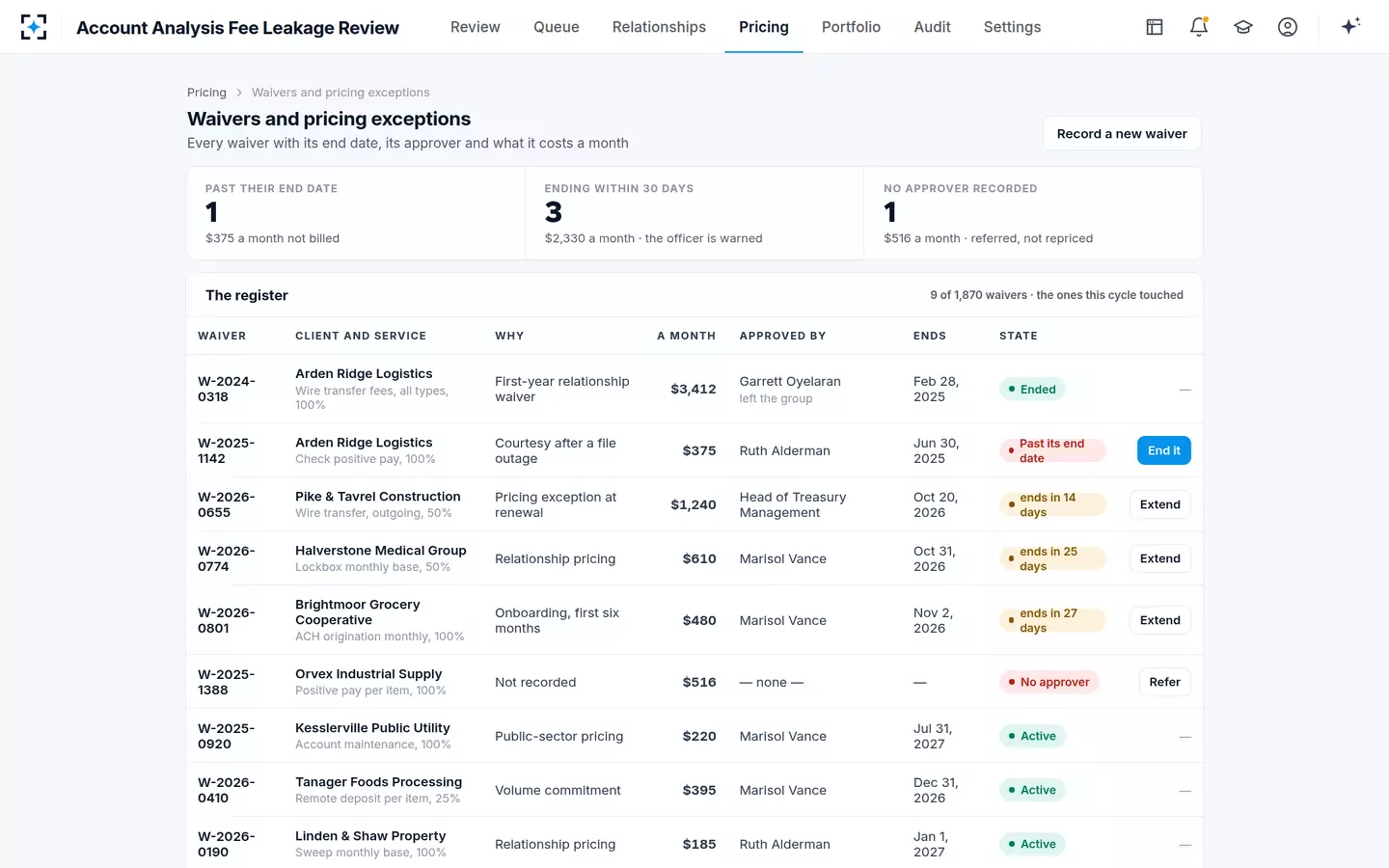
The two largest kinds in the sample are both failures of a date or a code rather than a price. An uncoded service has no line on the statement for anyone to question; the sample's ACH positive pay was enrolled under an implementation request on a platform with no field for a billing code. An expired waiver keeps a line that looks deliberate, and its approver may no longer be around to notice: the sample's first-year wire waiver was approved by someone who has since left the group. The services in use that have no code and the waivers that never expire each follow one cause to its fix.
The control answer is the one banks apply elsewhere: separate the person who makes a change from the person who checks it. The FDIC's examination manual describes segregation of duties as "two or more individuals" being "required to complete a transaction" (FDIC RMS Manual, Section 4.2). In treasury billing the missing second person is usually the one who would compare the enrollment, the waiver or the amendment with the analysis system. The Watch agent plays that part daily: it flags any service switched on with no code within two business days and warns the officer and product manager 30 days before each waiver ends, in the sample settings.
The waiver register the billing engine never kept
Building the business case from your own first cycle
The business case should be built after the first cycle on the bank's own closed statements, not before it. Until then every figure is someone else's estimate. The frame below shows the terms; each is filled from the bank's own data.
The annual value of a fee review, term by term
Forward-only corrections
Σ approved monthly amounts × months billed this year
From each fix's effective date, after the client notice period.
Treasury product
Recoveries billed
Σ recoveries chosen, within each agreement's limit
Can be declined for relationship reasons, with the reason on file.
Treasury product and officers
Overcharges refunded
Σ credits to clients
A cost in the year, and the reason clients trust the bill-backs.
Finance
Running cost
licence + integration + review hours
Botminds estimates about 1.1 hours of a person's time per relationship-month with findings, against about 12 by hand.
Operations
One discipline keeps the case honest: count only approved findings, at their effective dates. A programme that reports found dollars as revenue will be right about the direction and wrong about the size, and the first audit of the programme will say so.
What a leakage programme should report every month
Report the six measures, by kind, with the trend. The audience is the head of treasury management and the CFO, and the question each month is not "how much did we find" but "is the book getting cleaner": fewer findings per relationship, younger findings, fewer repeats, and more of the found value approved within the decision clock.
Two additions make the report useful to the people who can change the causes. The first is a count of new uncoded services flagged by platform, which tells the implementation teams where their hand-off to billing is failing. The second is the list of waivers ending in the next 30 days with their approvers, which turns each expiry into a decision the officer makes on time instead of a leak someone finds later. To see both on sample data, start from Account Analysis Fee Leakage Review.
Questions people ask
How much revenue do banks lose to billing errors?
No government, academic or non-profit source measures it for treasury fees, and the Call Report cannot show it, because it records fees billed net of refunds and has no line for fees never billed. Figures in circulation come from vendors and consultancies. The only reliable number is the one a bank's own full review produces.
What does revenue leakage mean?
It means income a business was entitled to under its own contracts and prices but did not collect. In banking it covers unbilled services, discounts applied past their terms, prices below the signed schedule and credits above the agreed rate, as distinct from deliberate discounts and pricing decisions.
What are the most useful revenue leakage metrics?
Coverage (share of relationships compared each month), yield (findings and dollars by kind), survival (approved against dismissed, by reason), speed (days to decision), age at discovery and recurrence. Age at discovery matters most for value, because older findings fall outside an agreement's recovery window.
Is a fee waiver revenue leakage?
Not while it is inside its term and approved by someone with the authority to grant it; then it is pricing. It becomes leakage when it is applied after its end date or when no approver is recorded, and in the solution a waiver with no approver is referred for review rather than repriced.
Should found or approved dollars be reported as the result?
Approved, at their effective dates. Found dollars include findings that will be dismissed, 12% of the value in the sample cycle, and approved ones only become income after the client's notice period and the next statement.