Account analysis software comes in two kinds, and buyers often ask for one when they need the other. The first is the account analysis system itself, the billing engine that stores each business client's prices, service codes, waivers and earnings credit rate, takes in monthly volumes and produces the analysis statement. The second checks that engine: it reads what each client actually used, what the statement billed and what the signed agreement says, and reports the differences. Botminds' Account Analysis Fee Leakage Review is the second kind. Six agents count, read and compare every analyzed relationship each month; none of them changes a price, writes to the analysis system or contacts a client, and a named person approves every correction.
This guide is for the treasury product and operations leaders evaluating software for that second job. The worked figures are sample data from a fictional bank, Corvane National Bank, and its fictional client Arden Ridge Logistics.
One relationship-month, as Account Analysis Fee Leakage Review read it
4
systems counted for usage: payments hub, lockbox platform, positive pay platform, core banking
23
priced services read from the agreement, two exhibits and two amendments
6of 11
services in use priced differently from the signed schedule
0
changes made by an agent to any system
What does account analysis software do today?
The account analysis system a bank already runs does four things well: it holds a price list per client, it applies waivers and exceptions, it computes the earnings allowance on average balances, and it renders a statement on paper, online and as a file. The ASC X12 822 account analysis transaction set exists so that statement can travel to a client's own treasury system, with its balances, service charges and adjustments line by line (X12); account analysis statement vs bank statement reads one.
Everything the engine produces is downstream of its own tables. If the table says lockbox items cost $0.32, the statement bills $0.32; if a wire waiver has no end date in the table, wires are free until someone removes it; if a service was switched on in a platform without a service code, the engine never receives a volume to price. The engine is working as designed in every one of those cases, which is why its own reports never flag them.
The fee decisions it executes belong to the bank. For national banks, 12 CFR 7.4002 leaves the amount of a fee and how it is calculated to each bank's own judgment, within safe and sound banking principles, and puts the cost of providing the service first among the factors it weighs (12 CFR 7.4002; the rule's words are in who decides the price of a treasury service). A review layer exists to make sure the bank is actually charging what it decided to charge.
The gap: a billing engine cannot audit itself
A billing engine checks arithmetic; a review checks agreement. The two need different inputs, and the second needs sources the engine never sees: the platforms' own usage files, the scanned agreement with its exhibits and amendments, and the waiver register with its approvers and end dates.
The analysis system and a contract review, side by side
Account analysis system (billing engine): Takes volumes only for services that have a service code.
Account Analysis Fee Leakage Review: Counts usage from the system that ran each service, coded or not, and cites the file and the record count.
Account analysis system (billing engine): Applies the price in its own table.
Account Analysis Fee Leakage Review: Reads the price of record from the signed exhibit and every amendment in date order, with the clause.
Account analysis system (billing engine): Applies a waiver until someone removes it.
Account Analysis Fee Leakage Review: Reads each waiver's approver and end date from the register and flags those past it or without an approver.
Account analysis system (billing engine): Applies the rate in its rate table.
Account Analysis Fee Leakage Review: Recomputes the credit from the average collected balance, the days and the agreed tiers.
Account analysis system (billing engine): A statement that reconciles.
Account Analysis Fee Leakage Review: A short list of differences per relationship, each opened to its sources, waiting for a person.
Account analysis system (billing engine): Is the system of record for prices.
Account Analysis Fee Leakage Review: Writes nothing; a specialist keys every approved change into the analysis system.
The comparison also shows why buying a second billing engine does not solve the problem. A newer engine with cleaner tables starts accurate and drifts the same way, because the drift comes from hand-offs: the implementation team switching on a service, the officer granting a first-year waiver, the product manager signing an amendment. Each hand-off changes the agreement or the platforms first and the engine later, if at all.
Six agents, and the line each one may not cross
The agents split the work along the three sources and the three follow-up jobs. Each has a written limit, and the limits are the design: an agent that can count may not price, an agent that can draft a fix may not apply it, and an agent that can draft a letter may not send it.
Account Analysis Fee Leakage Review: six agents, one person who decides
Agent
Usage agentCounts what each client used, service by service, from the system that ran it: wires and ACH from the payments hub, items from the lockbox platform, enrollments and reviews from positive pay, accounts and balances from core banking.
Never: Never counts a service from the statement it is checking; read-only on every system.
Agent
Pricing agentReads the treasury services agreement, its pricing exhibits, every amendment in date order and the waiver register; returns the price of record with exhibit, clause and amendment date.
Never: Never infers a price that is not written in a signed document; an exception with no recorded approver is not a price.
Agent
Billing agentCompares usage and contract with the statement and the codes billed; recomputes the earnings credit from balance, days and agreed tiers.
Never: Never nets one service against another; never writes to a statement; nothing below the materiality threshold is queued.
Agent
Fix agentProposes one correction per finding, with the effective date from the notice period, the recovery the agreement allows as an option, the general ledger account and a suggested reason code.
Never: Applies nothing; never chooses recovery over forward-only; skips relationships in workout or exiting.
A person decides
Treasury product managerApproves or rejects each proposal with a reason code; a different specialist keys the approved change.
Agent
Notice and Watch agentsNotice drafts the client letter for an approved fix; Watch tracks waiver end dates, newly switched-on services with no code and the decision clock.
Never: Notice sends nothing to a client; Watch never ends or extends a waiver and decides no finding.
Two of the limits deserve a buyer's attention because they are where a review tool can quietly cut corners. "Never counts a service from the statement it is checking" means usage must come from the platform, not from the bill being tested; a tool that reconciles the statement against itself will find arithmetic errors and nothing else. "Never nets one service against another" means an undercharge on wires cannot hide behind an overcharge on lockbox; each is a separate finding with its own decision, because the client is owed the overcharge whatever happens to the undercharge.
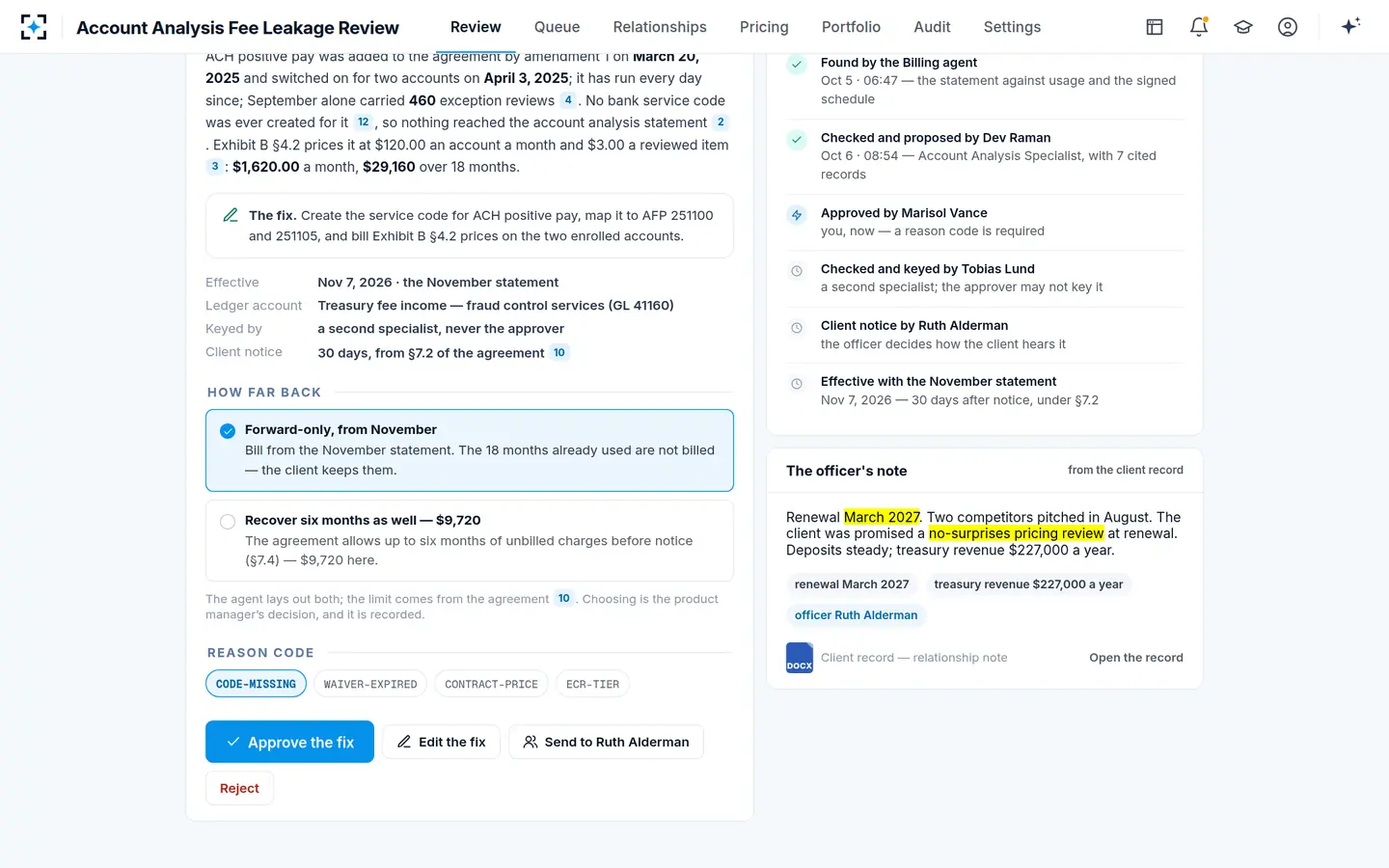
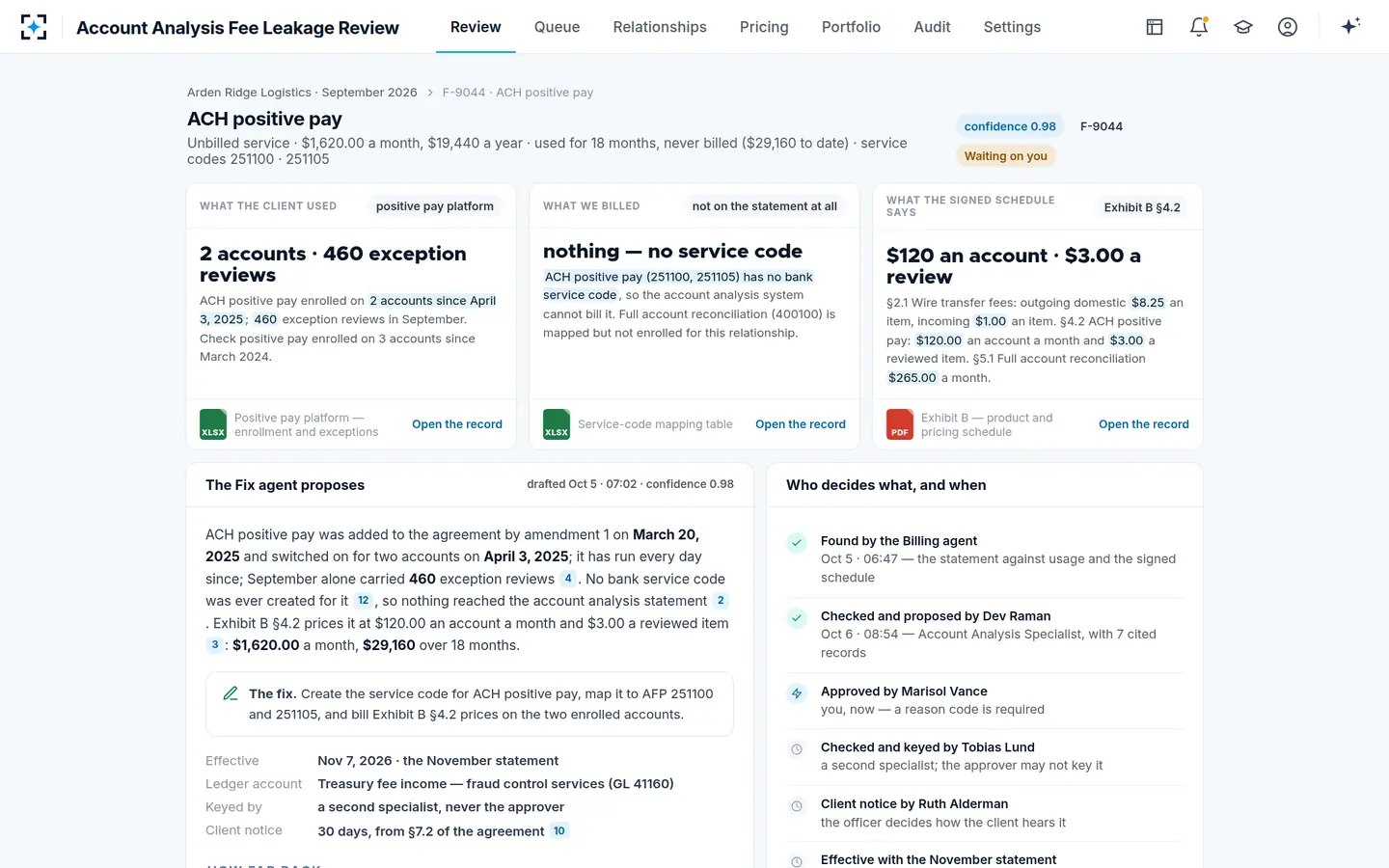
The run ends at a person: one finding, two choices, and a decision only the product manager can make
Can account analysis software read contracts?
It can, if reading means returning the clause, not a summary. The Pricing agent's output for each service is a price with its exhibit, section and amendment date, so a specialist can open the page it came from. For Arden Ridge the agent read a treasury services agreement of March 4, 2024, two exhibits and two amendments: one, dated March 20, 2025, added ACH positive pay at $120.00 an account a month and $3.00 a reviewed item; the other, effective January 1, 2026, raised lockbox items from $0.32 to $0.48.
Document reading is the use banks themselves expect from this generation of AI. In the Treasury Department's December 2024 report on AI in financial services, respondents named "document querying and extraction" among the near-term uses of generative AI (U.S. Treasury, Uses, Opportunities, and Risks of AI in Financial Services); the report summarizes respondents' views rather than Treasury's own findings. The useful test for a buyer is narrower: what does the software do with a document it cannot read? Here, an unreadable document is queued for a person instead of guessed, and a waiver with no recorded approver is referred for review rather than repriced.
One finding with its three sources: used, billed, signed
Who approves a fee change?
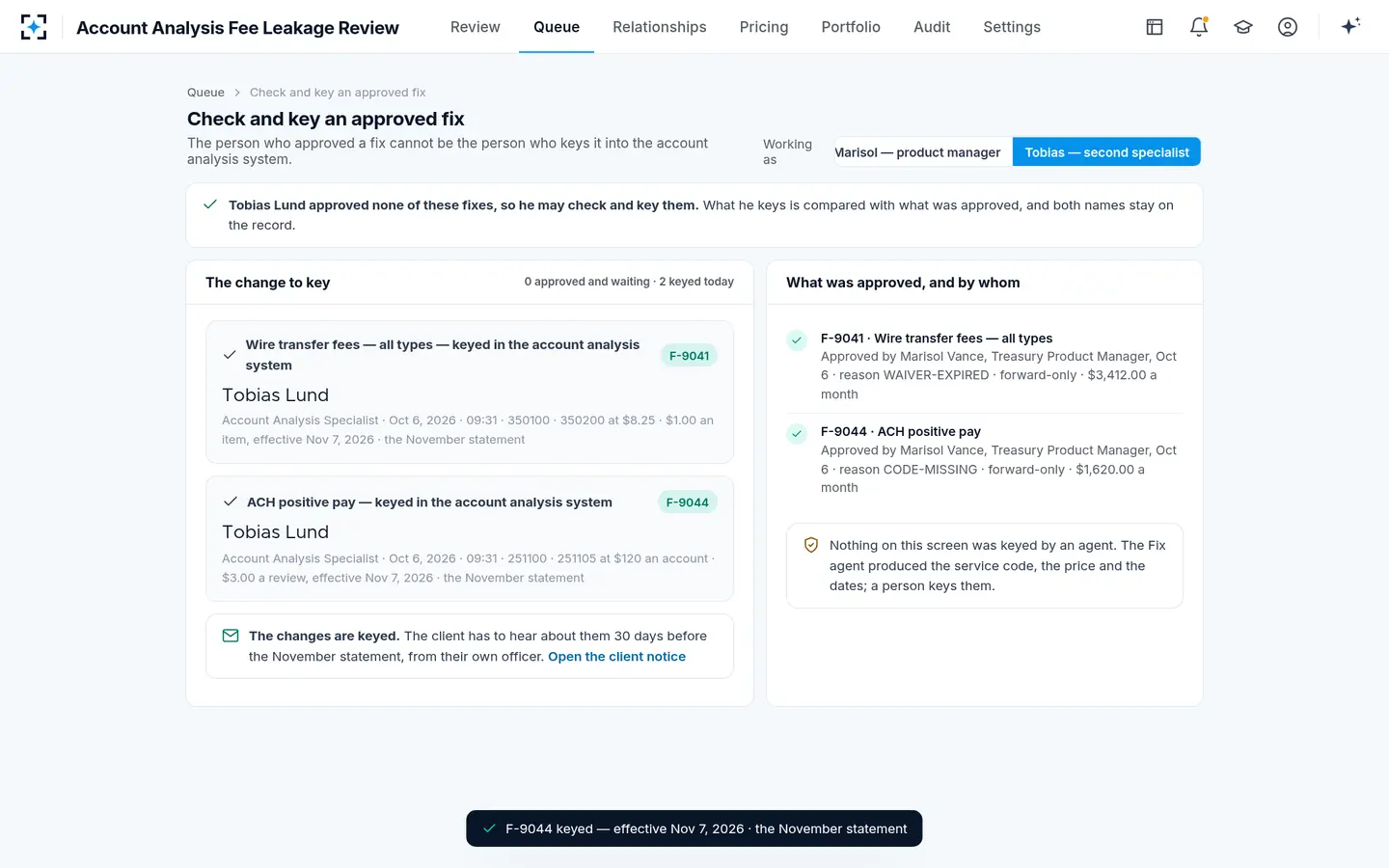
A person, and never the person who keys it. In the solution a specialist checks and proposes the fix with a reason code, the treasury product manager approves it, and a different specialist keys it into the analysis system; the approver's own name is unavailable on the keying screen. Above $5,000 a month, a sample-bank setting, a second approver is required.
That arrangement is ordinary bank internal control applied to billing. The FDIC's examination manual asks banks to split each transaction's steps between people, because fraud is far harder when no one person handles a transaction from start to finish (FDIC RMS Manual, Section 4.2; the manual's words are in dual control in banking). A fee change is a transaction against a client's account. Software that lets one user find, approve and apply it has removed a control the bank would insist on anywhere else.
A second specialist keys the approved change, never the person who approved it
What to look for when you evaluate account analysis software
The questions below separate a review that will find real money from one that will find rounding. Each can be tested on a sample of the bank's own closed statements before any contract is signed.
Ten questions to ask of account analysis review software
- Where does usage come from?
From the platform that ran the service, or from the statement under test? Only the first finds services that were never coded.
- Does every price carry its clause?
Exhibit, section and amendment date for each price of record, openable by the specialist.
- How are amendments ordered?
A later amendment replaces an earlier price only from its effective date; ask to see one month that spans an amendment.
- What happens to an unreadable document?
It should go to a person, not become a guessed price.
- Are waivers read with approver and end date?
A waiver with no recorded approver should be referred, not repriced and not treated as valid.
- Is the earnings credit recomputed independently?
From balance, days and the client's agreed tiers, with any reserve deduction shown as a line.
- Can one user find, approve and apply a change?
If yes, the tool has removed segregation of duties from a client-account transaction.
- Does it ever write to the analysis system?
Read-only connections make the tool easy to approve through third-party and information security review.
- How is recovery handled?
The tool should show the amount the agreement allows and leave the choice, and its reason, to a person.
- What does the auditor get?
Every finding, source, approval and keying on one trail, without the auditor being able to approve anything.
The first question carries the most weight. In the sample bank's September cycle, unbilled services were the largest kind of finding by value, and only usage read from the platforms reveals them; the services in use that have no code follows one from enrollment to the bill. On the client side of the same statement, treasurers run their own checks, and the audit your clients run on you shows what their tools see.
Where this fits, and where it does not
Review software earns its place in banks that analyze enough relationships that a manual check cannot reach them all, and whose agreements, exhibits and waivers live in documents rather than in the engine. It is a poor fit, or an unnecessary one, in other settings.
Where a contract review layer fits, and where it does not
| Situation | Fit | Why |
|---|---|---|
| Hundreds or thousands of analyzed relationships with negotiated exhibits | Strong | Too many agreements to review by hand; most differences sit in negotiated terms. |
| Waivers granted by officers, tracked in email or spreadsheets | Strong | End dates and approvers live outside the engine; the Watch agent reads the register daily. |
| Services enrolled by implementation teams on separate platforms | Strong | Uncoded services are only visible from platform usage. |
| A small book on a single standard price list with no exceptions | Weak | The engine's table is the agreement; there is little to compare. |
| Replacing the billing engine | Not this | The solution reads and proposes; the analysis system stays the system of record. |
| Setting prices or modelling pricing strategy | Not this | It returns the price the client signed, never a price it thinks the bank should charge. |
| Relationships in workout or exiting | Excluded | The Fix agent skips them; repricing a client in workout is a credit decision. |
Two limits apply even where the fit is strong. The review is only as complete as the platforms it is connected to: a service run on a system the agents cannot read is invisible to them too. And a finding is not a fee. The choice between fixing forward and billing back belongs to the product manager and the agreement, which is the subject of bank fee recovery.
How the AI is governed when model guidance leaves it out
The bank governs it through ordinary controls, because the model guidance does not reach it. The revised interagency model risk guidance issued on April 17, 2026 leaves generative and agentic AI models outside its scope, calling them too new and too fast-moving to cover yet (OCC Bulletin 2026-13; the guidance's own words, and what it does cover, are in the guide to AML risk rating models). Software bought from a vendor still falls under the agencies' third-party guidance, which "clarifies that not all third-party relationships present the same level of risk or criticality to a bank's operations" (OCC Bulletin 2023-17), so the bank sizes its diligence to what the tool can do. That guidance may be replaced: on September 15, 2026 the OCC, the Federal Reserve, the FDIC and the NCUA proposed new third-party risk management guidance, with comments due November 16, 2026, and until it is final the 2023 text is the standard (Proposed Third-Party Risk Management Guidance; what the change would mean is set out in the interagency guidance on third-party relationships).
In our view, a read-only review tool that proposes and never applies sits at the low end of that scale for operational risk. The controls that remain are the ones a bank would want on any analyst: each agent is versioned and carries a confidence floor (0.90 in the sample settings) and a written limit; nothing under the materiality threshold ($50 a month in the sample) is queued; an agent can be paused with a recorded reason; and every finding, decision and keying is kept with the account for five years in the sample settings, with account numbers masked on export.
To see the six agents on sample data, from the first count to the keyed change, start from Account Analysis Fee Leakage Review.
Questions people ask
What is bank account analysis software?
Usually it means the account analysis system: the billing engine that holds business clients' prices, codes, waivers and earnings credit rates and produces the monthly analysis statement. Review software is a separate layer that checks that engine's output against platform usage and the signed agreement.
Can AI review bank fee billing without changing anything?
Yes, and it should. In Account Analysis Fee Leakage Review every connection is read-only; the agents count, read, compare, propose and draft, and the one change the solution makes to a system of record is keyed by a named specialist after an approval with a reason code.
Does review software replace the account analysis specialist?
No. It replaces the counting and the document search, which by Botminds' estimate are most of the twelve hours a manual review of one relationship-month takes. The specialist still judges whether each difference is real, proposes the fix and keys approved changes made by someone else.
What account analysis tools do treasurers use on the client side?
Treasurers check analysis statements by hand or with fee analysis tools that load the statement, sometimes as an 822 file, and compare it with the pricing they negotiated. Those tools see what was billed, but not what the bank's platforms recorded or what the bank's own waiver register says.
How long does it take to see the first findings?
The first cycle runs on the bank's own closed statements, so the first findings are the bank's own. In the sample settings a cycle starts on the third business day after statements close, and each finding then has a five-business-day decision clock.