Account analysis in banking is the monthly billing of a business client's treasury services: the bank counts what each account used (wires, ACH items, lockbox items, positive pay, account maintenance), prices each service from a fee schedule, credits the client for the balances it kept, and charges or waives the difference. The output is the account analysis statement, and behind it sit the account analysis specialists, who keep the price list, the service codes, the waivers and the earnings credit rate tiers in step with what every client signed. The statement always adds up, which is why errors in it are hard to see. Botminds' Account Analysis Fee Leakage Review exists for that blind spot: each month its agents compare what every client used, what the statement billed and what the signed schedule says, and a named person decides each difference.
The examples below come from a fictional sample bank, Corvane National Bank, and one fictional client, Arden Ridge Logistics, as they run through the solution. The research figures come from the Federal Reserve, the FDIC, the OCC, the CFPB's Regulation DD and the Bureau of Labor Statistics, linked where they appear.
Account analysis fees land in a $35 billion Call Report line
$35.0B
service charges on deposit accounts at FDIC-insured institutions in 2025, consumer and business together
0%
reserve requirement since March 26, 2020, a deduction many older earnings credit formulas still carry
Consumer
accounts only: the reach of Regulation DD's fee disclosures and 30-day change notice; business analysis runs on the contract
What is account analysis in banking?
Account analysis is a billing method, not a report. A bank that analyzes a business relationship does not charge each wire or deposit as it happens; it lets a month of activity accumulate, prices it, and settles the net once. The client sees the result twice: as a detailed analysis statement listing every service, volume, unit price and charge, and as a single debit on the bank statement for whatever the earnings credit did not cover.
The method grew up around compensating balances. When banks could not pay interest on business demand deposits, they paid for the client's services with the value of its balances instead. The Federal Reserve's March 1992 survey of senior financial officers found that "a significant portion of firms' service charges are paid with earnings credits on these accounts" and that most banks then set the credit rate from the three-month Treasury bill (Federal Reserve, March 1992 SFOS); how that index carries into today's rate is worked through in the earnings credit rate calculator. The same survey found roughly half of business demand deposits held under formal compensating-balance arrangements. That was more than thirty years ago and is history, not today's share, but the machinery it describes is still the machinery most banks run.
The account analysis system is the software that does it: it holds each client's price list and waivers, takes in volumes from the platforms that ran the services, computes the earnings allowance on average balances, and produces the statement. It is a billing engine. It prices exactly what it is told, at exactly the price it holds.
How an analysis statement is built: balances, credits, charges
Every analysis statement follows the same arithmetic, whatever its layout: a balance section, a service section, and a settlement line. The steps below are how one month moves from raw activity to a charge on the client's account.
One month of account analysis, from activity to settlement, and what each step cannot catch
| Step | What happens | What the step cannot catch |
|---|---|---|
| 1. Volumes arrive | The payments hub, lockbox platform, positive pay platform and core banking system send counts by account: wires, ACH items, remittance items, exception reviews, maintained accounts. | A service with no service code never arrives as a billable volume. |
| 2. Services are priced | Each volume is multiplied by the unit price held for that client, then any waiver or exception the system holds is applied. | Whether the price and the waiver it holds are the ones in the signed exhibit. |
| 3. The earnings allowance is computed | Average collected balance × the earnings credit rate × days in the period over the year basis, after any deductions the bank's formula carries. | A rate table that differs from the agreed tiers is wrong in the same direction every month. |
| 4. Settlement | Charges less the allowance give the net due, debited once to the settlement account; surplus credit lapses or carries forward under the bank's rules. | Nothing: by this point every figure reconciles to every other figure. |
Take the sample client's September. The statement listed $18,940.00 of service charges and a $7,919.18 earnings credit on an average collected balance of $4.1 million, so Arden Ridge Logistics was debited $11,020.82. Every figure on it reconciled to every other figure, and none of the reconciliation said anything about whether the prices, the waivers or the credit rate were the ones in the agreement. The line-by-line anatomy is in account analysis statement vs bank statement, annotated.
Behind each step is a fee decision the bank owns. National banks get that authority from 12 CFR 7.4002, which says a national bank "may charge non-interest charges and fees, including deposit account service charges", and it leaves their amounts and how they are calculated to each bank's own judgment, within safe and sound banking principles. The first factor the rule asks a bank to weigh is what the service costs it to provide (12 CFR 7.4002, as amended by an OCC interim final rule effective June 30, 2026; the rule's words and its other factors are in who decides the price of a treasury service). A service the bank provides and never bills is that cost, with no charge against it.
Who prepares the account analysis statement?
The account analysis system prepares it; an account analysis specialist makes it right. The seat sits in treasury management operations or in the treasury product group, depending on the bank, and it is almost invisible from outside: clients deal with their treasury officer, executives see the product line's revenue, and the specialist sits between the two keeping the engine's tables accurate.
The Bureau of Labor Statistics publishes no occupation for the role. The nearest published category is billing and posting clerks, who "calculate charges and generate bills" across every industry: 418,000 jobs in 2025 and a median annual wage of $48,500 in May 2025 (BLS, Financial Clerks). The comparison flatters neither side. A specialist needs to read a pricing exhibit, a waiver approval and an earnings credit formula, which is closer to contract administration than to billing, and we found no public count of the people who do it in banks.
What the seat actually does, month after month, is maintenance: adding the service code when a new product is sold, loading the price from a new or amended exhibit, entering a waiver with its end date, changing an earnings credit tier when a relationship is repriced, and answering a client's question about a line. Each of those is a hand-off from someone else, the implementation team, the officer or the product manager, and each hand-off is a place where the engine and the agreement can stop matching.
"Account means a deposit account at a depository institution that is held by or offered to a consumer."
12 CFR 1030.2(a), Regulation DD (Truth in Savings)
The rule book is the client's own agreement
For a business client, no federal rule prescribes what an analysis statement must show, how a fee change must be noticed or how far back an error can be billed. Regulation DD, the Truth in Savings rule that requires fee disclosures and advance notice of adverse changes, applies to accounts held by a consumer, defined as "a natural person who holds an account primarily for personal, family, or household purposes." Its official interpretation adds that "accounts held by individuals as sole proprietors are not covered" (Regulation DD, Supplement I, comment 2(h)-3).
That leaves the treasury services agreement and its pricing exhibits as the only rule book. They set the unit prices, the earnings credit tiers, how a waiver is granted and when it ends, how much notice a price change needs and how far back the bank may bill a service it missed. The analysis system holds a copy of some of those terms. It does not hold the agreement, and it cannot read an amendment.
One exception matters in practice. A commercial relationship can include an account that is held by an individual for personal or household purposes; that account is a consumer account, and a fee change on it falls under Regulation DD's 30-day advance notice. In the sample, one of Arden Ridge's nine accounts is of that kind, so its notice wording and date went through a conduct review before anything was sent.
Where the specialist's month goes
Checking one relationship against its agreement by hand is a day and a half of work, most of it spent finding things rather than judging them. The split below is Botminds' estimate for one relationship reviewed by hand, used in the product's design, not a survey of banks.
One relationship-month checked by hand: most of the time is finding, not judging
About 12 hours by hand
- Counting usage, system by system · 33%
- Finding the agreement, exhibits, amendments · 17%
- Writing up, approval, keying, notice · 17%
- Pulling and exporting the statement · 13%
- Checking waivers and end dates · 12%
- Re-checking the earnings credit · 8%
Twelve hours per relationship explains why the check is rare. At that estimate, reviewing 3,000 analyzed relationships once a year would take 36,000 hours, roughly eighteen full-time years, so where the review happens at all it is kept for the largest clients, or for the client who complains. The relationships that are never looked at are exactly the ones where a missing code or an expired waiver can run for a year and a half.
What the seat cannot see from inside the billing system
The specialist's tools show what the engine holds, not what it should hold. Four kinds of difference follow from that, and each one leaves a statement that balances perfectly.
Four differences an analysis statement cannot show, from one sample client's September
| Kind of difference | Why the engine cannot see it | Arden Ridge Logistics, September 2026 |
|---|---|---|
| A service used but never coded | Usage with no service code never reaches the statement, so there is nothing to price. | ACH positive pay on two accounts since April 3, 2025: 460 exception reviews in September, $1,620.00 a month at the signed price, never billed. |
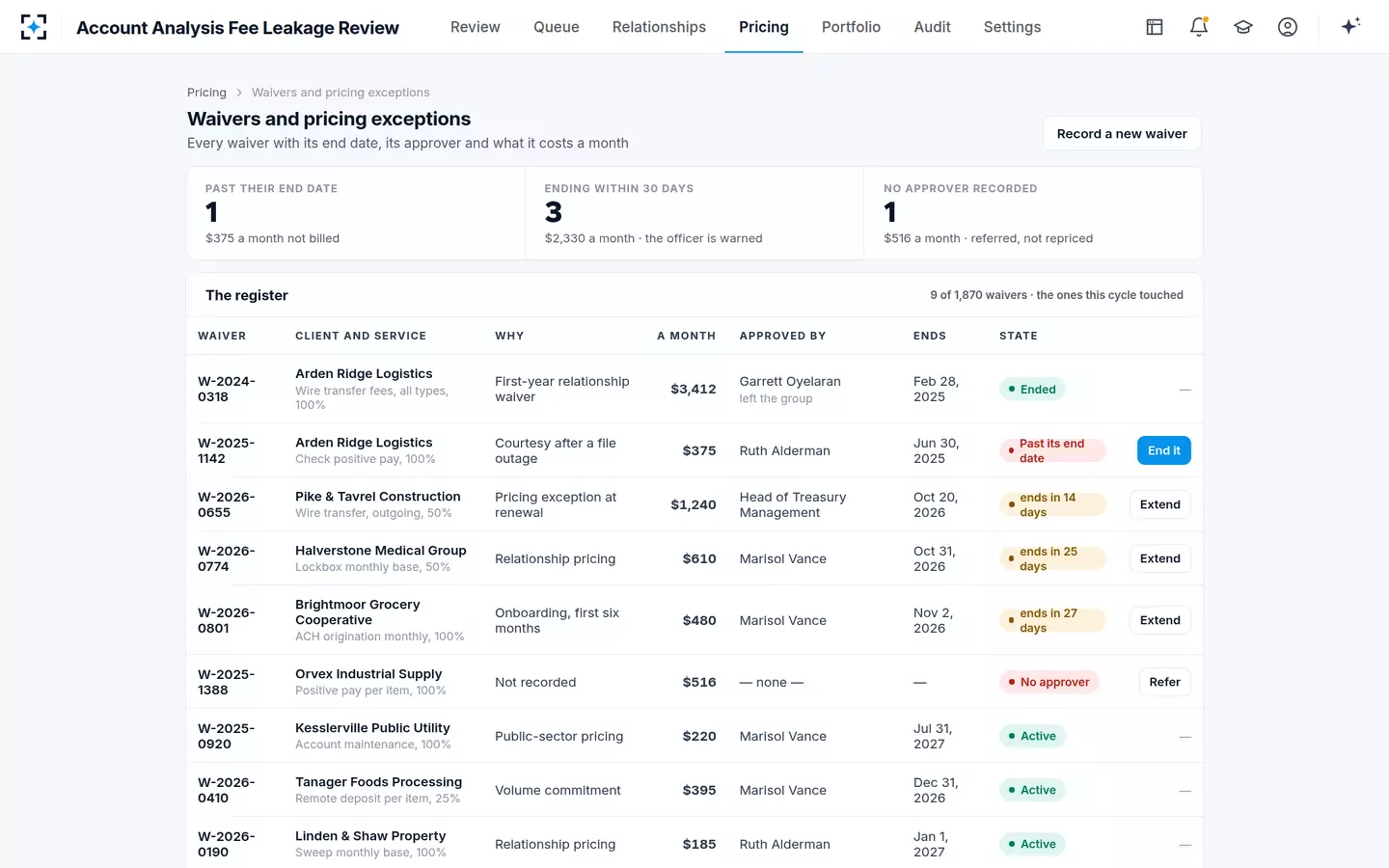
| A waiver past its end date | The engine applies a waiver until someone ends it; the end date lives in an approval email or a register. | A first-year wire waiver that ended February 28, 2025 was still applied: 400 outgoing and 112 incoming wires billed at $0, $3,412.00 a month. |
| A price an amendment changed | The engine holds the price it was given; the amendment sits in document imaging. | Lockbox items at $0.32 against $0.48 in the exhibit as amended January 1, 2026: $1,840.00 a month on 11,500 items. |
| An earnings credit outside the agreed tiers | The rate table is the bank's; the tiers are in the client's exhibit. | A flat 2.35% applied where the exhibit sets 1.85% up to $5 million, on a $4.1 million balance. |
The first two are about dates, and they are the ones a statement hides best. An uncoded service produces no line at all, so no one reading the statement can notice its absence; the services in use that have no code follows that gap from the platform to the bill. A waiver that outlives its end date produces a line that looks deliberate, a charge waived at 100%, and the waivers that never expire shows how a one-year concession becomes a nineteen-month one.
The waiver register in Account Analysis Fee Leakage Review: every waiver with its end date and approver
Why the fees matter at the scale of a bank
Analyzed charges levied on deposit accounts are reported in one line of the bank's income statement. The Call Report's "service charges on deposit accounts" line counts what depositors were charged after refunds (the definition is quoted in revenue leakage in banking), and its examples include maintenance charges, charges "based on the number of checks drawn on and deposits made", and charges "for wire transfer services provided to the institution's depositors" (FFIEC 031/041 Schedule RI instructions, item 5.b). Across FDIC-insured institutions that line came to $34.99 billion in 2025, up from $32.14 billion in 2024 (FDIC BankFind Suite). It includes consumer accounts, so it is the ceiling of the pool, not the size of treasury billing.
Two details in that definition matter for an analysis team. Fees are reported net of refunds, so every refund for an overcharge reduces the reported line. And a service the bank never billed does not appear anywhere: it is not a refund, a write-off or an exception. It is simply revenue the income statement never sees. No public source measures how much of that there is, and this series does not invent a rate for it; revenue leakage in banking sets out how a bank can measure its own.
What changes when agents do the counting
The specialist's judgement is the scarce part of the job, and the counting is not. In Account Analysis Fee Leakage Review, a Usage agent counts what each client used from the system that ran the service, a Pricing agent reads the agreement, its exhibits, every amendment in date order and the waiver register, and a Billing agent compares both with the statement and recomputes the earnings credit. A Fix agent drafts the correction, a Notice agent drafts the client letter and a Watch agent tracks end dates and newly switched-on services. None of them changes a price or writes to the analysis system.
The same relationship, four seats: before and with Account Analysis Fee Leakage Review
Today
Keeps the price list, the service codes, the waivers and the earnings credit tiers in the analysis system, and answers the officer when a client questions a line. Checks a relationship against its agreement only when asked, by exporting the statement and counting usage in four other systems.
With agents
Checks findings that already carry what was used, what was billed and what was signed, each opened to its source, and proposes the fix with a reason code.
Still theirs: The judgement on whether a difference is real, and the keying of every change, never their own approval.
Today
Owns the product line's revenue but sees only what the statements billed. Learns of a missing service code or an expired waiver when someone happens to look.
With agents
Sees each relationship as a short list of differences, largest first, and decides forward-only or recovery with the reason written down.
Still theirs: Every pricing decision and the reason behind it.
Today
Hears about a repricing when the client calls about an invoice.
With agents
Receives a drafted client letter with the dates and amounts already checked, and decides how the client hears it.
Still theirs: The client conversation, and the choice to call first.
Today
Samples a few corrections and emails several people for the evidence behind each one.
With agents
Reads the whole cycle with every source and every approval attached, and cannot approve anything.
Still theirs: Independence: read everything, change nothing.
What stays with people is the part that carries consequences: whether a difference is real, whether to bill back or only fix forward, how the client hears it, and who keys the change. The specialist proposes, the treasury product manager approves with a reason code, and a different specialist keys the change into the analysis system; the person who approved it cannot key it.
The signed schedule beside the price the analysis system is using
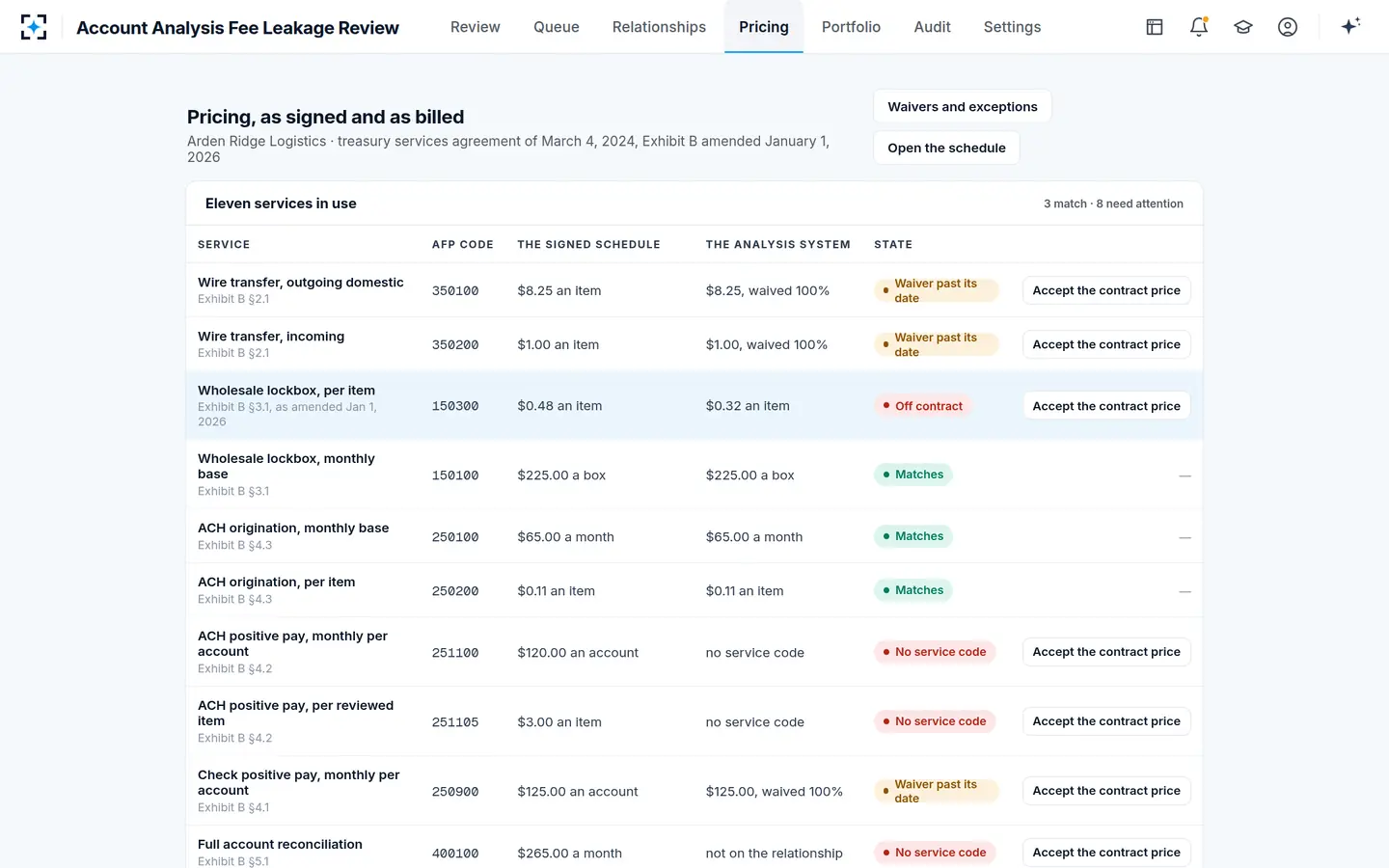
The specialist's month changes shape rather than disappearing. Instead of exporting statements to find a handful of problems on a handful of clients, the seat starts the month with every analyzed relationship already compared, and spends its hours on the findings that need a person. To see the whole cycle on sample data, start from Account Analysis Fee Leakage Review.
Questions people ask
What does account analysis mean on a business bank statement?
It means the bank bills your business services monthly through an analysis rather than item by item. The line on your bank statement, often labelled an analysis charge or settlement, is the net of the month's service charges less the earnings credit on your balances; the analysis statement itemizes how that net was reached.
Does Truth in Savings apply to business accounts?
No. Regulation DD defines an account as one held by or offered to a consumer, a natural person holding it primarily for personal, family or household purposes, and its official interpretation says accounts held by individuals as sole proprietors are not covered. Business account analysis is governed by the treasury services agreement and its pricing exhibits.
How are account analysis fees calculated?
Each service's monthly volume is multiplied by the client's unit price, less any waiver; the sum is offset by an earnings allowance, generally average collected balance times the earnings credit rate times the days in the period over the year basis. The client pays the difference if charges exceed the allowance.
What is an account analysis system?
It is the billing engine for analyzed business accounts: it stores each client's prices, service codes, waivers and earnings credit rates, takes in volumes from the platforms that ran each service, and produces the monthly statement. The statement can also travel as an ASC X12 822 file, the account analysis transaction set, which X12 defines as the set that carries balance, service charge and adjustment detail from a bank to its corporate clients; account analysis statement vs bank statement reads one line by line.
Is account analysis the same as a compensating balance?
Related, not the same. A compensating balance is the balance a client keeps so its credit pays for services; account analysis is the monthly calculation that values that balance and sets it against the fees. In 1992 the Federal Reserve found about half of business demand deposits held under formal compensating-balance arrangements, and the analysis statement was how those arrangements were settled.
Why do earnings credit formulas still mention reserves?
Because older formulas deducted the reserve requirement from the balance before applying the rate. The Federal Reserve reduced reserve requirement ratios to zero effective March 26, 2020, so that deduction should now be zero, and a formula that still applies one under-credits the client every month.