An account analysis fee schedule is the list of treasury services a bank bills through account analysis, each with a description, a service code, a pricing unit (per item, per account a month, per file) and a unit price, together with the earnings credit terms that offset the charges. Every bank keeps a standard version; every analyzed client has its own, the pricing exhibit to its signed treasury services agreement as changed by each amendment, and the two can differ line by line. To start a review that compares billing with the contract, a bank brings four things it already holds: its service and code table, each client's signed schedule with its amendments, the waiver register, and usage from the platforms that run the services. Botminds' Account Analysis Fee Leakage Review reads those inputs every month and reports where the statement and the signed schedule part ways.
The examples come from a fictional sample bank, Corvane National Bank, and its fictional client Arden Ridge Logistics, as their documents run through the solution.
What a bank brings to the first cycle of Account Analysis Fee Leakage Review
- Account analysis statements, as issued
The month's statements by relationship, with the service codes billed; an export or an ASC X12 822 file works.
- The service and code table
Every billable service with its bank code, its standard code mapping and its pricing unit, as the analysis system holds it.
- Signed agreements, exhibits and amendments
From document imaging, scanned or native: the treasury services agreement, each pricing and earnings credit exhibit, every amendment with its date.
- The waiver and exception register
Each waiver with client, service, percentage, approver, start and end date; a spreadsheet is acceptable to begin.
- Usage from each platform
Payments hub (wires, ACH), lockbox (items by box, including late files), positive pay (enrollments, exception reviews), core banking (accounts, balances, account-level services).
- Client records
Officer, segment, renewal date, and any relationship in workout or exiting, which the Fix agent skips.
- General ledger accounts
The fee income account for each service family, read-only, so each proposal names where the correction lands.
- The bank's settings and approval chain
Materiality threshold, decision clock, notice default, recovery limit, second-approver amount; see the settings table below.
What is in an account analysis fee schedule?
A schedule is a table of services and a set of terms. The table has a row for each service the bank can bill: account maintenance, deposits and items, ACH origination by file and by item, incoming and outgoing wires, lockbox by box and by item, positive pay by account and by exception, reconciliation, information reporting. Each row carries a pricing unit and a unit price and, where the bank uses them, a service code that ties the row to the analysis system and to the industry's standard code list.
The terms say how the charges are settled: the earnings credit rate or its index and tiers, the balance it applies to (ledger balance or collected), any reserve or deposit-insurance deduction, whether excess credit carries forward, and whether the client may pay in "hard dollars" or "soft dollars", the phrase Delaware uses for paying fees directly or through earnings credits. Public-sector buyers ask for all of this in writing. Delaware's 2025 banking request for proposals asks whether standard service codes can appear on the analysis statement (the subject of the service codes list), whether the bank will tie the earnings credit rate to a market index and whether a reserve requirement applies (both worked through in the earnings credit rate calculator), and "Can “excess” earnings credits be carried forward to cover charges in the following month?" (Delaware Office of the State Treasurer, RFP TRE25101-BANKINGSVC, June 9, 2025).
The earnings credit terms are where hand checks most often stop, because they are a formula rather than a price. The earnings credit rate calculator works one through line by line, including the reserve deduction that has been zero since 2020.
The standard schedule and the signed one are different documents
The bank's standard schedule is a price list; the client's signed exhibit is a contract term. A negotiated relationship starts from the standard list, discounts some rows in the proposal (laid out in a cash management proposal template), adds services the client buys, and then changes over time through amendments, each with its own effective date. The analysis system holds whatever was keyed, which is a third version.
Three versions of one client's fee schedule, and which one binds
| Document | Where it lives | What it says for lockbox items | Binds the bank? |
|---|---|---|---|
| Standard schedule | Treasury product group | The list price for the service | No; a starting point for negotiation |
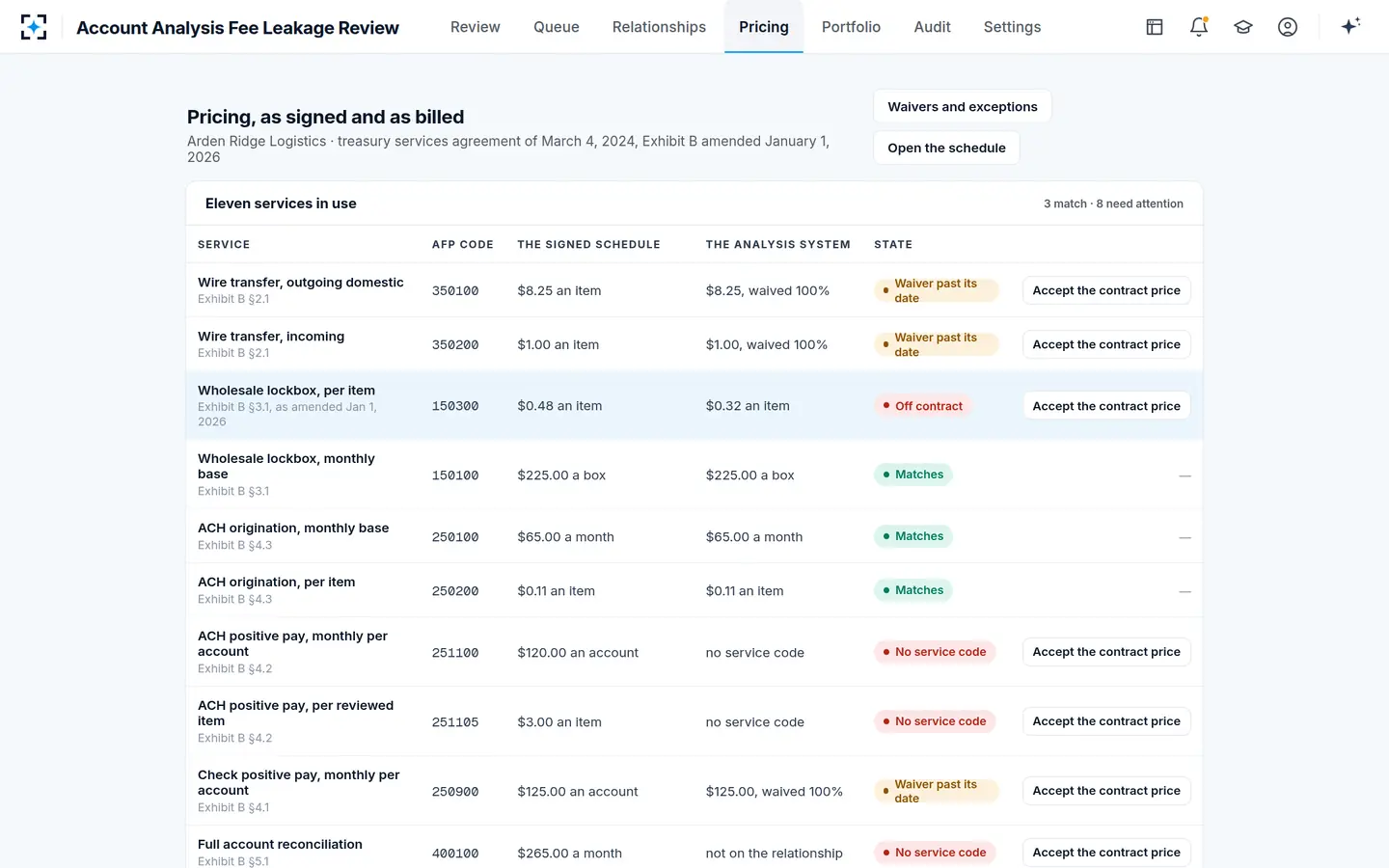
| Signed exhibit, as amended | Document imaging: agreement of March 4, 2024, Exhibit B amended January 1, 2026 | $0.48 an item (Exhibit B §3.1, as amended) | Yes, from each amendment's effective date |
| Analysis system price table | The billing engine | $0.32 an item | No; it is what was keyed, and it is what the statement bills |
The signed schedule beside the price the analysis system holds, service by service
What data does a fee review need?
It needs the three sources a statement is supposed to agree with, each from its own system of record: usage from the platforms, price from the signed documents and billing from the statement. A review that takes usage from the statement itself can check the arithmetic but cannot find a service that was never coded, because an uncoded service has no statement line to read.
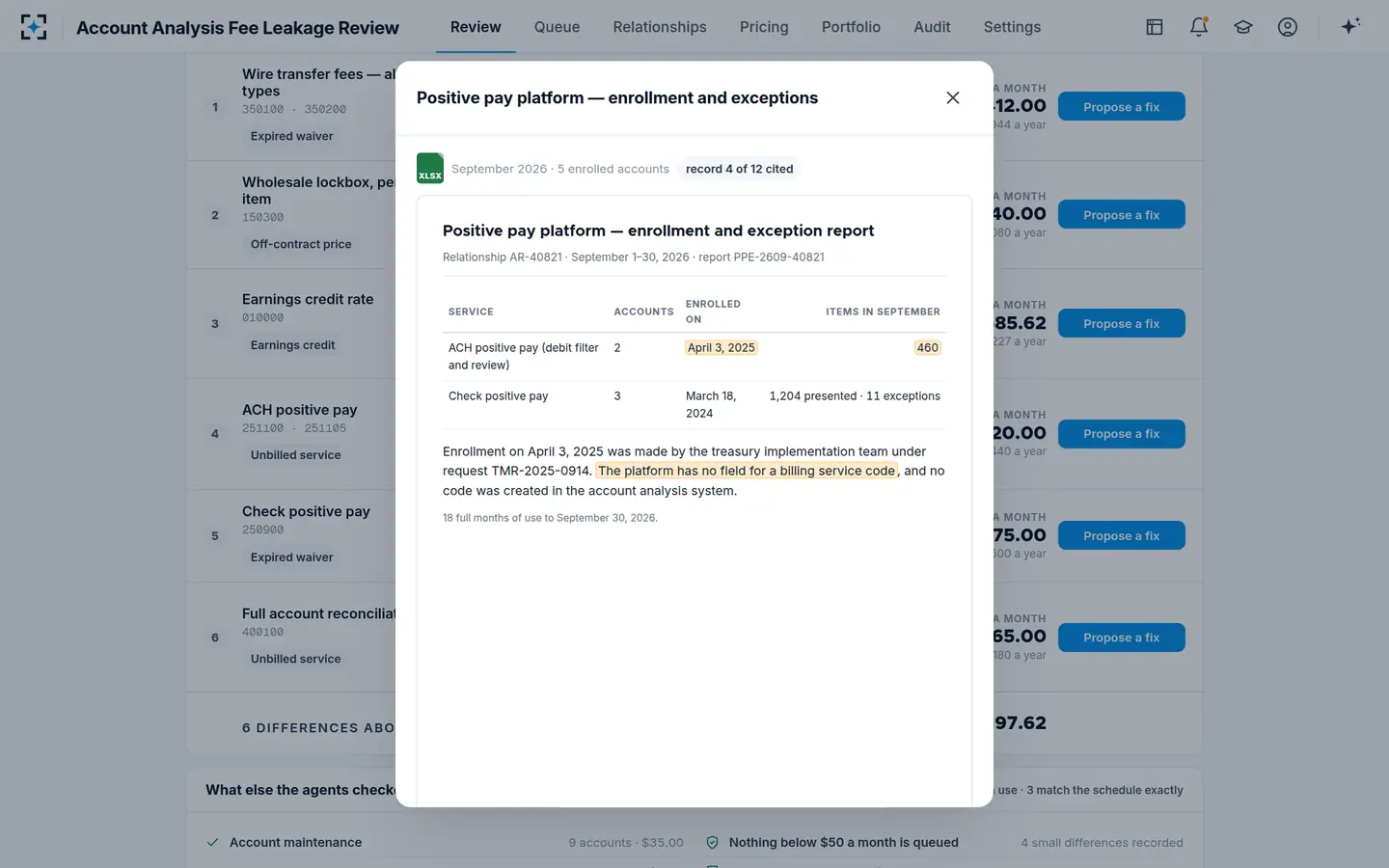
Two details decide whether the usage feeds are good enough. They must be at account level, so usage can be grouped into the same relationships the statement uses, and they must include late files: the solution's lockbox feed counts the file that arrives after the cut-off, because a count that ignores it reports a difference that is not there. The Usage agent cites the source file and record count behind every number, so a specialist can tell a real gap from a late file.
Every usage number opens the platform's own report
Where are waivers recorded?
Wherever the bank decided to record them, and that is the problem. A waiver is granted by an officer or a product manager, often at onboarding or renewal, and then keyed into the analysis system as a percentage on a service. The system applies it; it does not necessarily hold who approved it, why, or when it ends. Those facts sit in an approval email, a pricing committee note or a spreadsheet register.
The review needs the register, whatever form it takes, with four fields filled for every waiver: the approver, the percentage, the start date and the end date. A register without end dates turns every waiver into a permanent one. In the sample bank's register of 1,870 waivers, the cycle found one past its end date and one with no approver recorded at all; the second is referred for review and removed from client-facing views, never repriced, because a waiver with no approver is not evidence of a price either way.
The gaps that stall a first cycle
The likely stalls in a first cycle are documents rather than technology: documents that cannot be found, registers that were never complete and relationships that are grouped differently in each system. The table lists the common gaps and how each is handled.
What stalls a first review cycle, and what to do about it
| Gap | How it shows up | What to do |
|---|---|---|
| Amendments signed but not in imaging | Findings dismissed as AMENDMENT-PENDING | Load the amendment; the Pricing agent re-reads in date order next cycle. |
| Unreadable scans | A document queued for a person | Re-scan or key the exhibit; the agent never guesses a price. |
| Waiver register without end dates or approvers | Waivers referred, not compared | Complete the four fields, starting with the largest waivers. |
| Platforms with no billing-code field | Unbilled-service findings on enrollment | Expected: this is what the review is for. Fix the hand-off from implementation to billing. |
| Different relationship groupings across systems | Usage and statement totals that do not join | Agree one account-to-relationship map before the first run. |
| Late usage files | Differences that vanish the next day | Include late files in the feed; the Usage agent cites file and count. |
None of these blocks a first cycle outright. Missing or unreadable documents reduce the findings the review can propose; they do not produce false ones, because a price that is not written in a signed document is never inferred.
The settings a bank decides before the first run
A fee review is a set of policies as much as a comparison, and the bank sets them, not the software. The values below are the sample bank's; each is visible on a settings screen, and a change is recorded with its reason and applies to the next cycle.
Settings in Account Analysis Fee Leakage Review, with the sample bank's values
| Setting | Sample value | What it controls |
|---|---|---|
| Review cycle starts | 3rd business day | Any business day after statements close |
| Materiality threshold | $50 a month | Below it a difference is recorded, not queued |
| Confidence floor | 0.90 | Below it a specialist reviews before a proposal is allowed |
| Decision clock | 5 business days | Then escalation to the product manager, then the head of treasury management |
| Flag an uncoded service within | 2 business days | From enrollment in any connected platform |
| Warn before a waiver ends | 30 days | The officer and the product manager are told |
| Client notice before a billing change | 30 days | Taken from each client's own agreement |
| Recovery of unbilled charges | 6 months | Never more than the client's agreement allows; a person still chooses |
| Second approver above | $5,000 a month | Any amount, or off |
How a first fix reaches a client statement
About five weeks, most of it the client's notice period. In the sample, the cycle ran on October 5, 2026; a specialist proposed the ACH positive pay fix the next morning, the product manager approved it and a second specialist keyed it the same day, the officer's letter was dated October 7, and the change took effect with the November 7 statement.
From the cycle run to the corrected statement: one sample fix
- Cycle runs and drafts the finding, Oct 5: one day
- Proposed, approved and keyed, Oct 6: one day
- Letter dated Oct 7; 30-day notice under §7.231 d
- Effective with the November statementNov 7
The notice period is the part the bank does not control, and it is the reason to start early. A difference found on the third business day of a month and approved within the decision clock reaches the statement after next; one found in an annual review reaches it a year later.
Treasury management fee schedule rules for consumer accounts
Where an analyzed relationship includes an account held by an individual for personal, family or household purposes, that account's fee schedule is a Regulation DD disclosure. The rule requires disclosure of "the amount of any fee that may be imposed in connection with the account (or an explanation of how the fee will be determined) and the conditions under which the fee may be imposed" (12 CFR 1030.4(b)(4)), and advance notice of an adverse change at least 30 calendar days before it takes effect (12 CFR 1030.5(a)). A sole proprietor's account is outside the rule (official interpretation 2(h)-3; account analysis in banking sets out where business accounts stand).
The review needs to know which accounts those are. The Notice agent flags any account in a relationship held for personal or household purposes, and the wording and date of the client letter go through a conduct review before the officer sends it; in the sample, one of Arden Ridge's nine accounts was of that kind.
"Provide a detailed monthly account analysis statement for each individual account and a consolidated statement showing charges for all account services by the tenth business day of the month."
Delaware Office of the State Treasurer, RFP TRE25101-BANKINGSVC (June 9, 2025)
Clients set expectations for the schedule too. Delaware's request, like the Government Finance Officers Association's lockbox guidance, which lists "error tolerance" and the "treatment of exception (non-standard) items" among the minimum contract terms (GFOA, Use of Lockbox Services), shows how much of the schedule a sophisticated client will write into the agreement itself. Every term written there is a term the review must read. The services in use that have no code covers the code table in detail, and the statement those schedules produce is annotated in account analysis statement vs bank statement. To see the inputs at work on sample data, start from Account Analysis Fee Leakage Review.
Questions people ask
What is a treasury management fee schedule?
It is the bank's price list for treasury services: each service with its pricing unit and unit price, and usually a service code. For an analyzed client the binding version is the pricing exhibit to the signed treasury services agreement, as amended, which can differ from the bank's standard schedule.
Where can I find an account analysis statement sample?
Banks provide one on request, and public RFPs ask for it: Delaware's 2025 banking RFP asks bidders for a sample analysis statement using their actual service names, expected volumes and pricing. The statement anatomy, line by line, is in our annotated guide to the analysis statement.
Does the review need the agreements in a particular format?
No. Scanned or native documents are read clause by clause; an unreadable one is queued for a person rather than guessed, and a price that is not written in a signed document is never inferred.
How long does a fee review take to start?
The first cycle runs once the inputs above are connected and the settings agreed, and it runs on the bank's own closed statements, so its findings are the bank's own. The steps that take longest are usually completing the waiver register and agreeing one account-to-relationship map.
Is an ASC X12 822 file required?
No; a statement export works. The 822 is the account analysis transaction set, which carries a statement's balances, service charges and adjustments from a bank to its corporate client (X12), and public treasurers such as Delaware's ask whether a bank can send one.