UCC 4-406 is the section of Article 4 of the Uniform Commercial Code that sets a bank customer's duty to examine her statements and report an unauthorized signature or an alteration on a paid check, and the price of not doing so. Once the bank makes the statement or the items available, the customer must review them with reasonable promptness and report what she should have found. If she does not, and the bank proves it lost money as a result, she cannot make the bank recredit the item; later items by the same wrongdoer, paid after she had at most 30 days to review, can also become her loss; and after one year she is barred outright. The section matters to claims teams because of its last sentence: when the one-year bar applies, the paying bank may not recover from the depositary bank for breach of warranty either, and within the year the depositary bank can raise the customer's preclusion as a defense. The customer's late report sinks the bank's claim. Botminds' Check Fraud Claims puts the statement date, the report date and the deposit agreement's period into the liability reasoning on every claim, so the question is answered before another bank asks it.
The section is quoted from the official UCC text, which states enact with variations; the screens show the solution's sample data on fictional banks and customers.
UCC 4-406 as a decision path: is the customer precluded, and what happens to the bank's claim?
- 1
Did the bank make the statement or items available, with enough detail to identify each item?
YesThe customer’s duty to review starts.
NoNo duty under 4-406(c) yet; no preclusion.
- 2
Did the customer report the altered check or her forged signature within one year of the statement?
Yes, within the yearGo on to the next question.
NoPrecluded against the bank, whatever either side’s care; the paying bank may not recover for breach of warranty either (4-406(f)).
- 3
Should she reasonably have discovered it from the statement, and did she fail to report promptly?
YesGo on to the next question.
NoNot precluded: the bank recredits and pursues its warranty claim.
- 4
Can the bank prove the late report caused it a loss on this item, or is it a later item by the same wrongdoer paid after her review period, at most 30 days?
YesPrecluded on that item (4-406(d)), subject to the next question.
NoNot precluded on that item.
- 5
Can the customer prove the bank failed to exercise ordinary care, or did not pay in good faith?
YesOrdinary care: the loss is shared by fault (4-406(e)). Bad faith: no preclusion at all.
NoThe preclusion stands, and the depositary bank can raise it against the paying bank’s claim (4-208(c)).
What does UCC 4-406 say?
It does four things in six subsections. It tells the bank what it must give the customer to start her duty (subsections (a) and (b)); it sets the customer's duty to review and report (c); it says when a customer who fails that duty is precluded, and how far (d) and (e); and it sets a one-year limit that applies whatever anyone's care (f). A customer who is precluded cannot assert the alteration or her own unauthorized signature against the bank, so the bank may keep the item charged to her account.
The duty itself is two sentences. After requiring reasonable promptness in examining the statement, 4-406(c) adds: "If, based on the statement or items provided, the customer should reasonably have discovered the unauthorized payment, the customer must promptly notify the bank of the relevant facts." The test is what she should have found from what the bank gave her, not what she actually noticed.
The statement starts the clock
The customer's duty begins only when the bank has made available either the paid items or enough information to identify them, and the UCC says what is enough: "The statement of account provides sufficient information if the item is described by item number, amount, and date of payment." A bank that does not return items must keep them, or legible copies, for seven years after it receives them, and must provide one on request in a reasonable time.
For a claims team, the statement date is evidence and should be on every claim. Which statement first showed the item, when it was mailed or posted for the customer, and whether the item number and amount on it would have shown the change: a washed payee is invisible on a statement line that shows only number, amount and date, while a raised amount is not. The answer can change whether she "should reasonably have discovered" it before the next statement.
What is reasonable promptness under UCC 4-406?
The section does not define it, and it depends on the customer and the statement. The only number in the text caps one use of it: for repeat items by the same wrongdoer, the customer's review period is "a reasonable period of time, not exceeding 30 days". Regulators' consumer guidance uses the same figure: the OCC tells consumers they generally have up to 30 days from the statement date, and that periods vary by bank and state.
The reason the duty exists is practical. As the OCC explains why a bank paid a check with a signature that was plainly not the customer's: "Banks generally do not manually process checks. Each day, thousands of checks are processed through the clearinghouse for payment, using machines that read the micro encoded line at the bottom of the check." The customer is often the first person who looks at the check with knowledge of what she meant to write, and 4-406 puts that review on her.
The same-wrongdoer rule: 30 days, then the risk shifts
The second preclusion is the one that catches customers who were robbed of a checkbook or a batch of mail. Under 4-406(d)(2), a customer who failed her duty is precluded from asserting "the customer's unauthorized signature or alteration by the same wrongdoer on any other item paid in good faith by the bank if the payment was made before the bank received notice from the customer of the unauthorized signature or alteration and after the customer had been afforded a reasonable period of time, not exceeding 30 days, in which to examine the item or statement of account and notify the bank." The bank does not have to prove a loss for these later items; the risk simply shifts once the review period has passed.
An illustrative series by one thief: which checks the customer can still claim
| Item | Paid | Relative to the first statement showing a forgery | Can she still assert it? (if she failed her duty) |
|---|---|---|---|
| First forged check | Day 3 | On the statement made available on day 10 | Yes, unless the bank proves her delay caused it a loss on this item |
| Second forged check | Day 25 | Within her review period of at most 30 days | Yes, on the same terms as the first |
| Third forged check | Day 48 | After the review period; before she reported | Precluded under 4-406(d)(2): same wrongdoer, paid in good faith |
| Fourth forged check | Day 70 | After she reported on day 65 | Yes: paid after the bank had notice |
How does comparative negligence work under 4-406?
Through subsection (e), which lets the customer push back. If the bank asserts a preclusion and the customer proves the bank failed to exercise ordinary care in paying the item and that the failure substantially contributed to the loss, the loss is divided between them according to how much each one's failure contributed. If she proves the bank did not pay in good faith, there is no preclusion at all: "If the customer proves that the bank did not pay the item in good faith, the preclusion under subsection (d) does not apply."
The burdens are deliberately split. The bank must prove the customer failed her duty and, for the item itself, that it lost money because of it. The customer must prove the bank's lack of ordinary care or good faith. For a claims team reviewing a late report, the question is therefore not "was she late?" but "can we prove the lateness cost us, and is there anything in how we paid that she could use?"
What is the one year rule for checks?
It is the absolute limit in 4-406(f), and its second sentence is the one claims teams forget.
“Without regard to care or lack of care of either the customer or the bank, a customer who does not within one year after the statement or items are made available to the customer (subsection (a)) discover and report the customer's unauthorized signature on or any alteration on the item is precluded from asserting against the bank the unauthorized signature or alteration. If there is a preclusion under this subsection, the payor bank may not recover for breach of warranty under Section 4-208 with respect to the unauthorized signature or alteration to which the preclusion applies.”
Uniform Commercial Code § 4-406(f), official text
Within a year, preclusion depends on proof, care and loss; after a year, none of that matters. Comparative fault does not apply and neither does the bank's care. And the paying bank cannot turn to the depositary bank instead: the warranty claim for that alteration is gone with the customer's.
Reported late, within the year and after it: what happens to the customer and to the bank's claim
Within one year (4-406(d)–(e)): Only if the bank proves she failed her duty and, for the item itself, that it caused a loss.
After one year (4-406(f)): Yes, without regard to anyone’s care.
Within one year (4-406(d)–(e)): Can shift part of the loss back to the bank; bad faith ends the preclusion.
After one year (4-406(f)): Irrelevant.
Within one year (4-406(d)–(e)): Survives, but the depositary bank can defend by proving the customer is precluded (4-208(c)).
After one year (4-406(f)): Barred: the payor bank may not recover for breach of warranty for that item.
Within one year (4-406(d)–(e)): Likely unrecoverable if the depositary bank proves the preclusion.
After one year (4-406(f)): Unrecoverable from the depositary bank.
Can a bank recover if the customer reported late?
Often not, and that is the point of this page's title. The paying bank's warranty claim against the depositary bank is only as good as the customer's claim against the paying bank. Within the year, UCC 4-208(c) lets the depositary bank defend an alteration claim by proving the drawer is precluded under 4-406; after the year, 4-406(f) bars the warranty claim outright. A customer who reports late does not only risk her own recredit; she can end the bank's recovery.
The money question arises when the bank recredits a late-reporting customer anyway, as a courtesy or a policy exception. That recredit may be the right decision for the relationship, but it should be booked as what it is, a goodwill loss the bank is unlikely to recover, and not sent as a warranty claim that the depositary bank can defeat by pointing to the customer's dates. In the sample bank, a report 80 days after the statement, against the 60 days its deposit agreement allows, is flagged, and the specialist either asks the manager for a policy exception or denies the claim with a reason; the liability agent never waives a customer duty or grants an exception itself.
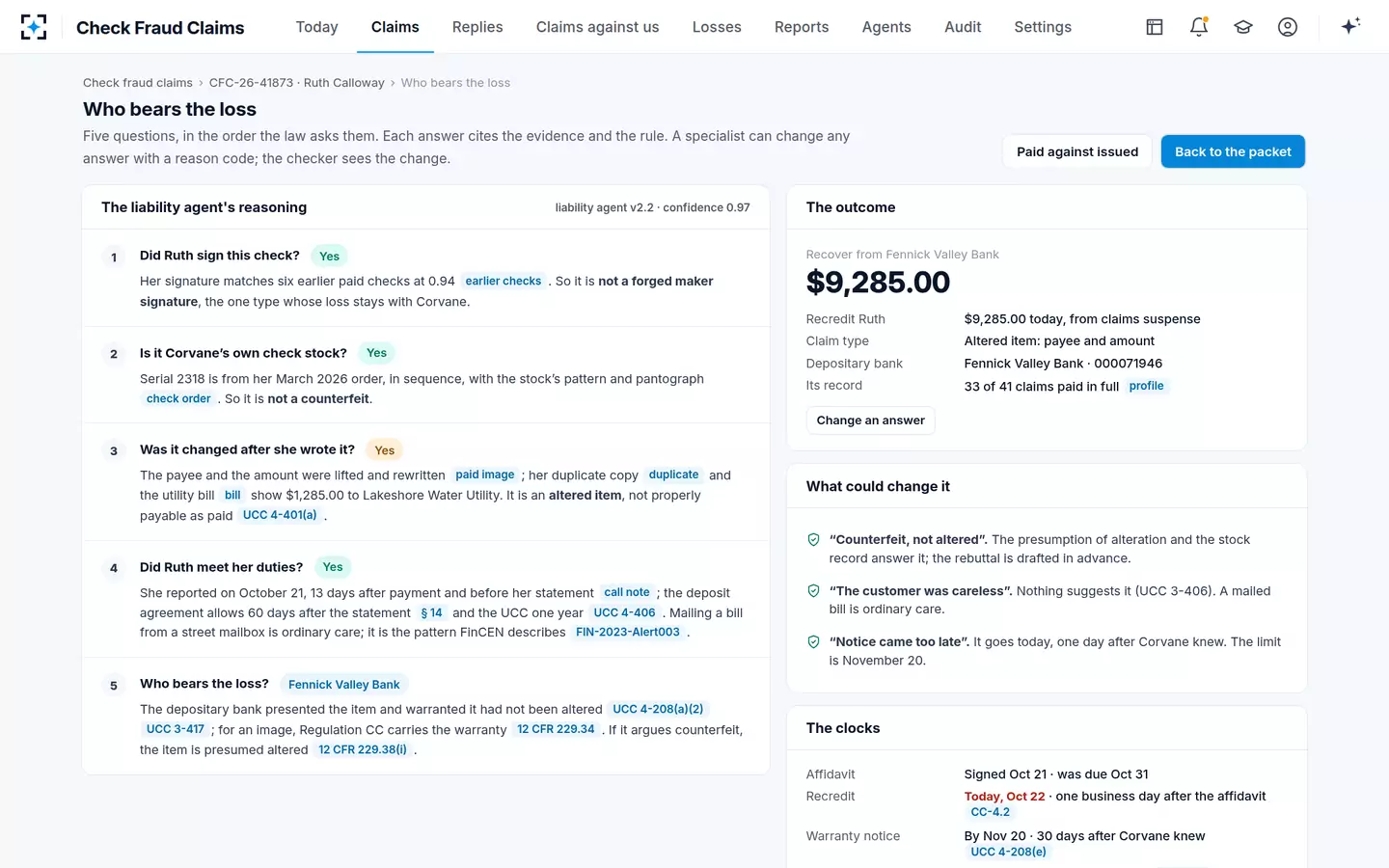
In Check Fraud Claims, the customer's duties are answered before another bank asks
Does 4-406 apply to forged indorsements?
Not by its terms. The section reaches the customer's own unauthorized signature and alterations of the item; a forged payee indorsement on the back of a check she wrote is neither. A customer whose check was paid to a thief who forged the payee's name has a claim that the item was not properly payable, and her time limit for it comes from other rules, including the three-year limit in UCC 4-111 and her deposit agreement, not from 4-406's one-year bar.
Regulation CC borrows 4-406 in one other place. For a remotely created check, the warranty that the account holder authorized the check is in Regulation CC itself, and the warranting bank "may defend by proving that the customer of the paying bank is precluded under UCC 4-406, as applicable". The same logic applies: the customer's late review becomes the other bank's defense.
Can a deposit agreement shorten the 4-406 period?
It can try, within limits the UCC sets in 4-103(a): "The effect of the provisions of this Article may be varied by agreement, but the parties to the agreement cannot disclaim a bank's responsibility for its lack of good faith or failure to exercise ordinary care or limit the measure of damages for the lack or failure." The parties may set the standards by which the bank's responsibility is measured if they are not manifestly unreasonable. Whether a particular shortened period holds is a question of the clause and of state law.
For claims work, record the agreement's period beside the UCC's on every claim, as the sample bank does with its 60 days. A customer who missed the agreement's period but not the UCC's year is the case to send to a person, because the bank's choice there decides both the customer's recredit and, through 4-208(c), whether its own claim can survive.
The affidavit records the dates the preclusion question turns on
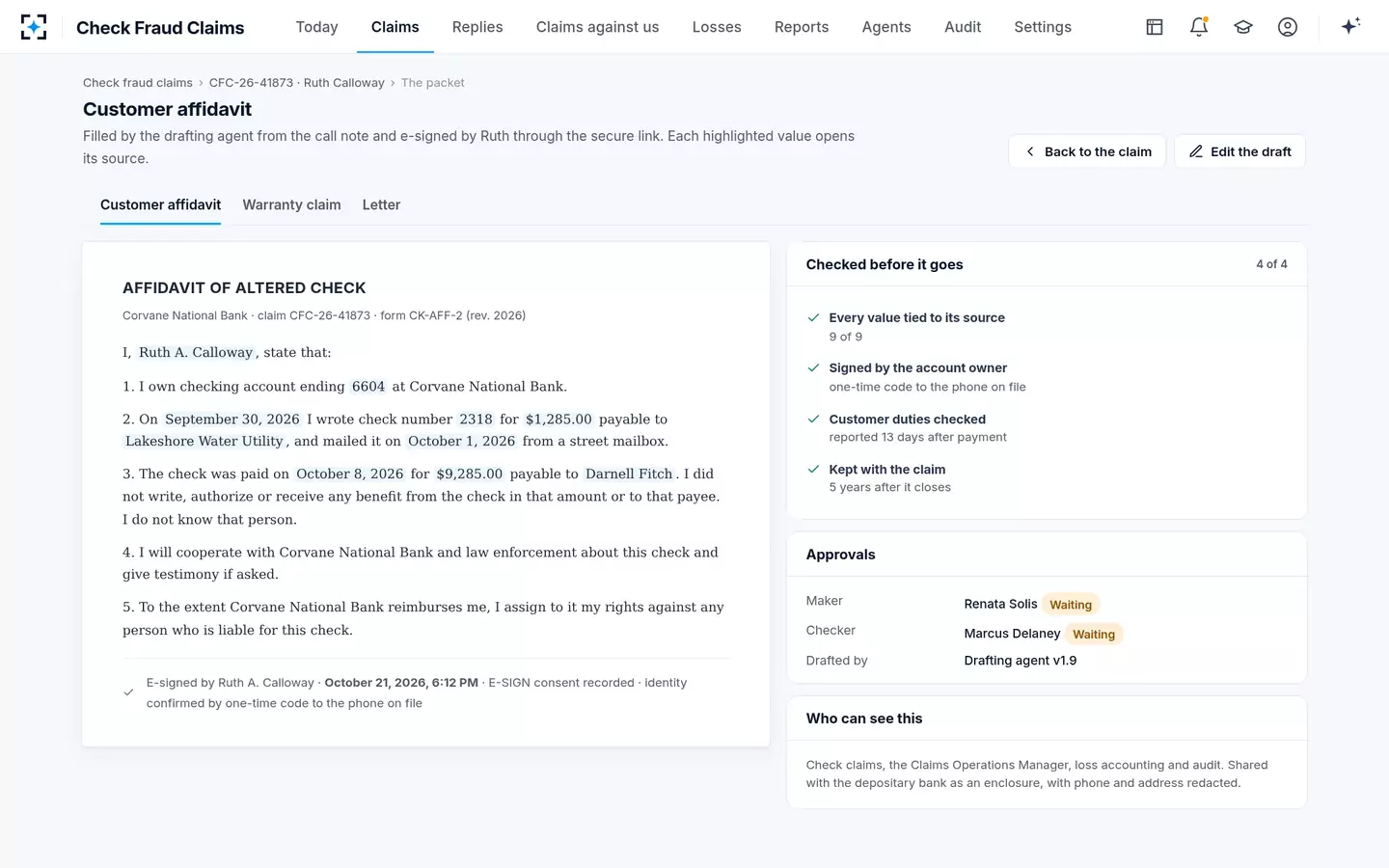
Recording the customer's clock on every claim in Check Fraud Claims
Four dates answer almost every 4-406 question: when the item was paid, when the statement showing it was made available, when the customer reported, and when any earlier item by the same wrongdoer was paid. A claim that carries all four, with the deposit agreement's period, has its answer ready for a depositary bank that raises the customer's conduct, and tells the bank's own people when a goodwill recredit would be unrecoverable before they grant it.
Check Fraud Claims does that on every claim. The intake agent records the report time and opens the clocks; the liability agent reads the statement history and the deposit agreement and answers "did the customer meet her duties?" in its reasoning; and a person decides anything the rules leave to judgment. The other time limits on a claim are in the check fraud claim time limit, and the replies that raise the customer's conduct are answered in the altered check claim denied. To see the customer's clock on a claim, start from Check Fraud Claims.
Questions people ask
What is UCC 4-406(f)?
It is the one-year bar: a customer who does not discover and report her unauthorized signature or an alteration within one year after the statement or items are made available cannot assert it against the bank, whatever either side's care. Its second sentence also stops the paying bank recovering for breach of warranty under 4-208 for that item.
What is UCC 4-406(d)(2)?
It is the same-wrongdoer rule. A customer who failed her duty to review is precluded from asserting later unauthorized signatures or alterations by the same wrongdoer on items the bank paid in good faith after she had a reasonable period, at most 30 days, to review and report, and before she did.
Does UCC 4-406 apply to business accounts?
Yes. It applies to any bank customer who receives statements, consumer or business. Business accounts can face it in its harshest form, with a series of checks by the same employee or thief over several statements, which is where the 30-day same-wrongdoer rule and the employee rule in UCC 3-405 meet.
Does 4-406 apply to electronic transfers?
No. Article 4 governs checks and other items; electronic fund transfers from a consumer account fall under Regulation E, which has its own 60-day notice period and liability tiers, and wire transfers fall under Article 4A. 4-406 is the check rule.
Who has to prove what under 4-406?
The bank proves the customer failed her duty and, for a preclusion on the item itself, that it suffered a loss as a result. The customer proves any lack of ordinary care or good faith by the bank. Under 4-406(f) after one year, nobody proves anything about care.