An altered check claim is the paying bank's demand that the depositary bank repay a check whose payee, amount or date was changed after the customer wrote it, under the warranty in UCC 4-208(a)(2) that the check had not been altered. When the depositary bank denies it, the reply usually makes one of a small number of arguments: that the item was a counterfeit, not an altered check; that the notice came too late; that the customer was careless or reported too late; that the indorsement was effective; or that its own customer's account is empty or closed. None of these ends a sound claim on its own. A counterfeit argument meets the Regulation CC presumption of alteration for image items, a late-notice argument needs proof of the loss the delay caused, a carelessness argument needs proof of carelessness, and an empty account is the depositary bank's problem, not the paying bank's. Botminds' Check Fraud Claims reads every reply as it arrives, sorts it, and drafts the rebuttal or the second demand with the evidence and the rule, for a maker and a checker to approve.
The replies and figures from the solution are sample data on fictional banks. The rules are quoted from the official UCC text and Regulation CC.
The replies that deny an altered check claim, and the answer to each
“Counterfeit, not altered.”
What it arguesThe item is a forgery, so the only warranty is no knowledge of it, and the paying bank keeps the loss.
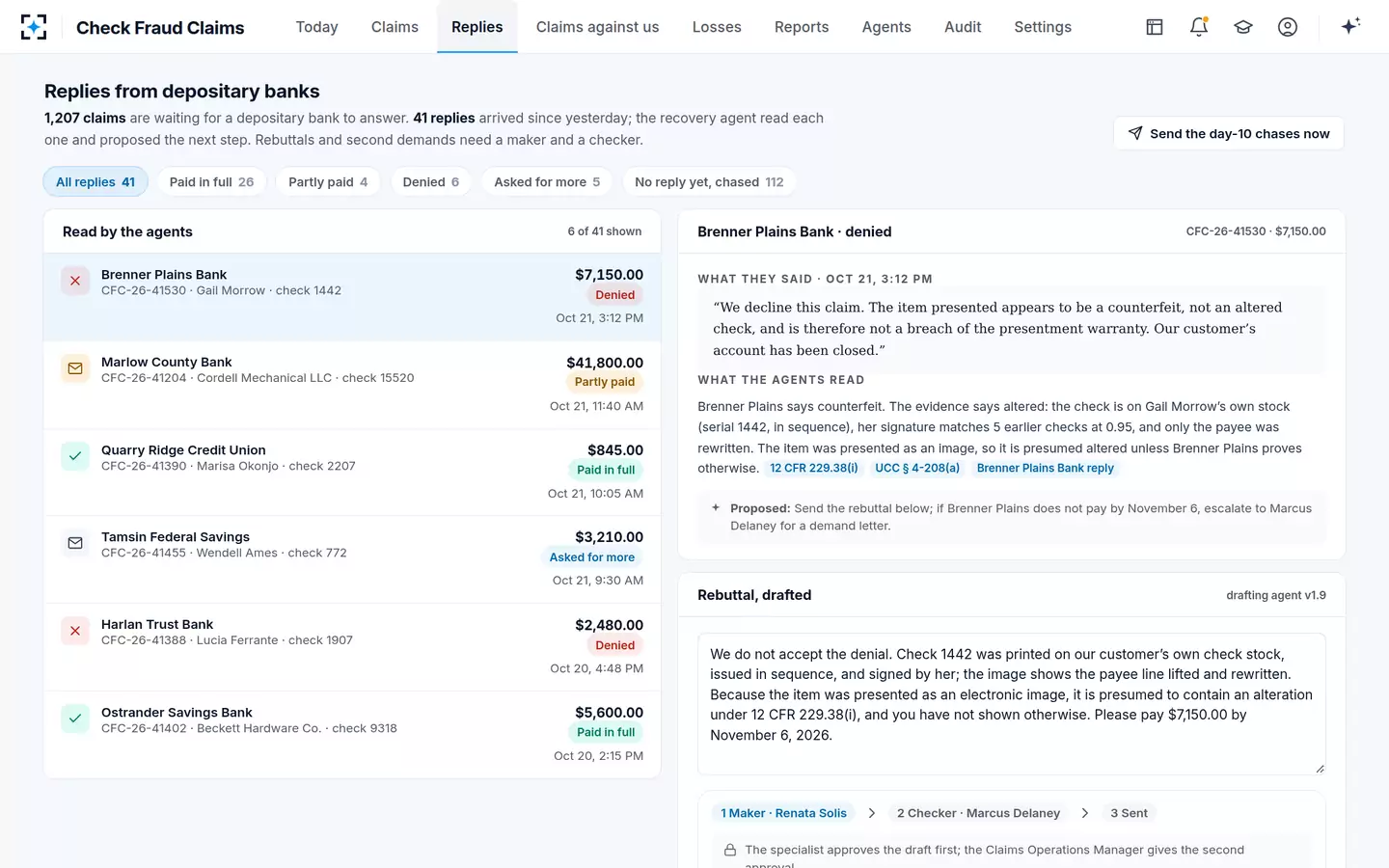
The answerShow the customer’s own stock, serial in sequence and genuine signature; for an image item, the depositary bank must rebut the presumption of alteration by a preponderance.
The ruleUCC 4-208(a)(2); 12 CFR 229.38(i)
“Untimely.”
What it arguesNotice came more than 30 days after the paying bank knew.
The answerGive the date known and the date sent; if late, ask the depositary bank to show the loss the delay caused. The discharge reaches only that loss.
The ruleUCC 4-208(e); 12 CFR 229.34(k)
“Your customer was careless.”
What it arguesThe drawer’s negligence contributed to the alteration, so the drawer, and with her the paying bank, is precluded.
The answerThe bank asserting the preclusion must prove the lack of ordinary care. Mailing a bill is not shown to be careless by saying so.
The ruleUCC 4-208(c); 3-406(a), (c)
“Your customer reported too late.”
What it arguesThe drawer missed her review duty, so she is precluded and so is the paying bank.
The answerGive the statement date and the report date. Within a year, 4-406(d) needs proof of loss and allows comparative fault; only the one-year bar is absolute.
The ruleUCC 4-406(d)–(f); 4-208(c)
“The indorsement was effective.”
What it arguesThe drawer issued the check to an impostor or a fictitious payee, or an employee forged it.
The answerAsk which facts support it. These defenses answer a forged-indorsement claim, not an altered payee written over the drawer’s own.
The ruleUCC 3-404, 3-405; 4-208(c)
“Our customer’s account is closed.”
What it arguesThere is nothing left to recover from the depositor.
The answerThe warranty was the depositary bank’s, not its depositor’s; what it can recover from its own customer is its own risk.
The ruleUCC 4-208(a); 4-207(a)
A part payment of “the balance remaining”
What it arguesUsually the depositor’s remaining balance, offered as if it closed the claim.
The answerRecord it as a partial recovery against the claim and demand the rest; do not treat it as a settlement unless the bank decides to.
The ruleThe claim amount under UCC 4-208(b)
Why was my altered check claim denied?
Because the depositary bank stands to absorb the loss, and each denial is an attempt to move it back. In a mail-theft case the depositor who deposited the altered check has often withdrawn the money, so paying the claim means the depositary bank pays from its own funds. Its reply therefore tries one of three things: to change the type of fraud to one it does not warrant against, to shift the loss to the customer who wrote the check, or to cut the claim down on timing.
Read every reply for which of the three it is attempting, because each needs different evidence. A reply that changes the type is answered with the issued record. A reply that blames the customer is answered with her conduct and the dates. A reply about timing is answered with the claim's own record of when the bank knew and when it sent. The rules on who is liable for altered checks set out why the type moves the loss in the first place.
A day of replies in Check Fraud Claims: most pay, and the denials are the ones to work
What does "counterfeit, not altered" mean?
It means the depositary bank says the check was never the customer's at all, but a fake made to look like hers. If that were true, the presenting bank's only warranty about the drawer's signature would be that it did not know it was unauthorized, and the loss would stay with the paying bank. The label matters because the law treats a counterfeit like a forgery, and the Federal Reserve's check fraud toolkit says so in a note: "(Note that case law has used the terms “forgery” and “counterfeit” interchangeably.)"
The answer has two parts, and the first is evidence. A counterfeit is printed on stock the customer never ordered; an altered check is on her own stock, from her order, with a serial number in her range and her own signature. Show those, beside her copy of the check with the original payee and amount. The second part is the rule: where the item passed between the two banks as an electronic or substitute check, 12 CFR 229.38(i) presumes it altered, and the depositary bank must prove by a preponderance of the evidence that it was not. How the 2019 presumption works, including why a scanned image does not rebut it, is set out separately.
A counterfeit denial, read and answered the same afternoon
Is a late warranty claim always lost?
No. The UCC's 30-day notice rule in 4-208(e) discharges the warrantor only to the extent the delay caused it a loss. A depositary bank that replies "untimely" has to connect the delay to a loss: typically, that its depositor's account held money it could have frozen had notice come on time, and that the money left during the delay. If the account was already empty on day 30, a notice on day 40 cost it nothing.
The answer is in the claim's own record. State when the bank had reason to know of the breach and identified the depositary bank, when the claim was sent, and to whom. If it went inside 30 days, say so and attach the proof; if it did not, ask the depositary bank to show the balance it lost and when. A claim that is partly discharged is still a claim for the rest. The arithmetic of a late notice is worked through in the check fraud claim time limit.
"Your customer was careless": the negligence reply
This reply borrows the customer's defenses, and the UCC lets it. Section 4-208(c) allows a warrantor facing an alteration or indorsement claim to "defend by proving that the indorsement is effective under Section 3-404 or 3-405 or the drawer is precluded under Section 3-406 or 4-406 from asserting against the drawee the unauthorized indorsement or alteration." The key word is proving. Under 3-406, a person whose lack of ordinary care "substantially contributes to an alteration" is precluded, and "the burden of proving failure to exercise ordinary care is on the person asserting the preclusion."
So ask what the carelessness was. A check written in ink with no blank space, mailed to pay a bill, is an everyday use of a check, and the paying bank's own reasoning should say so before the reply arrives; a check signed with the payee left blank, or a business that let one employee both write and reconcile its checks, is a different case.
“The right of the drawee to recover damages under this subsection is not affected by any failure of the drawee to exercise ordinary care in making payment.”
Uniform Commercial Code § 4-208(b), official text
That sentence answers a related reply: "you should have caught it." Whether the paying bank could have spotted the alteration when it paid is irrelevant to its warranty claim. The paying bank's own care matters only between it and its customer, never as a defense for the bank that presented the altered check.
"Your customer reported too late"
This is the 4-406 defense, and it comes in two strengths. Under 4-406(d), a customer who did not review her statement with reasonable promptness is precluded on that item only if the bank also proves the failure caused it loss, and if she shows the paying bank failed to exercise ordinary care the loss is shared. Under 4-406(f), a customer who did not report within one year of the statement is barred whatever the care on either side, and then the paying bank may not recover for breach of warranty either.
The answer is two dates: when the statement showing the item was made available, and when the customer reported. In the sample bank's claims both sit in the liability reasoning, with the deposit agreement's own period beside the UCC's. The defense is worth taking seriously only when the dates say it is. The full rule, including the same-wrongdoer clause, is in UCC 4-406 and the customer's late report.
Can the depositary bank refuse a warranty claim?
It can refuse one that fails on its facts, and on a few defenses the UCC lists; it cannot refuse a good one because its depositor is gone. The defenses are the ones above: the item was not altered, which for an image item means rebutting the presumption; the indorsement was effective under the impostor, fictitious-payee or employee rules; the drawer was negligent or reported too late; or notice came late and the delay caused loss. "Our customer's account has been closed", as in the sample reply above, is not on the list.
The indorsement defenses deserve a precise reading. Under UCC 3-404, an indorsement in the payee's name is effective if an impostor induced the drawer to issue the check to them, or if the payee was fictitious or not intended to have any interest; under 3-405, it is effective if an employee entrusted with responsibility for the employer's checks made it. These answer a forged-indorsement claim. On an altered check, where the payee the customer chose was lifted and a new one written over it, the thief's indorsement of the new name does not make the alteration disappear.
"Our customer's account is closed"
The reply confuses two claims. The warranty that the check had not been altered was made by the depositary bank when it presented the check, and it is liable on that warranty whatever its depositor does. The depositary bank has its own claim against its depositor, who warranted to it under UCC 4-207 that the item had not been altered, but whether it can collect is its risk, not the paying bank's.
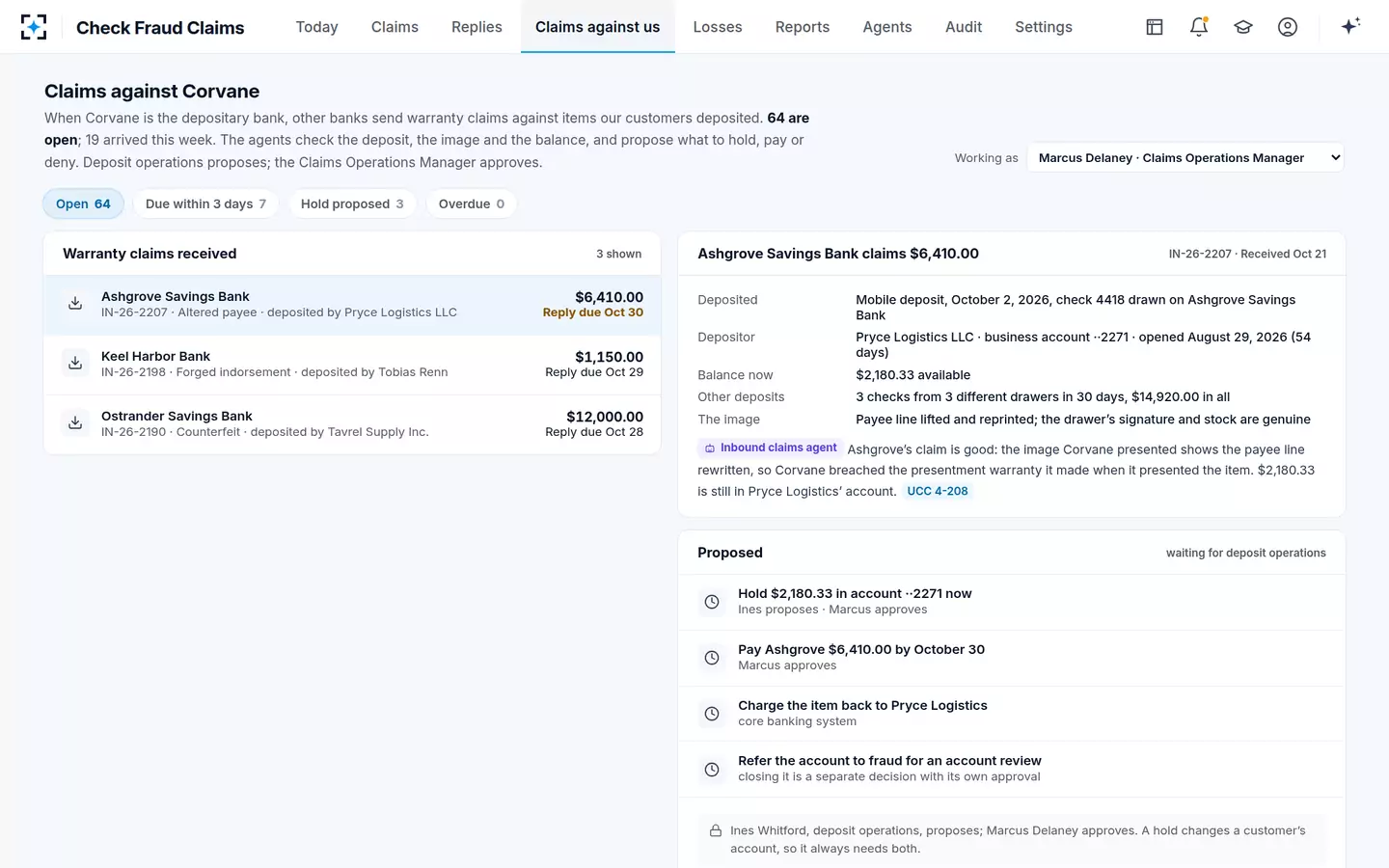
A closed account is, however, a reason to move faster on every other claim against the same depositor. In the sample bank, the next claim offered after a customer's packet was approved came from the same depositor at the same depositary bank; a depositor who drained one account may have used it for several checks, as the sample's three claims against one depositor show. Sending all of those claims together, early, is the best chance that some balance is still there.
Seen from the other side: a claim the bank is right to pay, and the hold that protects it
What if the other bank does not respond?
Chase it on a schedule, escalate it, and then decide between a demand letter and a suit. No rule sets a deadline for a depositary bank to answer, so the paying bank's own reply date and chases are the only pressure until the claim reaches counsel. The time to sue is long but not unlimited: three years under UCC 4-111 for a UCC claim, one year from the violation for a claim under Regulation CC's subpart C.
Regulators have also opened a door for persistent problems. In their 2025 request for information on payments fraud, the Federal Reserve Board, the FDIC and the OCC noted complaints about interbank check disputes and added: "The Board, OCC, and FDIC have each established mailboxes to receive interbank complaints about this issue concerning their supervised financial institutions." A complaint is a last step, best reserved for claims that are documented and plainly owed, and the claim's record of every chase is what makes it credible.
Writing the rebuttal, and how Check Fraud Claims drafts it
A rebuttal should answer the reply's argument with evidence first and the rule second, ask for a specific amount by a specific date, and be approved by two people like the claim was. The sample bank's rebuttal to the counterfeit denial is four sentences: the stock, the serial and the signature; the lifted payee line; the presumption and the absence of proof; the amount and the date.
Before you send a rebuttal to a denied altered check claim
- Name the argument the reply makes
Type, customer, or timing. Answer that one, not every possible defense.
- Put the evidence before the rule
Stock, serial, signature and the customer’s copy for a counterfeit reply; dates for a timing reply; conduct for a negligence reply.
- Cite the rule that sets the burden
12 CFR 229.38(i) for an image item; UCC 3-406(c) for negligence; for timing, a discharge that reaches only the loss the delay caused.
- State the amount and a pay-by date
If part was paid, demand the rest and say how it was worked out.
- Ignore what does not matter
A closed account, a victim depositor or “you should have caught it” changes nothing about the warranty.
- Leave out what must stay inside
No customer phone or address beyond need, and nothing that reveals a fraud referral or report.
- Get the second approval
A rebuttal commits the bank’s position; it needs a maker and a different checker.
In Check Fraud Claims the recovery agent reads every reply as it arrives and proposes the next step: a rebuttal for a denial, a second demand for a part payment, the documents for a request for more, and an escalation for silence. The drafting agent writes the rebuttal from the claim's own evidence, a specialist approves it as the maker and the claims operations manager gives the second approval; nothing goes to the other bank before both have. A part payment is recorded against the claim and the rest is demanded; it is never treated as a settlement unless a person decides it is. To see a denial answered from the reply to the rebuttal, start from Check Fraud Claims.
Questions people ask
How long should a bank wait for a reply before escalating?
There is no rule; each paying bank sets its own reply date. The sample bank expects a reply within 15 business days, chases on day 5 and day 10, and escalates to the claims operations manager when the date passes. The notice clock has already been met by then, so escalation is about pressure, not the 30 days.
Can the depositary bank ask for the original check?
It can ask, and if the paying bank holds the original and makes it available to every bank in the dispute, the Regulation CC presumption of alteration no longer applies and the paper decides. With mobile deposits neither bank usually has it, which is why the presumption exists.
What if the depositary bank pays part and says it is final?
Record the payment as a partial recovery, reply that the claim is not settled, and demand the rest with the calculation. Whether to accept less is a decision for the bank's people, with the reason recorded, not something that happens by default when a credit arrives.
Does a denial stop the paying bank recrediting its customer?
No. The customer's recredit depends on whether the check was properly payable from her account, which is between her and her bank. A denial affects only whether the paying bank recovers the money from the other bank.
Should a denied claim go to a lawyer?
A large or repeated one should. The paying bank has three years to sue on a UCC warranty claim and one year on a claim under Regulation CC's subpart C, so a well-documented claim that two rebuttals have not moved is a decision for counsel well before those dates.